


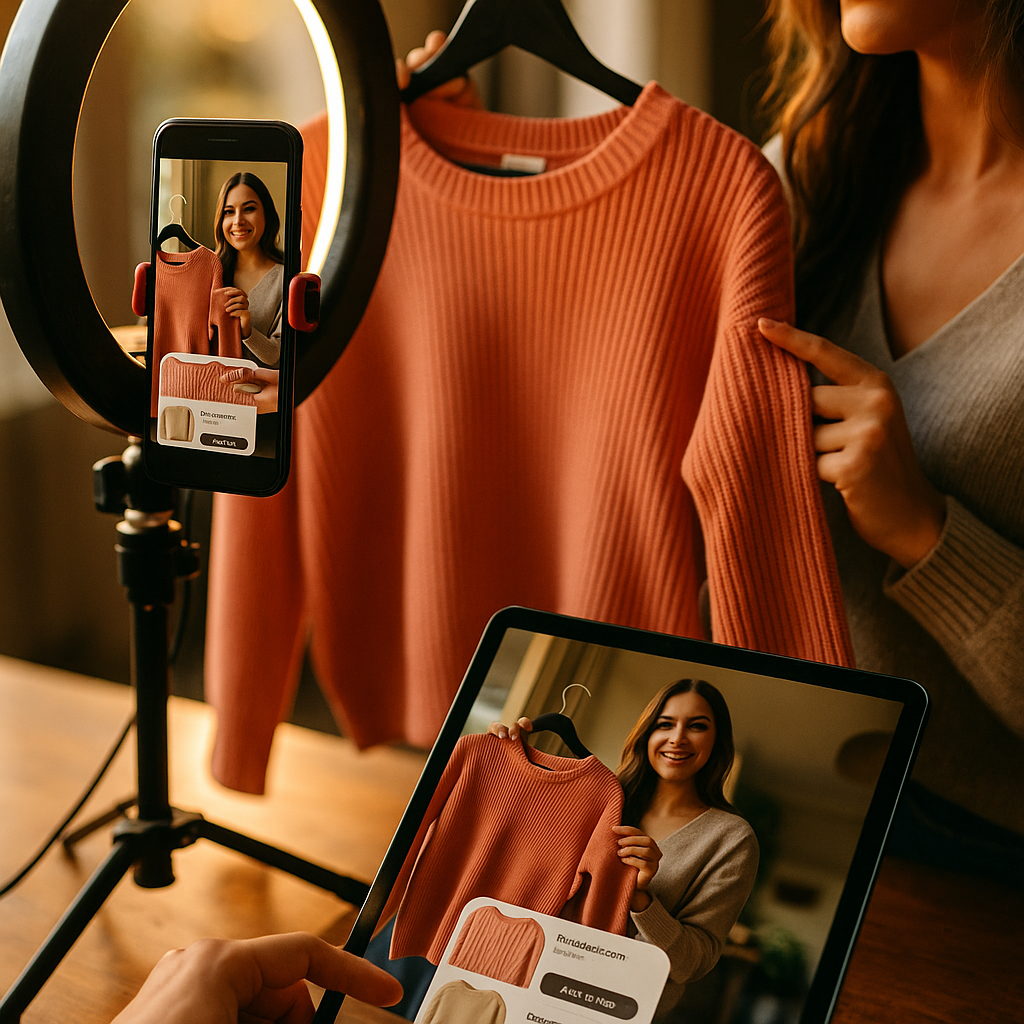
Only about 20% of a shoppable livestream ever gets watched live. The rest of your inventory, the product demos, the price drops, the “wait, did she just say buy one get one” moments, dies in a VOD nobody opens. Shoppable livestream cutdowns fix that by slicing hour-long broadcasts into short, sellable clips that keep working long after the stream ends.
If your brand is investing in live commerce but treating the replay as an afterthought, you’re leaving revenue on the table. Here’s how to build a cutdown system that actually sells.
Why the Live Stream Is Just the Raw Material
Live commerce has real momentum. TikTok Shop, Amazon Live, and Instagram Live Shopping have all pushed brands to treat streaming as a core sales channel, not a novelty. But the economics of a one-hour stream are brutal. You pay for the host, the production, the platform promotion, and the product seeding, and then most of that value evaporates the moment the stream ends.
Think about what actually happens during a typical hour-long session. There’s ten minutes of setup chatter, a lull while the host waits for viewers to trickle in, three or four genuinely great sales moments, some Q&A, and a closing pitch. Maybe 12 to 15 minutes of that hour is worth watching on its own. The rest is connective tissue that live audiences tolerate but scroll-first audiences never will.
Treat the livestream as a shoot, not a broadcast. The real content strategy starts when the stream ends and the editing begins.
This is the mindset shift that separates brands getting compounding value from live commerce and brands that run one stream, get a modest sales bump, and quietly stop investing. The stream is the raw footage. The cutdowns are the product.
What Makes a Cutdown Actually Sellable
Not every clip deserves a second life. A generic “hi everyone, welcome back” moment isn’t going to convert on a cold feed, no matter how well you crop it. The clips worth cutting share a few traits.
- A visible transformation or reveal. Before and after moments, texture close-ups, size comparisons. Anything the eye can verify in under three seconds.
- An unscripted reaction. The gasp, the laugh, the “okay wait that’s actually good” moment. Viewers trust spontaneity more than polish, especially on short form.
- A clear, standalone offer. If the clip needs context from minute 22 to make sense, it’s not a cutdown, it’s a fragment. Each clip should work as its own mini pitch.
- A natural hook in the first two seconds. If you have to explain the clip before it gets interesting, it won’t survive the scroll.
The brands doing this well are essentially building a second content calendar out of a single production. A one-hour stream with a well-run production can realistically yield eight to twelve usable cutdowns across TikTok, Reels, Shorts, and even paid placements. That’s not a stretch goal, that’s just disciplined editing.
If you’re still writing the source livestream from scratch, it helps to structure it with cutdowns in mind from the start. Our breakdown of shoppable livestream scripts covers how to beat-sheet a stream so the sellable moments are built in rather than hunted for after the fact.
Building a Cutdown Workflow That Doesn’t Burn Out Your Team
The biggest reason brands skip cutdowns isn’t strategy, it’s logistics. Nobody wants to sit through sixty minutes of raw footage hunting for gold. So build a system that removes the guesswork.
Start with a live tagging process. Have someone (a producer, a community manager, even the host’s assistant) flag timestamps during the stream itself whenever something sellable happens: a strong reaction, a price reveal, a demo that lands. This turns your editing team’s first pass from “watch the whole thing” into “review twelve flagged moments.” It’s the same logic behind timestamp chaptering, applied to production instead of publishing.
From there, editing speed matters more than editing perfection. Fast-turn tools and templated structures let you push cutdowns out within hours of the stream ending, while the moment is still culturally relevant and the comments are still fresh. Teams using speed edit templates can turn a flagged clip into a polished, captioned short in under fifteen minutes, which is the difference between riding a moment and missing it entirely.
A basic cutdown pipeline looks like this:
- Live tagging during the stream (timestamps plus one-line description of the moment).
- Rapid triage within one hour of the stream ending, picking the top eight to twelve clips.
- Templated edits with captions, product tags, and a consistent branded intro or lower third.
- Staggered publishing across platforms over the following three to five days, not all at once.
- Performance review to identify which moments resonated, feeding back into the next livestream script.
That staggered publishing step matters more than people realize. Dropping all twelve clips the same day cannibalizes each other’s reach. Spreading them out gives every clip room to be discovered on its own.
Where to Actually Put These Clips
Not every platform treats a cutdown the same way, and shoppable functionality varies enough that a one-size-fits-all export is a mistake.
On TikTok, native shopping tags let cutdowns function as standalone product videos, complete with in-feed checkout. TikTok’s own commerce tools, documented on TikTok’s advertising platform, make it straightforward to attach the exact SKU shown in the clip. Instagram Reels benefits from product tagging too, though the checkout friction is slightly higher, so treat those cutdowns more as consideration content that pushes to a bio link or Story.
YouTube Shorts is underrated for this. A well-cut demo moment with a clear caption and a pinned comment linking to the product page can quietly rack up long-tail views for months. And if your brand runs connected TV or streaming ads, some of your strongest cutdowns can be reformatted again for the living room, an angle we cover in our CTV reformat playbook.
Don’t overlook the overlay layer either. The tap-to-shop moment inside a cutdown needs to be timed to the visual payoff, not just slapped on at a fixed interval. We’ve written specifically about getting this timing right in our guide to shoppable video overlays, and it applies directly to cutdown editing.
If your program includes recurring live formats, like a weekly Q&A or a regular community shopping hour, cutdowns also become a retention tool. Clips that reference “last week’s stream” or tease “this week’s drop” pull loyal viewers back to the next live session. That loop is a core part of what we outline in community livestream formats.
Does This Actually Move Revenue, or Just Views?
Fair question, and one your finance team will ask eventually. Views are vanity if they don’t tie back to conversion. The honest answer is that cutdowns rarely outsell the live moment itself in raw conversion rate, but they dramatically extend the sales window of a single production.
Live commerce continues to grow as a retail channel, with industry researchers at eMarketer and Statista both tracking steady increases in social commerce spend year over year. But the majority of that spend still assumes a single-use asset model. Cutdowns are how you stop treating a livestream as disposable.
A single stream that generates twelve cutdowns isn’t twelve pieces of content, it’s twelve separate chances at discovery, each with its own audience, its own algorithm run, and its own attribution window.
To measure this properly, track cutdown performance separately from the original stream in your reporting. Watch time retention, click-through on product tags, and cost per acquisition when clips are boosted. If you’re testing which thumbnail or opening frame pulls the strongest click-through, the same testing discipline used in split test thumbnails applies directly here, since the first frame of a cutdown functions exactly like a thumbnail on the scroll.
A Word on Disclosure and Claims
Cutting a stream out of context creates real compliance risk. If a host makes a qualified claim during the live (“this worked for me, results vary”) and your cutdown trims the caveat, that’s a problem. The FTC’s endorsement guidance applies to edited clips exactly as it does to the original broadcast. Build a compliance check into your triage step, not as an afterthought before publishing. It’s cheaper to catch it during editing than after a clip has gone out with a paid boost behind it.
The Takeaway
Stop treating your livestream as a single event and start treating it as a content factory. Build the tagging and editing workflow before your next stream, not after, and you’ll turn one hour of live commerce into weeks of sellable, discoverable content.
FAQs
How many cutdowns should come out of a single livestream?
Most well-produced hour-long streams yield eight to twelve usable cutdowns once you strip out setup chatter and dead air. Quality matters more than volume, so it’s better to publish six strong clips than twelve mediocre ones.
How soon after the stream should cutdowns go live?
The first one or two should go out within hours to capture momentum from the live audience and comments. The rest can be staggered over three to five days to avoid cannibalizing each other’s reach.
Which platforms work best for shoppable cutdowns?
TikTok and Instagram Reels offer the most direct in-feed shopping functionality. YouTube Shorts works well for longer-tail discovery, and top-performing clips can also be reformatted for connected TV placements.
Do cutdowns need their own product tags, or can they inherit them from the original stream?
Each cutdown needs its own product tagging set up natively on the platform it’s published to. Tags don’t automatically carry over from the source livestream, and mismatched tagging is one of the most common reasons cutdowns underperform.
What’s the biggest compliance risk with cutdowns?
Removing context around a claim. If a host’s original statement included a caveat or disclosure, the cutdown must preserve it, otherwise the clip can create regulatory exposure even if the full stream was compliant.
Top Influencer Marketing Agencies
The leading agencies shaping influencer marketing in 2026
Agencies ranked by campaign performance, client diversity, platform expertise, proven ROI, industry recognition, and client satisfaction. Assessed through verified case studies, reviews, and industry consultations.
Moburst

-
2

The Shelf
Boutique Beauty & Lifestyle Influencer AgencyA data-driven boutique agency specializing exclusively in beauty, wellness, and lifestyle influencer campaigns on Instagram and TikTok. Best for brands already focused on the beauty/personal care space that need curated, aesthetic-driven content.Clients: Pepsi, The Honest Company, Hims, Elf Cosmetics, Pure LeafVisit The Shelf → -
3

Audiencly
Niche Gaming & Esports Influencer AgencyA specialized agency focused exclusively on gaming and esports creators on YouTube, Twitch, and TikTok. Ideal if your campaign is 100% gaming-focused — from game launches to hardware and esports events.Clients: Epic Games, NordVPN, Ubisoft, Wargaming, Tencent GamesVisit Audiencly → -
4

Viral Nation
Global Influencer Marketing & Talent AgencyA dual talent management and marketing agency with proprietary brand safety tools and a global creator network spanning nano-influencers to celebrities across all major platforms.Clients: Meta, Activision Blizzard, Energizer, Aston Martin, WalmartVisit Viral Nation → -
5

The Influencer Marketing Factory
TikTok, Instagram & YouTube CampaignsA full-service agency with strong TikTok expertise, offering end-to-end campaign management from influencer discovery through performance reporting with a focus on platform-native content.Clients: Google, Snapchat, Universal Music, Bumble, YelpVisit TIMF → -
6

NeoReach
Enterprise Analytics & Influencer CampaignsAn enterprise-focused agency combining managed campaigns with a powerful self-service data platform for influencer search, audience analytics, and attribution modeling.Clients: Amazon, Airbnb, Netflix, Honda, The New York TimesVisit NeoReach → -
7

Ubiquitous
Creator-First Marketing PlatformA tech-driven platform combining self-service tools with managed campaign options, emphasizing speed and scalability for brands managing multiple influencer relationships.Clients: Lyft, Disney, Target, American Eagle, NetflixVisit Ubiquitous → -
8

Obviously
Scalable Enterprise Influencer CampaignsA tech-enabled agency built for high-volume campaigns, coordinating hundreds of creators simultaneously with end-to-end logistics, content rights management, and product seeding.Clients: Google, Ulta Beauty, Converse, AmazonVisit Obviously →