


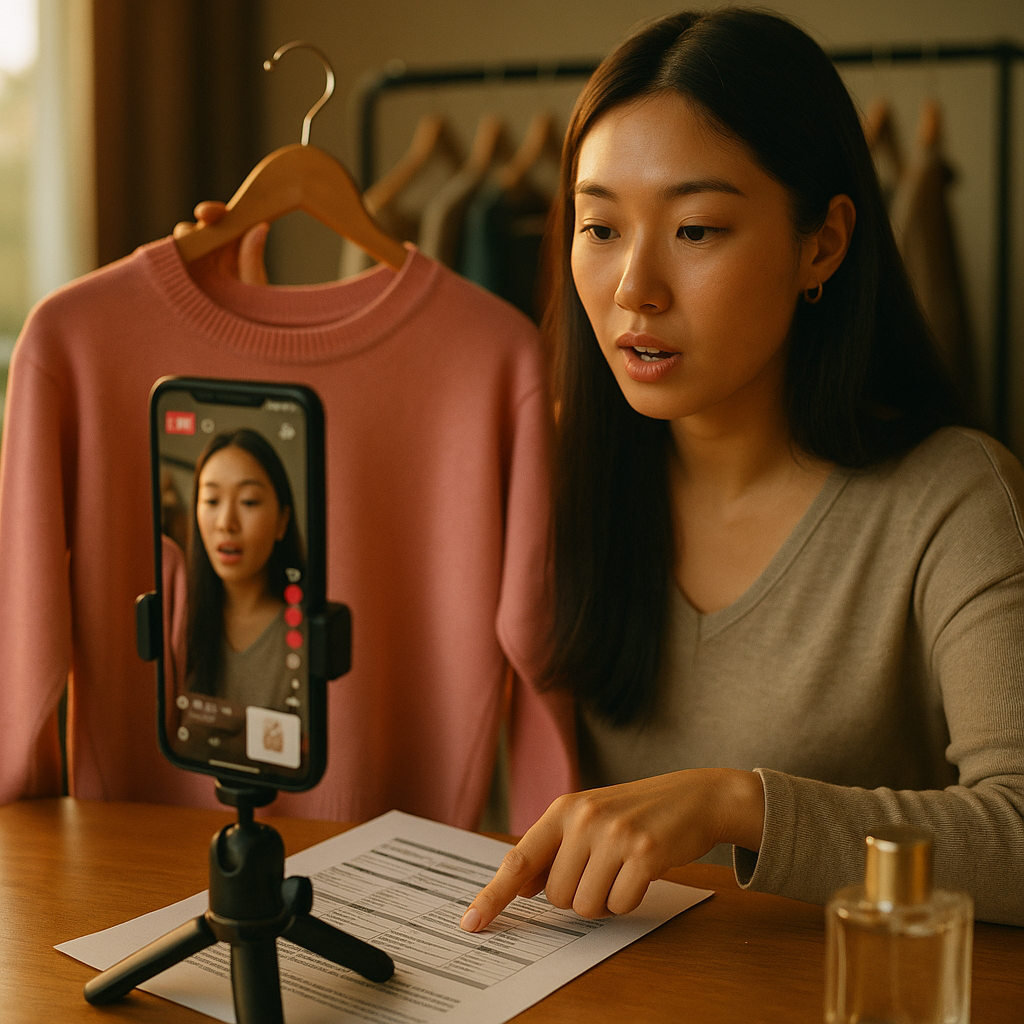
TikTok Shop crossed $4.4 billion in Q3 sales in the United States alone, according to figures widely reported across the creator economy press, and a disproportionate share of that revenue traces back to a single format: the shoppable livestream script. Not the platform. Not the algorithm. The script. Brands that treat live selling as improv are leaving money on the table, while the ones winning have reverse-engineered a repeatable structure that turns idle scrollers into checkout completions in under ninety seconds.
Why Scripts Matter More Than Charisma
Live commerce feels spontaneous. It isn’t. Every high-converting TikTok Shop stream you’ve watched follows a hidden architecture: a hook within the first fifteen seconds, a proof segment, a scarcity trigger, and a call-to-action loop that repeats every two to three minutes. Hosts who improvise without this skeleton see conversion rates half those of scripted counterparts, based on internal benchmarks that agencies running TikTok Shop LIVE campaigns have shared in trade circles.
The uncomfortable truth for brand managers: charisma sells attention, but structure sells product. A magnetic host with no script produces a fun stream and a mediocre GMV report. A disciplined host running a tested script produces both.
Brands running scripted shoppable livestreams report conversion rates two to three times higher than unscripted sessions, because viewers are told exactly when and why to tap the cart.
The Anatomy of a Shoppable Livestream Script
Strip away the personality and every winning TikTok Shop LIVE script hits the same beats. Think of it as a sales funnel compressed into a live video feed.
- The Hook (0-15 seconds): A price reveal, a before/after flash, or a direct callout of the viewer’s problem. This is not the time for “hey guys, welcome back.”
- The Proof Beat (15-45 seconds): Demonstration, not description. Show the product working, ideally on camera in real time.
- The Objection Kill (45-90 seconds): Address the thing viewers are silently worried about: shipping time, sizing, ingredient safety, return policy.
- The Scarcity Trigger: Limited stock counters, timed discounts, or “only for the next ten minutes” framing tied to the platform’s native urgency tools.
- The CTA Loop: A verbal and visual prompt to tap the yellow cart, repeated on a two to three minute cycle throughout the stream.
Miss any one of these and the whole funnel leaks. Skip the objection kill and you’ll watch viewers add to cart, then abandon. Skip the CTA loop and even a great product demo generates views without sales.
Pacing Is a Retention Lever, Not Just a Sales Lever
Shoppable scripts also have to manage watch time, because TikTok’s algorithm rewards streams that keep viewers in the room. That means pacing decisions borrowed from short-form editing now apply to live formats too. Teams that have already done the work on pacing and watch time for recorded video are finding those same principles transfer directly to live scripting: vary segment length, avoid dead air, and never let more than ninety seconds pass without a visual change or a new product angle.
What Makes TikTok Shop’s Format Different From QVC-Style Selling
Skeptics compare shoppable livestreams to home shopping television, and the comparison isn’t entirely wrong. But TikTok Shop’s format has three structural advantages QVC never had.
First, the comment section is live and public, functioning as real-time social proof. A viewer typing “just ordered mine” does more conversion work than any host line. Second, the algorithm surfaces streams to warm audiences already primed by the creator’s short-form content, so the top of funnel is pre-qualified. Third, checkout happens inside the app in two taps, removing the friction of a phone call or a separate browser session.
That third point is why script writers now build CTAs around the tap mechanic itself, borrowing heavily from the timing logic used in shoppable video overlays. The overlay disciplines that work in recorded content, telling viewers exactly when to tap and why, map almost one-to-one onto live scripting cues.
Building a Script Your Compliance Team Won’t Flag
Live selling moves fast, which is exactly why it’s risky. There’s no editing pass before a claim goes out to ten thousand concurrent viewers. Brand and agency teams running TikTok Shop LIVE at scale have learned to build compliance directly into the script document rather than relying on host judgment in the moment.
Practical guardrails that experienced teams now bake into every script:
- Pre-approved claim language for any health, beauty, or efficacy statement, reviewed against FTC disclosure guidance before the stream airs.
- A mandatory “#ad” or “Paid Partnership” verbal disclosure at stream open and at least once every fifteen minutes thereafter.
- Banned phrase lists for anything implying guaranteed results, medical outcomes, or unverified before/after comparisons.
- A designated moderator briefed to flag if the host drifts off-script into unapproved claims territory.
This isn’t bureaucracy for its own sake. One unscripted claim during a live, unedited broadcast can trigger a platform strike or worse, regulatory attention. The script is your paper trail as much as your sales tool.
Casting the Right Host for a Scripted Format
Here’s the tension brands keep running into: the best scripted performers aren’t always the biggest-name creators. A micro-creator who has hosted forty TikTok Shop LIVE sessions and can hit script beats naturally, without sounding robotic, will consistently outsell a mega-influencer reading cue cards for the first time.
Brands sourcing live hosts should treat the casting call like an audition, not a follower-count filter. Ask for a sample run-through of a sixty-second product demo using your script skeleton. Watch for two things: can they hit the objection-kill beat without sounding defensive, and can they loop back to the CTA without repeating the exact same sentence three times in a row (viewers notice, and it reads as fake urgency).
This casting discipline echoes what brands have already learned running reaction content briefs: a good brief only works if the talent can execute it in a way that still feels human. Scripts that sound scripted kill trust, and trust is the entire mechanism live commerce depends on.
Measuring What Actually Drove the Sale
GMV is the headline metric, but it hides the mechanics. Teams serious about optimizing shoppable livestream scripts track segment-level data: which minute of the stream produced the spike in cart adds, which objection-kill line correlated with lower cart abandonment, and how average watch time before purchase compares across hosts.
Most brands running TikTok Shop at scale pull this from the platform’s native seller dashboard alongside TikTok’s advertising and shop analytics tools, cross-referencing it against broader benchmarks from firms like eMarketer to understand whether performance is format-driven or seasonal. Statista’s retail and social commerce data is also useful for benchmarking category-level conversion rates against your own, available through Statista’s e-commerce research.
The pattern that shows up repeatedly: streams with a clearly defined script structure retain viewers longer during the proof beat and lose fewer of them at the CTA loop. That’s not charisma. That’s architecture doing its job.
Where This Format Goes From Here
Live commerce isn’t replacing recorded shoppable content, it’s compounding it. Brands are now pulling clips from their best-performing livestreams and re-cutting them as short-form assets, essentially running the reverse of the usual production pipeline. Instead of shooting a video ad and hoping it converts, they’re mining live footage that already proved it converts, then formatting it for feed distribution.
That approach borrows directly from principles covered in format agnostic distribution, where a single production effort gets sliced across multiple channels and formats without a full reshoot. Applied to live commerce, it means your best thirty-second objection-kill moment from last week’s stream becomes tomorrow’s paid social ad, no new script required.
Next step: Before your next TikTok Shop LIVE session, write the five-beat script skeleton first, cast a host who can execute it naturally, and build your compliance checklist into the document itself rather than trusting live improvisation.
FAQs
What is a shoppable livestream script?
A shoppable livestream script is a structured outline that guides a host through a live shopping broadcast, typically including a hook, product demonstration, objection handling, scarcity messaging, and repeated calls to action, all designed to move viewers toward an in-app purchase.
How long should a TikTok Shop LIVE script segment run?
Most high-performing segments run between ninety seconds and three minutes before cycling back to a call to action, since the algorithm and viewer attention both favor frequent pacing changes over long uninterrupted demos.
Do scripted livestreams actually outperform unscripted ones?
Brands running both formats consistently report scripted sessions produce higher conversion rates, largely because scripts ensure the objection-kill and call-to-action beats aren’t accidentally skipped in the flow of live conversation.
What compliance risks come with shoppable livestreams?
The biggest risks are unscripted claims about product efficacy, missed or inconsistent disclosure of paid partnerships, and hosts drifting into language that implies guaranteed results, all of which can trigger platform penalties or regulatory scrutiny.
Can smaller creators run effective shoppable livestreams?
Yes. Experienced micro-creators who can execute a script naturally often outperform larger creators unfamiliar with the format, since live commerce conversion depends more on script execution and audience trust than follower count.
Top Influencer Marketing Agencies
The leading agencies shaping influencer marketing in 2026
Agencies ranked by campaign performance, client diversity, platform expertise, proven ROI, industry recognition, and client satisfaction. Assessed through verified case studies, reviews, and industry consultations.
Moburst

-
2

The Shelf
Boutique Beauty & Lifestyle Influencer AgencyA data-driven boutique agency specializing exclusively in beauty, wellness, and lifestyle influencer campaigns on Instagram and TikTok. Best for brands already focused on the beauty/personal care space that need curated, aesthetic-driven content.Clients: Pepsi, The Honest Company, Hims, Elf Cosmetics, Pure LeafVisit The Shelf → -
3

Audiencly
Niche Gaming & Esports Influencer AgencyA specialized agency focused exclusively on gaming and esports creators on YouTube, Twitch, and TikTok. Ideal if your campaign is 100% gaming-focused — from game launches to hardware and esports events.Clients: Epic Games, NordVPN, Ubisoft, Wargaming, Tencent GamesVisit Audiencly → -
4

Viral Nation
Global Influencer Marketing & Talent AgencyA dual talent management and marketing agency with proprietary brand safety tools and a global creator network spanning nano-influencers to celebrities across all major platforms.Clients: Meta, Activision Blizzard, Energizer, Aston Martin, WalmartVisit Viral Nation → -
5

The Influencer Marketing Factory
TikTok, Instagram & YouTube CampaignsA full-service agency with strong TikTok expertise, offering end-to-end campaign management from influencer discovery through performance reporting with a focus on platform-native content.Clients: Google, Snapchat, Universal Music, Bumble, YelpVisit TIMF → -
6

NeoReach
Enterprise Analytics & Influencer CampaignsAn enterprise-focused agency combining managed campaigns with a powerful self-service data platform for influencer search, audience analytics, and attribution modeling.Clients: Amazon, Airbnb, Netflix, Honda, The New York TimesVisit NeoReach → -
7

Ubiquitous
Creator-First Marketing PlatformA tech-driven platform combining self-service tools with managed campaign options, emphasizing speed and scalability for brands managing multiple influencer relationships.Clients: Lyft, Disney, Target, American Eagle, NetflixVisit Ubiquitous → -
8

Obviously
Scalable Enterprise Influencer CampaignsA tech-enabled agency built for high-volume campaigns, coordinating hundreds of creators simultaneously with end-to-end logistics, content rights management, and product seeding.Clients: Google, Ulta Beauty, Converse, AmazonVisit Obviously →