


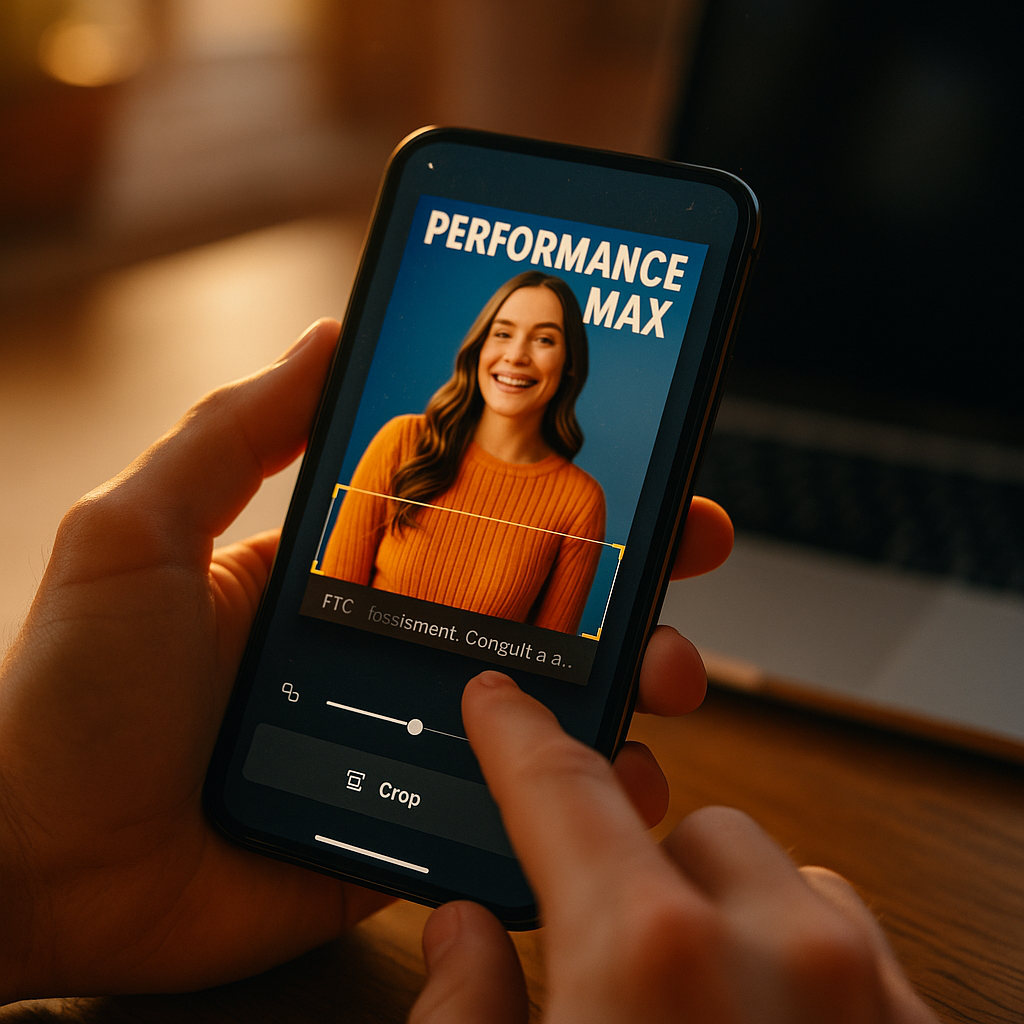
Google’s Performance Max will auto-crop your 16:9 video into a 9:16 vertical asset in milliseconds. What it won’t tell you is whether your #ad disclosure survived the crop. AI-generated video resizing is quietly creating a brand safety and FTC compliance gap that most marketing teams haven’t audited — and regulators aren’t going to care that a machine did the cropping.
The Problem Nobody Budgeted For
Performance Max campaigns pull assets — images, headlines, video — and automatically generate variants across Search, Display, YouTube, Discover, Gmail, and Maps. Google’s asset library does the resizing for you. That’s the entire pitch: fewer manual exports, faster testing, broader reach with one upload.
The trouble starts when that source video already carries a disclosure overlay burned into the frame — a “Paid partnership with [Brand]” tag sitting in the lower third, sized and positioned for a 16:9 landscape crop. Feed that into Performance Max, let the AI reformat it for a 9:16 vertical Shorts placement, and there’s a real chance that text gets clipped, shrunk past legibility, or pushed entirely out of frame.
Nobody flags it. The campaign launches. The impressions roll in. And your disclosure is gone.
A disclosure that’s technically present but cropped out of the visible frame is, legally speaking, no disclosure at all.
This isn’t a hypothetical edge case. Google has been pushing advertisers toward Performance Max aggressively, and eMarketer has repeatedly flagged automated ad formats as a growing share of total programmatic video spend. As budgets shift toward these AI-managed campaign types, the surface area for compliance slippage grows right alongside it.
For context on how similar automation problems are playing out elsewhere, see our coverage of AI ad variants multiplying FTC risk — the pattern is nearly identical: speed and scale outrunning compliance review.
Why Aspect Ratio Isn’t a Cosmetic Detail
Marketers tend to treat aspect ratio as a design nuisance. It’s not. The FTC’s Endorsement Guides are explicit that disclosures must be “clear and conspicuous” — unavoidable, readable, and not buried, blocked, or minimized by design choices. A disclosure that survives on a landscape YouTube pre-roll but disappears on a vertical Shorts feed placement doesn’t meet that standard on the second placement, even if the source asset was fully compliant.
Here’s the part that trips up teams: each aspect ratio variant is functionally a separate ad from a compliance standpoint. Google might generate five to seven reformatted versions from one source video. If your review process only checks the original upload, you’ve audited one-seventh of your actual exposure.
- 16:9 landscape — Standard YouTube in-stream. Disclosure overlays typically have room to breathe.
- 9:16 vertical — Shorts, Reels-style placements. Safe zones shrink dramatically; UI elements (like buttons and captions) often cover the bottom third.
- 1:1 square — Feed placements. Text sized for widescreen can become illegible when the frame compresses horizontally.
- 4:5 portrait — Increasingly common on Display and Discover; disclosure placement conventions here are less standardized than on Meta or TikTok.
Each format has different “safe zones” where platform UI (captions, share buttons, progress bars) can obscure text. Google’s AI resizing tool optimizes for visual composition and subject framing. It does not optimize for regulatory text legibility. Those are two different jobs, and only one of them is currently automated.
What Google’s Own Tools Actually Do (and Don’t Do)
Google’s Performance Max asset guidelines recommend keeping key visual elements within a central “safe zone” to avoid cropping during automated reformatting. That guidance exists for logos and product shots. It says nothing about compliance overlays, because Google’s system has no concept of what a disclosure is — to the algorithm, your #ad tag is just another text layer competing for pixel space.
That means the burden sits entirely with the brand or agency uploading the asset. Google won’t reject a video for a missing disclosure. It also won’t tell you when its own cropping logic removed one that was there originally.
Building a Reconciliation Workflow, Not Just a Checklist
A one-time audit won’t solve this. Performance Max campaigns refresh creative dynamically, sometimes generating new resized variants weeks after launch as the algorithm tests combinations. You need an ongoing process, not a pre-launch checkbox.
Here’s what that looks like in practice for teams running influencer-sourced video through Performance Max:
- Design disclosures for the tightest crop first. Build your overlay for 9:16 safe zones, then let it scale up to landscape — not the reverse. It’s far easier for a disclosure to survive expansion than survive cropping.
- Use in-video verbal disclosure alongside text overlay. If a creator says “this is a paid partnership with [Brand]” in the first three seconds, that disclosure survives every aspect ratio, every crop, every platform UI element. Text-only disclosure is the single point of failure here.
- Pull and review the actual served variants, not just the source file. Google Ads’ preview tool lets you see how an asset renders across placements. Budget time — weekly, not quarterly — to spot-check live variants for disclosure visibility.
- Contractually push responsibility upstream to creators and editors. If a creator delivers a raw video file that gets fed into automated resizing tools, your contract needs to specify where the disclosure lives and how it must be positioned to survive reformatting. This overlaps heavily with ownership questions covered in who owns your ad variants — if you don’t control the source file’s structure, you can’t control its downstream compliance.
- Log every variant reviewed, with timestamps. If the FTC or a state AG ever asks how you monitor disclosure compliance across automated ad formats, “we checked the original upload” is not going to satisfy anyone. A documented, recurring review process is your defensible position.
If you can’t show a documented review cadence for AI-resized variants, you don’t have a compliance program — you have a hope.
Brand Safety Runs on the Same Fault Line
Disclosure isn’t the only thing that gets mangled by automated cropping. Brand safety elements — logo placement, required legal supers, age-gating text for regulated categories (alcohol, financial services, supplements) — face the identical risk. An AI resizing tool doesn’t know your logo needs 10% margin clearance for trademark reasons. It knows pixels and composition rules.
This is particularly acute for brands running influencer content through paid amplification, where the source video was shot and edited for organic feed consumption, not built with a compliance-first frame structure. HubSpot’s research on video marketing consistently shows vertical short-form as the highest-growth format for paid social — meaning more of your influencer content is heading toward exactly the aspect ratio where disclosure clipping risk is highest.
If you’re already managing cross-border creator campaigns, the complexity compounds. Disclosure wording and placement rules differ by jurisdiction, and an automated resizing tool has zero awareness of which market a given ad variant is serving into. Our cross-border disclosure compliance guide covers the jurisdictional variance in more depth, but the short version: AI resizing adds a format-level risk on top of an already fragmented regulatory landscape.
Where This Intersects With Talent Contracts
Brands frequently assume liability for disclosure sits entirely with the creator. It doesn’t — not once the brand’s media team takes that content and pushes it through paid automated distribution. At that point, you’ve made an editorial and placement decision, and the FTC has been clear that brands share responsibility for ensuring disclosures remain adequate through paid amplification.
This is where talking points and creative briefs matter. If your brief specified disclosure text and placement for the original asset but said nothing about how that asset needs to survive automated reformatting, you’ve left a gap. We’ve covered a related liability question in how brand talking points become FTC script liability — the throughline is the same: once you exert creative or distribution control, you inherit compliance exposure.
A Practical Test Before You Trust the Algorithm
Before greenlighting any influencer video for Performance Max distribution, run this quick gut-check:
Pull up the vertical 9:16 preview. Can you read the disclosure without pausing the video? Is it positioned where platform UI elements (share icons, captions, progress bars) won’t cover it? Does the disclosure appear within the first three seconds, ideally reinforced verbally?
If the answer to any of those is no, don’t launch the campaign yet. Fix the source asset, add a verbal disclosure, or build a separate vertical-native cut specifically for that placement. It costs more time upfront. It costs far less than a consent decree.
The uncomfortable truth is that AI resizing tools were built to solve a production bottleneck, not a compliance one. Marketing teams that treat them as fully autonomous — upload once, trust the output everywhere — are the ones who’ll discover the gap during an audit, not before a launch.
FAQs
Does Google’s Performance Max check for FTC disclosure compliance during video resizing?
No. Google’s automated asset generation optimizes for visual composition and platform fit, not regulatory text. It has no mechanism to detect, preserve, or flag disclosure overlays during cropping or reformatting.
Who is liable if an AI-resized video variant loses its disclosure?
The advertiser running the campaign generally holds primary responsibility, since the FTC treats brands as accountable for disclosures in paid amplification, regardless of whether a human or an automated tool performed the reformatting.
What’s the safest way to disclose across all aspect ratios at once?
Pair a verbal disclosure spoken in the first few seconds with a text overlay positioned in the central safe zone, designed for the tightest crop (typically 9:16) first. Verbal disclosure survives cropping in a way text alone cannot.
How often should brands audit live Performance Max variants for compliance?
At minimum, weekly, since Performance Max can generate new resized or recombined variants after launch. A one-time pre-launch check does not cover creative refreshed mid-flight.
Do creator contracts need to address AI resizing specifically?
Yes. Contracts should specify disclosure placement, safe-zone requirements, and responsibility for verifying compliance if the brand intends to run the content through automated multi-format ad tools like Performance Max.
The fix isn’t slowing down your Performance Max rollout — it’s building disclosure survivability into the source asset before automation ever touches it. Start with your next campaign’s vertical preview, not your last campaign’s post-mortem.
Top Influencer Marketing Agencies
The leading agencies shaping influencer marketing in 2026
Agencies ranked by campaign performance, client diversity, platform expertise, proven ROI, industry recognition, and client satisfaction. Assessed through verified case studies, reviews, and industry consultations.
Moburst

-
2

The Shelf
Boutique Beauty & Lifestyle Influencer AgencyA data-driven boutique agency specializing exclusively in beauty, wellness, and lifestyle influencer campaigns on Instagram and TikTok. Best for brands already focused on the beauty/personal care space that need curated, aesthetic-driven content.Clients: Pepsi, The Honest Company, Hims, Elf Cosmetics, Pure LeafVisit The Shelf → -
3

Audiencly
Niche Gaming & Esports Influencer AgencyA specialized agency focused exclusively on gaming and esports creators on YouTube, Twitch, and TikTok. Ideal if your campaign is 100% gaming-focused — from game launches to hardware and esports events.Clients: Epic Games, NordVPN, Ubisoft, Wargaming, Tencent GamesVisit Audiencly → -
4

Viral Nation
Global Influencer Marketing & Talent AgencyA dual talent management and marketing agency with proprietary brand safety tools and a global creator network spanning nano-influencers to celebrities across all major platforms.Clients: Meta, Activision Blizzard, Energizer, Aston Martin, WalmartVisit Viral Nation → -
5

The Influencer Marketing Factory
TikTok, Instagram & YouTube CampaignsA full-service agency with strong TikTok expertise, offering end-to-end campaign management from influencer discovery through performance reporting with a focus on platform-native content.Clients: Google, Snapchat, Universal Music, Bumble, YelpVisit TIMF → -
6

NeoReach
Enterprise Analytics & Influencer CampaignsAn enterprise-focused agency combining managed campaigns with a powerful self-service data platform for influencer search, audience analytics, and attribution modeling.Clients: Amazon, Airbnb, Netflix, Honda, The New York TimesVisit NeoReach → -
7

Ubiquitous
Creator-First Marketing PlatformA tech-driven platform combining self-service tools with managed campaign options, emphasizing speed and scalability for brands managing multiple influencer relationships.Clients: Lyft, Disney, Target, American Eagle, NetflixVisit Ubiquitous → -
8

Obviously
Scalable Enterprise Influencer CampaignsA tech-enabled agency built for high-volume campaigns, coordinating hundreds of creators simultaneously with end-to-end logistics, content rights management, and product seeding.Clients: Google, Ulta Beauty, Converse, AmazonVisit Obviously →