


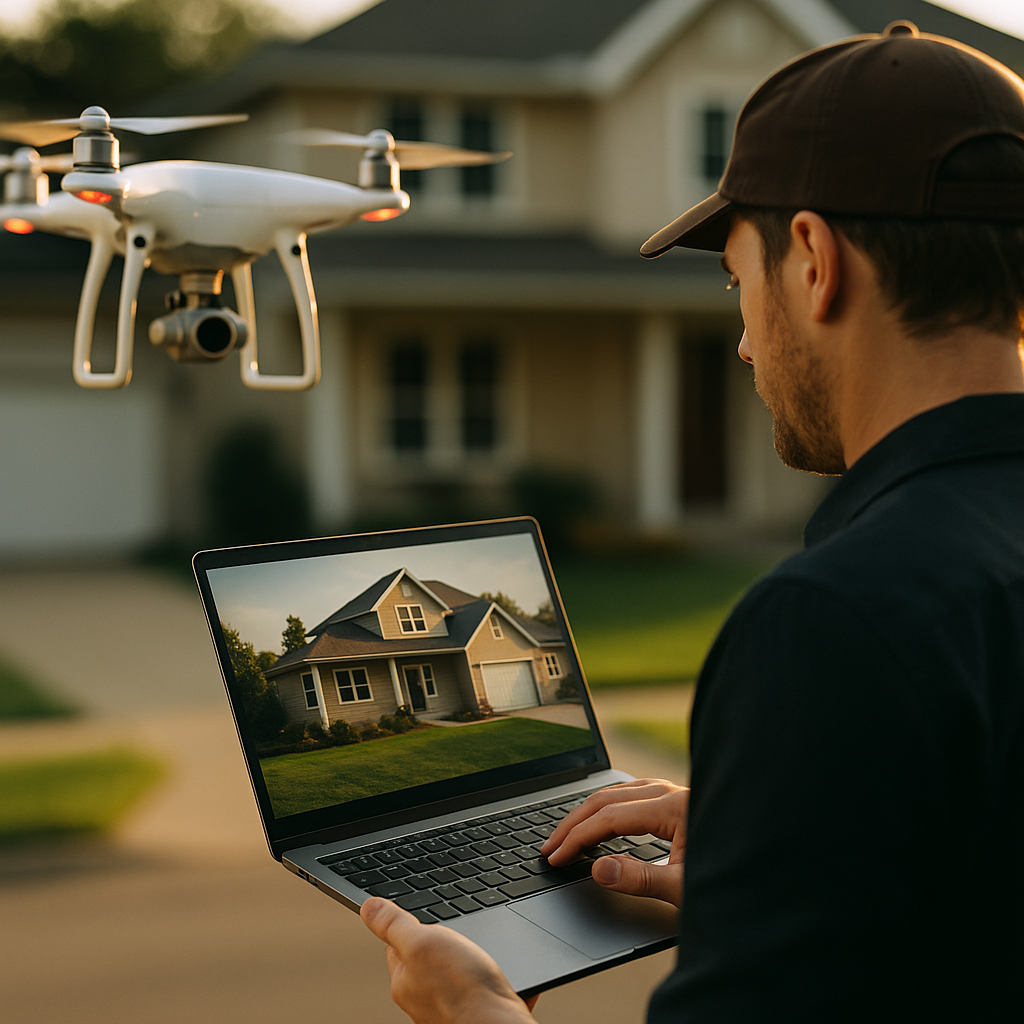
In 2025, buyers expect more than static photos—they want to understand a property’s layout, light, and surroundings before they book a tour. This case study shows how one agency used drones for 3D video sales to shorten decision cycles, increase qualified inquiries, and win more listings. The results weren’t accidental; they followed a repeatable playbook. Ready to see what changed?
Drone real estate marketing: The brand, the challenge, and the goal
Brand profile: “Harbor & Hearth Realty” (pseudonym used to protect commercial confidentiality) is a mid-sized real estate brand operating in coastal and suburban markets. The team sells a mix of family homes, waterfront properties, and new-build communities. By early 2025, they had solid photography and strong agent reputations, but their marketing performance was flattening.
The challenge: Listing pages were getting traffic, yet inquiry quality varied. Buyers frequently arrived at in-person showings with mismatched expectations about yard size, neighborhood context, road noise, and the property’s relationship to nearby amenities. Sellers wanted proof that Harbor & Hearth could stand out online—especially for higher-priced homes where “trust the photos” no longer worked.
The goal: Improve listing differentiation and increase qualified inquiries without inflating ad spend. The brand set three operational targets for 2025:
- Reduce wasted showings by pre-qualifying interest with clearer property context.
- Increase listing win rate by demonstrating premium marketing capabilities at pitch meetings.
- Standardize production so every agent could use the same high-quality assets without relying on one “tech-savvy” teammate.
They chose drone-captured 3D video because it could communicate scale and setting—two details that standard interior tours often miss.
3D property video tour: The strategy and creative concept
Harbor & Hearth didn’t start by buying drones or hiring pilots. They began with a simple question: What do buyers need to understand quickly to decide whether to book a viewing? Their answer guided the creative plan:
- Where the home sits relative to neighbors, coastline, parks, and main roads.
- How the outdoor space flows—yard depth, privacy lines, pool placement, deck orientation.
- How the interior connects to the exterior—patio-to-kitchen transitions, views from primary rooms.
The marketing team built a “3D video tour” format that blended:
- Establishing aerial to orient the viewer (front approach, street context).
- Low-altitude orbit to show frontage, landscaping, and setbacks.
- Reveal shots transitioning from roofline to backyard or waterfront edge.
- Interior-to-exterior continuity using matched cuts from indoor video to drone footage.
Important decision: They avoided gimmicky “spin for the sake of spinning.” Every move had a message: layout clarity, neighborhood credibility, or lifestyle value. That focus improved viewer comprehension and made the footage usable in listing presentations, ads, and social clips.
To support trust, each video included a short, consistent overlay system (no exaggerated claims): property address area (where permitted), key features (bed/bath/lot highlights), and a clear call to action to book a showing. They also created a lightweight compliance checklist so agents didn’t improvise claims that could raise advertising or fair housing concerns.
Aerial videography for listings: Production workflow, equipment, and partners
To keep quality consistent across agents, Harbor & Hearth documented a workflow that balanced speed, safety, and repeatability. They tested a few approaches and settled on a hybrid model: a trained internal coordinator plus a vetted network of licensed drone operators.
Workflow in 7 steps:
- Listing intake: Agent fills a one-page brief: target buyer, top three differentiators, filming constraints, and preferred timing for light and activity level.
- Pre-flight planning: Operator checks airspace, local restrictions, weather, and neighbor privacy considerations. If permissions are needed, they’re requested before scheduling.
- Shot list selection: The coordinator chooses from a standardized library: “coastal reveal,” “cul-de-sac approach,” “acreage boundary sweep,” “community amenity flyover,” etc.
- On-site capture: Drone footage plus short ground clips to connect interior/exterior.
- Post-production: Color correction, stabilization, and a consistent edit pace (the brand found that clarity beat speed-ramp theatrics).
- Quality review: Check for factual accuracy, privacy issues, license plates, faces, and signage.
- Distribution packaging: Export versions for MLS-compliant video, social cutdowns, and vertical formats.
Equipment philosophy: They prioritized reliability and image consistency rather than chasing every new feature. The team defined minimum capture standards (resolution, frame rate, and stabilization) so different operators could deliver interchangeable footage. They also standardized file naming and cloud delivery to prevent delays and missing assets.
Partner selection criteria (EEAT-driven): Harbor & Hearth screened operators for licensing/authorization where required, safety record, portfolio relevance, turnaround time, and ability to follow privacy-first guidelines. They added a written scope of work that covered insurance expectations and content usage rights so the brand could repurpose footage across channels without confusion.
Common reader question: “Should we do this in-house?” Their conclusion was practical: start with partners to prove ROI, then bring specific coordination tasks in-house (briefing, shot-listing, distribution) to improve speed and consistency.
Real estate video conversion: Distribution, funnel design, and sales enablement
The brand treated 3D video as a conversion tool, not just “pretty content.” They redesigned where and how the video appeared so it moved prospects from curiosity to action.
Where the videos lived:
- Listing pages: Video placed above the fold, with a short caption focusing on location context and outdoor flow.
- Agent pitch decks: A “before/after” slide comparing standard photo-only marketing to the 3D drone package.
- Email follow-ups: After inquiry, prospects received a link to the full video plus a 20-second “context clip” highlighting the neighborhood setting.
- Paid social: Short vertical edits targeted to likely buyer segments, leading to the listing page or a showing request form.
Funnel improvements that mattered:
- Pre-qualification: Videos clearly showed proximity to roads, elevation, and neighboring structures. That reduced surprise objections during tours.
- Faster trust-building: The brand positioned the video as an “honest look” at the property and surroundings. This reduced the perception of selective framing.
- Stronger seller confidence: Listing presentations included a sample video and a simple distribution plan, making the marketing feel concrete.
Sales enablement: Agents received a short script and FAQ sheet so they could answer the questions buyers typically ask after watching aerial footage:
- “Is that park walkable, or is there a barrier?”
- “How private is the backyard in summer?”
- “Where does the sun set relative to the patio?”
Instead of guessing, agents used the video to guide a clear, factual conversation. This improved credibility, especially for remote buyers who rely heavily on digital evidence.
Drone video ROI: Results, metrics, and what changed in 2025
Harbor & Hearth tracked performance at three levels: marketing engagement, lead quality, and operational efficiency. They didn’t rely on vanity metrics alone; they tied video usage to measurable actions such as showing requests, seller consultations booked, and time spent by agents on unqualified tours.
What they measured:
- Engagement: video plays, average watch time, and click-through to “book a tour.”
- Lead quality: percentage of inquiries that booked a showing, and percentage of showings that reached offer discussions.
- Operational impact: number of “no-fit” showings reduced (tracked via agent notes) and time-to-first-serious-inquiry.
Outcome summary (internal reporting, 2025): Listings using the full 3D drone package produced a noticeable lift in qualified showing requests versus comparable photo-only listings in the same neighborhoods. Agents also reported fewer tours where buyers immediately dismissed the property due to context issues the drone video would have revealed. On the seller side, the brand used the package to win more competitive listing presentations, especially for higher-value homes where premium marketing served as a clear differentiator.
Why the results improved:
- Better expectation setting: Context reduces “marketing shock” when buyers arrive.
- Higher perceived transparency: Aerial coverage can feel more complete than selective interior angles.
- Stronger narrative: The video format connected lifestyle features (views, privacy, proximity) to the home’s layout.
Reader follow-up: “How long did it take to see traction?” Harbor & Hearth saw the clearest change after standardizing the workflow and distribution. In other words, the lift came when the videos became a system, not an occasional add-on.
Drone regulations for real estate: Compliance, privacy, and risk management
Drone marketing fails when teams treat it like a hobby. Harbor & Hearth built a simple risk-management layer so agents could scale the approach confidently.
Compliance principles they enforced:
- Use qualified operators: Work with properly authorized pilots and follow applicable aviation rules for the area of operation.
- Respect privacy: Avoid lingering shots into neighbors’ yards, windows, or private spaces. When unavoidable, adjust angles, altitude, or framing.
- Be careful with identifiers: Remove or avoid capturing license plates, children, or identifiable individuals without consent.
- Truth in advertising: Do not imply boundaries, beach access, or exclusive amenities unless legally accurate and verifiable.
Process safeguards: Every edit passed a quick review checklist before posting. The checklist focused on: factual overlays, sensitive visuals, prohibited claims, and whether the footage could mislead (for example, compressing distance to amenities). This protected the brand and strengthened trust with both buyers and sellers.
Common reader question: “Will drones scare sellers or neighbors?” Harbor & Hearth reduced concerns by explaining the plan upfront: flight duration, angles, privacy approach, and how footage would be used. Clear communication prevented complaints and helped sellers feel in control.
FAQs
What is a “3D video” in real estate drone marketing?
It’s a video approach that uses drone movement and perspective to communicate depth, layout, and spatial relationships—how the home sits on the lot, how the yard connects to the house, and how close nearby amenities are. It can be combined with interior footage for continuity.
Do drone videos replace interior walkthroughs?
No. They complement interior tours by adding context. Interior walkthroughs explain rooms and finishes; drone footage explains setting, privacy, access, and outdoor flow. Together they reduce uncertainty and improve the quality of inquiries.
How long should a drone-based property video be?
Harbor & Hearth standardized a full version designed for listing pages and a set of short cutdowns for social. The best length depends on the property, but clarity matters more than duration: show the setting, prove the lot, connect interior to exterior, then stop.
What properties benefit most from drone video?
Homes where context drives value: waterfront, acreage, hillside views, new-build communities, properties near parks, and homes with standout outdoor features (pool, guest house, large patio). Drones also help when street approach and neighborhood feel are selling points.
How do you measure ROI from drone video in real estate?
Track performance beyond views: showing requests per listing, showing-to-offer conversations, time-to-first-serious-inquiry, and reduction in “no-fit” showings. On the seller side, track listing presentation win rate when the drone package is included.
What are the biggest compliance risks?
Operating without proper authorization, capturing neighbors in a way that violates privacy expectations, and making inaccurate claims (such as implied access or boundaries). A short pre-flight plan and a post-edit review checklist reduce most issues.
Harbor & Hearth’s case shows that drone-led 3D video works when it improves understanding, not just aesthetics. By standardizing shot plans, partnering with qualified operators, and distributing videos across the full funnel, the brand increased qualified interest and strengthened listing presentations. The takeaway for 2025 is simple: build a repeatable system that prioritizes clarity, compliance, and conversion—then scale it.