


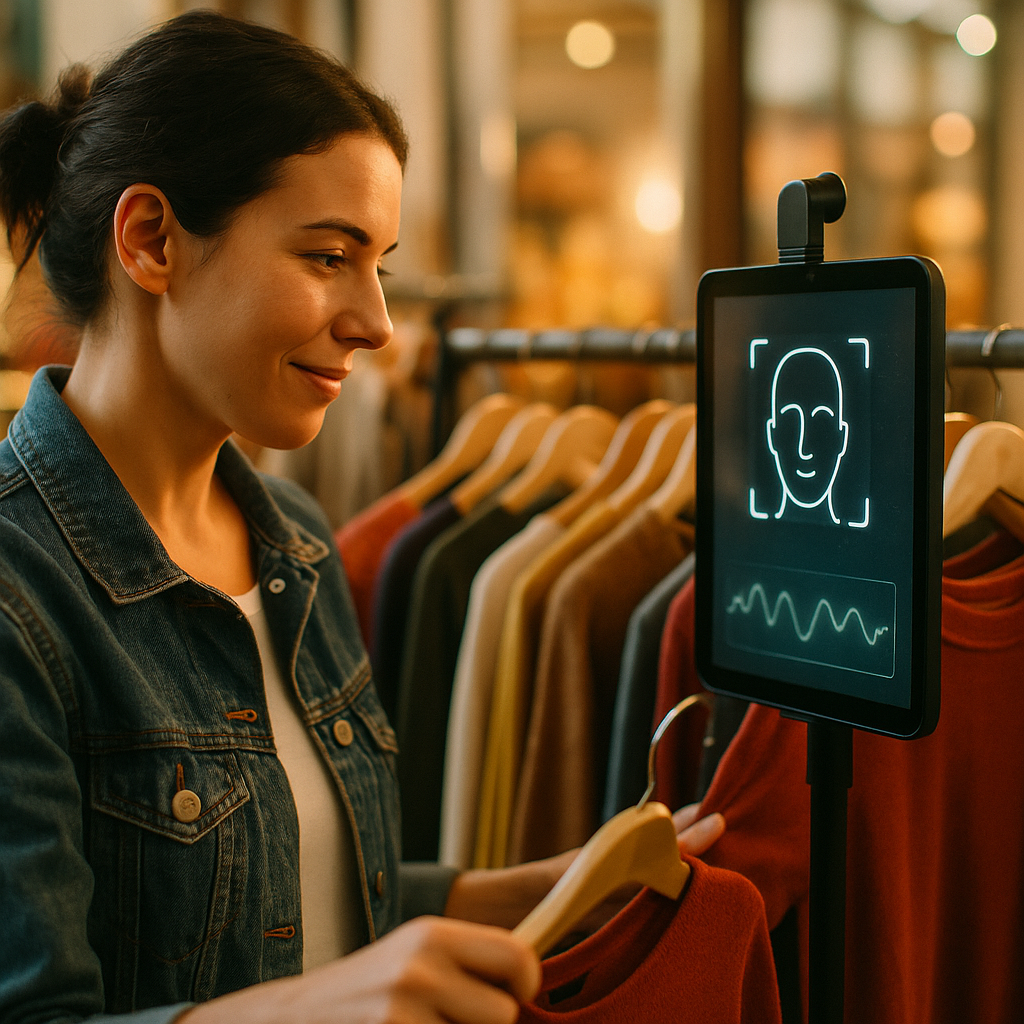
Bio metric feedback loops in immersive retail experiences are reshaping how stores sense, respond, and personalize in real time. In 2026, retailers use consent-based signals like gaze, heart rate, movement, and facial expression to adapt lighting, content, product recommendations, and store layouts. The result is a more responsive shopping journey, but what makes this model effective and trustworthy?
What Bio Metric Feedback Loops Mean for immersive retail experiences
A bio metric feedback loop is a system that captures a shopper’s physical or behavioral signals, interprets them, and then changes the environment or content in response. In retail, this can happen through smart mirrors, wearable integrations, in-store cameras that estimate attention, voice analysis, pressure-sensitive flooring, or connected fitting rooms.
The loop has three parts:
- Signal collection: A shopper opts in to share data such as dwell time, gaze direction, gesture patterns, skin temperature, pulse from a wearable, or voice tone.
- Interpretation: AI models translate those signals into likely intent, interest, confusion, stress, excitement, or decision readiness.
- Response: The retail environment changes in real time, such as adjusting product displays, simplifying digital signage, offering assistance, or triggering personalized promotions.
This differs from standard personalization because it is not only based on historical data. It reacts to what a shopper is experiencing in the moment. That makes immersive retail experiences feel less static and more conversational.
For example, a beauty retailer may detect that a customer lingers on a skincare display but appears hesitant during ingredient comparisons. The screen can switch from promotional messages to a simplified educational mode, highlighting fragrance-free options and dermatologist-tested products. A sportswear store might detect rising engagement in a motion-tracking zone and recommend products aligned with the shopper’s movement style.
When designed well, these systems reduce friction rather than add novelty for its own sake. That is the practical value retailers care about: better engagement, clearer decision support, and stronger conversion without overwhelming the customer.
Why biometric retail technology is gaining traction in 2026
Several forces explain the rapid rise of biometric retail technology in 2026. First, retailers need stronger differentiation as e-commerce convenience has become a baseline expectation. Physical stores now compete on experience, guidance, and emotional resonance. Responsive environments help stores deliver something digital channels cannot fully replicate.
Second, the hardware and software stack has matured. Edge computing enables faster on-site processing, reducing latency for real-time adaptation. Sensor costs have become more manageable for pilot programs. AI models for sentiment estimation, gesture recognition, and traffic analysis are more accurate than earlier generations, especially when tuned for retail settings.
Third, shoppers increasingly expect personalization if it produces clear value. Many customers will share data when they understand what is being collected, how long it is retained, and what benefit they receive in return. That benefit might be faster product discovery, reduced decision fatigue, more relevant recommendations, or accessibility support.
Retailers also use bio metric feedback loops to solve operational problems. They can identify where shoppers disengage, which displays create confusion, and when associates should intervene. This turns immersive retail from a branding exercise into a performance channel tied to measurable outcomes.
The strongest use cases in 2026 are not the most futuristic. They are the ones that improve known retail pain points:
- Choice overload: Dynamic interfaces can narrow options based on visible interest and interaction patterns.
- Low associate availability: Systems can flag moments when shoppers need help but have not asked for it.
- Weak product understanding: Content can adapt from marketing language to clearer explanation.
- Fitting room abandonment: Smart environments can speed item requests, sizing help, and style suggestions.
- In-store analytics gaps: Retailers can see emotional and behavioral responses instead of relying only on footfall and sales data.
Adoption is growing because the business case is broader than conversion alone. Brands are using these loops to improve loyalty, reduce returns, and create better product education, especially in categories such as beauty, health, consumer electronics, luxury, and automotive retail.
How real-time personalization improves the customer journey
Real-time personalization is the most visible output of a bio metric feedback loop. It allows the environment to respond while the customer is still shopping, not after the session ends. That timing matters because many buying decisions are emotional, situational, and short-lived.
Consider how this works across a typical store journey:
- Entry: Digital signage changes messaging based on traffic density, shopper profiles from opted-in apps, or observed engagement cues.
- Discovery: Interactive displays shift from broad category messaging to specific benefits once interest becomes clear.
- Evaluation: Smart mirrors or kiosks can compare products differently if the shopper seems uncertain, rushed, or highly engaged.
- Decision: If hesitation is detected, the system may surface social proof, stock availability, financing, or product care guidance.
- Post-purchase: Retail apps can continue the loop with tailored onboarding, usage tips, or reorder prompts.
Good real-time personalization should feel helpful, not intrusive. That means keeping interventions relevant, lightweight, and easy to dismiss. A retail environment that changes too often or too aggressively can create discomfort and erode trust.
Retailers that succeed usually follow three principles:
- Use progressive personalization: Start with low-sensitivity signals like dwell time and interaction patterns before introducing more advanced biometric inputs.
- Explain the value exchange: Shoppers are more likely to opt in when they know the system helps with fit, speed, accessibility, or product matching.
- Give control: Provide clear settings, opt-outs, and session-based consent rather than hidden, always-on tracking.
These principles align with helpful content and EEAT expectations because they center on real user benefit, transparent practice, and practical expertise rather than hype. Retail leaders need to show that personalization is grounded in tested customer experience design, privacy governance, and measurable outcomes.
Building trust through retail data privacy and ethical design
No discussion of bio metric feedback loops is credible without addressing retail data privacy. Biometric data is sensitive. Mishandling it can damage brand trust, trigger legal scrutiny, and undermine the entire experience. In 2026, the winning brands treat privacy as part of the product, not a compliance footnote.
Trust starts with clear boundaries. Retailers should distinguish between:
- Behavioral observation: Dwell time, navigation paths, product interaction, gesture trends.
- Biometric inference: Attention estimation, emotional response modeling, wearable-linked pulse or stress indicators.
- Identity-linked data: Loyalty account details, purchase history, app profiles, saved preferences.
Each category requires different handling. The most privacy-conscious deployments minimize collection, anonymize where possible, process at the edge, and avoid storing raw biometric data unless there is a compelling, consented reason. In many use cases, the system only needs a transient interpretation, such as “high interest” or “needs assistance,” not the underlying signal.
Ethical design also means avoiding manipulative use. A retailer should not exploit signs of stress or urgency to pressure purchases. Instead, it should use these signals to simplify information, reduce friction, or offer help. This is where expert governance matters. Cross-functional review involving CX leaders, legal teams, security specialists, and store operations helps prevent misuse.
To strengthen EEAT, brands should publish plain-language disclosures, train staff to explain the experience, and document how models are tested for bias. Different demographics may express emotion, attention, or discomfort differently. If a model is not validated across varied populations, the experience may become inaccurate or unfair.
Shoppers also want practical answers:
- What data is collected?
- Is it stored or processed instantly?
- Can I shop without opting in?
- Who can access the data?
- How do I delete it?
Retailers that answer these questions upfront are far more likely to earn participation. Trust is not separate from performance here. It is what makes the feedback loop viable at scale.
Practical use cases for sensory shopping technology
Sensory shopping technology covers the interface layer where biometric insight becomes an immersive experience. The strongest applications combine physical space, digital content, and responsive service in a way that supports a clear shopping objective.
Here are the most effective use cases emerging in 2026:
- Smart fitting rooms: Mirrors recommend sizes, complementary items, and alternate colors based on body movement, fit reactions, and selected preferences. Associates receive alerts when a shopper may need assistance.
- Beauty and wellness diagnostics: Skin analysis, attention tracking, and guided consultations adapt recommendations according to concern areas and product reactions.
- Automotive showrooms: In-cabin sensors and interactive displays adjust feature demonstrations depending on where interest concentrates, such as safety, comfort, or infotainment.
- Luxury retail: Private clienteling experiences adapt sound, lighting, and product narratives to pace, mood, and preference signals from opted-in customers.
- Grocery and food retail: Digital shelves and kiosks simplify dietary choices by reacting to search behavior, hesitation, and repeat comparison patterns.
- Accessible shopping: Environments detect when a shopper may need larger text, lower sensory intensity, voice guidance, or route assistance.
Not every use case needs advanced biometrics. In many cases, combining movement, dwell time, product interaction, and declared preferences delivers most of the value. Retailers should start with the least invasive signal set that can solve the problem effectively.
Store teams remain essential. Immersive systems work best when they augment human service rather than replace it. For example, a client advisor equipped with contextual prompts can provide more precise support at the right moment. This blend of technology and trained staff often outperforms fully automated experiences because it retains empathy and judgment.
A practical rollout usually follows this path:
- Identify one high-friction journey such as fitting rooms, product education, or complex comparison.
- Select a low-risk signal set and define what real-time response will occur.
- Test for business impact on conversion, dwell time, basket size, assistance requests, or returns.
- Audit privacy and fairness before scaling.
- Train staff thoroughly so the technology feels coherent in-store.
This disciplined approach helps retailers avoid expensive, underused installations that impress at launch but fail in daily operations.
Measuring success with customer experience analytics
Customer experience analytics is what turns bio metric feedback loops from an experimental concept into a repeatable retail strategy. Retailers need proof that these systems improve outcomes without harming trust or increasing operational complexity.
The right metrics should cover three dimensions:
- Commercial impact: conversion rate, average order value, cross-sell rate, return rate, repeat visits.
- Experience quality: task completion time, assisted conversion, dwell depth, content engagement, customer satisfaction.
- Trust and compliance: opt-in rate, opt-out rate, consent comprehension, privacy complaints, data retention adherence.
Retailers often make the mistake of focusing only on engagement. A shopper who spends more time in an immersive display is not necessarily closer to purchase. Better signals include reduced friction, faster confident decisions, fewer product mismatches, and improved service timing.
Testing should be rigorous. Compare stores or zones with and without a feedback loop. Measure whether the response itself caused improvement, not just the presence of a new installation. Qualitative validation matters too. Post-visit surveys, associate observations, and usability testing help reveal whether the experience felt useful or invasive.
From an EEAT perspective, credible reporting matters. Claims should reflect actual pilot outcomes, clearly defined sample sizes, and transparent limits. If a retailer cannot explain how a model works at a high level, why it was chosen, and how it is monitored, it should not deploy it broadly.
The long-term winners in this space will be the brands that pair technical sophistication with operational discipline. They will know which signals matter, when to intervene, how to preserve trust, and how to prove that the experience helps the customer make better decisions.
FAQs about bio metric feedback loops
What are bio metric feedback loops in retail?
They are systems that capture shopper signals, interpret them, and adjust the retail environment in real time. Signals may include movement, gaze, interaction patterns, or opted-in wearable data. The goal is to improve relevance, guidance, and experience quality during the shopping session.
Are bio metric feedback loops the same as facial recognition?
No. Facial recognition identifies a person. Many retail feedback loops do not need identity recognition at all. They may use anonymous attention estimation, dwell time, gesture tracking, or wearable-linked data that the shopper explicitly connects to the experience.
Do customers have to opt in?
For sensitive biometric collection, yes, they should. Best practice in 2026 is clear, session-based consent with an easy opt-out. Shoppers should also be able to access core store services without agreeing to advanced data collection.
What benefits do shoppers actually get?
The main benefits are faster product discovery, more relevant recommendations, better fit and comparison support, reduced sensory overload, and more timely staff assistance. The experience should solve a problem, not just showcase technology.
Which retail sectors benefit most from this technology?
Beauty, fashion, luxury, electronics, grocery, wellness, and automotive retail are seeing strong results because shoppers often need comparison help, education, or fit guidance in those categories.
What are the biggest risks?
The main risks are privacy violations, unclear consent, biased models, and overly intrusive personalization. These can be reduced through data minimization, edge processing, transparent disclosures, fairness testing, and strong internal governance.
How should retailers start?
Start with one customer journey that has clear friction, such as fitting rooms or product comparison. Use a minimal signal set, define a simple response, measure impact carefully, and scale only after privacy, usability, and business performance are validated.
Will immersive retail replace human associates?
No. The most effective deployments support associates with better context and timing. Human service remains essential for trust, empathy, and complex decision-making, especially in premium or high-consideration categories.
Bio metric feedback loops are becoming a practical layer of immersive retail, not a futuristic sideshow. In 2026, the brands that benefit most use them to remove friction, improve guidance, and respect privacy from the start. The clear takeaway is simple: responsive retail works best when it is transparent, useful, measurable, and always designed around customer trust.