


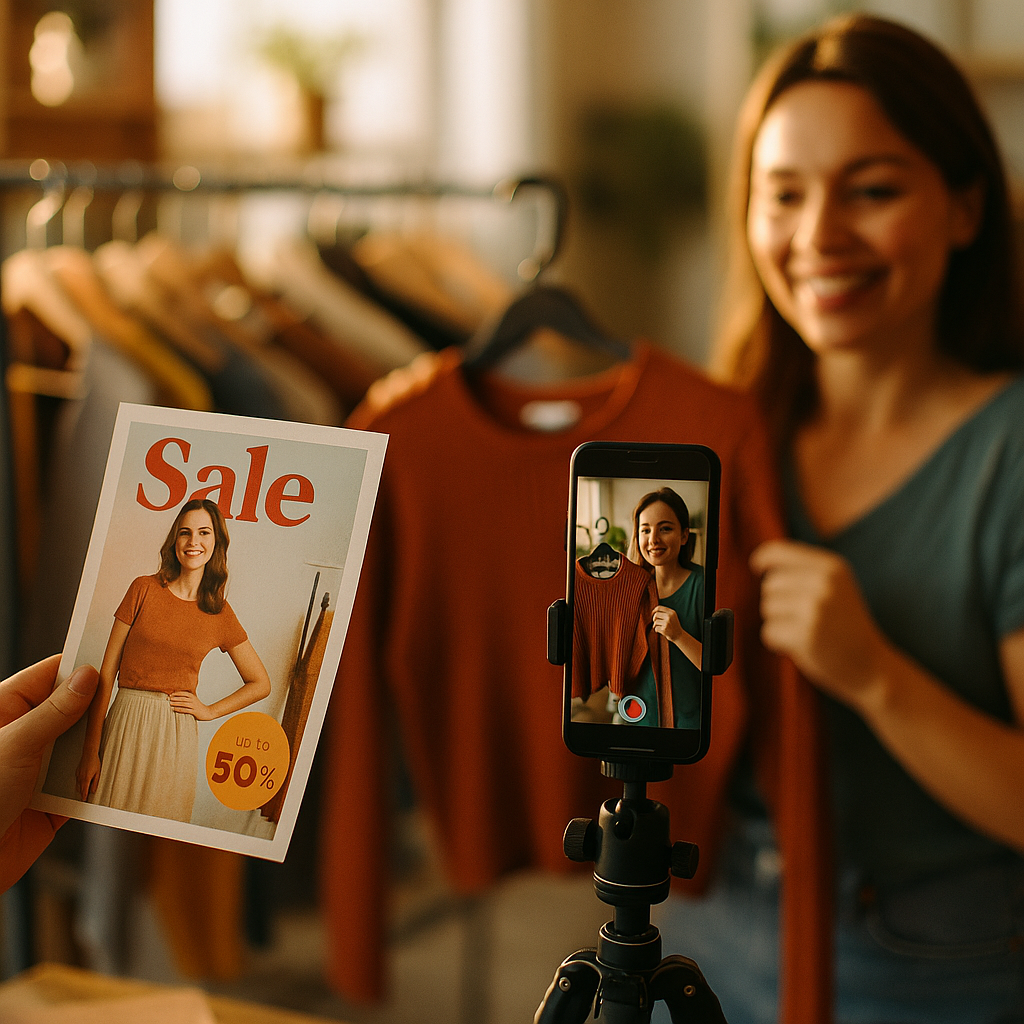
For many retailers, shrinking print performance and rising digital attention have forced a rethink of how marketing budgets work. This case study: a retailer’s successful transition from print to social video shows what changed, why it worked, and how measurable gains followed. If your brand still leans on flyers, inserts, or catalogs, the lessons here may reshape your next campaign.
Retail marketing strategy: why print stopped delivering efficient growth
The retailer in this case was a mid-sized home and lifestyle brand with regional store coverage and a growing ecommerce business. For years, its marketing mix depended heavily on direct mail, newspaper inserts, seasonal print catalogs, and point-of-sale signage. Print had once been reliable. It built awareness, supported promotions, and gave local stores a predictable traffic lift.
By early 2026, however, the leadership team saw clear signs of decline. Print costs had increased, household response rates had softened, and campaign measurement remained slow and incomplete. The brand could estimate store visits after a mail drop, but it struggled to connect those visits to creative themes, audience segments, or actual revenue impact with confidence.
At the same time, customer behavior had shifted. The retailer’s audience was spending more time on short-form video platforms and increasingly discovering products through creators, reviews, and social recommendations. Internal analytics showed that users who engaged with video content on owned channels spent more time on product pages and were more likely to convert than visitors who arrived from static campaign assets.
This did not mean print had no value. It still reached older loyal customers and supported certain store events. But the board and marketing team recognized an important truth: the old media mix was no longer efficient enough to drive growth at the pace the business needed. The problem was not only cost. It was opportunity cost. Every dollar locked into underperforming print was a dollar not invested in channels with stronger targeting, faster creative testing, and better attribution.
The retailer’s goal was not to abandon brand-building. It was to modernize it. That distinction mattered. The transition succeeded because leadership treated social video as a strategic growth engine, not a trend experiment.
Social video marketing: setting goals, audiences, and channel priorities
The first step was disciplined planning. Instead of moving budget into social video all at once, the retailer built a 2-quarter transition framework with clear targets. The executive team asked three practical questions:
- Which business outcomes should social video improve first: awareness, traffic, conversion, or retention?
- Which customer segments were most likely to respond to video-led storytelling?
- How would success be measured against the legacy print benchmark?
The answers shaped the rollout. The retailer prioritized three objectives:
- Increase qualified traffic to product pages and store locator pages.
- Improve return on ad spend compared with seasonal print campaigns.
- Raise new-customer acquisition without weakening repeat purchase rates.
Audience strategy was equally focused. Rather than target “everyone,” the team built social video around four high-value groups: first-home buyers, style-conscious families, deal-driven local shoppers, and loyal customers likely to respond to new arrivals. This audience segmentation gave the creative team a clear brief. Different people needed different messages, offers, and formats.
The retailer then selected channels based on user intent and content behavior. Short-form vertical video became the lead format across Instagram Reels, TikTok, YouTube Shorts, and paid social placements. Meta also remained important for retargeting and local store promotion. The brand did not treat every platform the same. Instead, it adapted creative to how people used each one:
- Fast product demos and trend-led edits for discovery-based channels.
- Offer-led local messages for store traffic campaigns.
- How-to content and styled-room inspiration for consideration.
- Testimonial-style clips and limited-time promotions for conversion.
This planning stage reflected strong EEAT principles. The team relied on first-party data, platform analytics, and operational sales inputs rather than assumptions. Marketing, ecommerce, retail operations, and finance agreed upfront on definitions for success. That cross-functional alignment reduced friction later when budgets started shifting away from familiar print programs.
Video content strategy: building creative that customers actually watched
The retailer’s biggest early mistake was producing social video that looked like print ads in motion. The first test assets were polished but slow, heavily branded, and built around promotional copy rather than platform-native behavior. Completion rates were weak, and engagement lagged.
The turnaround came when the team changed its creative rules. It moved from campaign-first production to audience-first production. Instead of asking, “How do we convert our catalog into video?” the team asked, “What would stop a shopper from scrolling?”
The new video content strategy included several practical changes:
- Show the product in the first 2 seconds. Hooks focused on utility, surprise, price, or transformation.
- Use real spaces and relatable people. Styled content remained polished, but it felt livable rather than studio-perfect.
- Design for silent viewing. Captions, text overlays, and visual pacing carried the message without requiring sound.
- Lead with one message per video. Promotions, styling tips, and product benefits were separated instead of crowded together.
- Create in batches. The team filmed modular assets that could be edited into dozens of versions for testing.
Creative themes were based on customer questions and shopping triggers. These included “small-space upgrades,” “weekend room refreshes,” “best picks under a price threshold,” and “what’s new in store this week.” The strongest-performing videos solved a problem quickly or visualized a product in context. Shoppers were not looking for the digital version of a brochure. They wanted useful ideas and proof.
User-generated style content also played a role. The retailer partnered with micro-creators and store associates to produce authentic demonstrations, shelf picks, and seasonal styling clips. This lowered production costs while increasing trust. Store staff, in particular, became valuable on-camera experts because they knew which items customers asked about, what sold out quickly, and which combinations led to larger baskets.
To protect brand quality, the team created lightweight content standards covering lighting, framing, product visibility, claims, accessibility, and calls to action. This balanced speed with consistency. The result was a social video system that could scale without becoming chaotic.
Performance marketing case study: execution, testing, and budget reallocation
The rollout began with a controlled test. The retailer shifted a modest share of its spring print budget into paid and organic social video while keeping a smaller print presence in two core markets. This allowed for direct comparison without exposing the business to unnecessary risk.
The media plan used a simple funnel structure:
- Top of funnel: broad interest and lookalike audiences reached with short discovery videos.
- Mid funnel: engaged viewers and site visitors retargeted with product-specific social video.
- Bottom of funnel: dynamic offers, local inventory messages, and urgency-focused creative to drive purchase.
Measurement was set up before launch, not after. The team connected platform reporting with ecommerce analytics, promo code tracking, store-locator interactions, and regional sales data. Where possible, they used holdout comparisons between markets with lower print activity and stronger video support. This was not perfect attribution, but it was much more actionable than the retailer’s previous print readout.
Within weeks, patterns became clear. Shorter edits outperformed longer ones for prospecting. Videos that featured people using products beat product-only montages. Localized overlays improved store-related results. Testimonials and “why shoppers love this” creative performed especially well among returning audiences.
Most importantly, the budget model changed from fixed allocation to performance-based reallocation. Under print, major spending decisions were often locked months in advance. Under social video, the retailer could move budget weekly toward winning formats, audiences, and offers. Underperforming concepts were cut quickly. Winners were refreshed and expanded.
By the end of the second quarter, the results justified a larger transition. The retailer reported stronger engagement, more efficient traffic, and a measurable lift in ecommerce revenue from social-led cohorts. Store traffic also improved in markets where local social video featured nearby promotions and clear geographic calls to action. Although print still had limited tactical uses, it no longer held the primary budget position.
From an EEAT perspective, this outcome was credible because it rested on real operational evidence: tracked behavior, controlled comparisons, and repeatable optimization. The retailer did not claim that social video replaced every traditional channel. It demonstrated where social video was better, why it was better, and how the business adapted based on observed performance.
Digital transformation in retail: operational changes behind the results
The visible success came from more than creative and media. The retailer made several internal changes that often determine whether digital transformation in retail succeeds or stalls.
First, it shortened approval cycles. Print campaigns had encouraged long lead times and layered sign-off processes. Social video required a faster rhythm. The company introduced pre-approved messaging frameworks and visual templates so teams could publish and test creative quickly without sacrificing compliance.
Second, it reorganized ownership. Instead of separating brand, ecommerce, and store marketing into isolated tracks, the retailer created a shared weekly performance review. Leaders looked at content output, paid performance, inventory signals, store priorities, and merchandising updates together. This reduced conflicting promotions and improved timing.
Third, it invested in content operations. The brand did not need a massive in-house studio, but it did need repeatable production. A lean content calendar, creator roster, store-level footage pipeline, and editing workflow made social video sustainable. This operational backbone is what many retailers miss. One good campaign is not a transition. A repeatable system is.
Fourth, it trained teams on platform behavior and customer intent. Merchandisers learned what types of product stories worked in short-form video. Store managers learned how localized content affected traffic. Executives learned to evaluate creative performance beyond vanity metrics. Views mattered, but not in isolation. The retailer focused on watch time, click quality, assisted conversion, and blended revenue impact.
This broader business alignment allowed social video to influence more than marketing. It informed assortment priorities, promotional timing, and even in-store storytelling. When certain product bundles performed well in video, stores adjusted displays to mirror those pairings. Digital insights became operational decisions.
Retail video advertising ROI: lessons, risks, and a practical framework for brands
The strongest lesson from this case is that retail video advertising ROI improves when video is treated as a system, not a set of isolated posts. The retailer won because it aligned audience insight, platform-native creative, disciplined testing, and cross-functional execution.
For other retailers considering a similar move, several takeaways stand out:
- Do not cut print blindly. Compare channels against clear business outcomes and transition in stages.
- Start with customer behavior. Build creative around what shoppers need to see, understand, and trust.
- Measure beyond views. Tie video performance to traffic quality, conversion, revenue, and store actions.
- Refresh creative often. Social video fatigue happens quickly, especially in paid placements.
- Use local relevance. Store-specific messages can significantly improve footfall and promotional response.
- Create feedback loops. Let paid results inform organic content, merchandising, and store execution.
There were also risks. Fast-moving video programs can create inconsistent branding if standards are weak. Attribution can still be messy, especially for omnichannel retailers. Teams may overvalue short-term conversion assets and underinvest in brand-building content. The retailer managed these risks by maintaining creative guardrails, using blended measurement, and balancing performance media with broader storytelling.
One likely follow-up question is whether this model works only for large chains. It does not. Smaller retailers can apply the same principles with fewer channels, tighter geographies, and leaner production. Another question is whether print should disappear entirely. Not necessarily. In categories with older audiences, local events, or premium catalog traditions, print may still play a supporting role. The key is to make every channel earn its budget based on current customer behavior, not legacy habit.
In 2026, the real competitive edge is not simply “being on social.” It is building a retail marketing system that learns faster than the market shifts. This retailer did exactly that, and the payoff extended beyond ad efficiency. It gained a more responsive brand, stronger customer insight, and a marketing engine better suited to how people now discover and buy.
FAQs about print to social video transition
Why are retailers moving from print to social video?
Retailers are shifting because social video offers stronger targeting, faster testing, clearer performance data, and lower creative turnaround times. It also matches how customers now discover products and promotions across mobile-first platforms.
Can social video drive in-store traffic as well as ecommerce sales?
Yes. Localized social video with store-specific offers, inventory messages, map cues, and nearby audience targeting can increase footfall while also supporting online conversion. The strongest programs connect both store and digital outcomes in one measurement plan.
How much print budget should a retailer reallocate first?
There is no universal number, but a phased test is usually safest. Start with a controlled portion of seasonal print spend, compare results across matched markets or audience groups, and expand only after performance evidence is clear.
What types of social video work best for retail brands?
Short, product-led videos usually perform best, especially when they show use cases, transformations, price points, styling ideas, or staff recommendations quickly. The key is to match each video to audience intent and platform behavior.
How should retailers measure success during the transition?
Track a mix of metrics: watch time, engagement quality, click-through rate, product page visits, store-locator interactions, conversion rate, return on ad spend, and revenue by campaign cohort. Use market comparisons where possible to assess incremental impact.
Does social video require a large production budget?
No. Many successful retail video programs rely on lean production, modular shooting, creator partnerships, and store-generated footage. What matters most is consistency, testing speed, and relevance to customer needs.
What is the biggest mistake in moving from print to social video?
The most common mistake is repurposing print messaging without adapting it to video behavior. Social audiences respond better to fast hooks, clear visuals, simple messages, and native formats designed for mobile viewing.
This case study shows that a successful move from print to social video depends on more than swapping channels. The retailer won by setting measurable goals, creating native video content, testing relentlessly, and aligning teams around real customer behavior. For brands planning a similar shift in 2026, the takeaway is simple: transition gradually, measure honestly, and let performance—not tradition—shape your media mix.