


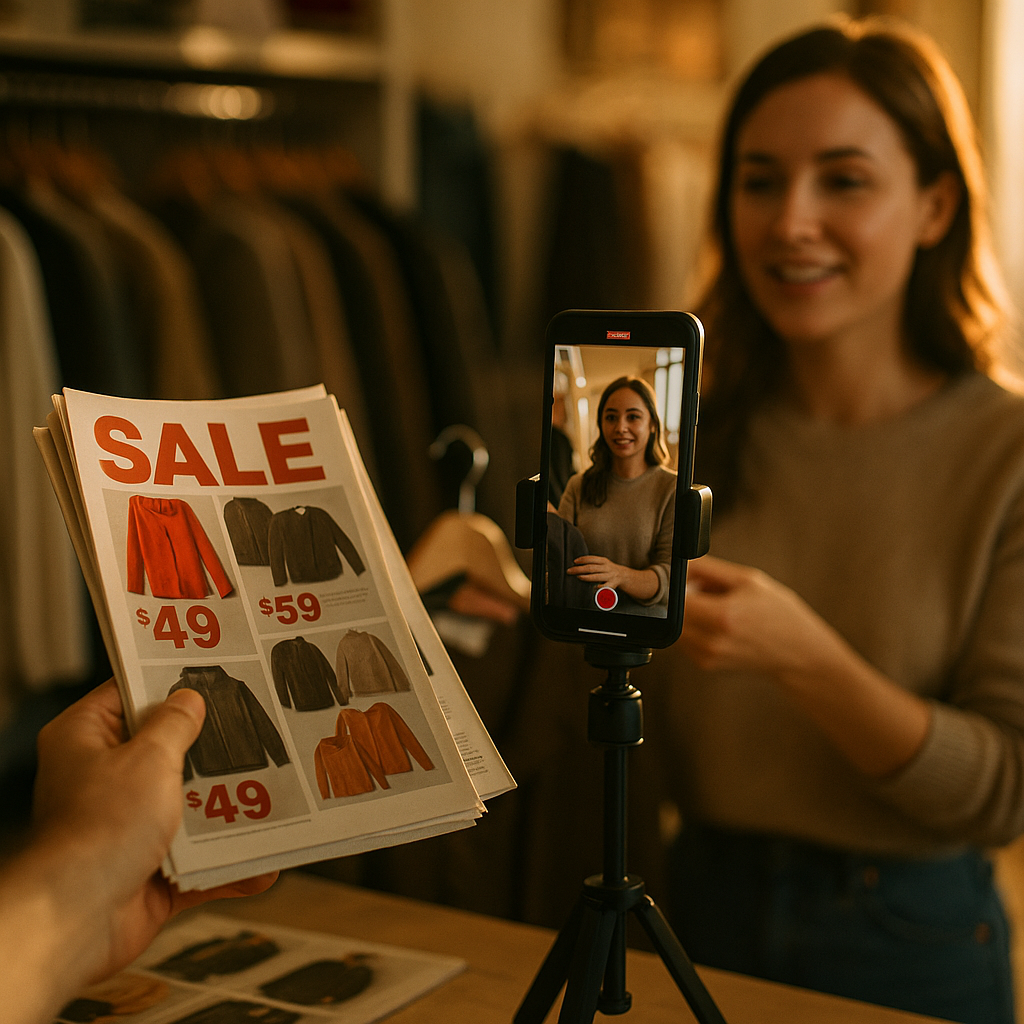
In 2026, marketers still ask whether legacy retail channels can thrive in a video-first world. This case study: a retailers successful transition from print to social video shows how one mid-sized brand replaced declining catalog performance with measurable engagement, stronger conversion paths, and better customer insight. The shift was not instant, but the results reveal a practical roadmap worth studying.
Retail marketing strategy: Why print stopped delivering growth
The retailer in this case study is a regional home and lifestyle brand with more than 80 stores and a long history of direct-mail catalogs, newspaper inserts, and seasonal print promotions. For years, print supported foot traffic and brand recall. But by 2026, the company faced a familiar problem: rising production costs, slower campaign turnaround, weaker attribution, and shrinking response rates among younger and mid-career shoppers.
Leadership did not abandon print because it had no value. They reduced reliance on it because the economics and customer behavior had changed. Audience research showed that target buyers were spending more time on short-form video platforms, watching product reviews, saving inspiration clips, and responding to creator-style demonstrations. Meanwhile, store teams reported that shoppers often referenced videos they had seen online rather than print mailers.
The company’s marketing director made one decision that shaped the success of the transition: the team treated print decline as a data problem, not a creative failure. Instead of assuming social video was automatically better, they compared channels across four business metrics:
- Cost per incremental store visit
- Cost per qualified website session
- Time from campaign brief to launch
- Revenue attributable to each campaign theme
This framework gave executives confidence. It also prevented the team from chasing vanity metrics such as raw views without considering conversion quality. The retailer saw that print was still useful for a narrow high-value audience, but social video offered better scalability, faster testing, and stronger audience feedback loops.
That insight set the stage for a phased transition rather than a risky all-or-nothing channel switch.
Social video marketing: How the retailer built the transition plan
The retailer designed a 120-day migration plan with clear ownership across brand, performance, merchandising, ecommerce, and store operations. This cross-functional setup matters because social video campaigns often fail when creative teams work in isolation from inventory, customer service, and analytics teams.
The plan had three phases.
Phase one: Audit and audience mapping. The team reviewed twelve months of print campaigns, top-selling product categories, store traffic trends, and web analytics. They identified which print themes had historically driven action: seasonal room refreshes, back-to-school organization, holiday gifting, and limited-time product bundles. Then they matched those themes to video-native audience behaviors such as “how it looks in real spaces,” “quick styling tips,” and “what you get for the price.”
Phase two: Creative system design. Instead of producing one polished brand film, the retailer created a repeatable video framework. Every campaign included multiple assets: a 10-second hook video, a 20- to 30-second product demo, a testimonial-style clip, and a vertical version optimized for mobile-first feeds. This lowered production waste and increased testing opportunities.
Phase three: Test-and-scale deployment. The brand launched on Instagram Reels, TikTok, YouTube Shorts, and paid social placements. Email and onsite banners supported the rollout, but video was the lead asset. Each campaign used UTM tracking, promo-code grouping, and location-level reporting to connect digital exposure with ecommerce and store outcomes.
One of the strongest execution choices was using real employees and actual customers alongside polished product footage. The retailer’s team had learned from focus groups that highly staged ads felt less trustworthy in social environments. Authenticity was not used as a buzzword; it was operationalized through on-camera experts, store associates, and clear product demonstrations.
This is a useful EEAT lesson for any brand. Experience and expertise are stronger when audiences can see who is speaking, what they know, and how the claim is supported. In this case, a storage specialist showed how to organize a small apartment entryway, and a bedding buyer explained why one fabric line performed better for families with pets. Specific knowledge built trust faster than generic slogans.
Video content strategy: What content replaced the catalog
The retailer did not try to turn print pages into moving images. That would have failed. Instead, the team translated the job of the catalog into video formats that matched user expectations on social platforms. The catalog had once done three things well: sparked ideas, grouped products into themes, and pushed urgency around promotions. The new video content strategy recreated those functions in more dynamic ways.
They developed five recurring content pillars:
- Room transformations: before-and-after videos showing complete looks with price callouts
- Problem-solving demos: videos answering practical questions such as storage, cleaning, or space-saving
- Staff picks: quick recommendations from in-store associates and buyers
- Seasonal collections: short edits grouping products by mood, color palette, or occasion
- Offer-led videos: promotional clips with clear deadlines, bundles, and shopping paths
Several creative rules improved performance quickly. The first two seconds had to communicate either a problem or a visual payoff. Captions were added because many users watched with sound off. Products were tagged where possible, and every video ended with one clear action: shop now, save this idea, visit a local store, or view the full collection.
The retailer also learned that not every product deserved video. Functional items with little visual appeal performed better when bundled into “solution” videos instead of standing alone. For example, baskets, shelving, hooks, and trays sold best when presented as one entryway organization system rather than as separate items. This shifted merchandising strategy too, because social content exposed which products had stronger story value.
Another insight involved campaign volume. The team initially thought they needed a constant stream of new concepts. In practice, iterative variation outperformed endless reinvention. They took one strong room-makeover concept and tested different hooks, price points, camera angles, and calls to action across platforms. That approach reduced creative fatigue while improving media efficiency.
For readers wondering how much polish is enough, this case suggests a balanced answer. The retailer used professional lighting and editing, but kept the tone direct and human. Overproduced content felt like old advertising. Lightly structured, expertise-led content felt native to the feed and more credible.
Retail customer engagement: Results across awareness, traffic, and sales
Within six months, the retailer saw a measurable shift in channel performance. The company did not evaluate success based on views alone. It looked at engagement quality, site behavior, local store impact, and revenue contribution.
The most important outcomes included:
- Higher engagement rates on short-form video compared with static social posts and digital versions of print creative
- Faster traffic spikes after campaign launches, especially around seasonal collections and room transformations
- Improved assisted conversions as viewers returned via branded search, email, and direct site visits
- Stronger store-level response in regions where paid video was paired with geo-targeted offers
- Lower creative turnaround time compared with catalog production cycles
More importantly, the brand gained visibility into customer intent. Print had delivered broad exposure but limited real-time feedback. Social video gave the team comments, saves, shares, completion rates, click behavior, and creator-style questions from shoppers. Those signals influenced not only marketing but inventory planning, visual merchandising, and customer support scripts.
One campaign illustrates the impact. A “small living room reset” video series featured modular furniture, layered lighting, and compact storage. Engagement was strong, but the biggest surprise came from comments asking for exact dimensions, assembly difficulty, and pet durability. The retailer responded by producing follow-up videos that answered each question directly. Conversion rates on the follow-up assets were significantly higher than on the original inspiration clips because they addressed real purchase friction.
This is where EEAT becomes commercially useful. Helpful content is not just educational for SEO purposes. It reduces hesitation at the moment of decision. By showing expertise and addressing practical concerns, the retailer increased trust and moved prospects toward action.
The transition also improved executive reporting. Instead of waiting for delayed print-response indicators, the marketing team could optimize live campaigns weekly. Underperforming creative was paused. Strong performers received more budget. Store managers got localized insights. Merchandising teams learned which combinations of products generated stronger watch time and click-through rates.
Did print disappear completely? No. The retailer retained limited print for loyalty segments and high-intent seasonal promotions. But social video became the lead storytelling engine, and print shifted into a supporting role rather than the centerpiece of the media plan.
Marketing attribution model: How the team proved social video ROI
A transition from print to video only earns long-term support if finance and leadership can trust the numbers. The retailer therefore invested early in a better marketing attribution model. This prevented a common problem: social video drives demand, but the sale gets credited elsewhere because the buyer converts later through search, email, or in-store purchase.
The measurement setup combined several methods:
- Platform analytics for view-through trends, engagement, and audience retention
- Web analytics tied to campaign URLs, landing pages, and on-site product behavior
- Promo-code clusters aligned to creative themes rather than single ads
- Geo-lift analysis comparing exposed and less-exposed store regions
- Post-purchase surveys asking customers what influenced discovery
This blended model gave the retailer a more realistic view of performance. Last-click data alone would have undervalued video because many customers watched, researched later, then purchased through another touchpoint. By using multiple evidence sources, the team could show that social video was not only creating awareness but improving conversion efficiency across the funnel.
The company also established a practical definition of success for each content type. Inspiration videos were judged on saves, watch time, and assisted traffic. Offer-led videos were judged on click-through rate, revenue per visit, and store redemption. Expertise videos were judged on engagement depth, product page views, and return visitor rates. This removed confusion about whether every asset needed immediate direct response to be considered valuable.
For marketers considering a similar move, this is a major takeaway: define the role of each video before launch. If every asset is asked to do everything, reporting becomes noisy and creative decisions become reactive.
The finance team eventually supported a larger reallocation from print because the retailer could demonstrate three things clearly: faster learning, more precise targeting, and stronger attributable revenue. That combination made the transition sustainable.
Digital transformation in retail: Lessons other brands can apply
This retailer’s success was not based on trendy platforms alone. It came from disciplined change management. Brands that want to repeat the result should focus on the underlying operating principles.
- Start with customer behavior, not channel bias. The retailer moved because its audience had changed, not because social video was fashionable.
- Translate the purpose of print instead of copying its format. Video should solve different user needs in a native way.
- Build content around expertise. Buyers, store staff, and category specialists can communicate trust better than vague brand language.
- Use a testing system, not one-off campaigns. Repeating formats with controlled variations produces cleaner learning.
- Connect creative to merchandising and operations. If a featured product is unavailable, difficult to ship, or poorly explained online, even strong video will underperform.
- Measure beyond last click. Social video often influences sales before the final transaction point.
The broader lesson is that digital transformation in retail is rarely a media-only decision. It changes how teams plan, create, analyze, and respond to customers. In this case, marketing became more agile, merchandising became more informed, and stores benefited from content that answered real shopper questions before they walked in.
Retailers with legacy print investments should not assume they must choose between heritage and innovation. The better approach is to identify which legacy strengths still matter, then repackage them for current behavior. This brand kept its strong promotional discipline and merchandising instincts. It simply delivered them through faster, more measurable, more engaging formats.
FAQs about social video for retailers
Why are retailers moving from print to social video?
Retailers are following customer attention and demand for faster, more interactive content. Social video allows brands to demonstrate products, answer questions, test creative quickly, and track performance with more precision than most print campaigns.
Does social video work for brick-and-mortar retailers or only ecommerce brands?
It works for both. In-store retailers can use geo-targeting, localized offers, store associate content, and region-level reporting to drive foot traffic as well as online sales.
What kind of retail products perform best on social video?
Products with visual transformation value, clear utility, or demonstrable benefits tend to perform best. However, less visual items can also succeed when grouped into a practical solution or featured in a problem-solving format.
How much should a retailer reduce print during the transition?
That depends on audience behavior and current ROI. A phased reduction is usually safer than a full stop. Keep print where it still serves high-value segments, and shift budget gradually as social video proves performance.
What metrics matter most when evaluating social video?
Focus on metrics tied to business outcomes: qualified traffic, assisted conversions, store visits, revenue per visit, repeat engagement, and creative turnaround speed. Views alone are not enough.
How often should retailers publish social video content?
Consistency matters more than volume. A repeatable weekly cadence with multiple tested variations often outperforms irregular bursts of brand-new concepts. Quality control and relevance should guide frequency.
Do retailers need influencers to make social video successful?
No. Influencers can help, but many retailers succeed using store associates, category experts, customers, and internal creative teams. Credible expertise and useful demonstrations often outperform expensive partnerships.
What is the biggest mistake in moving from print to video?
The biggest mistake is treating video as a direct copy of print layouts. Social video needs stronger hooks, clearer storytelling, native formatting, and content built around how people browse and decide on social platforms.
The retailer in this case study succeeded because it treated social video as a measurable business system, not a creative experiment. By aligning audience insight, expert-led content, smarter attribution, and agile testing, the brand replaced declining print efficiency with stronger engagement and sales impact. The clearest takeaway is simple: retailers win when helpful video answers real shopping questions faster than traditional media can.