


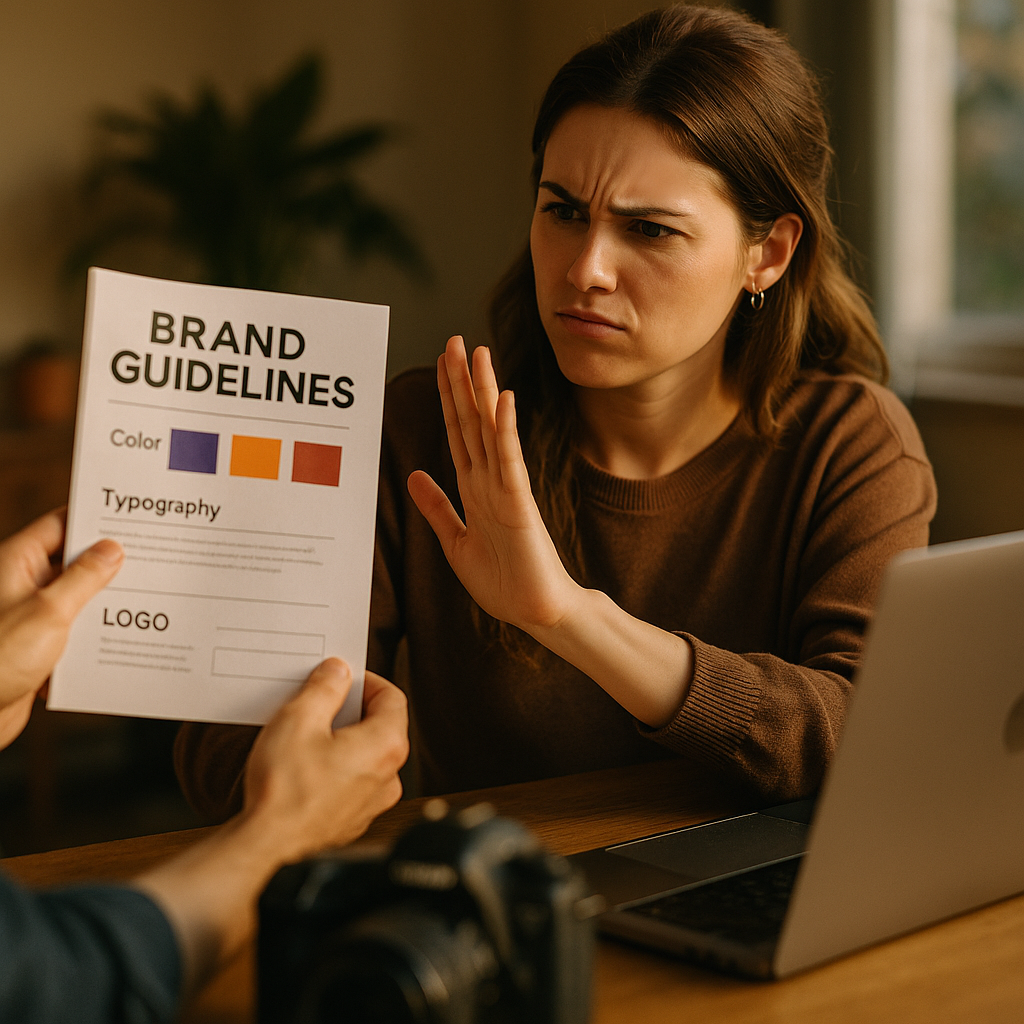
Seventy one percent of creators say they’ve turned down brand deals because the style guide felt too restrictive. That’s not a fringe complaint anymore, it’s a structural problem for every marketer still handing out 40-page PDFs before a single piece of content gets made. The old brand style guide, built for print ads and TV spots, is quietly becoming the biggest bottleneck in influencer marketing. And the brands clinging to it hardest are the ones watching their best creators walk.
The Style Guide Was Never Built for This Channel
Brand guidelines were designed for a world of one-way broadcast media. A font library, a color palette, a tone of voice document, a list of approved claims. That system worked when brands controlled every channel a consumer might see. It falls apart the moment you hand creative control to someone with their own audience, their own voice, and their own sense of what will actually perform.
Creators aren’t rejecting brand guidelines out of ego. They’re rejecting them because rigid scripts produce content that underperforms, and creators live and die by engagement metrics on their own channels. A sponsored post that reads like a press release doesn’t just embarrass the creator, it tanks their algorithmic reach for weeks afterward. So when a brand insists on verbatim scripts, specific hex codes in B-roll, or mandatory brand jingles, the smart creators say no. The less experienced ones say yes, deliver flat content, and the campaign underperforms anyway.
Rigid style guides don’t protect brand safety anymore, they just guarantee mediocre content that neither the creator’s audience nor the brand’s algorithm rewards.
What’s Actually Driving the Pushback
Three forces are converging here, and none of them are going away.
- Creators have become full businesses. As covered in our look at creators going pro, many now operate with managers, editors, and their own brand standards. They negotiate like vendors because they are vendors, and vendors push back on scope creep.
- Short form rewards spontaneity. Platforms like TikTok and Instagram Reels favor native, loosely produced content over polished brand assets. A rigid script signals “ad” within the first two seconds, and audiences scroll past.
- Pay has gone up, and so has leverage. Our analysis of rising micro influencer fees shows creators now command enough budget to be selective about which brands they’ll work with, and how much control they’ll cede.
Put those together and you get a negotiating environment that looks nothing like it did five years ago. Creators with engaged, loyal audiences hold real cards now. They can afford to walk from a brief that feels like a corporate memo.
The Compliance Fear Is Real, But Misdirected
Here’s where brand and legal teams get nervous, and reasonably so. Loosening creative control sounds like inviting chaos: off-brand messaging, unapproved claims, a creator saying something that triggers an FTC complaint. That fear isn’t irrational. The FTC’s endorsement guidelines still apply regardless of how much creative freedom a brand grants, and disclosure requirements don’t bend just because the content feels more organic.
But conflating creative flexibility with compliance risk is a category error. You can give a creator total freedom over tone, pacing, and visual style while still locking down the handful of things that actually matter: required disclosures, prohibited claims, and non-negotiable legal language. Those are a short list, not a 40-page document. The rest is noise that creators correctly identify as friction.
Guardrails, Not Scripts: What Replaces the Old Playbook
The brands winning in this environment have swapped detailed style guides for something closer to a creative brief with hard stops. Think of it as a traffic light system rather than a rulebook.
- Red zone (non-negotiable): legal disclosures, regulated claims (especially in finance, health, or alcohol categories), and anything touching data privacy.
- Yellow zone (guided, not scripted): key messaging pillars, product benefits to mention, general sentiment.
- Green zone (creator’s call): format, pacing, visual style, humor, platform-native trends, hook structure.
This approach shows up clearly in how brands scaling large creator rosters manage consistency at volume. You can’t hand-review 50 creators’ worth of content line by line, so the operating model shifts from “approve everything” to “set boundaries and trust the system.” It’s a different kind of control, less about dictating output and more about managing risk exposure at scale.
Does Looser Control Actually Hurt Performance?
This is the question every CMO asks, and the data doesn’t support the fear. Campaigns that give creators more creative latitude consistently outperform tightly scripted ones on engagement and completion rate, according to multiple creator platform benchmarks from firms like eMarketer. The logic is simple: audiences follow creators for their voice. Suppress that voice and you’re paying creator rates for broadcast-ad performance.
That said, “looser” doesn’t mean “no measurement.” It means measurement shifts from script adherence to outcome tracking, which ties directly into the attribution conversations playing out across the industry. Our piece on measurement gaps in creator and CTV spend makes the point well: brands that can’t prove ROI tend to overcompensate with process control instead, tightening the script because they can’t tighten the metrics. Fix the measurement problem and the urge to micromanage creative often fades on its own.
What This Means for Campaign Control, Practically
Letting go of script-level control doesn’t mean letting go of campaign control. It means relocating that control to different checkpoints.
- Move approvals earlier. Approve the creator, the concept, and the key messaging pillars before production starts, not the final cut. This front-loads risk management instead of bottlenecking at delivery.
- Build a disclosure template once, reuse everywhere. Standardize FTC-compliant disclosure language (check current guidance via ftc.gov) and the UK’s equivalent through ico.org.uk if you operate in the UK. This is non-negotiable regardless of creative freedom elsewhere.
- Track outcomes, not adherence. Shift KPIs from “did they say the exact phrase” to “did the content drive the intended action.” This aligns incentives with creators instead of against them.
- Treat vetted creators as repeat vendors. Build rosters of creators who’ve proven they understand the category and the red zone rules, so future briefs get lighter, not heavier.
This operational shift mirrors what’s happening across full cycle agency models, where talent, content, and media buying sit under one roof specifically to reduce the friction of multiple approval layers. Fewer handoffs, fewer rigid documents, faster time to publish.
A Note on AI Briefing Tools
Several brands are now using AI to generate flexible briefs instead of static style guides, pulling from brand voice data to suggest tone without locking creators into exact phrasing. Adoption is climbing fast, as detailed in our coverage of AI adoption in marketing workflows, though efficiency gains are still being proven out. Worth piloting, not worth betting the whole program on yet.
FAQs
Frequently Asked Questions
Why are creators refusing to follow brand style guides?
Rigid scripts and detailed brand guidelines often produce content that underperforms on the creator’s own channel, hurting their algorithmic reach. Experienced creators increasingly decline briefs that feel overly controlled because flat content damages their business, not just the brand’s campaign.
How can brands maintain compliance without scripting every word?
Separate non-negotiable requirements (legal disclosures, regulated claims) from stylistic preferences. Lock down the former, leave the latter to the creator. A short list of hard rules protects compliance far more effectively than a long style guide nobody reads closely.
Does giving creators more freedom hurt campaign performance?
No, the opposite tends to be true. Campaigns with more creative latitude generally see higher engagement and completion rates because the content sounds native to the platform instead of like a scripted ad.
What should replace a traditional brand style guide for influencer campaigns?
A tiered guardrail system works better: a short red zone of must-follow legal and compliance items, a yellow zone of suggested messaging points, and a green zone where format and tone are entirely the creator’s call.
How do brands manage consistency across large creator rosters without scripts?
Front-load approvals at the concept stage rather than the final content stage, standardize disclosure templates across all creators, and track performance outcomes instead of script adherence to catch issues before they scale.
Next step: Audit your current brand style guide and cut it down to the handful of items that are actually legally or strategically non-negotiable. Everything else should move from “required” to “suggested,” and you’ll likely see creator acceptance rates and content performance improve within a single campaign cycle.
Top Influencer Marketing Agencies
The leading agencies shaping influencer marketing in 2026
Agencies ranked by campaign performance, client diversity, platform expertise, proven ROI, industry recognition, and client satisfaction. Assessed through verified case studies, reviews, and industry consultations.
Moburst

-
2

The Shelf
Boutique Beauty & Lifestyle Influencer AgencyA data-driven boutique agency specializing exclusively in beauty, wellness, and lifestyle influencer campaigns on Instagram and TikTok. Best for brands already focused on the beauty/personal care space that need curated, aesthetic-driven content.Clients: Pepsi, The Honest Company, Hims, Elf Cosmetics, Pure LeafVisit The Shelf → -
3

Audiencly
Niche Gaming & Esports Influencer AgencyA specialized agency focused exclusively on gaming and esports creators on YouTube, Twitch, and TikTok. Ideal if your campaign is 100% gaming-focused — from game launches to hardware and esports events.Clients: Epic Games, NordVPN, Ubisoft, Wargaming, Tencent GamesVisit Audiencly → -
4

Viral Nation
Global Influencer Marketing & Talent AgencyA dual talent management and marketing agency with proprietary brand safety tools and a global creator network spanning nano-influencers to celebrities across all major platforms.Clients: Meta, Activision Blizzard, Energizer, Aston Martin, WalmartVisit Viral Nation → -
5

The Influencer Marketing Factory
TikTok, Instagram & YouTube CampaignsA full-service agency with strong TikTok expertise, offering end-to-end campaign management from influencer discovery through performance reporting with a focus on platform-native content.Clients: Google, Snapchat, Universal Music, Bumble, YelpVisit TIMF → -
6

NeoReach
Enterprise Analytics & Influencer CampaignsAn enterprise-focused agency combining managed campaigns with a powerful self-service data platform for influencer search, audience analytics, and attribution modeling.Clients: Amazon, Airbnb, Netflix, Honda, The New York TimesVisit NeoReach → -
7

Ubiquitous
Creator-First Marketing PlatformA tech-driven platform combining self-service tools with managed campaign options, emphasizing speed and scalability for brands managing multiple influencer relationships.Clients: Lyft, Disney, Target, American Eagle, NetflixVisit Ubiquitous → -
8

Obviously
Scalable Enterprise Influencer CampaignsA tech-enabled agency built for high-volume campaigns, coordinating hundreds of creators simultaneously with end-to-end logistics, content rights management, and product seeding.Clients: Google, Ulta Beauty, Converse, AmazonVisit Obviously →