


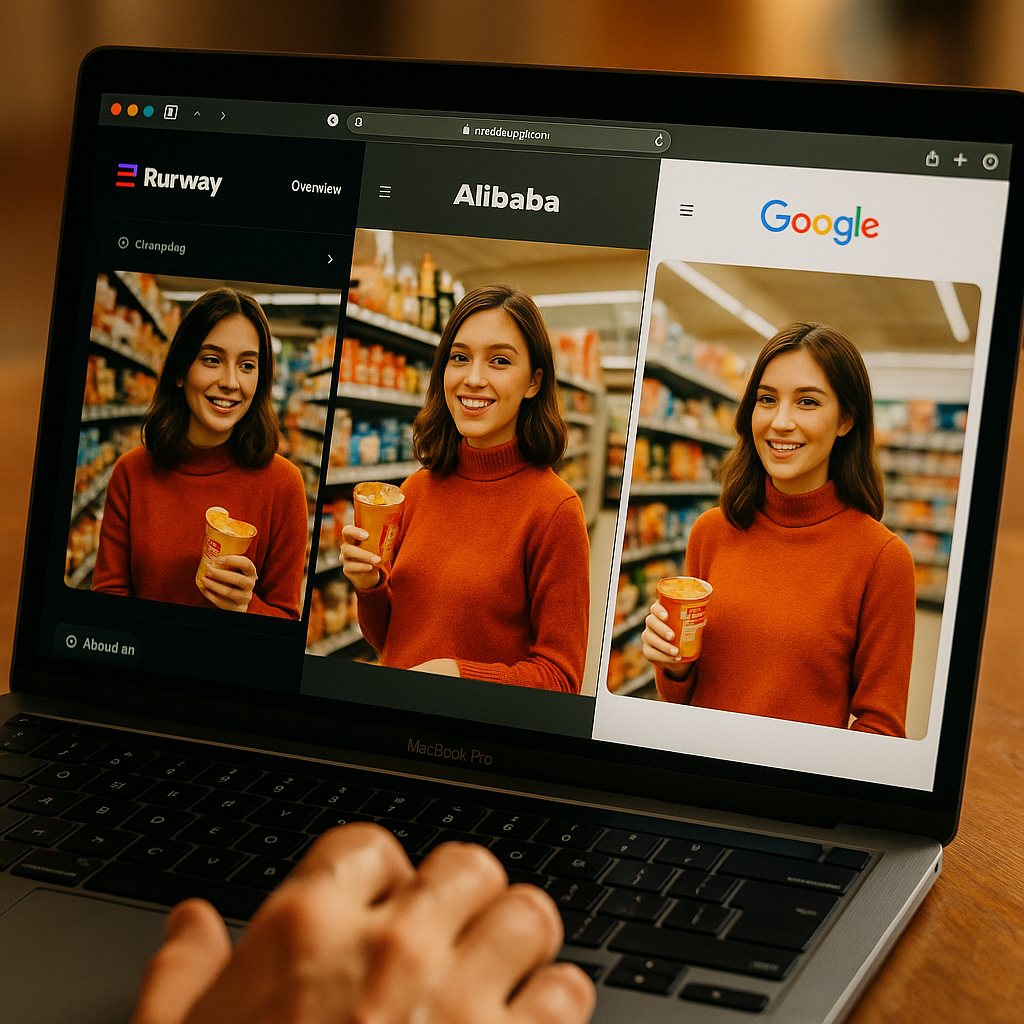
Marketers spent last year testing AI video generators in isolated pilots. Now they’re being asked to scale them into full campaign systems, with real budget attached. So the question shifts: which AI ad activations platform actually survives contact with a quarterly media plan — Runway, Alibaba’s AI suite, or Google’s generative tools? Roughly 73% of large advertisers are running at least one generative video test right now, according to eMarketer. Few have picked a winner.
This isn’t a feature comparison. It’s a risk-and-ROI audit for anyone deciding where to route creative budget next quarter.
Why This Comparison Matters Now
Three platforms have pulled ahead of the generative-ad pack for distinct reasons. Runway built its reputation on cinematic control — fine-grained motion brushes, camera direction, and a creative community that treats it like a filmmaking tool rather than a marketing widget. Alibaba’s suite, anchored by its Tongyi models, is optimized for commerce: product shots, localized variants, and catalog-scale output tied directly to marketplace listings. Google’s generative tools, folded into Performance Max and its broader ads ecosystem, skip the standalone-tool experience entirely and embed generation directly into the buying workflow.
Three different philosophies. Three different cost structures. And three very different answers to the question every CMO eventually asks: what happens when this breaks, and who’s liable?
The real differentiator in 2026 isn’t output quality — all three platforms clear that bar. It’s whether the tool fits your existing martech stack without forcing a rebuild.
Runway: Built for Craft, Priced for Agencies
Runway remains the darling of production teams that want granular control. Its Gen-series models support keyframe-level direction, which matters if your brand still cares about visual consistency across a campaign arc. That’s a real advantage for luxury, auto, and entertainment verticals where a slightly-off frame gets noticed.
The tradeoff is workflow friction. Runway isn’t natively wired into ad-buying platforms. Output has to be exported, formatted, and pushed into whatever DSP or social ad manager you’re running. For agencies already juggling multiple point solutions, that’s another tool to reconcile — and another vendor contract to scrutinize. If you’re evaluating cost efficiency here, it’s worth benchmarking Runway against other generators using a framework like the one in this cost-per-usable-ad breakdown, because sticker price rarely reflects true output cost once revision cycles are counted.
Runway also carries the highest per-seat cost of the three, but the highest usable-output rate in creative-heavy categories. That’s the actual tradeoff: pay more, get fewer wasted renders.
Where Runway Falls Short for Brand Teams
- No native ad-platform integration — everything routes through manual export
- Limited catalog-scale automation compared to Alibaba’s commerce-first tooling
- Steeper learning curve for teams without in-house motion designers
If your team is producing twelve hero videos a quarter, Runway’s craft edge pays for itself. If you’re producing twelve hundred SKU variants, it doesn’t.
Alibaba’s AI Suite: Commerce-Native, Compliance-Complicated
Alibaba’s generative stack was never built to win creative awards. It was built to move product. The suite generates localized ad variants at a scale most Western tools can’t match — swapping backgrounds, models, and languages across dozens of markets from a single product image. For brands running cross-border e-commerce, particularly into Southeast Asia and parts of Europe, that’s a genuinely different value proposition than Runway or Google offer.
The catch is governance. Alibaba’s tools generate synthetic models and localized talent representations automatically, which raises the same disclosure questions that have dogged synthetic influencer content for two years now. Brands running these outputs into markets with strict ad-disclosure rules need a compliance review before launch, not after. The FTC’s endorsement guidance and the UK’s ICO data rules both apply differently depending on where synthetic talent appears, and Alibaba’s suite doesn’t flag jurisdiction automatically. That’s on your legal team.
There’s also a data residency question that doesn’t get enough airtime. Alibaba’s infrastructure runs largely through Chinese cloud regions, which matters if your data governance policy restricts where creative assets and customer signals get processed. Brands with EU or California privacy obligations should treat this as a contract-review item, not an afterthought — similar to the vetting process outlined in this martech contract checklist.
Google’s Generative Tools: The Default, Not the Best
Google’s approach is the most pragmatic and, frankly, the least exciting. Its generative ad tools live inside Performance Max and Demand Gen, generating headline variants, image sets, and short video cuts directly from existing assets. No separate login. No export step. The output feeds straight into the auction.
That integration is the entire pitch. Google isn’t trying to out-craft Runway or out-scale Alibaba. It’s betting that most advertisers will trade creative ceiling for operational simplicity — and for mid-market brands running lean marketing teams, that bet is probably correct.
The limitation shows up in output diversity. Google’s models lean heavily on existing brand assets rather than generating genuinely novel creative directions, which means campaigns can start to look homogenized across advertisers in the same category. If you’ve noticed a certain sameness to Performance Max creative lately, that’s not your imagination — it’s the model optimizing toward whatever pattern performs, across every advertiser using it.
Google’s generative tools optimize for auction performance, not brand distinctiveness. That’s a fine tradeoff for direct response. It’s a risky one for brand-building campaigns.
The Real Comparison: Cost, Control, and Compliance Risk
Strip away the marketing copy and three variables actually decide which platform fits your stack:
- Cost per usable asset — Runway’s per-render cost is high but revision rates are low; Alibaba’s per-unit cost is near-zero at scale but requires heavier compliance review; Google’s cost is effectively bundled into media spend, which makes it hard to isolate creative ROI at all.
- Integration depth — Google wins by default. Alibaba integrates tightly with its own commerce ecosystem but poorly with non-Alibaba stacks. Runway integrates with almost nothing natively.
- Compliance exposure — Alibaba carries the most synthetic-talent and data-residency risk. Google carries the least, mostly because it doesn’t generate human-like talent by default. Runway sits in the middle, dependent on how your team uses it.
None of these platforms is objectively “best.” They’re optimized for different failure modes. Choosing wrong means either overpaying for craft you don’t need or under-investing in compliance review you absolutely do.
A Quick Gut Check Before You Commit Budget
Ask three questions before signing a contract with any generative ad vendor: Does this tool’s output route into your existing attribution stack without manual reconciliation? Does your legal team have sign-off on synthetic talent disclosure in every market you’re running? And can you actually measure cost-per-usable-asset, or are you just trusting the vendor’s demo reel?
Teams skipping that third question tend to discover, three months in, that “AI-generated at scale” quietly became “AI-generated, then manually fixed by an agency at scale.” The savings evaporate. If you’re building out a broader evaluation framework, the due-diligence approach in this attribution vendor checklist translates surprisingly well to creative-generation vendors too — the same questions about data lineage and output verification apply.
What This Means for Budget Allocation
The smartest allocation isn’t picking one platform. It’s segmenting by use case. Hero brand campaigns go to Runway, where craft control justifies the cost. High-volume catalog and localization work goes to Alibaba, with a compliance gate built into the workflow. Programmatic, always-on performance creative goes to Google, where the integration savings outweigh the creative ceiling.
That segmentation only works if your measurement stack can actually attribute performance back to the right platform. Plenty of brands running all three simultaneously still can’t answer which one drove the incremental sale, which is less an AI problem and more an attribution infrastructure problem. Fix that before adding a fourth tool to the mix.
Worth noting too: none of these platforms solve the underlying creative fatigue problem. Generating more variants faster doesn’t help if your audience has already seen the pattern a hundred times across competitor ads running the same model. Novelty decays fast in a market where everyone has access to the same generative infrastructure.
Takeaway
Don’t ask which AI ad platform is best. Ask which failure mode you can least afford — wasted spend on unusable renders, compliance exposure from unreviewed synthetic content, or homogenized creative that blends into the feed. Pick the platform that avoids your worst-case scenario, then build the compliance and attribution guardrails around it before scaling spend.
FAQs
Which AI ad platform has the lowest total cost per usable asset?
It depends on volume and revision rate. Runway has higher per-render costs but fewer wasted outputs for brand-quality work. Alibaba’s suite is cheapest at catalog scale but often requires added compliance review that adds hidden cost. Google’s cost is bundled into media spend, making isolated creative ROI hard to calculate without dedicated tracking.
Do these AI ad tools require FTC disclosure for synthetic talent?
Any ad using AI-generated human likenesses that could mislead a viewer into thinking it’s a real endorsement typically falls under existing endorsement guidance from the FTC. Alibaba’s suite generates synthetic models by default, which raises this issue more often than Runway or Google’s tools.
Can Runway, Alibaba, and Google’s tools integrate with existing martech stacks?
Google’s tools integrate natively since they live inside its ad platforms. Alibaba integrates tightly within its own commerce ecosystem but poorly outside it. Runway has the least native integration and generally requires manual export into whatever DSP or ad manager a brand already uses.
Is Alibaba’s AI suite usable outside of cross-border e-commerce?
Technically yes, but its core strength — rapid localized product variant generation — is built for commerce use cases. Brands outside e-commerce typically find Runway or Google’s tools better suited to their creative needs.
What’s the biggest risk in scaling generative AI ad creative quickly?
Creative homogenization and compliance blind spots. When multiple advertisers use the same underlying models, output patterns converge. Combined with unreviewed synthetic talent disclosures, that creates both a performance risk and a regulatory one.
Top Influencer Marketing Agencies
The leading agencies shaping influencer marketing in 2026
Agencies ranked by campaign performance, client diversity, platform expertise, proven ROI, industry recognition, and client satisfaction. Assessed through verified case studies, reviews, and industry consultations.
Moburst

-
2

The Shelf
Boutique Beauty & Lifestyle Influencer AgencyA data-driven boutique agency specializing exclusively in beauty, wellness, and lifestyle influencer campaigns on Instagram and TikTok. Best for brands already focused on the beauty/personal care space that need curated, aesthetic-driven content.Clients: Pepsi, The Honest Company, Hims, Elf Cosmetics, Pure LeafVisit The Shelf → -
3

Audiencly
Niche Gaming & Esports Influencer AgencyA specialized agency focused exclusively on gaming and esports creators on YouTube, Twitch, and TikTok. Ideal if your campaign is 100% gaming-focused — from game launches to hardware and esports events.Clients: Epic Games, NordVPN, Ubisoft, Wargaming, Tencent GamesVisit Audiencly → -
4

Viral Nation
Global Influencer Marketing & Talent AgencyA dual talent management and marketing agency with proprietary brand safety tools and a global creator network spanning nano-influencers to celebrities across all major platforms.Clients: Meta, Activision Blizzard, Energizer, Aston Martin, WalmartVisit Viral Nation → -
5

The Influencer Marketing Factory
TikTok, Instagram & YouTube CampaignsA full-service agency with strong TikTok expertise, offering end-to-end campaign management from influencer discovery through performance reporting with a focus on platform-native content.Clients: Google, Snapchat, Universal Music, Bumble, YelpVisit TIMF → -
6

NeoReach
Enterprise Analytics & Influencer CampaignsAn enterprise-focused agency combining managed campaigns with a powerful self-service data platform for influencer search, audience analytics, and attribution modeling.Clients: Amazon, Airbnb, Netflix, Honda, The New York TimesVisit NeoReach → -
7

Ubiquitous
Creator-First Marketing PlatformA tech-driven platform combining self-service tools with managed campaign options, emphasizing speed and scalability for brands managing multiple influencer relationships.Clients: Lyft, Disney, Target, American Eagle, NetflixVisit Ubiquitous → -
8

Obviously
Scalable Enterprise Influencer CampaignsA tech-enabled agency built for high-volume campaigns, coordinating hundreds of creators simultaneously with end-to-end logistics, content rights management, and product seeding.Clients: Google, Ulta Beauty, Converse, AmazonVisit Obviously →