


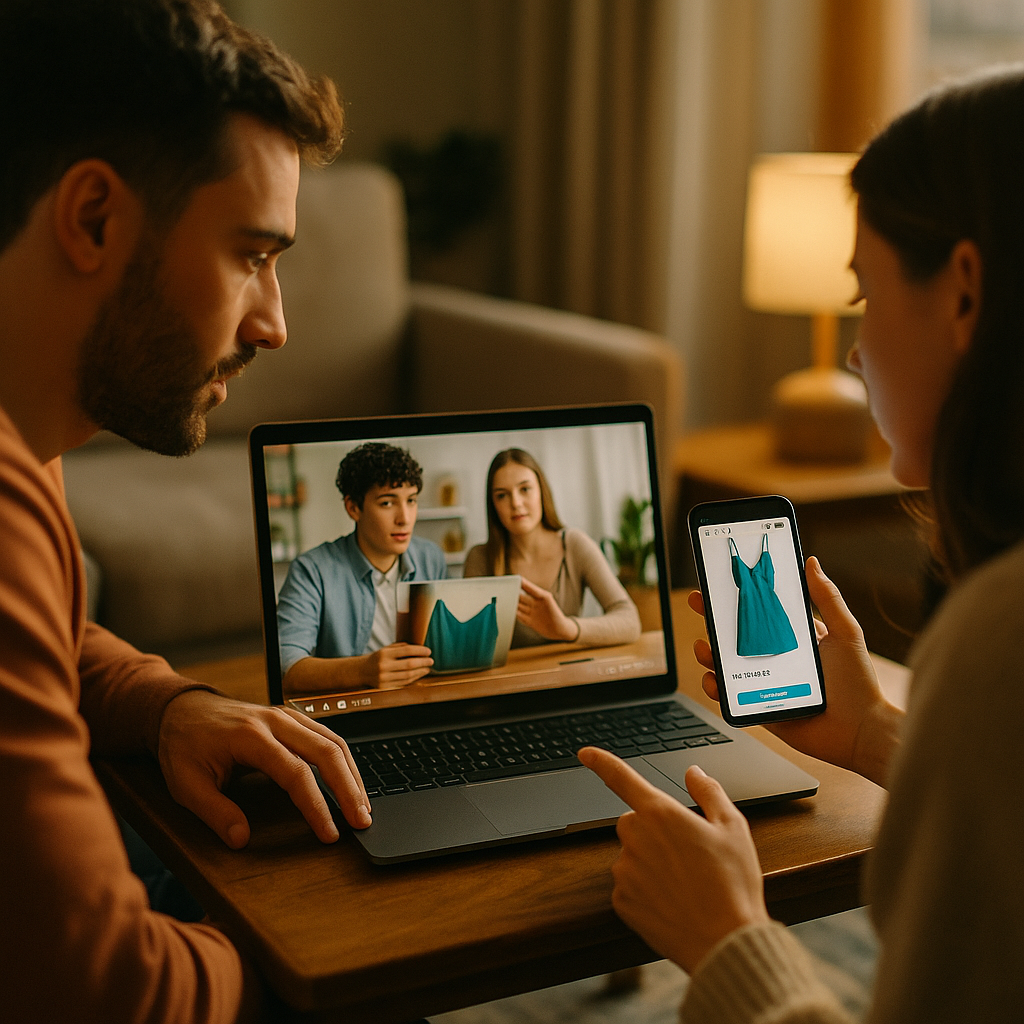
Two creators. One shared cart. Zero script. That’s the shared-screen shopping format, and it’s quietly outperforming solo haul videos across TikTok Shop and Instagram in early tests. Why? Because watching one influencer decide is content. Watching two people negotiate a decision is theater — and theater keeps people watching.
Brands chasing conversion right now are stuck between two bad options: overly polished product demos nobody trusts, and chaotic UGC that’s hard to brief for compliance. The shared-screen shopping format splits the difference. It’s structured enough to hit legal and brand-safety marks, loose enough to feel real.
What the Format Actually Looks Like
Picture a split-screen or shared-cart livestream: two creators, each on their own device, browsing the same product page or scrolling the same shop tab in sync. They talk each other into (or out of) items in real time. One’s a skeptic, one’s a fan. One’s budget-conscious, one’s ready to buy anything in a nice bottle. The tension between them is the hook.
This isn’t new mechanically — split-screen reaction content has existed for years. What’s new is applying it specifically to the purchase decision itself, not the unboxing or the review. The camera isn’t capturing a verdict. It’s capturing the deliberation.
The format works because it externalizes the internal monologue every shopper already has: “Do I actually need this?” Two creators arguing that question out loud is more persuasive than one creator declaring an answer.
Platforms have made this technically easy. TikTok Shop supports co-hosted LIVE sessions with shared product pins. Instagram’s Live Rooms allow up to four participants, with product tags visible to all viewers simultaneously. Neither platform requires custom development — just two phones, two logins, and a shared shopping list.
Why Duo Browsing Converts Better Than Solo Hauls
Solo haul content has a trust ceiling. The viewer knows the creator is performing enthusiasm for the camera, even when it’s genuine. Add a second person — especially one who pushes back, questions the price, or picks a competing product — and the performance cracks open into something closer to real conversation.
eMarketer data on social commerce trends consistently shows that perceived authenticity is now a stronger purchase driver than production quality among Gen Z and younger millennial shoppers. Two creators disagreeing about whether a $68 serum is worth it does more for conversion than either creator alone declaring it “life-changing.”
There’s also a practical commerce mechanic at play: shared decision-making mirrors how people actually shop with friends. Think about the last time you stood in a Sephora with someone, holding up two shades and asking “which one though?” That’s the exact dynamic the format recreates on screen, just with a checkout button instead of a register.
- Social proof, doubled: two independent opinions carry more weight than one, even when both creators are paid.
- Built-in objection handling: the skeptical creator raises the exact hesitations your target buyer has, and the brief lets the other creator answer them naturally.
- Lower script fatigue: viewers can tell when one person is reciting bullet points. Two people riffing off each other hides the seams.
Briefing It Without Killing the Chemistry
Here’s the trap brands fall into: they write a full script for both creators, and the format dies instantly. The entire value proposition of shared-screen shopping is unscripted tension. Kill that, and you’ve just made an expensive two-person infomercial.
Instead, brief the outcome, not the dialogue. Give each creator a distinct point of view before filming. One is briefed to be genuinely undecided about budget. The other is briefed to already be sold and to make the case. Neither gets lines — they get a role and a product list.
This is similar in spirit to the tension-based structure used in the skeptic-to-convert arc, except here the skepticism and conversion happen between two people instead of inside one creator’s arc. It’s the same trust mechanism, just externalized.
A workable brief structure looks like this:
- Set the shared goal: “You’re both trying to build a spring skincare routine under $150 combined.”
- Assign contrasting starting positions: one budget-focused, one ingredient-obsessed.
- List required product mentions (for legal and tracking purposes) without dictating phrasing.
- Set a time or item cap so the session doesn’t sprawl into an unfocused hour.
- Leave the ending open — did they agree? Did one buy and one bail? Real outcomes outperform forced consensus.
The Compliance Question Nobody Wants to Answer First
Two paid creators, one live purchase decision, real-time product tags — this is exactly the kind of format the FTC has flagged repeatedly in its endorsement guidance. Both creators need individual, unambiguous disclosure, even if only one of them is the “lead” on the brand relationship. A single #ad in one creator’s bio does not cover the other participant.
The safest approach: verbal disclosure from both creators near the top of the session, plus on-screen text tags that persist through the shared-screen segments, plus platform-native paid partnership labels where available. Redundancy isn’t overkill here — it’s the standard set by the FTC’s endorsement guidelines, and it protects both the brand and the creators if a viewer only catches part of the stream.
Brands already navigating similar dual-disclosure complexity should look at how the silent comparison format handles labeling without dialogue, and how the confession-booth format approaches compliance when the emotional register is loose and unscripted. Both offer transferable lessons for keeping legal teams comfortable with looser creative control.
If your legal team can’t tell, from a thirty-second clip alone, that this is paid content, the format isn’t ready to publish — regardless of how good the chemistry looked in editing.
Measuring What Actually Moved the Sale
Attribution gets trickier with two creators sharing screen time, because click-through data often can’t tell you which creator’s commentary triggered the add-to-cart moment. Brands need to plan tracking before filming, not after.
Practical fixes: assign each creator a unique promo code or shoppable link, even though they’re appearing in the same session. TikTok Shop’s affiliate dashboard and Instagram’s creator shopping insights both support multi-creator attribution if you set it up in advance. Retrofitting tracking after a live session airs is nearly impossible.
Sprout Social’s research on social commerce engagement notes that co-branded or multi-creator content tends to generate longer average watch times than solo posts, which matters because platform algorithms increasingly reward watch-through rate over raw view count. Longer, tenser, more collaborative content simply performs better in the feed, independent of whether it converts.
Still, watch time isn’t revenue. Pair every shared-screen session with:
- Unique discount codes per creator to isolate contribution
- UTM-tagged shop links inside each creator’s bio during the live window
- Post-session surveys or comment-sentiment analysis to catch qualitative signals codes miss
For brands running multiple briefs off a single production day, this format also pairs efficiently with a broader content plan — see how the multi-format creator brief approach stretches one shoot across several deliverables, which cuts cost-per-asset without adding creator fatigue.
Where It Breaks Down
Not every category fits. High-consideration purchases (financial products, certain health categories) don’t lend themselves to spontaneous, casual back-and-forth — the format can accidentally trivialize a decision that needs more care. And if your two creators have zero rapport, the tension reads as awkward, not authentic. Casting matters more here than in almost any other format on this list, because chemistry can’t be edited in during post-production.
Budget-wise, expect to pay a premium over solo content, generally 40-60% more per session, since you’re compensating two creators for coordinated (if unscripted) work, plus additional production oversight to manage two disclosure streams and two attribution links.
Getting Started Without Overcomplicating It
Run a small pilot before committing serious budget. Pick two creators with existing rapport, give them a $100-150 shopping cap, a category theme, and disclosure requirements — then get out of the way. Measure watch-through rate and per-creator conversion before scaling to a full campaign or recurring series.
Frequently Asked Questions
What is the shared-screen shopping format in influencer marketing?
It’s a content format where two creators browse and decide on a purchase together in real time, either via split-screen video or a co-hosted live shopping session, with the deliberation itself serving as the persuasive hook rather than a scripted product review.
Does each creator need separate FTC disclosure?
Yes. Both creators must disclose their material connection to the brand individually and clearly, regardless of which one holds the primary partnership. Relying on a single disclosure or one creator’s bio tag doesn’t meet FTC endorsement guidance for multi-participant content.
How do you track sales when two creators appear in one session?
Assign each creator a unique promo code or UTM-tagged shoppable link before the session airs. Platforms like TikTok Shop and Instagram support multi-creator attribution, but only if it’s configured ahead of filming, not added retroactively.
Which platforms support this format natively?
TikTok Shop supports co-hosted LIVE sessions with shared product pins, and Instagram Live Rooms allow up to four participants with visible product tags. Both work without custom development.
How much should a shared-screen shopping session cost compared to solo content?
Expect a 40-60% premium over a single-creator deliverable, reflecting dual compensation, coordinated scheduling, and the added production oversight needed for two disclosure and tracking streams.
What products or categories should avoid this format?
High-consideration or sensitive categories, like financial products or certain health and medical items, generally don’t suit the casual, spontaneous tone of shared-screen shopping. The lighthearted deliberation can undercut the seriousness the purchase actually requires.
Visible FAQ Section (HTML)
Frequently Asked Questions
What is the shared-screen shopping format in influencer marketing?
It’s a content format where two creators browse and decide on a purchase together in real time, either via split-screen video or a co-hosted live shopping session, with the deliberation itself serving as the persuasive hook rather than a scripted product review.
Does each creator need separate FTC disclosure?
Yes. Both creators must disclose their material connection to the brand individually and clearly, regardless of which one holds the primary partnership. Relying on a single disclosure or one creator’s bio tag doesn’t meet FTC endorsement guidance for multi-participant content.
How do you track sales when two creators appear in one session?
Assign each creator a unique promo code or UTM-tagged shoppable link before the session airs. Platforms like TikTok Shop and Instagram support multi-creator attribution, but only if it’s configured ahead of filming, not added retroactively.
Which platforms support this format natively?
TikTok Shop supports co-hosted LIVE sessions with shared product pins, and Instagram Live Rooms allow up to four participants with visible product tags. Both work without custom development.
How much should a shared-screen shopping session cost compared to solo content?
Expect a 40-60% premium over a single-creator deliverable, reflecting dual compensation, coordinated scheduling, and the added production oversight needed for two disclosure and tracking streams.
What products or categories should avoid this format?
High-consideration or sensitive categories, like financial products or certain health and medical items, generally don’t suit the casual, spontaneous tone of shared-screen shopping. The lighthearted deliberation can undercut the seriousness the purchase actually requires.
Start small: pair two creators who already have real chemistry, give them a spending cap instead of a script, and build your tracking links before the camera rolls, not after. The format rewards restraint in the brief and rigor in the compliance — get that balance right, and the conversion follows.
Top Influencer Marketing Agencies
The leading agencies shaping influencer marketing in 2026
Agencies ranked by campaign performance, client diversity, platform expertise, proven ROI, industry recognition, and client satisfaction. Assessed through verified case studies, reviews, and industry consultations.
Moburst

-
2

The Shelf
Boutique Beauty & Lifestyle Influencer AgencyA data-driven boutique agency specializing exclusively in beauty, wellness, and lifestyle influencer campaigns on Instagram and TikTok. Best for brands already focused on the beauty/personal care space that need curated, aesthetic-driven content.Clients: Pepsi, The Honest Company, Hims, Elf Cosmetics, Pure LeafVisit The Shelf → -
3

Audiencly
Niche Gaming & Esports Influencer AgencyA specialized agency focused exclusively on gaming and esports creators on YouTube, Twitch, and TikTok. Ideal if your campaign is 100% gaming-focused — from game launches to hardware and esports events.Clients: Epic Games, NordVPN, Ubisoft, Wargaming, Tencent GamesVisit Audiencly → -
4

Viral Nation
Global Influencer Marketing & Talent AgencyA dual talent management and marketing agency with proprietary brand safety tools and a global creator network spanning nano-influencers to celebrities across all major platforms.Clients: Meta, Activision Blizzard, Energizer, Aston Martin, WalmartVisit Viral Nation → -
5

The Influencer Marketing Factory
TikTok, Instagram & YouTube CampaignsA full-service agency with strong TikTok expertise, offering end-to-end campaign management from influencer discovery through performance reporting with a focus on platform-native content.Clients: Google, Snapchat, Universal Music, Bumble, YelpVisit TIMF → -
6

NeoReach
Enterprise Analytics & Influencer CampaignsAn enterprise-focused agency combining managed campaigns with a powerful self-service data platform for influencer search, audience analytics, and attribution modeling.Clients: Amazon, Airbnb, Netflix, Honda, The New York TimesVisit NeoReach → -
7

Ubiquitous
Creator-First Marketing PlatformA tech-driven platform combining self-service tools with managed campaign options, emphasizing speed and scalability for brands managing multiple influencer relationships.Clients: Lyft, Disney, Target, American Eagle, NetflixVisit Ubiquitous → -
8

Obviously
Scalable Enterprise Influencer CampaignsA tech-enabled agency built for high-volume campaigns, coordinating hundreds of creators simultaneously with end-to-end logistics, content rights management, and product seeding.Clients: Google, Ulta Beauty, Converse, AmazonVisit Obviously →