


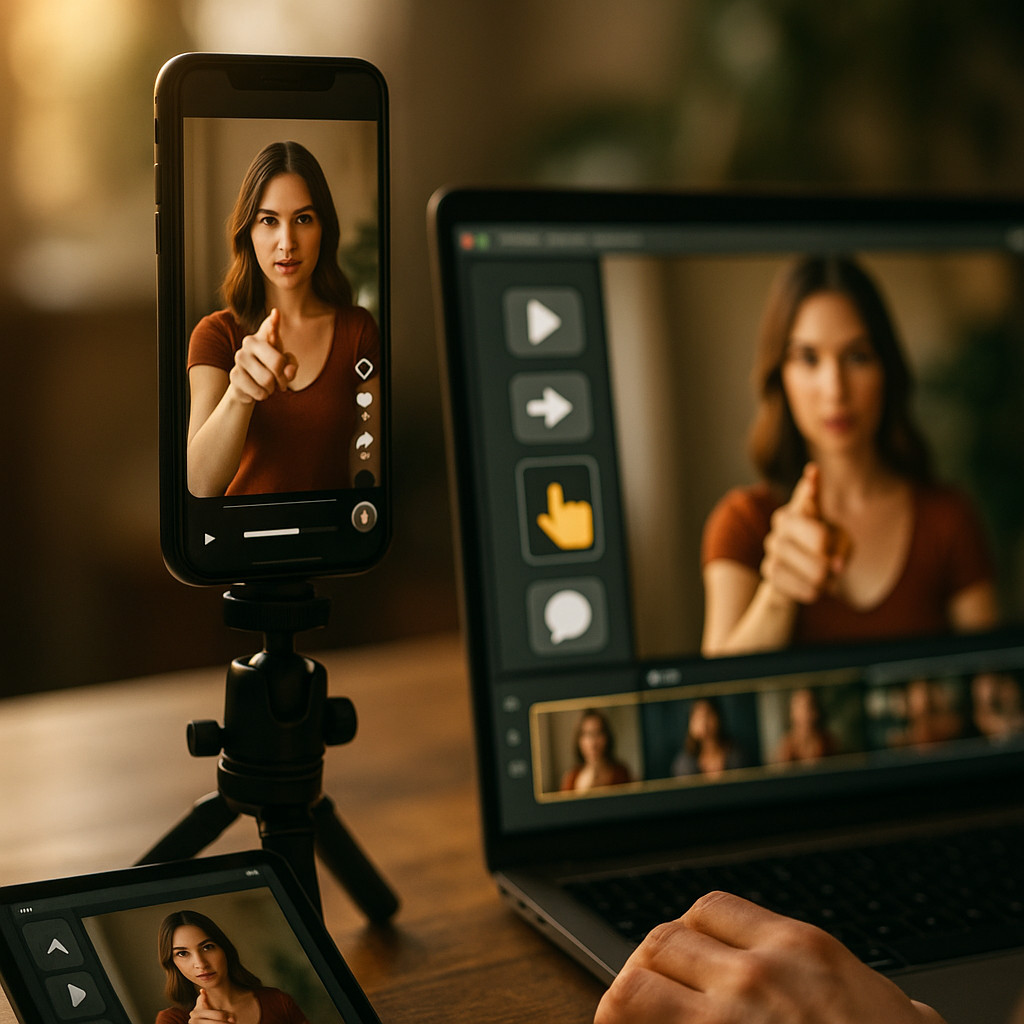
Three Seconds. That’s Your Entire Budget.
Watch time on short-form video is up 20 percent year-over-year, yet average completion rates are falling. More content, more competition, and an AI feed that decides your fate before a human even registers your brand. For creative directors running influencer and branded content programs, short-form video hook design for AI-curated feeds is no longer a production nicety — it is the core strategic discipline.
Why the Algorithm Changed the Brief
TikTok’s For You Page and Instagram’s Recommendation Feed are not human editors making taste decisions. They are reinforcement-learning systems optimizing for a single proxy metric: continued engagement. Every signal — swipe-away rate, replay rate, comment velocity, shares — feeds back into a model that decides whether to push your content to the next cohort of viewers or bury it.
The implication for creative directors is stark. You are not designing for a human viewer in the first instance. You are designing for a classifier. The classifier watches your first three seconds and makes a probabilistic judgment: does this content pattern match the behavior signatures of videos that historically drive watch-through? If yes, it gets distributed. If no, it dies in a pool of 200 impressions.
TikTok’s internal research suggests that 63 percent of top-performing ads deliver their core message or brand signal within the first three seconds. The algorithm rewards content that front-loads meaning — not content that builds to a payoff.
This is not a creative constraint. It is a design specification. Treat it like one.
The Anatomy of a High-Performance Hook
A hook is not just a visual. It is a promise. Specifically, it is a contract between your content and a viewer’s brain: keep watching and you will receive X. The best hooks in AI-curated feeds do three things simultaneously in under three seconds: they create a pattern interrupt, establish a content frame, and signal a payoff.
Pattern interrupt is movement, color contrast, or audio that forces the visual cortex to pause a scroll. This is not about being loud or chaotic — it is about being unexpected within the specific feed context. If your competitor’s branded Reels all open on a product shot with upbeat music, your pattern interrupt is a close-up human face with ambient sound and a half-spoken sentence.
Content frame is the implicit genre signal. Viewers classify content in milliseconds: tutorial, reaction, review, story, entertainment. Your first visual and audio cues must align with your intended frame. Misalignment — a tutorial opening that looks like a lifestyle vlog — destroys watch-through because viewers feel deceived by frame three. For deeper guidance on structuring these signals per platform, the Reels hook and CTA guide breaks down the sequencing logic by content type.
Payoff signal is the explicit or implicit promise. “Wait until you see the before and after.” A question left unanswered. A process started but not finished. The brain’s completion instinct is a powerful retention mechanism, and the hook is where you arm it.
What Creative Directors Get Wrong
Most brand creative directors trained on broadcast logic front-load brand identity. Logo on frame one. Brand color palette dominating the composition. A product reveal that takes four seconds to reach. This is the single most expensive mistake you can make in a short-form context.
The AI feed interprets an early logo card as a low-engagement signal because branded content historically underperforms organic content on completion metrics. You are flagging yourself as an ad before viewers have consented to watch one. The workaround is not to hide your brand — it is to earn attention before you claim it. Brand integration in seconds two through seven outperforms frame-one brand placement by a significant margin in TikTok’s creative best practices data.
The second common error is audio-first thinking designed for headphone environments. More than 60 percent of TikTok content is now consumed with sound on, which sounds like good news. But the first-scroll behavior is still often silent — a viewer moving through content before committing to audio. Your hook must work visually before it works aurally. On-screen text in the first two seconds is not a caption; it is load-bearing creative.
Engineering the Hook: A Production Framework
Think in three layers: visual frame, audio layer, text overlay. Each layer carries independent weight. Each layer must function if the others are removed.
- Visual frame (0:00 to 0:03): Motion in frame one. Not necessarily action — motion. A face turning, a hand entering frame, a product pouring, a cut to a reaction. Static frame ones are scroll targets. Use a 9:16 composition with the primary subject occupying the top two-thirds of frame, leaving the bottom third for overlaid UI elements and your text.
- Audio layer (0:00 to 0:03): Either ambient environmental sound that grounds the viewer in a world, or a spoken half-sentence that creates an open loop. “I was completely wrong about…” is more effective than “Today I’m going to show you…” The former creates tension; the latter creates expectations of a tutorial that may not survive the first swipe.
- Text overlay (0:01 to 0:04): One claim. Seven words maximum. Positioned in the safe zone above the caption bar and below the top UI. This is your secondary hook for silent viewers and your reinforcement signal for the algorithm. The text should restate or escalate the audio hook, not duplicate it.
For brands running multi-platform productions, the single-shoot multi-platform brief framework addresses how to capture hook variations for TikTok, Reels, and Shorts without reshooting core content. The hook layers differ per platform even when the body content is shared.
Testing at Scale: The Hook Variable Protocol
Creative directors who run one version of a hook are leaving performance data on the table. A minimum viable hook testing protocol uses three variants: visual-first (motion-led, minimal text), audio-first (spoken open loop, secondary visual), and text-first (bold claim on screen, visual serving the text). Each variant gets the same body content and CTA. You are isolating hook format as the variable.
Platforms like Sprout Social and native TikTok Analytics give you three-second view rate as a reportable metric — this is your primary hook KPI, not overall completion. If three-second view rate is below 30 percent, the hook failed before the algorithm could assess the rest of your content. The modular brief framework for A/B testing details how to operationalize variant production without inflating shoot budgets.
Three-second view rate is the canary metric. If it’s below 30 percent, no amount of mid-video storytelling will save your distribution. Fix the hook first — always.
For paid amplification specifically, hook testing is non-negotiable. TikTok’s Creative Center flags top-performing ad hooks by industry vertical, and iterating against category benchmarks rather than your own historical average accelerates performance improvement significantly. Pair this with the paid amplification brief guide to align creator deliverables with your hook testing cadence.
The Emotional Physics of a Three-Second Hook
Neuroscience and platform data agree on one thing: emotion travels faster than information. A hook that makes a viewer feel something — curiosity, recognition, mild anxiety, delight — before it tells them anything is structurally superior to one that leads with a claim. Research from HubSpot’s video benchmarks and category-level analysis consistently shows emotionally activated viewers watch longer and share more than informationally activated ones.
For brand creative directors, this means briefing creators on emotional beats, not just message points. The hook brief should specify: the viewer should feel [X] within two seconds. That instruction produces better creative outcomes than “open with a product demo.” For understanding which emotional triggers convert best on TikTok specifically, emotional trigger frameworks for TikTok maps those feelings to purchase intent stages.
The completion rate gains from watch-time growth are not automatic. That 20 percent year-over-year increase in watch time reflects audience willingness to consume more — but only content that clears the algorithm’s initial threshold. The distribution of that attention has become more concentrated, not more democratic. Better hooks capture a disproportionate share of a growing pool of viewing time. Weaker hooks get nothing.
Audit your last five brand Reels or TikToks. Watch only the first three seconds of each with the sound off. Ask: would I keep watching? If the honest answer is no, you have found your production priority for the next quarter.
Frequently Asked Questions
How long should a short-form video hook actually be?
The functional hook window is zero to three seconds. Some practitioners extend this to five seconds for content with strong mid-hook build, but platform data from TikTok and Meta consistently shows that swipe-away decisions cluster in the two-to-three second range. Design for three seconds as your ceiling, not your target.
Does the hook design change between TikTok and Instagram Reels?
Yes, meaningfully. TikTok’s algorithm places higher weight on audio signals and trending sound patterns, making the audio layer of your hook more critical. Reels’ recommendation feed is more visually compositional — face-forward hooks and high-contrast imagery tend to perform better relative to TikTok benchmarks. Text overlay placement also differs due to UI element positioning on each platform.
Should branded content hooks look different from organic creator hooks?
They should look as similar as possible. The algorithm does not reward polished production values — it rewards engagement behavior. Creator-style hooks (casual framing, ambient sound, conversational open loops) consistently outperform broadcast-style branded hooks on completion metrics. The more your brand hook mirrors high-performing organic content in your category, the better its distribution potential.
What role does on-screen text play in hook performance?
On-screen text in the first two to four seconds functions as a secondary hook for viewers scrolling without audio — still a significant segment of the audience in discovery environments. It also provides the algorithm with text-based content signals that reinforce your video’s topical relevance. Keep it to seven words or fewer, position it in the safe zone, and ensure it escalates rather than duplicates your audio hook.
How do you measure whether a hook is working?
The primary metric is three-second view rate, available in TikTok Analytics and Meta Ads Manager. A rate above 30 percent indicates the hook cleared the initial attention threshold. Secondary metrics include video completion rate and replay rate, which indicate whether the hook’s promise was fulfilled by the body content. A high three-second view rate with low completion often signals hook-content mismatch.
How often should brands refresh their hook formats?
Hook fatigue is real and faster-moving than most brand teams anticipate. A hook format that performs well in month one typically shows declining three-second view rates by weeks six to eight as the algorithm has distributed it to the highest-propensity segment of your audience. Build a library of at least three to five hook variants per campaign and rotate based on performance data, not on a fixed calendar schedule.
Top Influencer Marketing Agencies
The leading agencies shaping influencer marketing in 2026
Agencies ranked by campaign performance, client diversity, platform expertise, proven ROI, industry recognition, and client satisfaction. Assessed through verified case studies, reviews, and industry consultations.
Moburst

-
2

The Shelf
Boutique Beauty & Lifestyle Influencer AgencyA data-driven boutique agency specializing exclusively in beauty, wellness, and lifestyle influencer campaigns on Instagram and TikTok. Best for brands already focused on the beauty/personal care space that need curated, aesthetic-driven content.Clients: Pepsi, The Honest Company, Hims, Elf Cosmetics, Pure LeafVisit The Shelf → -
3

Audiencly
Niche Gaming & Esports Influencer AgencyA specialized agency focused exclusively on gaming and esports creators on YouTube, Twitch, and TikTok. Ideal if your campaign is 100% gaming-focused — from game launches to hardware and esports events.Clients: Epic Games, NordVPN, Ubisoft, Wargaming, Tencent GamesVisit Audiencly → -
4

Viral Nation
Global Influencer Marketing & Talent AgencyA dual talent management and marketing agency with proprietary brand safety tools and a global creator network spanning nano-influencers to celebrities across all major platforms.Clients: Meta, Activision Blizzard, Energizer, Aston Martin, WalmartVisit Viral Nation → -
5

The Influencer Marketing Factory
TikTok, Instagram & YouTube CampaignsA full-service agency with strong TikTok expertise, offering end-to-end campaign management from influencer discovery through performance reporting with a focus on platform-native content.Clients: Google, Snapchat, Universal Music, Bumble, YelpVisit TIMF → -
6

NeoReach
Enterprise Analytics & Influencer CampaignsAn enterprise-focused agency combining managed campaigns with a powerful self-service data platform for influencer search, audience analytics, and attribution modeling.Clients: Amazon, Airbnb, Netflix, Honda, The New York TimesVisit NeoReach → -
7

Ubiquitous
Creator-First Marketing PlatformA tech-driven platform combining self-service tools with managed campaign options, emphasizing speed and scalability for brands managing multiple influencer relationships.Clients: Lyft, Disney, Target, American Eagle, NetflixVisit Ubiquitous → -
8

Obviously
Scalable Enterprise Influencer CampaignsA tech-enabled agency built for high-volume campaigns, coordinating hundreds of creators simultaneously with end-to-end logistics, content rights management, and product seeding.Clients: Google, Ulta Beauty, Converse, AmazonVisit Obviously →