


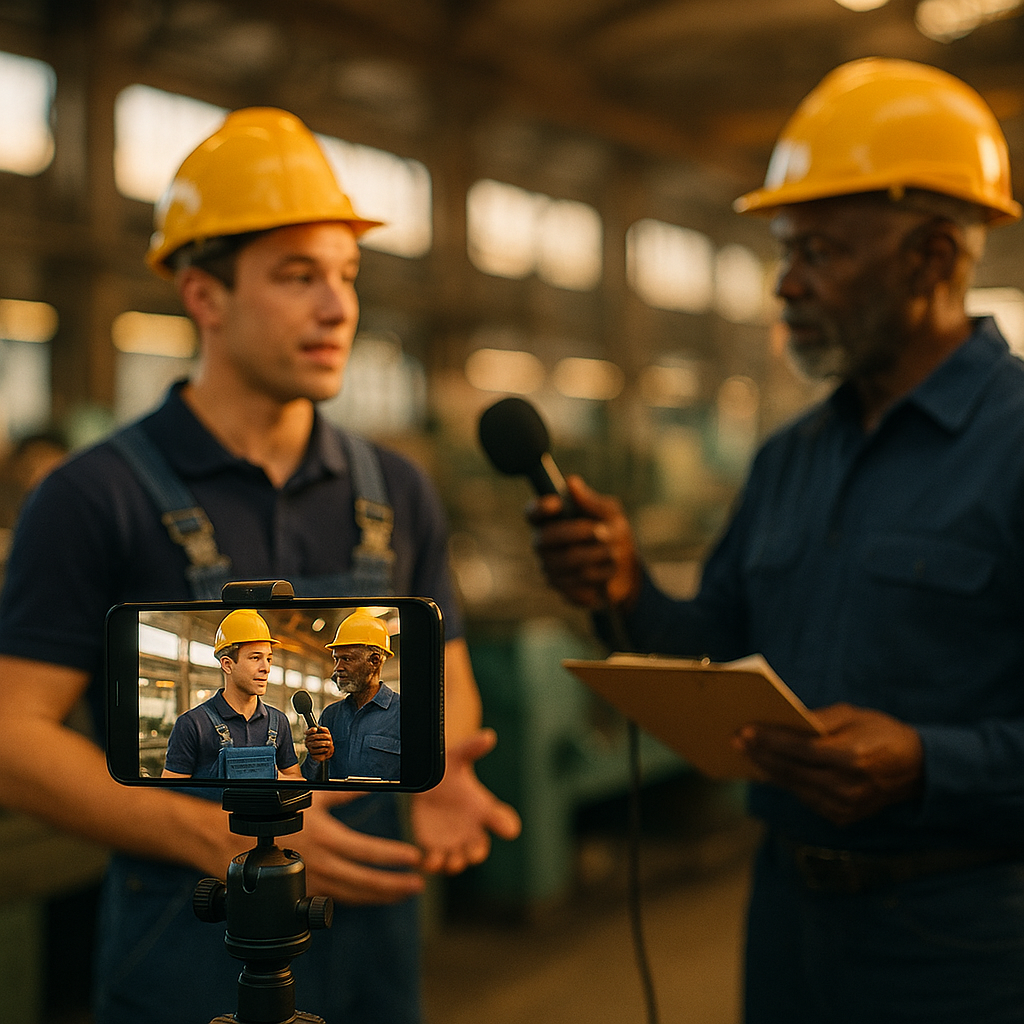
Many industrial employers still rely on job boards and referrals, yet social video recruitment is changing how manufacturers compete for skilled talent in 2026. This case study shows how a traditional manufacturer used authentic short-form video to improve employer brand visibility, increase applications, and attract better-fit candidates without abandoning its practical, operations-first culture. Here’s what made it work.
Employer branding for manufacturers: the challenge behind the hiring gap
A mid-sized traditional manufacturer in the United States faced a familiar problem: open roles stayed open too long, especially in maintenance, CNC machining, quality, engineering, and frontline supervision. The company had strong pay, stable contracts, and modernized equipment, but candidates rarely understood that from the outside.
Its recruiting process was not broken. The issue was visibility and perception. Job seekers often assumed manufacturing work meant outdated facilities, limited growth, and rigid environments. Competing employers in logistics, construction, energy, and even retail were speaking directly to talent on social platforms, while this manufacturer still depended on career pages, recruiters, and local ads.
Leadership initially questioned whether video belonged in industrial hiring. Would social content seem too casual? Would it attract the wrong audience? Those concerns were valid. A weak strategy can create noise without improving hiring quality. But the company’s talent team identified a more important risk: staying invisible.
They also recognized a key truth aligned with Google’s EEAT principles: candidates trust content that demonstrates real experience and expertise. A polished slogan about culture means little. A video showing an actual team lead explaining training paths, shift expectations, and safety standards carries far more authority. For hard-to-fill roles, proof beats promises.
The manufacturer set a practical objective: use social video to show what the work, people, and environment actually looked like, then measure whether that visibility improved recruiting outcomes. This was not a branding exercise alone. It was a hiring strategy tied to business needs.
Video content strategy for recruitment: what the manufacturer changed
The company did not start with expensive campaigns or scripted corporate videos. Instead, it built a focused video content strategy for recruitment around candidate questions. Recruiters and plant leaders listed the issues applicants asked about most:
- What does a typical shift look like?
- How clean and modern is the facility?
- What training is offered?
- Are there advancement opportunities without a four-year degree?
- How strict is attendance?
- What are the supervisors like?
- How seriously does the company take safety?
Those questions became the editorial calendar. The team created short videos for LinkedIn, Instagram, YouTube Shorts, and TikTok, with each piece serving one purpose. Rather than chasing trends, they prioritized clarity and trust.
Content formats included:
- Day-in-the-life clips featuring machinists, technicians, and quality specialists
- Supervisor explainers about schedules, onboarding, and performance expectations
- Facility walkthroughs highlighting equipment, cleanliness, break areas, and safety processes
- Career growth stories from employees promoted from operator to lead or technician to planner
- Myth-versus-reality videos addressing misconceptions about manufacturing careers
- Recruiter Q&As that explained the application and interview process
The company established simple guardrails. Every video had to be accurate, useful, and easy to understand. No exaggerated claims. No vague culture language. If overtime varied by season, they said so. If some roles required physical effort or rotating shifts, they made that clear. That transparency improved candidate trust and reduced drop-off later in the funnel.
They also chose recognizable employee voices over executive messaging. Skilled tradespeople, trainers, and frontline managers carried more credibility because they spoke from direct experience. This strengthened the “experience” and “expertise” signals that job seekers value, and it reduced the distance between the brand and the audience.
Talent acquisition on social media: how the campaign was executed
Strong content alone does not create results. The manufacturer paired its videos with disciplined talent acquisition on social media execution.
First, the company segmented its hiring priorities by geography and role type. It knew that maintenance technicians within commuting distance of one plant were a different audience from graduate engineers evaluating relocation. That meant creative, copy, and targeting could not be generic.
The recruiting and marketing teams built a simple operating model:
- Organic publishing on the company’s channels to build credibility and a consistent employer brand presence
- Paid amplification for roles with urgent demand, using location, interest, and skills-adjacent targeting
- Retargeting for users who watched videos, visited job pages, or started applications
- Landing page alignment so the message in the video matched the role description and next step
- Recruiter follow-up within defined service-level times for qualified applicants
This last step mattered more than many companies realize. Social video can increase applicant volume quickly, but if candidate response times lag, momentum disappears. The manufacturer assigned recruiters to priority roles and required same-day or next-business-day outreach where possible.
The team also optimized creative for platform behavior. On LinkedIn, they used career growth, technology investment, and leadership visibility. On Instagram and TikTok, they focused on human stories, quick facility visuals, and concise answers to common concerns. YouTube Shorts supported discoverability for search-driven audiences researching manufacturing careers or specific trades.
Captions were essential because many users watched with sound off. Hooks were direct: “What does a CNC operator actually do here?” or “Thinking manufacturing means old equipment? Take a look inside.” This simple framing improved watch time because viewers immediately understood the value of the content.
Importantly, the company never treated social as a replacement for referrals, schools, apprenticeships, or staffing partners. It treated video as a force multiplier. That mindset kept the strategy grounded and measurable.
Employee generated content in manufacturing: why authenticity outperformed polish
The biggest surprise in the case study was how well employee generated content in manufacturing performed compared with more polished assets. Videos recorded on a phone by a respected maintenance lead often earned stronger engagement and better completion rates than heavily edited brand pieces.
Why? Because candidates read authenticity quickly. In sectors where safety, reliability, and practical skill matter, overly produced messaging can feel disconnected from reality. Prospects want to know: are these real people, in a real plant, doing real work under realistic conditions?
The manufacturer created a lightweight employee ambassador program. Participation was voluntary. Employees received basic guidance on privacy, safety, and messaging boundaries, but they were encouraged to speak naturally. Topics included:
- How they learned the job
- What surprised them after joining
- What a productive team looks like
- How scheduling works in practice
- What advancement required
- What they would tell a friend considering applying
This content delivered three recruiting advantages.
First, it improved candidate quality. Applicants arrived with a clearer picture of the role, so fewer withdrew after interviews because the environment was not what they expected.
Second, it increased trust. Candidates believed employee voices more than polished claims from the corporate page. That helped in a labor market where skepticism toward employer messaging remains high.
Third, it supported retention. When people join with informed expectations, early turnover tends to decline. In this case, recruiters reported fewer surprises around shift structure, physical demands, and advancement timelines.
There were governance considerations. Manufacturing environments require attention to safety, confidentiality, and customer restrictions. The company addressed that with a simple approval process and filming rules around proprietary equipment, restricted areas, and personal protective equipment. By setting clear boundaries, it preserved authenticity without creating risk.
Manufacturing recruitment metrics: what results proved the strategy worked
No case study is useful without outcomes. The company tracked a set of practical manufacturing recruitment metrics rather than vanity numbers alone. Views and engagement mattered, but hiring performance mattered more.
Over two quarters, the manufacturer observed improvements across the funnel:
- Higher reach among local skilled-trade audiences who had not engaged with the employer before
- Increased traffic to career pages from social platforms
- More completed applications for targeted hard-to-fill roles
- Better interview show rates among candidates sourced from video campaigns
- Lower rate of self-selection out after the first recruiter conversation
- Improved time-to-fill for several priority positions
Not every role improved equally. Commodity roles with high local demand remained competitive. However, positions that benefited most from context and employer differentiation, such as maintenance, machine setup, quality, and skilled operator roles, showed the strongest gains.
The most valuable insight was not just “video drove more applications.” It was that specific content types correlated with better outcomes. Facility walkthroughs improved early-stage trust. Employee advancement stories increased applications from career-switchers. Supervisor explainers reduced confusion about scheduling and expectations. Recruiter Q&As helped conversion when paired with active openings.
The company also learned that comments and direct messages provided useful qualitative data. Candidates repeatedly asked about certifications, shift premiums, training length, and relocation support. Those questions informed future videos and even improvements to job descriptions. In that way, social video became both a marketing channel and a listening tool.
From an EEAT perspective, this matters. Helpful content is not just content that attracts clicks. It answers real questions, reflects subject matter expertise, and is maintained based on user needs. The manufacturer’s best-performing videos did exactly that.
Recruitment marketing best practices: lessons other manufacturers can apply
This case study offers several recruitment marketing best practices for industrial employers that want to attract talent through social video without losing credibility.
Start with candidate truth, not brand language. Identify what applicants genuinely want to know and answer those questions directly. This will outperform generic culture messaging almost every time.
Show the environment clearly. In manufacturing, visuals reduce uncertainty. Cleanliness, equipment quality, team interaction, and safety standards all influence whether someone applies.
Use the right messengers. Frontline employees, trainers, and hiring managers often have more recruiting credibility than executives. Let expertise and lived experience lead.
Align content with the application journey. If a video makes a role attractive but the landing page is outdated or confusing, conversion suffers. Consistency matters.
Be honest about demands. Transparency filters out poor fits and builds trust with serious candidates. Realistic previews are efficient recruiting.
Measure beyond engagement. Track source quality, interview rates, time-to-fill, early retention, and hiring-manager satisfaction. The goal is better hiring outcomes, not social applause.
Build repeatable systems. One viral clip is not a strategy. Document content themes, approvals, posting cadence, recruiter follow-up standards, and reporting.
Treat comments as market research. Questions from viewers reveal objections and gaps in your employer brand narrative. Use them to improve both content and process.
For traditional manufacturers, the larger lesson is simple: social video does not require abandoning a serious brand. It requires making that seriousness visible. Companies that communicate clearly, show their workplace honestly, and respond quickly to candidate interest can compete more effectively for talent in 2026.
FAQs about social video hiring in manufacturing
Why is social video effective for manufacturing recruitment?
It reduces uncertainty. Candidates can see the facility, hear from employees, and understand the role before they apply. That improves trust and often increases both application volume and applicant quality.
Which platforms work best for recruiting manufacturing talent?
LinkedIn is effective for professional and technical roles. Instagram, TikTok, and YouTube Shorts can work well for skilled trades, operators, and early-career audiences. The best mix depends on your geography, roles, and content quality.
Do manufacturers need a large budget to start?
No. Many successful campaigns begin with low-cost, phone-recorded videos and selective paid promotion for priority openings. Clear messaging and consistent execution matter more than high production value.
What type of video content performs best?
Day-in-the-life videos, facility tours, employee testimonials, supervisor explainers, and short Q&As usually perform well because they answer practical questions candidates already have.
How can companies keep social hiring content compliant and safe?
Set filming rules, approval workflows, and safety requirements. Avoid restricted areas, proprietary processes, and any footage that does not reflect proper PPE or workplace standards.
How should success be measured?
Track career-site traffic, completed applications, qualified applicant rate, interview show rate, time-to-fill, cost per hire, and early retention. Engagement metrics are useful, but they should not be the main definition of success.
Can social video help retention as well as hiring?
Yes. When candidates see realistic previews of the job and workplace, they join with better expectations. That can reduce early exits caused by misunderstanding schedules, physical demands, or advancement timelines.
What is the biggest mistake manufacturers make with recruitment video?
Trying to sound polished instead of useful. Candidates respond better to clear, honest, role-specific information delivered by credible employees than to generic employer branding.
This case study shows that social video can help a traditional manufacturer compete for talent by making the workplace visible, credible, and easier to understand. The winning formula was not flashy production. It was honest employee voices, practical content, strong recruiter follow-up, and measurement tied to hiring outcomes. For manufacturers in 2026, visibility and authenticity are now a recruiting advantage.