


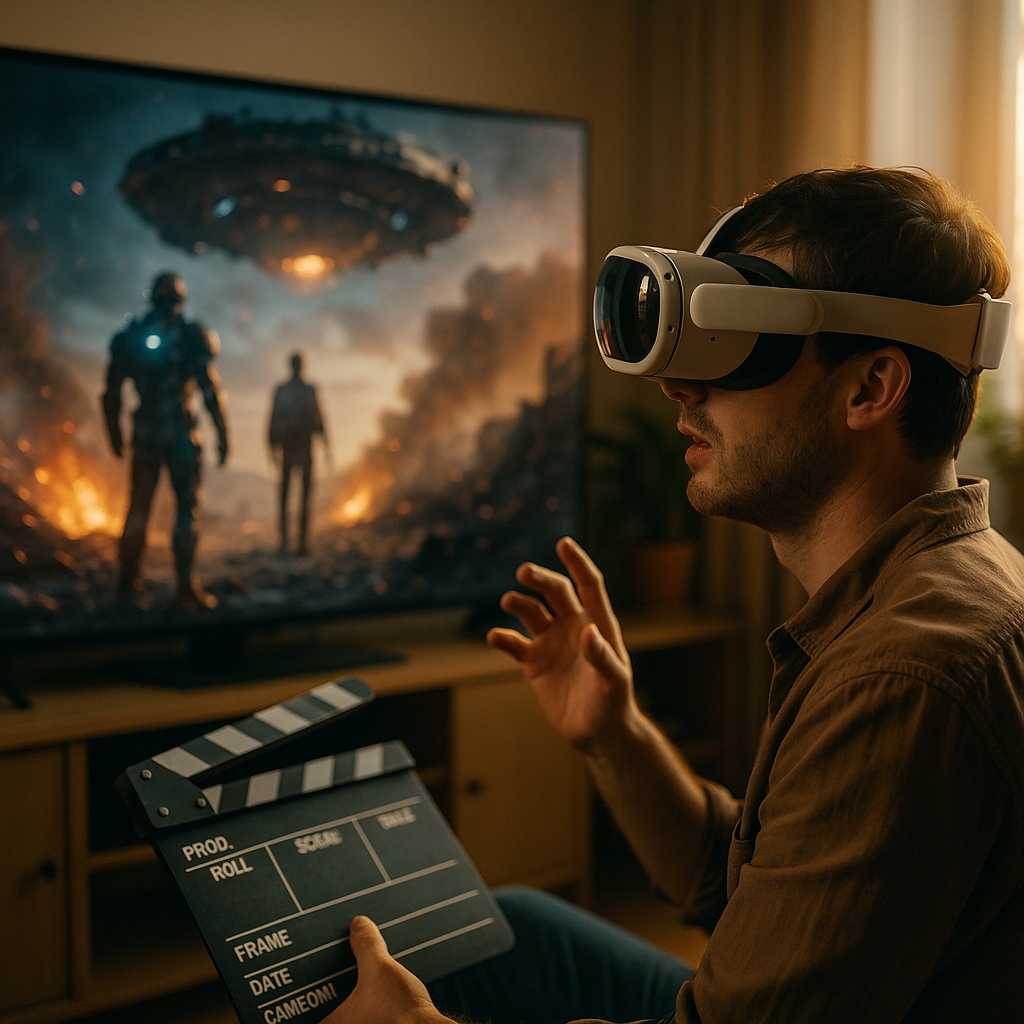
Spatial computing and narrative video are converging fast in 2025, reshaping how stories are written, shot, distributed, and experienced. As headsets and mixed reality platforms mature, audiences expect scenes to respond to gaze, movement, and real-world context. Creators now design story beats across space, not just time, shifting language, pacing, and production workflows—so what does the next chapter of storytelling demand?
Spatial computing in storytelling: from frames to spaces
Traditional narrative video is built around a frame: the director chooses what you see, when you see it, and how long you stay with it. Spatial computing replaces the frame with an environment. Instead of watching a scene, the viewer occupies it. That single change alters almost every narrative assumption—blocking, performance, cinematography, editing, sound, and even the meaning of “scene.”
In spatial experiences, story information can live anywhere: behind the viewer, above a table, embedded in a wall, or attached to a character as a floating interface. This forces creators to answer new questions that audiences will immediately test: What happens if I don’t look where you expect? What if I walk away? What if I interact too early? The strongest spatial narratives plan for those choices without punishing curiosity.
Spatial computing also introduces context-aware storytelling. When a device understands surfaces, distance, lighting conditions, and the viewer’s position, a story can adapt its staging. That unlocks intimate, “performed-for-me” scenes, but it also raises craft expectations. If a scene can happen on a real coffee table or across a living-room wall, production design must hold up under close inspection and from multiple angles. The payoff is presence: a felt sense that events are happening with you, not merely in front of you.
Immersive narrative video: new grammar for attention, pacing, and emotion
Immersion does not automatically create engagement. In fact, a 360-degree stage can dilute drama if the viewer doesn’t know where to focus. Immersive narrative video succeeds when it provides clear, motivated attention cues while preserving agency. In 2025, the emerging grammar relies on a few proven methods:
- Diegetic cues: Characters look, move, or gesture toward critical action; lights flicker; a door opens; footsteps approach from a specific direction.
- Spatial audio staging: Sound becomes the editor, pulling attention with directionality, distance, and occlusion that match the environment.
- Blocking for discovery: Key plot beats occur in the “forward” comfort zone, while optional character moments live in peripheral areas for viewers who explore.
- Micro-editing through movement: Instead of hard cuts, creators use natural transitions—turning corners, following a character, crossing a threshold, or watching an object transform.
Pacing also changes. Viewers need time to orient themselves, scan the environment, and settle into the rules of interaction. That means early scenes often include more “breathing room” than standard film, while later scenes can accelerate once the viewer has learned the world. Emotional performance must scale too: subtle facial acting can be powerful at close range, but only if capture fidelity and lighting are strong enough to avoid uncanny results.
Creators should anticipate a practical follow-up question: Do we have to make everything interactive? No. Many of the most effective spatial narratives are “lean-back” experiences with selective interaction. The key is to align interaction with meaning. If touching an object reveals character backstory, it earns its place. If it’s only there to prove the technology works, audiences will feel the distraction.
Mixed reality filmmaking: production pipelines, performance, and craft standards
Mixed reality filmmaking combines the demands of cinema with the constraints of real-time 3D. In 2025, most teams blend familiar film roles (director, cinematographer, editor, production designer) with game and XR specialists (technical artist, real-time lighting, UX designer, spatial sound designer). The pipeline typically falls into three approaches:
- Volumetric capture + real-time playback: Performers are captured as 3D video, then placed into an environment. This supports natural acting, but it can be heavy on storage, lighting consistency, and playback performance.
- CG characters + performance capture: Greater flexibility and optimization, but it requires stronger animation direction to maintain believability in close proximity.
- Hybrid live-action plates + spatial set extensions: Uses filmed elements where they shine (hands, faces, practical textures) while leveraging 3D for depth, parallax, and interaction.
One of the biggest craft shifts is camera authorship. If the viewer controls their head position, the “camera” becomes a set of constraints rather than a fixed lens. Directors still shape experience through staging, lighting, and sound, but they can’t rely on a cut to force meaning. As a result, previsualization and user testing move earlier. Creators block scenes in 3D, test comfort and clarity, then revise the story beats before expensive capture or final asset builds.
Quality standards are rising quickly. Audiences notice aliasing, texture repetition, and mismatched shadows more in mixed reality because digital elements are judged against the real room. To maintain trust, productions need consistent scale, physically plausible lighting, and stable anchoring. When a virtual character’s feet slide or a prop drifts, the illusion breaks—and so does emotional investment.
Accessibility is also a core craft requirement, not an add-on. Comfortable locomotion options, readable subtitles in space, and alternatives to gesture-heavy interaction expand reach. These choices signal professionalism and care, supporting EEAT by demonstrating responsible, audience-first design.
Interactive storytelling design: agency without chaos
Interactive storytelling design is where many narrative projects struggle: too little agency feels like a tech demo, too much agency dissolves structure. The practical goal is bounded agency—freedom inside a well-authored container.
In spatial narrative video, bounded agency often takes one of these forms:
- Branching with restraint: A few meaningful choices that change relationships, reveal different scenes, or alter endings—without exploding production scope.
- Layered narrative: A core story that plays reliably, with optional interactions that deepen context (letters, objects, side conversations) for explorers.
- Role-based participation: The viewer is cast as a defined role (witness, assistant, suspect). This clarifies why they can interact and what they are allowed to influence.
- Temporal gating: Interactions become available only at certain beats, preserving pacing and reducing the risk of viewers “breaking” the scene.
Designers should proactively answer another likely question: How do we handle viewers who miss key plot points? Use redundancy without repetition. Deliver essential information through multiple channels—dialogue, spatial audio, environmental text, and character behavior—so a missed glance doesn’t become confusion. Also include subtle re-centering tools: a character calls the viewer’s attention, a sound cue pulls focus, or an environmental highlight signals importance in a natural, in-world way.
Trust matters. If the experience trains viewers that interactions lead to payoff, they will explore more. If interactions feel arbitrary or inconsistent, they will stop trying. Consistency is a narrative promise: the world should behave predictably, even when the plot surprises.
Spatial video platforms in 2025: distribution, discovery, and measurement
Spatial video platforms in 2025 are maturing beyond niche app stores into broader ecosystems where premium entertainment, short-form spatial clips, and mixed reality utilities coexist. For creators and studios, the opportunity is real, but so are platform constraints—performance budgets, content guidelines, comfort standards, and varying input methods.
Distribution strategy now starts at concept stage. Teams must decide: Is this experience designed for seated viewing, room-scale exploration, or pass-through mixed reality? Each choice affects audience size and production complexity. Seated experiences generally lower friction and can be easier to finish at high polish. Room-scale can be unforgettable, but it demands more safety design and robust spatial mapping.
Measurement is also evolving. Traditional metrics (views, completion rate) still matter, but spatial experiences add behavioral signals that can improve storytelling if used ethically:
- Attention heatmaps: Where viewers looked during key beats, helping refine cues and staging.
- Interaction rates: Which objects were touched or ignored, indicating clarity and perceived value.
- Comfort drop-offs: Moments that correlate with exits, suggesting motion, brightness, or pacing problems.
EEAT-aligned practice requires transparency and restraint. If you collect analytics, explain what you collect and why, minimize personally identifiable data, and use insights to improve clarity and comfort rather than to manipulate behavior. Responsible measurement strengthens audience trust and supports long-term adoption.
Ethics and authenticity in spatial narratives: privacy, bias, and audience trust
Spatial experiences often rely on sensors that understand the viewer’s surroundings. That creates new ethical duties for narrative creators: protect privacy, avoid intrusive prompts, and maintain clear boundaries between story and surveillance. In 2025, audiences are more aware of data issues, and trust can evaporate quickly if an experience feels overly extractive.
Practical guidelines that align with EEAT and reduce risk:
- Minimize environmental capture: Use only the spatial data required for anchoring and occlusion; avoid storing raw room scans unless essential.
- Explain permissions in plain language: Tell viewers what’s used (e.g., surface detection) and what is not (e.g., recording video of the room).
- Avoid dark patterns: Don’t lock key story beats behind unnecessary data sharing, contacts access, or manipulative engagement loops.
- Respect physical boundaries: Don’t encourage unsafe movement or surprising jump-scares that can cause collisions or panic in a real room.
- Audit representation: Spatial proximity intensifies character portrayal; stereotypes and caricatures land harder when the viewer is “in the room.”
Authenticity is also a craft issue. When characters appear life-sized and close, audiences read micro-behaviors—eye contact, timing, personal space. Directors should choreograph respectful distance, provide comfort options, and avoid using forced intimacy as a shortcut to intensity. The most effective spatial narratives earn closeness through story context, not headset novelty.
FAQs
-
What is spatial computing in narrative video?
It’s the use of devices that understand 3D space—position, surfaces, and movement—to deliver story experiences that occur around the viewer, not only on a flat screen. The narrative can be staged in a room, anchored to real objects, or unfold in an interactive 3D environment.
-
How does spatial computing change storytelling structure?
It shifts structure from purely time-based editing to a blend of time and space. Creators plan where information lives, how viewers discover it, and how the story progresses if attention is split. Many projects use bounded agency: a reliable core arc plus optional layers.
-
Is spatial narrative video the same as VR film?
Not exactly. VR film typically places the viewer inside a fully virtual environment. Spatial narrative video can include VR, but it also includes mixed reality experiences that blend digital story elements with the viewer’s real room, plus spatial video designed for depth and presence.
-
What skills do filmmakers need to succeed in mixed reality?
They still need strong directing, writing, and performance craft, but they also need comfort-first experience design, spatial audio literacy, real-time 3D collaboration, and iterative testing. Teams often add UX, technical art, and real-time lighting expertise.
-
How do creators guide attention without taking away freedom?
They use motivated cues: character movement, lighting changes, directional sound, and environmental triggers. The goal is to make the “right” place to look feel natural, while still rewarding exploration with optional moments and details.
-
What are the biggest risks for audience trust in spatial storytelling?
Privacy overreach, unclear permissions, unstable anchoring that breaks realism, and manipulative interaction design. Transparent data practices, consistent world rules, and safety-aware staging protect trust and improve long-term engagement.
Spatial computing is redefining narrative video in 2025 by turning stories into lived environments where attention, emotion, and meaning move through space. The winning approach blends film craft with experience design: clear cues, bounded agency, high visual and audio fidelity, and responsible data practices. Build for comfort and trust, test early, and let interaction serve character and plot—then spatial storytelling delivers lasting impact.