


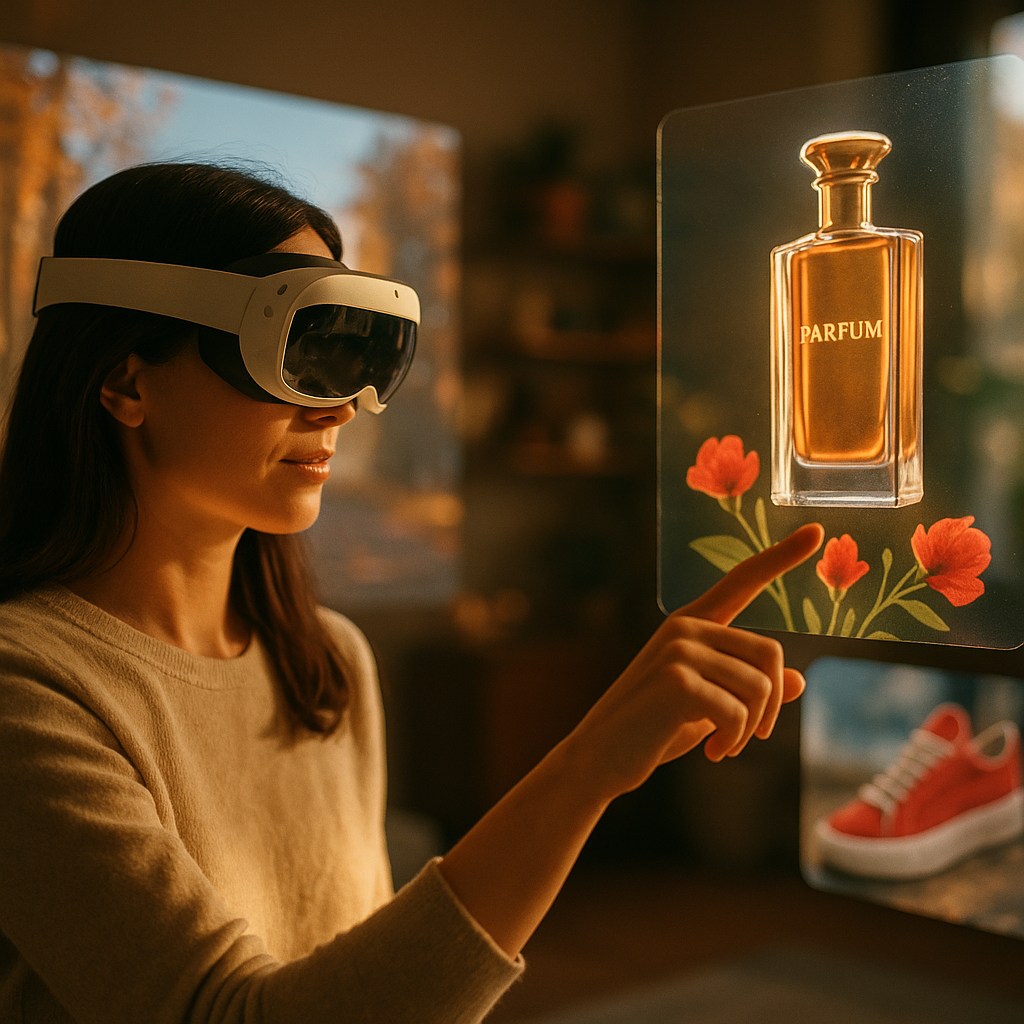
In 2025, brands compete for attention across screens, feeds, and physical spaces. Spatial computing changes that contest by turning stories into interactive environments customers can enter, explore, and influence. It blends digital content with the real world and makes narrative feel personal at scale. This article explains how spatial computing reshapes future brand storytelling formats and what marketers must do next to win.
Immersive storytelling: why spatial computing changes narrative structure
Traditional brand storytelling is usually linear: a beginning, a middle, an end, delivered through video, copy, or a scrollable experience. Spatial computing introduces a different grammar. Stories become navigable spaces where people choose their path, dwell on what matters to them, and uncover meaning through interaction.
That shift impacts how brands design story arcs:
- From sequence to scenario: Instead of forcing one timeline, brands create situations users explore. Discovery replaces exposition.
- From passive viewing to participation: Actions become part of the narrative. A user’s movement, gaze, and choices can reveal chapters or trigger character moments.
- From universal message to contextual meaning: A story adapts to location, time, and intent, so the same campaign can feel different in a store than at home.
For marketers, the follow-up question is practical: “How do we keep control of the message if users choose their own path?” The answer is to treat your brand values as the non-negotiable spine. Anchor the experience with a few consistent narrative beats—product truth, mission, proof points—then allow freedom in how people reach them. Think of it as designing a museum: visitors choose rooms, but the exhibition still delivers a coherent point of view.
Spatial experiences also reward clarity. The more immersive the format, the less tolerance users have for confusing interfaces or vague objectives. Your story must communicate what to do within seconds, without breaking immersion.
Augmented reality marketing: blending physical context with brand meaning
Augmented reality marketing is often described as adding digital layers to the world, but its brand impact goes deeper: it lets companies attach meaning to physical context. A product display can become a tutorial. A billboard can become a portal. A package can become a chapter in an origin story.
The strongest AR storytelling formats in 2025 share three traits:
- They solve a real job: guidance, visualization, fit, assembly, troubleshooting, or inspiration.
- They respect the environment: lighting, occlusion, and scale feel believable, so the overlay supports credibility rather than undermining it.
- They keep the brand promise measurable: AR isn’t “cool tech”; it should improve conversion, reduce returns, raise confidence, or increase time spent with the product.
Common high-performing formats include:
- Try-before-you-buy visualization: Place furniture, cosmetics looks, or equipment in real context to reduce uncertainty.
- Interactive product provenance: Scan packaging to reveal sourcing, sustainability proof, and behind-the-scenes manufacturing in a spatial timeline.
- In-store narrative layers: Let shoppers “unlock” stories aisle by aisle—recipes, usage tips, or founder narratives tied to shelf placement.
A frequent follow-up question is, “Will AR annoy people?” It can—if it interrupts. The best approach is opt-in utility: offer AR as a helpful mode, not a forced gateway. Make it quick to start, easy to exit, and valuable even if used for 30 seconds.
XR brand experiences: new formats from mixed reality to spatial video
XR brand experiences (covering AR, VR, and mixed reality) expand the format menu beyond what flat media can do. In 2025, brands are experimenting with immersive storytelling that ranges from lightweight phone-based overlays to high-fidelity headset experiences designed for deeper engagement.
Key emerging formats include:
- Mixed-reality product theaters: Users see their real room while interacting with life-size 3D product models, exploded views, and guided demos. This is powerful for complex products where understanding drives purchase confidence.
- Spatial video storytelling: Instead of a rectangle on a screen, moments feel present. Brands can use it for founder stories, craftsmanship, field reporting, or customer testimonials that benefit from intimacy and presence.
- Immersive episodic series: Short chapters released over time, where returning users unlock new spaces, artifacts, or choices. This supports retention and community building.
- Training and onboarding narratives: For B2B and services, XR can deliver consistent learning while reinforcing brand standards through scenario-based storytelling.
To choose the right format, match intent to immersion level. If the user’s goal is quick reassurance (“Will this fit?”), AR is often best. If the goal is emotional depth or complex understanding (“Why does this system matter?”), mixed reality or VR can justify the time investment.
Another common question: “Do we need a headset strategy?” Not always. Many winning experiences start as mobile-first AR, then scale to headsets for premium audiences, retail activations, events, or training. Build assets and narratives in a way that can travel across devices without rewriting the story from scratch.
Interactive brand narratives: designing for agency, emotion, and memory
Interactive brand narratives work when they combine user agency with a carefully designed emotional arc. Spatial computing adds new interaction signals—movement, gaze, gestures, voice—so brands can build stories that feel responsive rather than simply clickable.
Design principles that reliably improve outcomes:
- Define the user role: Are they a learner, a creator, a detective, a co-designer, a helper? Clear roles reduce friction and increase completion.
- Use meaningful choices: Let choices change what users see or learn, not just what button lights up. Even small branching can increase perceived personalization.
- Anchor interactions to brand truths: If your brand stands for durability, show stress tests users can trigger. If you stand for simplicity, make interactions effortless and forgiving.
- Design for short sessions: Many spatial experiences are sampled. Offer a “30-second win” and a “5-minute deep dive” so both casual and committed users feel rewarded.
Memory formation improves when people do, not just watch. If you want brand recall, give users a task that mirrors the product benefit. For example, a wellness brand might guide a user through a spatial breathing exercise that calms them quickly, then connect that feeling to a product routine. The narrative becomes embodied, not merely stated.
Teams often ask, “How do we avoid making it feel like a game?” You don’t need points or gimmicks. Focus on purposeful interactivity: guided exploration, reveal mechanics, hands-on product understanding, and emotional pacing. Make the story feel like a service, not a stunt.
3D content strategy: scalable production, governance, and brand consistency
Spatial storytelling succeeds or fails on execution. Without a strong 3D content strategy, brands end up with one-off demos that can’t scale, assets that don’t match across channels, and experiences that feel inconsistent with the brand’s tone.
Build a strategy that covers:
- Asset pipeline: Define standards for polygon counts, textures, lighting, and formats so 3D works across mobile, web, and headsets. Plan for optimization from day one.
- Brand system in 3D: Translate identity into spatial rules: materials, motion language, sound cues, typography placement, and interaction patterns.
- Content governance: Assign ownership for approvals, updates, localization, and accessibility reviews. Spatial experiences age quickly if product details change.
- Measurement framework: Track completion, dwell time, interaction depth, assisted conversion, return rates, and post-experience brand lift surveys. Define success before you build.
EEAT matters more in immersive formats because presence amplifies trust signals. If a spatial demo makes claims, users expect evidence. Add proof points that are easy to verify: certifications, lab test summaries, clear sourcing explanations, and transparent limitations. Ensure product representations are accurate in scale, color, and functionality; misleading 3D can damage credibility faster than misleading copy.
Privacy and safety also affect trust. Spatial computing can involve camera access, room scanning, and location data. Use plain-language permissions, minimize data collection, and explain the value users get in exchange. If an experience uses personalization, offer clear controls and avoid “surprise” data use.
A final operational question: “What skills do we need?” Most teams need a cross-functional pod: brand strategy, UX, 3D design, engineering, analytics, legal/privacy, and QA across devices. Start small with reusable assets and templates, then expand once you’ve proven a repeatable measurement loop.
FAQs: spatial computing and future brand storytelling
What is spatial computing in brand storytelling?
Spatial computing uses digital content anchored to physical space or immersive environments to tell brand stories through exploration and interaction, rather than only through linear media like video or web pages.
How does spatial computing improve marketing performance?
It can increase understanding and confidence by letting people visualize, test, or learn in context. That often supports higher conversion, fewer returns, and stronger recall when the experience is utility-led and measured against clear goals.
Do spatial experiences require expensive hardware?
No. Many effective formats run on smartphones using AR. Headsets can add depth for premium activations, training, or high-consideration products, but they are not mandatory to start.
What types of brands benefit most?
Brands with products that are hard to evaluate on a flat screen—size, fit, function, craftsmanship, complex systems—or brands that win through education, trust, and experience (retail, home, beauty, automotive, travel, B2B solutions).
How do you measure ROI for immersive storytelling?
Use a mix of behavioral and business metrics: interaction depth, time-to-value, completion rate, assisted conversion, store visits, lead quality, return rate changes, and brand lift surveys tied to exposed vs. control audiences.
What are the biggest risks?
Low utility, poor usability, inaccurate product representation, inaccessible design, and unclear privacy practices. Each can reduce trust quickly in immersive formats.
Spatial computing pushes brand storytelling beyond campaigns and into lived experiences that people can navigate, personalize, and remember. In 2025, the winners will treat immersion as a service: useful, truthful, and measurable. Start with a clear narrative spine, design interactions that prove your promise, and build a scalable 3D pipeline. When your story fits the user’s world, attention follows.