


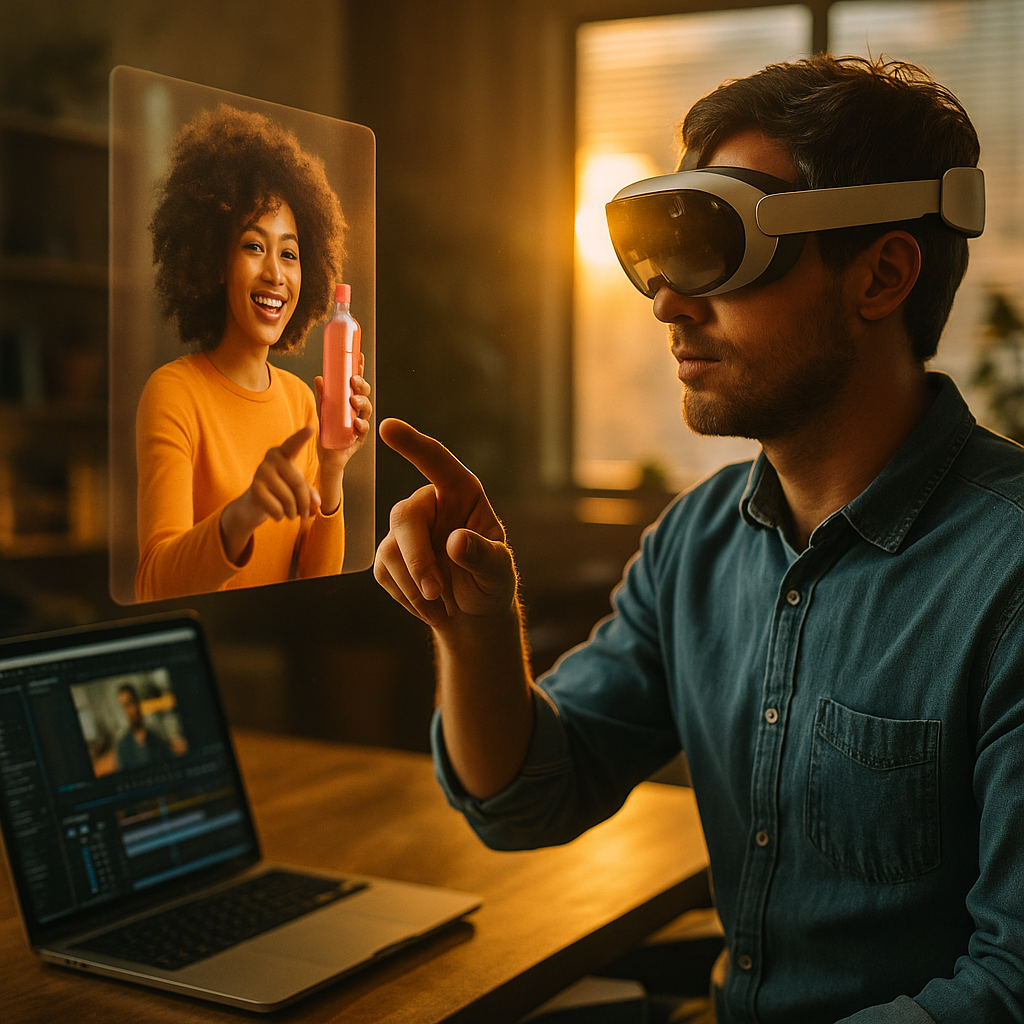
In 2025, spatial computing is reshaping how brands tell stories, letting audiences step inside narratives rather than watch from a distance. As headsets, sensors, and mixed-reality platforms mature, narrative advertising becomes more interactive, measurable, and context-aware. This shift changes creative strategy, production, and trust requirements. The big question: will your next ad be something people experience?
Spatial computing advertising: what it is and why narrative ads are changing
Spatial computing advertising uses device sensors and 3D mapping to place digital content into physical environments, enabling people to interact with branded stories through gestures, voice, movement, and gaze. Unlike standard video or even interactive web ads, spatial formats respond to the viewer’s surroundings—room size, lighting, surfaces, proximity, and sometimes location (when permission is granted).
This matters because narrative ads rely on progression: a beginning, tension, and resolution. Spatial computing adds two powerful capabilities that alter narrative design:
- Presence: viewers feel “in” the story, not outside it. That shifts emotional impact and memory formation.
- Agency: viewers influence pacing and outcomes by moving, selecting, or manipulating objects.
In practice, a spatial narrative ad might let a shopper “unbox” a product virtually on their kitchen table, trigger story beats by walking around it, and then unlock a personalized offer once they complete a short challenge. The story still has structure, but it becomes conditional: scenes adapt to actions, time, and context.
Marketers often ask a follow-up: does this replace video? Not in 2025. It extends video into moments where immersion and interaction increase understanding—especially for complex products, experiential brands, or high-consideration purchases.
Immersive storytelling in AR: new narrative structures, pacing, and emotion
Immersive storytelling in AR changes how you write and storyboard narrative ads. Traditional ads control attention with editing; spatial ads guide attention with environmental cues—sound direction, object scale, lighting, and spatialized prompts. The best creative teams design for “discovery,” ensuring the story remains clear even when the viewer looks elsewhere.
Key narrative patterns that work well in spatial formats:
- Branching micro-arcs: short scenes that can be experienced in different orders while still landing on the same core message.
- Object-centered storytelling: the product (or a symbolic object) becomes the anchor; interaction reveals features as story moments.
- Place-based chapters: each area of a room triggers a beat (setup near the doorway, tension near the table, payoff near the window).
- Embodied metaphors: users “feel” benefits through movement—e.g., stepping into a calm zone for a wellness brand.
To keep pacing tight, plan for time-to-first-delight (a meaningful visual or interactive payoff within seconds) and guided freedom (users can explore, but the story gently funnels them toward completion). Overly open worlds can confuse viewers and dilute brand recall.
Another likely question: will people tolerate longer ads? They will if the experience feels like utility or entertainment rather than interruption. Spatial narrative ads perform best when they earn attention by giving the viewer control and a reason to continue.
Mixed reality marketing: targeting, context, and personalization without creepiness
Mixed reality marketing introduces targeting signals that go beyond clicks and cookies. Spatial platforms can infer context like proximity to a product in a store, the type of environment (home vs. retail), or interaction patterns (what a user explored, for how long). Used responsibly, this enables personalization that feels helpful rather than invasive.
High-utility personalization examples:
- Adaptive demonstrations: a furniture brand scales an item to your room dimensions and highlights fit issues before purchase.
- Skill-level onboarding: a sports brand offers beginner vs. advanced tips based on interaction confidence.
- Contextual story endings: the ad concludes with the most relevant CTA—store locator in retail, save-to-wishlist at home.
To avoid “creepiness,” apply three practical rules:
- Visible value exchange: if the experience uses location, camera, or room mapping, the benefit should be obvious and immediate.
- On-device first: process spatial understanding locally when possible, and upload only what is necessary for functionality and measurement.
- User-controlled modes: offer an easy toggle for personalization depth (basic, enhanced, off) without breaking the experience.
Many brands also ask how to handle accessibility. Build alternatives: captions for spatial audio, controller-based input alongside gesture input, and clear prompts that do not require rapid movement. Inclusive design expands reach and reduces abandonment.
3D brand experiences: creative production, tools, and cross-platform delivery
3D brand experiences require a different production mindset than standard ad units. You are no longer producing a single linear asset; you are producing a small interactive system—models, materials, lighting behaviors, audio, and logic. Success depends on balancing fidelity with performance so experiences load quickly and run smoothly.
Core production components for spatial narrative ads:
- 3D asset pipeline: optimized models, texture compression, and LOD (level of detail) for multiple devices.
- Spatial UX: interaction design that feels natural, with clear affordances and minimal tutorial overhead.
- Sound design: spatial audio cues to guide attention and reinforce emotion without relying on on-screen text.
- Real-world anchoring: stable placement on surfaces, correct occlusion when objects pass behind real items, and believable shadows.
Cross-platform delivery is another recurring concern. In 2025, spatial experiences often need to work across a spectrum: phones (AR), tablets, and headsets. Plan for graceful degradation: keep the core narrative intact even if advanced features (like hand tracking or full room mapping) are unavailable.
Practical guidance that improves outcomes:
- Start with a “hero interaction”: one signature moment that communicates the main benefit and is easy to complete.
- Keep sessions short: design for completion in under a minute, with optional exploration for engaged users.
- Use modular scenes: reusable story blocks simplify iteration and A/B testing.
To strengthen EEAT, document your production choices. Maintain an internal “experience spec” that outlines device support, data handling, accessibility decisions, and QA results. This makes approvals faster and reduces risk.
Spatial analytics and measurement: proving impact while protecting privacy
Spatial analytics and measurement can move narrative advertising beyond impressions and clicks into behavior-based insights—while raising higher privacy expectations. Spatial ads can measure interactions such as object manipulation, completion rate, dwell time per scene, attention proxies (like view direction where allowed), and conversion actions (save, share, add to cart, visit store).
Use measurement frameworks that connect story to outcomes:
- Narrative completion funnel: entry → first interaction → midpoint → climax moment → CTA → conversion.
- Interaction quality: meaningful actions (try-on, configuration, comparison) vs. accidental taps.
- Brand lift mapping: correlate key story beats with survey-based recall or intent measures.
Because spatial data can be sensitive, privacy-by-design is non-negotiable. Apply these safeguards:
- Data minimization: collect only what you need to improve the experience and validate performance.
- Aggregation and anonymization: report at cohort level, avoiding raw environmental captures when possible.
- Explicit consent: request permissions in-context and explain why, using plain language.
Advertisers also need to anticipate regulatory and platform requirements. Even if you are not a legal team, your marketing operations should maintain a checklist for permissions, retention, and user rights. Trust is a performance driver in spatial environments: if people feel watched, they leave.
Trust, safety, and ethics in narrative ads: building EEAT for spatial experiences
Trust, safety, and ethics determine whether spatial narrative ads become a mainstream channel or remain niche. In immersive formats, persuasive design can feel stronger because people experience stories with their bodies and surroundings. That raises the bar for responsible storytelling.
EEAT-aligned practices for spatial narrative ads:
- Expert-led claims: ensure product claims are reviewed by qualified experts, especially in health, finance, and child-focused categories.
- Clear labeling: make it obvious that the experience is sponsored, without hiding disclosures inside menus.
- Safety constraints: design interactions that do not encourage unsafe movement, obstruct real-world awareness, or require risky behaviors.
- Age-appropriate design: avoid manipulative urgency cues and limit data collection for younger users where applicable.
- Content integrity: prevent deceptive deepfakes or misleading simulations; if visualization is illustrative, say so.
Brand teams should also prepare for moderation challenges: user-generated elements (photos, voice, or shared scenes) can introduce risk. Build reporting tools, filters, and clear community guidelines if the experience supports sharing.
The most credible spatial ads feel like guided experiences that respect the user’s space—literally. When your narrative earns trust, your metrics improve: higher completion, more shares, and stronger long-term brand affinity.
FAQs
What is the impact of spatial computing on narrative advertising in 2025?
It turns narrative ads into interactive experiences that adapt to the viewer’s environment and actions. Brands can deliver presence, personalization, and measurable engagement, but must meet higher expectations for privacy, usability, and trust.
Do spatial narrative ads work better on phones or headsets?
Phones offer reach and low friction, making them strong for scalable campaigns. Headsets deliver deeper immersion and more natural interaction, which can improve understanding and emotional impact. Many brands design one core experience with tiers for each device class.
How do you measure success for spatial computing advertising?
Use completion funnels, interaction quality metrics, and conversion actions tied to story beats. Combine behavioral data with brand-lift studies when possible, and report results in aggregated cohorts to protect privacy.
How expensive is it to produce 3D brand experiences?
Costs vary based on asset complexity, realism, and platform coverage. You can control budget by reusing modular scenes, optimizing assets early, and focusing on one hero interaction instead of building a large world.
What are the biggest creative mistakes in immersive storytelling in AR?
Common issues include unclear prompts, slow time-to-first-delight, overly open exploration with no narrative guidance, heavy assets that load poorly, and interactions that feel gimmicky rather than meaningful.
How can mixed reality marketing stay privacy-safe?
Ask for permissions only when needed, explain the benefit in plain language, process spatial understanding on-device when possible, minimize data collection, and provide user controls for personalization depth.
Spatial computing is pushing narrative advertising toward experiences that feel personal, interactive, and situated in the real world. Brands that win in 2025 will design stories around presence and agency, produce lightweight 3D systems that run everywhere, and measure impact with privacy-first analytics. The takeaway is straightforward: treat the user’s space as sacred, and your narrative ads will earn attention.