


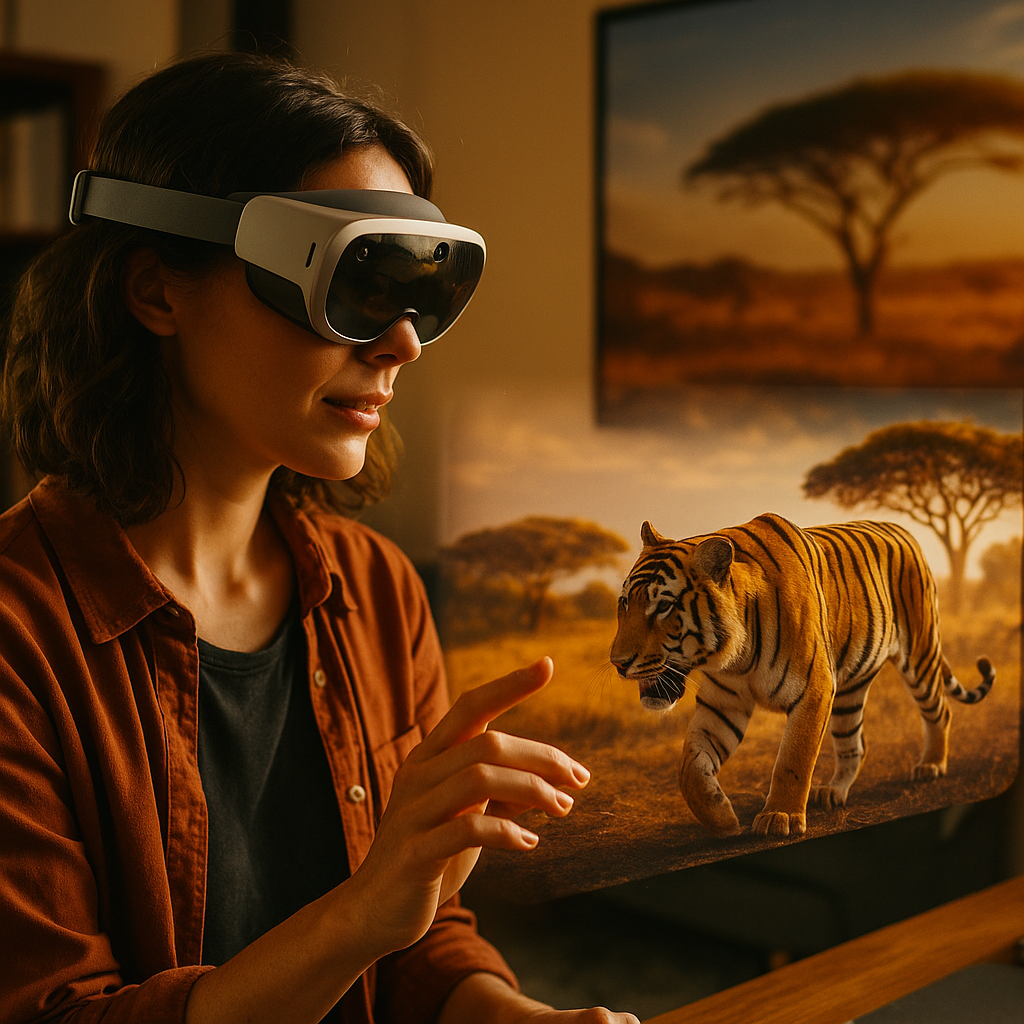
In 2025, The Impact Of Spatial Computing On The Future Of Narrative Brand Content is no longer theoretical—it’s reshaping how audiences experience stories. Spatial interfaces blend digital layers with physical space, turning passive viewers into active participants. Brands that master this shift can earn deeper attention, stronger recall, and measurable action without relying on interruption-based tactics. What does “story” become when space itself is the screen?
Spatial computing for brand storytelling: what it is and why it changes narrative
Spatial computing describes technologies that understand and respond to the 3D world—mapping environments, tracking movement, and placing digital objects into real space in ways that feel anchored and interactive. It includes augmented reality (AR), mixed reality experiences, spatial audio, 3D scanning, and interfaces that let people navigate content with hands, gaze, voice, or movement.
For narrative brand content, the shift is structural. Traditional storytelling assumes a flat frame: a page, a feed, a pre-roll, a TV spot. Spatial computing changes the “frame” into a volume, a room, a street, a store aisle—where the audience chooses where to look, what to touch, and what to do next. That interactivity forces brands to rethink narrative as:
- Situational: the environment influences meaning (home vs. store vs. event).
- Non-linear: people assemble the story through exploration.
- Embodied: gestures and proximity become part of the experience.
- Context-aware: location, time, and object recognition can shape what appears.
If you’re wondering whether this reduces storytelling quality, it doesn’t have to. The best spatial narratives use interactivity to deepen the plot, not distract from it. The question becomes: what should the audience do to understand the brand’s promise?
Immersive narrative content: new story structures that earn attention
Spatial computing rewards brands that design stories with clear roles, stakes, and progression—without forcing a single viewing path. The most effective immersive narrative content typically follows one of these structures:
- Guided journey: the experience leads the user through chapters (best for launches and education).
- Explorable world: users discover artifacts and scenes in any order (best for heritage and brand universe building).
- Task-based plot: completing actions reveals narrative beats (best for product value demonstration).
- Social co-presence: multiple participants shape the story together (best for community and fandom).
To keep attention, spatial stories need tighter clarity than linear video because users can “walk away” instantly. Design around three anchors:
- Orientation: a quick “what is this and what can I do?” moment within the first 10 seconds.
- Motivation: a meaningful reason to continue—unlocking, solving, previewing, customizing, or earning.
- Payoff: a clear reward—insight, surprise, personalization, or utility that maps to the brand.
Brands often ask how long a spatial story should be. There’s no universal duration; measure completion of key beats rather than minutes. If a user completes the “moment of truth” (e.g., configuring a product in their space, or experiencing a before/after), you’ve delivered value—even if the session is short.
AR brand experiences: where utility and emotion meet
AR brand experiences are the fastest route to spatial storytelling because they work on widely available devices and can tie directly to real-world context. The winning approach in 2025 is not “AR as a gimmick,” but AR that delivers either confidence or status—ideally both.
Confidence comes from utility: letting customers preview fit, scale, placement, or outcomes. This reduces uncertainty and accelerates decisions. For narrative content, utility becomes the plot device: the brand helps the customer move from doubt to certainty.
Status comes from identity and shareability: digital fashion, collectible layers, personalized scenes, or brand “auras” that people can place in their environment and share. Here, the narrative centers on self-expression and belonging.
To ensure AR reinforces your narrative brand content (instead of fragmenting it), connect each AR interaction to a specific story function:
- Exposition: reveal origin, craft, or ingredients through spatial overlays on packaging or objects.
- Demonstration: show how it works via animated cutaways anchored to the product.
- Transformation: visualize a “before/after” in the user’s own environment.
- Choice: let users customize and see consequences (colors, features, bundles).
- Proof: surface credible evidence—certifications, lab methods, or sourcing details—without burying them on a webpage.
Readers often worry about production complexity. A practical starting point is one hero interaction tied to one core claim—then expand with chapters after you validate engagement and conversion lift.
3D content marketing strategy: building an engine, not a one-off
Spatial computing can either become a costly novelty or a durable advantage. The difference is whether you treat 3D as an asset system. A modern 3D content marketing strategy focuses on reusable components that can appear across channels: web, AR previews, in-store screens, product pages, and immersive events.
Key building blocks include:
- 3D product models with multiple levels of detail for performance across devices.
- Material and lighting standards to keep the brand look consistent.
- Spatial audio cues that support emotion and guidance.
- Interaction patterns (tap to reveal, pinch to resize, walk to explore) documented like a design system.
- Narrative modules: short scenes, explainers, and proofs that can be rearranged per audience.
Governance matters. Assign clear ownership across brand, product, legal, and engineering teams so content stays accurate and compliant. In 2025, audiences are increasingly sensitive to manipulated visuals and misleading demos; your 3D claims must be defensible the same way copy and data are.
To operationalize, build a pipeline:
- Create once: produce verified 3D and narrative elements based on product truth.
- Adapt: generate channel-specific versions (lighter files for mobile, richer for headsets or kiosks).
- Measure: track interactions that indicate intent (place in room, compare variants, save configuration).
- Iterate: A/B test story beats, not just UI colors—e.g., different “reveal” moments and proof placements.
If you’re choosing metrics, align them with narrative outcomes: comprehension (did they understand the value?), confidence (did they feel ready to decide?), and advocacy (did they share or save?).
Interactive brand storytelling with ethics, trust, and measurement (EEAT in practice)
Spatial computing increases persuasive power because it feels personal and real. That makes trust non-negotiable. Applying Google’s EEAT principles in 2025 means your spatial narratives must demonstrate:
- Experience: show real-world use, not only idealized renders. Include authentic scenarios and limitations.
- Expertise: consult product specialists, engineers, and subject matter experts for accurate interactions and claims.
- Authoritativeness: reference recognized standards, certifications, or independent validations where relevant.
- Trustworthiness: be transparent about data collection, permissions, and what is simulated vs. actual.
Practical trust-building tactics for interactive brand storytelling:
- Permission-first design: clearly explain why you request camera, location, or spatial mapping access.
- On-screen disclosures: label visualizations as “illustration,” “simulation,” or “measured” when appropriate.
- Accessible defaults: provide non-spatial alternatives (video, images, transcripts) so the story remains usable.
- Safety boundaries: prevent experiences that encourage unsafe movement or distraction in public spaces.
Measurement must respect privacy while still proving ROI. Favor event-based analytics that capture intent without collecting unnecessary personal data. Examples of meaningful events include:
- Object placed in environment
- Variant compared
- Proof element opened (e.g., sourcing map, certification card)
- Configuration saved or exported
- Store locator tapped after interaction
One common follow-up question: how do you attribute sales? Use a layered approach—unique experience URLs/QRs, saved configuration IDs, and lift studies where possible—rather than relying on a single last-click metric. Spatial storytelling often influences decisions across multiple touchpoints.
Spatial computing and the future of narrative brand content: what to do next in 2025
The near-term future is not “everyone lives in headsets.” It’s a blended environment where phones, wearables, kiosks, and lightweight spatial interfaces turn everyday moments into story surfaces. For brands, that means narrative content must become more modular, more contextual, and more actionable.
Key shifts you should plan for:
- From campaign to ecosystem: spatial stories persist and evolve instead of disappearing after a flight.
- From impressions to interactions: value is measured by what people do, not just what they see.
- From brand voice to brand behavior: the brand “acts” as a guide, coach, stylist, or technician inside the experience.
- From generic to personal: stories adapt to room size, product ownership, preferences, and prior engagement.
If you’re deciding where to start, choose one high-friction decision in your funnel and design a spatial narrative to remove doubt. Examples: sizing and fit, installation clarity, performance expectations, or quality proof. Then build outward: add chapters for onboarding, maintenance, upgrades, and community.
The brands that win won’t be the ones with the flashiest 3D effects. They’ll be the ones that use spatial computing to tell the truth more clearly—at the exact moment the customer needs it.
FAQs about spatial computing and narrative brand content
-
What is spatial computing in marketing?
Spatial computing in marketing uses technologies like AR, mixed reality, and spatial mapping to place interactive digital content into real environments. It lets customers explore products and stories in 3D, often improving understanding and confidence compared with flat media.
-
How does spatial computing improve narrative brand content?
It turns storytelling into an experience where the audience participates. Instead of only watching, people explore scenes, reveal proof, customize outcomes, and connect the brand promise to their own space—often increasing recall and intent.
-
Do you need a headset to run spatial experiences?
No. Many effective spatial stories run on smartphones through AR. Headsets and in-store installations can add depth, but mobile-first experiences are often the most scalable entry point in 2025.
-
What industries benefit most from spatial storytelling?
Retail, home improvement, automotive, travel, consumer electronics, beauty, and healthcare education see strong use cases because 3D visualization reduces uncertainty. Any brand with complex features, fit questions, or high-consideration decisions can benefit.
-
What are the biggest risks with spatial brand experiences?
The main risks are misleading visualizations, intrusive data collection, poor accessibility, and overcomplicated interactions. Clear disclosures, permission-first design, and simplified “hero interactions” reduce these risks while improving trust.
-
How do you measure success for immersive narrative content?
Track intent-rich actions such as placing a product in a room, comparing variants, opening proof elements, saving configurations, and moving to a purchase or store-locator step. Pair this with conversion lift studies or controlled tests when possible.
Spatial computing is pushing narrative brand content beyond the screen and into lived environments, where attention is earned through interaction and relevance. In 2025, brands that build modular 3D assets, design clear story beats, and operate with transparent, permission-first practices can turn immersive moments into measurable business outcomes. The takeaway is simple: treat space as the medium—and trust as the message.