


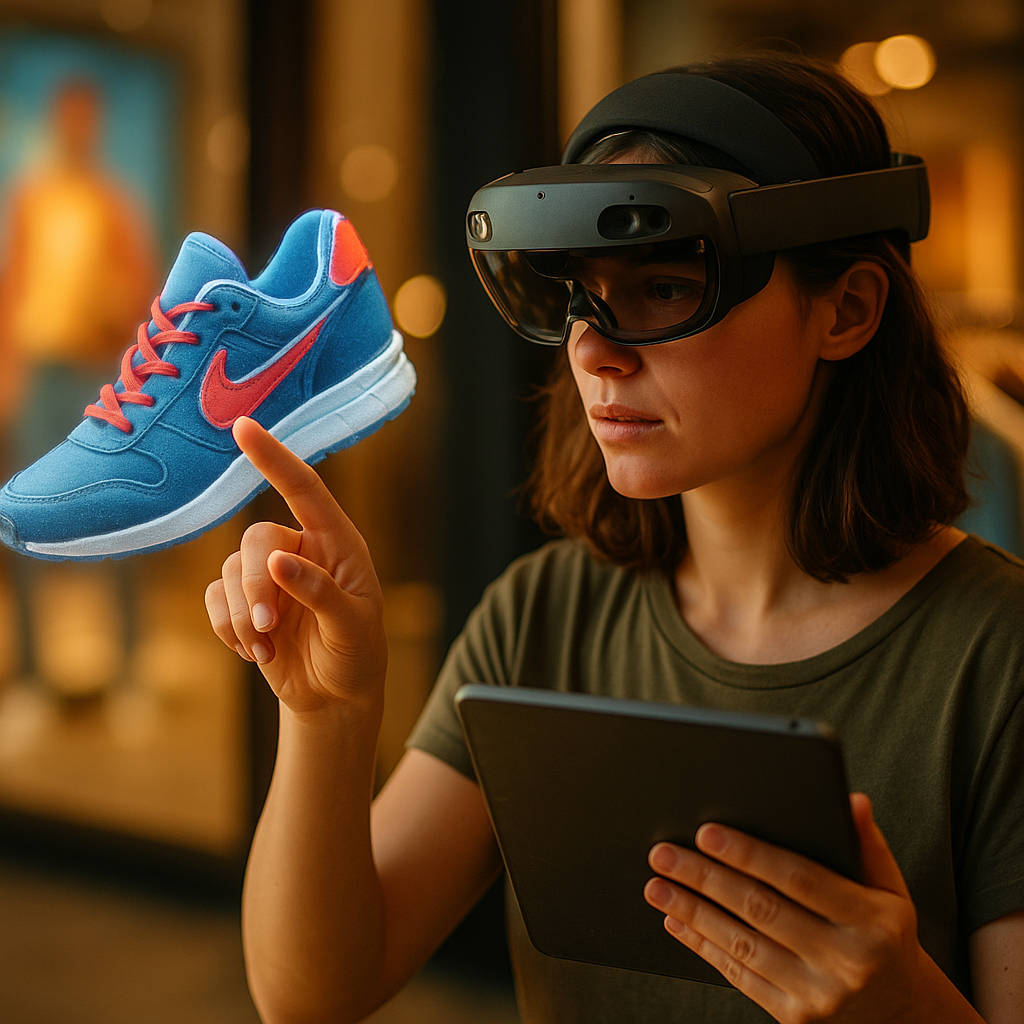
In 2025, brands no longer compete only on messages; they compete on experiences. The Impact Of Spatial Computing On Future Narrative Brand Content Strategies is reshaping how stories are designed, delivered, and measured across AR, VR, and mixed reality. This shift changes creative workflows, data ethics, and distribution models. The most prepared teams will win attention by making narratives tangible—will yours be ready?
Spatial computing in brand storytelling: why narratives become environments
Spatial computing blends digital content with physical space using devices and sensors that understand position, surfaces, lighting, and movement. For narrative brand content, this means your story is no longer confined to a screen. It can unfold as an environment where the audience walks, looks, speaks, and interacts to reveal meaning. Instead of “watching” a campaign, people explore it.
This changes narrative structure. Traditional content relies on linear sequencing (beginning, middle, end) and attention management through editing. Spatial storytelling must guide audiences through space and choice. The plot becomes a set of meaningful interactions: a product demo that responds to the room, a brand mission revealed through objects you can inspect, or a character-driven journey that adapts to how long someone lingers.
For marketers, the opportunity is higher immersion and memory formation. The risk is confusion and fatigue if the experience lacks clear narrative cues. Strong spatial narratives use:
- Spatial anchors: consistent locations where key story beats occur.
- Progressive disclosure: reveal information in layers to avoid overload.
- Environmental storytelling: let design elements carry the message (sound, light, object placement).
- Guided agency: meaningful choice within a curated path, not infinite options.
Answering the common question—“Do we need a fully immersive headset experience?”—not necessarily. Spatial computing includes phone-based AR and web-based 3D too. The strategic shift is thinking in space: how your narrative behaves in the audience’s environment, not only on your brand channels.
Immersive content strategy: aligning brand narrative with device realities and user intent
An immersive content strategy starts with intent, not technology. Spatial computing can serve multiple jobs: education, conversion, loyalty, customer support, or brand perception. The same “spatial experience” will perform differently depending on what people came to do and where they are when they encounter it.
Effective planning in 2025 requires mapping narrative depth to device context:
- Mobile AR: best for utility, product try-ons, location-based story moments, and fast shareable experiences.
- Mixed reality headsets: best for high-consideration demos, guided tutorials, premium storytelling, and enterprise training.
- In-store spatial activations: best for brand theater, assisted selling, and event-driven narratives.
Brands should also anticipate follow-up behaviors. If someone completes a spatial story, what’s next? Build a narrative “ladder”:
- Entry: a short AR moment that communicates a single promise.
- Depth: a longer mixed reality chapter that proves credibility (how it’s made, impact, performance).
- Conversion: a frictionless handoff to purchase, booking, or lead capture.
- Retention: post-purchase spatial support, onboarding, or community experiences.
This approach answers a practical concern from stakeholders: “How do we avoid one-off stunt campaigns?” You avoid it by designing a repeatable narrative system—modules, characters, environments, and interaction patterns—that can be reused across product lines and channels while staying consistent with brand voice.
AR and VR narrative design: crafting interaction-first plots without losing clarity
AR and VR narrative design demands a shift in how teams write and storyboard. In spatial experiences, the audience’s gaze, movement, and choices change the pacing. The writer and designer must collaborate to ensure the story remains coherent even when people behave unpredictably.
Key principles for interaction-first narrative design:
- Motivated interaction: every tap, gesture, or movement should reveal story value, not busywork.
- Clear objectives: users should know what to do within seconds, even if the story is mysterious.
- Scene economy: fewer, richer spaces usually outperform many shallow ones.
- Comfort and accessibility: avoid motion discomfort triggers; include seated modes, subtitles, and audio alternatives.
Spatial narratives also benefit from “micro-beats”—short moments of emotional payoff that happen every 20–40 seconds. These might be a transformation of the environment, a character reaction, or a reveal of a product benefit. Micro-beats keep audiences oriented and reduce drop-off.
Brands should be careful with interactivity that undermines trust. If an experience feels manipulative (forcing engagement to unlock basic information), audiences disengage. The best spatial brand stories treat interactivity as a service: helping people understand a product, a mission, or a community impact through firsthand exploration.
When a leader asks, “How do we tell a brand story without feeling like an ad?” the answer is narrative utility: make the user’s action the protagonist. If the experience helps them solve a problem or learn something meaningful, persuasion becomes a byproduct of value.
3D content production workflow: building scalable pipelines, not artisanal prototypes
Spatial computing raises production complexity: 3D assets, lighting, physics, spatial audio, and device optimization. Without a disciplined 3D content production workflow, teams risk high costs and slow iteration. The goal in 2025 is a pipeline that supports creative ambition while staying measurable and maintainable.
A scalable workflow typically includes:
- Asset strategy: create a brand-approved 3D library (products, environments, materials) with clear naming and version control.
- Performance budgets: define limits for polygon count, texture sizes, and effects per device class to prevent late-stage rework.
- Design systems for space: reusable interaction components (hover states, tooltips, object inspection patterns) aligned with brand guidelines.
- Cross-functional reviews: creative, legal, privacy, accessibility, and platform compliance checks built into milestones.
Measurement must also be baked in. Unlike video, spatial experiences generate behavioral signals: dwell time per object, navigation paths, repeat interactions, completion rates, and drop-off points. Instrumentation should be planned early to avoid gaps in reporting.
To strengthen EEAT, involve credible experts and document the process. For example, include input from product engineers for technical accuracy, UX researchers for usability, and privacy counsel for compliance. Capture decisions in internal playbooks, so future campaigns build on proven patterns rather than reinventing fundamentals.
Teams also benefit from vendor governance. If you outsource 3D work, establish standards for asset ownership, portability, and security. Ask vendors for optimization evidence and device testing protocols. This protects long-term value and reduces dependency on any single studio.
Brand experience personalization: using spatial signals responsibly to increase relevance
Spatial computing can personalize experiences using contextual signals such as room layout, proximity, user behavior, and sometimes biometric or gaze-based inputs depending on platform permissions. This can make brand narratives more relevant—but it also introduces privacy sensitivity and trust risks.
Practical personalization that adds value without crossing lines:
- Contextual adaptation: adjust the experience to available space (small-room vs open area modes).
- Progress-based storytelling: remember what the user has explored and tailor the next chapter accordingly.
- Preference selection: let users choose themes, difficulty, or product goals rather than inferring too much.
Where brands get into trouble is silent data collection or unclear purpose. In 2025, responsible personalization follows three rules:
- Explain: state what data you use and why, in plain language.
- Minimize: collect only what is needed for the experience to function or improve.
- Control: offer easy opt-in/opt-out and accessible settings.
This addresses the reader’s likely concern: “Will spatial personalization feel invasive?” It can, unless you design consent as part of the narrative. For instance, ask permission at the moment it becomes useful (“Allow room scanning to place objects accurately”), not as a blanket request upfront. Trust is a competitive advantage, and spatial computing makes trust visible because the experience literally enters the user’s environment.
Spatial analytics and measurement: proving ROI when attention is physical and interactive
Spatial experiences change what “engagement” means. Views and clicks matter less than exploration, completion, and behavior change. To prove ROI, brands need spatial analytics that connect experience metrics to business outcomes while respecting privacy.
High-signal spatial metrics include:
- Time-to-first-value: seconds until the user reaches a meaningful payoff (a benefit reveal, a successful placement, a key insight).
- Object interaction rate: which elements people inspect, manipulate, or revisit.
- Path analysis: common navigation routes and where confusion occurs.
- Completion and chapter drop-off: where the narrative loses momentum.
- Conversion assists: whether spatial exposure correlates with add-to-cart, lead submission, store visits, or customer support deflection.
To align with EEAT, define measurement methodology clearly. Document event definitions, sampling, and attribution assumptions. Avoid claiming causal impact if you only have correlation. When possible, use controlled experiments: A/B testing a spatial chapter versus a 2D equivalent, or testing different onboarding flows to improve completion.
Also plan for distribution realities. Spatial experiences often rely on platform ecosystems, app stores, or in-venue installations. Track the full funnel: acquisition source, device compatibility drop-off, onboarding success, and repeat usage. If the experience requires a large download or complex setup, optimize entry points with lighter web-based previews or QR-triggered AR that proves value before asking for commitment.
The most important follow-up question is: “What success looks like?” In many categories, the early win is not direct sales—it’s reduced uncertainty. If your spatial narrative helps customers understand fit, scale, setup, or outcomes, you can justify investment through fewer returns, shorter sales cycles, and higher satisfaction, measured with post-experience surveys and downstream behavioral signals.
FAQs
What is spatial computing in simple terms?
Spatial computing is technology that understands and interacts with physical space, letting digital content appear anchored in the real world or in a fully virtual environment. For brands, it enables stories and product experiences that users can explore through movement, gaze, and interaction.
How does spatial computing change narrative brand content strategies?
It shifts narratives from linear playback to interactive exploration. Brands must design story beats as environments, plan for user choice, and measure engagement through behavior (interactions, paths, completion) rather than only views.
Do small brands need AR/VR to stay competitive in 2025?
Not always, but they do need a spatial mindset where it fits customer needs. Lightweight mobile AR, web-based 3D, and in-store spatial demos can deliver value without building large headset-only experiences.
What skills should a marketing team build for spatial storytelling?
Prioritize spatial UX, 3D asset management, interaction design, narrative design for branching paths, analytics instrumentation, and privacy-aware personalization. Strong cross-functional collaboration is often more important than hiring a single specialist.
How can brands ensure spatial experiences are accessible?
Offer seated and standing modes, minimize motion discomfort triggers, include captions and audio controls, support controller alternatives where possible, and provide clear onboarding cues. Test with diverse users early to catch barriers before launch.
How do you measure ROI for spatial brand experiences?
Combine spatial engagement metrics (time-to-first-value, interaction rates, completion) with business metrics (conversion assists, reduced returns, lead quality, support deflection). Use experiments where possible and document attribution assumptions to maintain credibility.
Spatial computing is turning brand narratives into experiences people inhabit, not just consume. In 2025, the brands that win will design interaction-first stories, build scalable 3D pipelines, personalize responsibly, and measure what truly matters: exploration that reduces uncertainty and increases confidence. Treat space as a channel, trust as a feature, and narrative as a guided journey—then make it repeatable.