


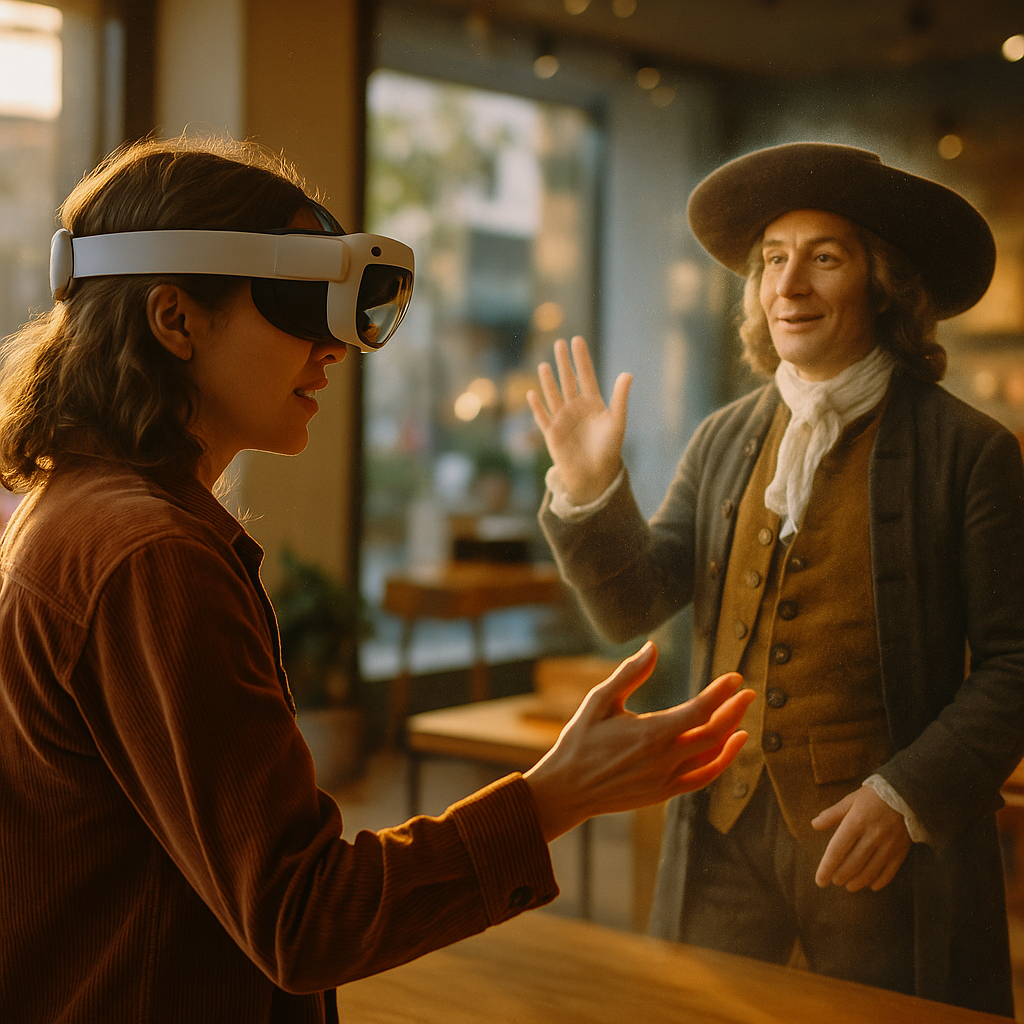
Spatial computing is reshaping how brands design, deliver, and measure immersive narratives across digital and physical environments. As screens evolve into interactive spaces, marketers must rethink content, UX, and trust. The impact of spatial computing on future brand storytelling formats reaches far beyond novelty, opening new ways to build memory, relevance, and participation. What will effective storytelling look like next?
Spatial computing marketing and the new storytelling canvas
Spatial computing marketing changes the basic structure of brand communication. Instead of placing a story inside a flat ad, website, or video, brands can now build stories around the user’s environment, gestures, voice, location, and intent. That shift matters because attention in 2026 is fragmented, and audiences expect experiences to respond to them in real time.
Spatial computing combines technologies such as augmented reality, mixed reality, computer vision, 3D mapping, wearable interfaces, and AI-driven contextual understanding. For storytellers, this means the medium itself can become dynamic. A product reveal no longer has to be a single video asset. It can be a room-scale experience, a guided overlay in-store, or a persistent branded layer that appears when a user explores a product at home.
The practical impact is significant:
- Stories become situational: content can adapt based on place, time, and user behavior.
- Users become participants: they do not just watch a narrative; they move through it.
- Brand assets become spatial: logos, products, characters, and calls to action can exist in 3D environments.
- Measurement becomes behavioral: brands can evaluate dwell time, gaze patterns, object interaction, and completion paths.
This does not mean every campaign needs a headset or complex immersive build. Helpful brand storytelling in a spatial era starts with a clearer question: where can immersion solve a real communication problem better than a standard format? Brands that answer that well will create experiences that feel useful rather than performative.
Immersive brand experiences that deepen memory and emotion
Immersive brand experiences have a clear advantage over passive formats: they can strengthen emotional encoding. When users explore, manipulate, or personalize an environment, they tend to form stronger memories than when they simply scroll past a message. That is one reason spatial storytelling is becoming important for high-consideration purchases, brand education, and premium launches.
Consider how this plays out across sectors:
- Retail: a customer visualizes furniture at scale in their living room, then follows a story layer explaining craftsmanship, materials, and care.
- Beauty: a user tries on products virtually while a guided narrative explains shades, routines, and skin concerns.
- Automotive: a potential buyer explores safety systems and features as contextual overlays around a life-size vehicle model.
- Travel: a destination brand creates a spatial preview of a hotel, route, or attraction before booking.
These examples work because they unite utility with storytelling. The user is not forced into a theatrical experience that delays action. Instead, the brand story emerges through exploration. That matters for trust. People are more likely to engage with immersive formats when the value is immediate and easy to understand.
Strong spatial stories also create emotional proximity. A flat banner can describe sustainability, for example, but a spatial experience can let users inspect material origins, follow a product’s lifecycle, and see the environmental impact represented visually around them. When abstract claims become tangible, brand messaging becomes more credible.
To make this effective, marketers should align immersion with the emotional job of the campaign. If the goal is confidence, reduce ambiguity. If the goal is excitement, add surprise and movement. If the goal is education, support self-paced discovery. Spatial format should amplify meaning, not distract from it.
Augmented reality storytelling and context-aware narratives
Augmented reality storytelling is likely to become one of the most accessible spatial formats because it works across smartphones, wearables, and connected retail environments. Its strength lies in context. AR can anchor a brand narrative to the objects, locations, and decisions already in front of the user.
That opens several storytelling models:
- Product-centered overlays: users point their device at packaging or an item to unlock instructions, provenance, reviews, or style inspiration.
- Place-based narratives: stores, venues, and public spaces trigger branded experiences tied to local relevance.
- Sequential story layers: users unlock chapters by completing actions, visiting locations, or interacting with products.
- Collaborative experiences: multiple users share a persistent branded layer, making storytelling social rather than solitary.
For brands, AR is valuable because it shortens the gap between awareness and action. A campaign can inspire, educate, and convert within one flow. A shopper sees a product, explores it through AR, compares variants, and buys without leaving the narrative entirely.
Still, context-aware storytelling demands restraint. If an experience asks for too many permissions, drains battery, loads slowly, or interrupts a user at the wrong moment, it weakens trust. Helpful content principles apply here directly. The best AR stories answer user intent quickly, explain why features are needed, and deliver a clear payoff.
Brands should also design for accessibility. Not every user will have the same device capabilities, comfort level, or sensory preferences. Good spatial storytelling offers alternate paths, simple onboarding, and clear controls. A story that only works for a narrow technical audience will struggle to scale.
3D content strategy for future brand storytelling formats
3D content strategy is becoming central to future brand storytelling formats because spatial experiences require assets, systems, and governance that many marketing teams do not yet have. In 2026, success depends less on a one-off activation and more on building reusable content infrastructure.
That starts with treating 3D objects as long-term brand assets. Product models, environmental scenes, character systems, animation libraries, and interaction patterns can be repurposed across channels. A single product model might support ecommerce visualization, retail displays, training, social content, and mixed reality demos.
Brands should think in layers:
- Core assets: accurate 3D models, textures, motion systems, lighting logic, and brand-safe visual standards.
- Narrative modules: stories, product features, educational moments, and calls to action that can be inserted into different experiences.
- Delivery environments: mobile AR, headsets, web-based 3D, in-store installations, and connected screens.
- Data connections: links to product catalogs, customer profiles, inventory, CRM, and analytics platforms.
This modular approach improves consistency and lowers production waste. It also supports experimentation. Teams can test whether a compact interactive explainer outperforms a full immersive environment for a given audience segment. That is especially important because not every use case justifies heavy production.
Another key question is brand expression. In spatial environments, typography, sound, scale, movement, and interaction all carry meaning. A luxury brand may use slower transitions, precise haptics, and minimal scene design. A youth-focused brand may prefer playful physics, bold motion, and collaborative mechanics. Storytelling format and brand identity must reinforce each other.
Companies that invest in content operations now will be better positioned as spatial touchpoints become more common. Those that wait may find themselves rebuilding assets from scratch every time a new platform gains traction.
Mixed reality advertising, measurement, and customer trust
Mixed reality advertising introduces new opportunities, but it also raises critical questions about privacy, measurement, and ethical design. Because spatial systems can process gaze, gestures, movement, room mapping, and environmental data, brands must handle this information with care. Trust is not optional. It is a performance factor.
EEAT principles are especially relevant here:
- Experience: brands should demonstrate real understanding of how people use spatial interfaces in everyday settings.
- Expertise: claims about immersion, performance, and user benefit should be grounded in tested implementation, not hype.
- Authoritativeness: marketers should rely on transparent methods, reliable analytics, and clear disclosures.
- Trustworthiness: users need to know what is being collected, why it matters, and how to control their data.
Measurement in spatial storytelling is more sophisticated than counting clicks, but sophistication does not guarantee meaning. Useful KPIs may include scene completion rate, interaction depth, assisted conversion, repeat visits, product understanding, and post-experience brand lift. However, marketers should avoid overvaluing vanity metrics such as raw interaction volume without linking them to business outcomes.
There is also a brand safety issue. Spatial experiences can feel intimate because they occur in a person’s home, body space, or immediate surroundings. Overly intrusive prompts, manipulative personalization, or aggressive retargeting can damage perception quickly. Respectful design principles include:
- Clear opt-in moments
- Visible privacy controls
- Minimal data collection by default
- Easy exit options
- Transparent labeling of sponsored spatial content
Brands that lead here will gain more than compliance. They will build the kind of confidence that encourages users to spend more time with immersive experiences in the first place.
Spatial commerce trends and how brands should prepare now
Spatial commerce trends suggest that storytelling, shopping, and service will continue to merge. The path from discovery to decision is becoming more visual, interactive, and environment-aware. For brands, preparation does not start with expensive hardware adoption. It starts with capability building.
Here are the most practical moves to make now:
- Audit your storytelling journey: identify where customers need confidence, inspiration, or education. Those are strong candidates for spatial formats.
- Build reusable 3D assets: prioritize hero products, key environments, and top educational moments.
- Start with high-intent use cases: product visualization, guided try-on, setup support, and in-store navigation often deliver clearer ROI than abstract immersive branding.
- Set cross-functional ownership: spatial storytelling touches brand, UX, engineering, ecommerce, analytics, and legal teams.
- Create measurement frameworks early: define success before launch so teams can compare immersive formats against standard channels.
- Write interaction guidelines: establish brand rules for motion, voice, object behavior, privacy prompts, and accessibility.
One common concern is cost. The answer depends on scope. A lightweight web-based 3D experience or mobile AR utility can be relatively efficient compared with custom installations or fully persistent mixed reality environments. Another concern is user adoption. That is why practical utility matters. When spatial storytelling helps people decide faster, understand better, or enjoy the process more, adoption becomes a result of value rather than novelty.
Looking ahead, the strongest brand storytellers will think less like campaign producers and more like experience architects. They will create narratives that move across products, places, and interfaces while staying coherent. In that environment, the question is not whether spatial computing will influence brand storytelling. It already is. The real question is which brands will use it to be more helpful, more memorable, and more trusted.
FAQs about spatial computing and brand storytelling
What is spatial computing in marketing?
Spatial computing in marketing refers to using technologies such as AR, mixed reality, 3D environments, sensors, and contextual AI to create interactive brand experiences that respond to a user’s physical space, movement, and surroundings.
How does spatial computing improve brand storytelling?
It makes storytelling more immersive, participatory, and context-aware. Instead of watching a fixed message, users can explore products, unlock information, and interact with a narrative in ways that improve understanding and memory.
Is augmented reality the same as spatial computing?
No. Augmented reality is one part of spatial computing. Spatial computing is a broader category that includes AR, mixed reality, computer vision, spatial mapping, wearable interfaces, and systems that understand and respond to the physical environment.
Which industries benefit most from spatial storytelling?
Retail, beauty, automotive, healthcare, travel, education, real estate, and consumer electronics are strong examples because they often require visualization, explanation, comparison, or emotional engagement before conversion.
What are the biggest risks for brands?
The main risks are poor usability, intrusive data practices, accessibility gaps, weak measurement, and building immersive experiences that feel like gimmicks instead of solving a real customer need.
Do brands need headsets to use spatial storytelling?
No. Many effective spatial experiences work through smartphones, tablets, web-based 3D, connected retail displays, and emerging wearable devices. Headsets can be useful, but they are not required for most brand use cases.
How should marketers measure success?
Measure both engagement and business impact. Useful metrics include interaction depth, completion rate, assisted conversion, product understanding, return visits, brand lift, and downstream revenue performance.
What is the first step for a brand starting now?
Start by identifying one high-intent customer journey where immersion can reduce friction or improve confidence. Then build a small, measurable experience using reusable assets rather than launching a complex, isolated project.
Spatial computing is transforming brand storytelling from static messaging into interactive, context-aware experience design. The brands that will win in 2026 are not the ones chasing spectacle, but the ones using immersion to clarify value, build trust, and support real decisions. Start with customer needs, invest in reusable content systems, and treat privacy and usability as strategic advantages.