


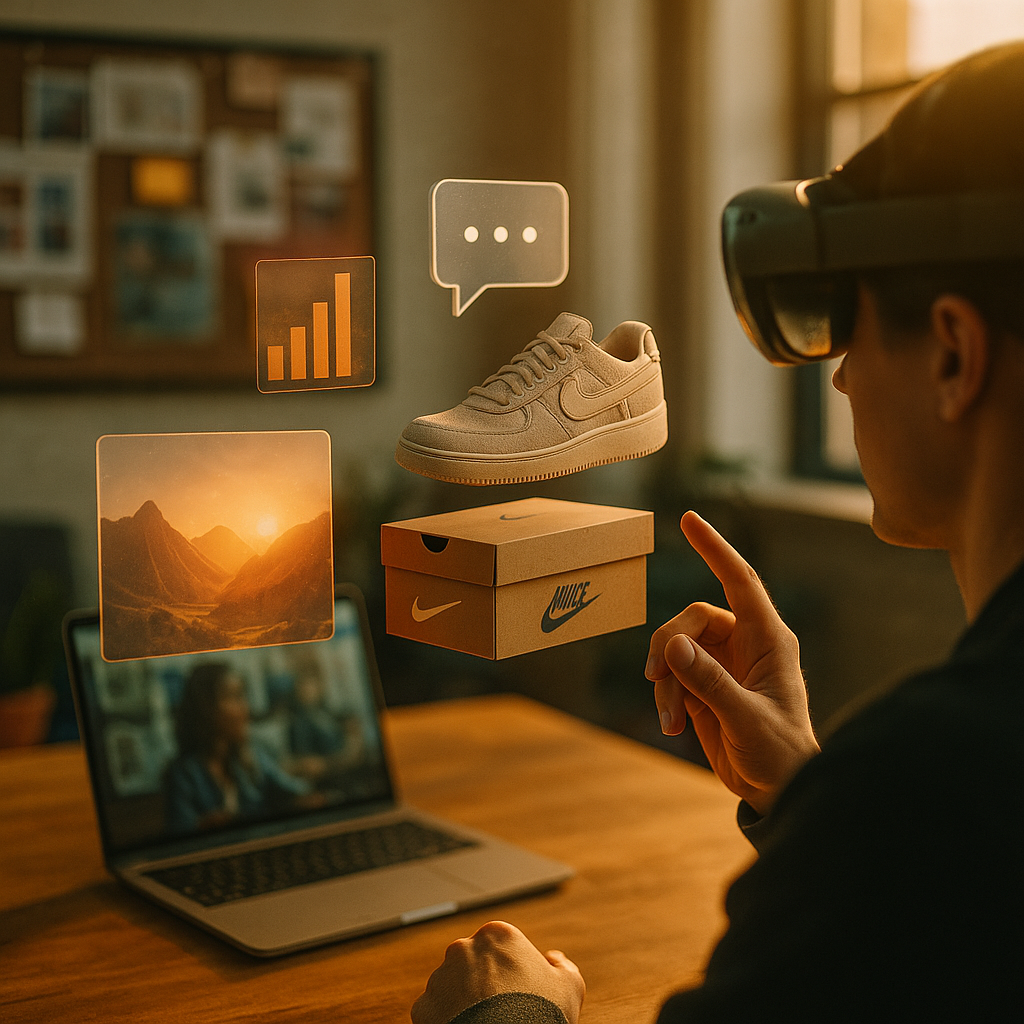
In 2025, brand storytelling is shifting from screens to environments, and the impact of spatial computing on future narrative brand content is becoming impossible to ignore. When digital objects behave like they belong in the real world, narratives feel less like ads and more like lived experiences. The question isn’t whether audiences will engage—it’s how you’ll earn their attention inside the story.
Spatial computing definition and why it changes brand narratives
Spatial computing blends digital content with physical space so people can see, hear, and interact with information as if it exists around them. Instead of tapping through a linear sequence (feed, landing page, checkout), audiences explore narratives through movement, gaze, voice, and gesture.
This is a structural shift for narrative brand content:
- Stories become navigable. The audience chooses paths, pace, and proximity—like walking through chapters.
- Context becomes part of the plot. Location, lighting, objects in the room, and even shared presence can influence what the story shows next.
- Meaning comes from interaction. The “message” is not only what you say, but what the audience does to reveal it.
For brand teams, that means you can’t simply port a video script into a headset or AR layer. You have to design narrative logic: what happens if someone leans in, walks away, or revisits the scene later? The best spatial narratives anticipate these choices and guide them without forcing them.
Follow-up readers often ask: “Does this replace video?” No. Video remains efficient for reach. Spatial computing changes the depth layer—what you build when you want higher attention, stronger memory, and clearer intent signals than a passive format can deliver.
Immersive storytelling for brands: new narrative mechanics
Immersive storytelling for brands relies on mechanics that are closer to experience design than traditional copywriting. The core opportunity is to turn brand claims into demonstrable moments.
Key mechanics that work in spatial narrative design:
- Spatial pacing. Instead of editing cuts, you control pacing through environment layout. A narrow entry can slow the reveal; an open atrium can deliver scale and awe.
- Diegetic UI. Menus and prompts can be embedded into objects (labels, tools, signage) to keep attention inside the story world.
- Embodied metaphors. Audiences remember what they physically do. Example: “building” something with gestures can communicate craft, reliability, or customization better than a tagline.
- Perspective shifts. You can let someone view a product’s impact from multiple angles—consumer, maker, community—without cutting away.
To keep narratives from feeling like demos, anchor the experience in a human problem and a clear transformation. A strong spatial story answers: What changes for me by the end? That transformation can be emotional (confidence), practical (time saved), or social (belonging), but it must be explicit in the experience design.
Another common follow-up: “How long should a spatial story be?” In 2025, the best-performing experiences often favor short, repeatable modules (2–7 minutes) that can be revisited, updated, and personalized. Design for re-entry: a first-time path, a deeper path, and a quick “show someone else” path.
AR and VR marketing strategy: choosing the right format for the story
An effective AR and VR marketing strategy starts by matching the narrative goal to the medium—then matching the medium to distribution reality (devices, friction, setting, staffing). Spatial computing is not one channel; it’s a toolkit.
Use AR when:
- Context is the point. You want the audience to see the product in their home, their body space, their store aisle, or their worksite.
- Access must be broad. Mobile AR reduces friction and supports shareable moments.
- Utility supports narrative. Try-on, configuration, “before/after,” or guidance can be framed as a story of progress.
Use VR when:
- Presence is the point. You need deep attention, emotional immersion, or controlled environment storytelling.
- You’re building a flagship narrative. Launches, brand worlds, high-consideration categories, training, or premium loyalty moments.
- The audience needs a safe simulation. Complex products and services benefit from experiential proof.
Use mixed/extended reality experiences when:
- You want shared presence. People collaborate, co-create, or experience the narrative together in the same space.
- Physical objects matter. Retail fixtures, packaging, or installations become interactive story elements.
Answering the practical follow-up: “Where does this live?” Plan a distribution stack. For example: a mobile AR teaser (reach), a spatial web/installation layer (consideration), and a headset-based premium chapter (conversion or loyalty). That stack keeps costs aligned with funnel impact instead of forcing one expensive experience to do everything.
3D content production pipeline: tools, teams, and governance
A reliable 3D content production pipeline is the difference between a one-off stunt and a scalable narrative program. Spatial narratives demand consistency across assets, interactions, and performance constraints—especially when experiences must run on multiple devices.
Build the pipeline around reuse:
- Modular asset libraries. Treat 3D models, environments, soundscapes, and interaction components as reusable “story blocks.”
- Real-time optimization standards. Define polygon budgets, texture sizes, lighting rules, and performance targets early to prevent last-minute cuts that weaken the story.
- Version control and approvals. Spatial experiences change fast; governance prevents brand drift and broken interactions.
Staffing realities in 2025: Most teams succeed with a hybrid model—brand strategist and narrative lead, experience designer, 3D artist, technical artist, and QA. You may not need all roles full-time, but you do need clear ownership of story logic (what happens when users do X) and technical constraints (what devices and environments must be supported).
EEAT in production choices: If you claim a product reduces waste, improves outcomes, or performs under specific conditions, encode that claim responsibly. Use verified specs, validated demos, and on-screen disclosures where appropriate. A spatial experience can make a claim feel “proven,” so your internal review should treat it with the same rigor as packaging copy or a product sheet.
Follow-up: “What about cost?” Costs vary widely, but you can control them by limiting environment size, prioritizing interaction quality over endless scenes, reusing assets across channels, and designing for incremental updates. Plan for maintenance—OS changes and device fragmentation can break experiences if you ship and forget.
Brand experience design and personalization: relevance without creepiness
Brand experience design in spatial computing shines when it uses personalization to increase relevance while respecting privacy. Spatial platforms can infer intent from behavior—where someone looks, how long they pause, what they pick up, what they repeat. That creates powerful narrative adaptivity, but it also raises trust questions.
Principles for ethical personalization:
- Value first. Personalization should make the experience easier, clearer, or more useful—not just more persuasive.
- Transparent control. Let people choose modes (guided vs. explore), save progress optionally, and understand what’s being customized.
- Minimize sensitive inference. Avoid designing narrative outcomes that rely on potentially sensitive signals unless you can clearly justify and protect them.
Make personalization part of the story: Instead of quietly adapting, narrate the benefit. For example: “Want to see how this fits your space?” or “Choose the scenario that matches your routine.” When audiences understand why the experience changes, it feels helpful rather than manipulative.
A likely follow-up: “Is personalization necessary?” Not always. Many strong spatial narratives rely on situational relevance (what’s in the room, what product is scanned, what aisle you’re in) without identity-based personalization. That approach can deliver relevance with lower risk.
Spatial analytics and measurement: proving narrative impact
Spatial analytics and measurement should connect narrative engagement to business outcomes without over-collecting data. Spatial experiences generate rich signals, but the goal is clarity, not surveillance.
Measure the story, not just the session:
- Attention and intent indicators. Time-in-zone, object interactions, repeat visits, and “chapter completion” can show whether the narrative structure works.
- Comprehension checks. Lightweight prompts (“What matters most to you?”) can validate whether the narrative communicated the intended value.
- Conversion bridges. Clear handoffs to purchase, booking, store maps, saved configurations, or follow-up content turn immersion into action.
- Lift studies for credibility. When possible, compare exposed vs. control groups for brand recall, consideration, or qualified leads.
EEAT and measurement: Document methodology, define metrics in plain language, and avoid overstating causality. If you report outcomes publicly, be specific about what you measured and where the experience ran. Spatial computing will be judged by trust as much as novelty; careful measurement practices protect that trust.
Follow-up: “What’s a good KPI set?” Many teams use a three-layer model: (1) narrative engagement (completion, interaction depth), (2) brand impact (recall, preference, NPS-style feedback), (3) business action (adds to cart, bookings, qualified leads). Keep it consistent across activations so you can learn and improve.
FAQs: Spatial computing and narrative brand content
What is narrative brand content in spatial computing?
Narrative brand content uses story structure—setup, tension, transformation—to communicate value. In spatial computing, that story is experienced through exploration and interaction in a 3D environment rather than consumed as a linear post or video.
How do brands keep spatial experiences from feeling like gimmicks?
Start with a real audience problem, design a clear transformation, and make interaction meaningful (not decorative). Tie each action to a product truth, and ensure the experience works smoothly in the real settings where people will use it.
Do users need a headset for spatial brand storytelling?
No. Mobile AR can deliver spatial storytelling at scale, while headsets support deeper immersion. Many effective programs use both: AR for reach and utility, headset experiences for high-attention moments like launches, retail events, or loyalty programs.
What skills are required to produce spatial narrative content?
You need narrative strategy, experience design, 3D art, technical implementation, sound design, and QA. Governance matters too: brand standards, legal review for claims, accessibility considerations, and ongoing maintenance planning.
How can spatial narratives support accessibility?
Offer multiple input methods (voice, controller, gaze), provide captions and clear audio mixing, avoid motion that triggers discomfort, and design readable UI with strong contrast. Include a guided mode for users who prefer less exploration.
How should brands handle privacy in spatial computing?
Collect only what you need, explain why it’s collected, and provide controls. Favor on-device processing where possible, avoid sensitive inferences, and design personalization that delivers clear user value rather than hidden persuasion.
Spatial computing is redefining how audiences experience stories: narrative brand content becomes interactive, contextual, and measurable through behavior—not just views. In 2025, the winners will treat spatial as a disciplined storytelling medium, not a novelty. Build modular 3D pipelines, choose AR or VR based on narrative goals, and measure responsibly. The takeaway: design experiences that prove value through action.