


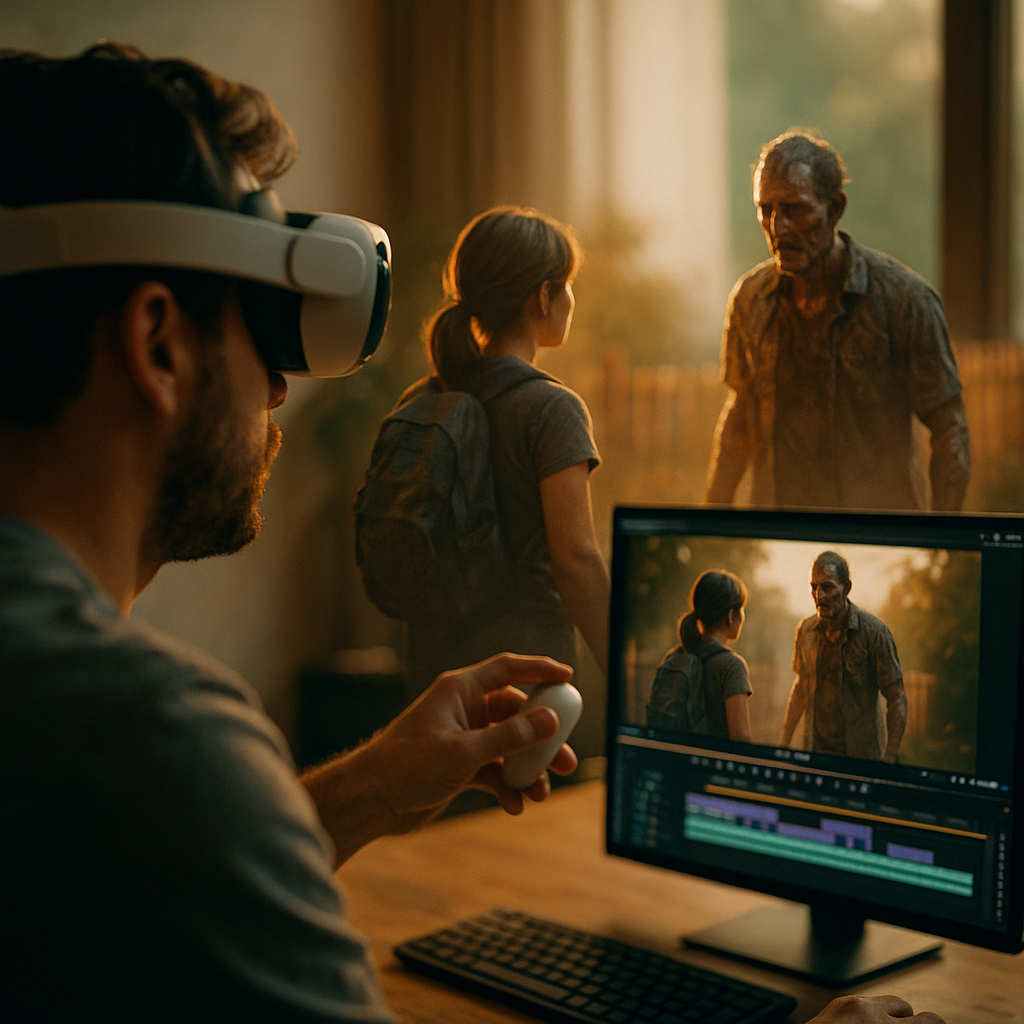
In 2025, spatial computing is reshaping how stories are filmed, edited, distributed, and experienced across headsets, phones, and mixed-reality screens. Narrative video no longer lives on a flat rectangle; it can occupy the viewer’s room, respond to movement, and unfold from multiple angles. Creators who adapt will reach deeper attention and new revenue—so what changes first?
Spatial narrative storytelling: from framed scenes to lived scenes
Traditional narrative video relies on a controlled frame: the director chooses what you see, when you see it, and how long you stay with it. Spatial narrative storytelling expands that language. The “frame” becomes the environment, and the viewer’s body becomes part of the camera grammar.
This shift does not remove authorship; it changes where authorship happens. Instead of cutting between close-ups and wide shots, creators guide attention using blocking in 3D space, directional sound, lighting cues, and interactive pacing. In a headset or mixed-reality view, a character can step behind your couch, a clue can sit on your table, and the story can reveal itself through proximity.
Readers often ask whether this turns every story into a game. It doesn’t have to. The biggest change is agency over perspective, not necessarily agency over plot. Many successful spatial narratives keep a fixed storyline while letting viewers choose where to look. That choice is powerful: it creates ownership and emotional presence, but it also increases the risk of missed beats.
Practical takeaway: write scenes with attention resilience. If a viewer looks away, the story should still make sense. Use layered cues—dialogue that carries the plot, environmental action that enriches it, and spatial audio that points the viewer toward the next moment.
Immersive video production workflows: new tools, new constraints
Spatial computing changes production long before distribution. Immersive video production workflows blend film, VFX, game engines, and real-time rendering. Even for live-action projects, creators increasingly plan shots in 3D previs, capture volumetric or multi-camera footage, and assemble scenes in engine-based timelines.
Key workflow impacts include:
- Preproduction moves earlier and gets more technical: You must decide what is interactive, what is dynamic, and what is fixed. This affects budgets, schedules, and staffing.
- Camera decisions become experience decisions: In 180/360, camera placement can cause discomfort if it conflicts with natural head movement. In mixed reality, anchoring content to real-world surfaces introduces lighting and occlusion challenges.
- Sound design becomes a navigation system: Spatial audio is no longer polish; it is storytelling infrastructure. It can lead gaze, define off-screen space, and create tension without forcing a cut.
- Editing becomes orchestration: You still edit, but you also choreograph where attention can go. You may add “soft gates” (subtle light shifts, character eye-lines, or motion) to direct focus.
A likely follow-up question is whether small teams can compete. Yes—if they design for constraints. Shorter runtimes, fewer locations, and strong audio-first storytelling can outperform expensive visuals. A focused spatial short with excellent pacing and clear attention cues often beats a visually ambitious piece that overwhelms the viewer.
EEAT note for creators: document your pipeline choices and test results. When pitching partners or platforms, evidence of comfort testing, accessibility checks, and device performance benchmarks builds credibility and reduces perceived risk.
Interactive narrative video: balancing agency with authorship
Interactive narrative video sits on a spectrum. At one end, viewers only choose where to look; at the other, they influence outcomes. Spatial computing makes both ends more compelling because interaction feels physical: a glance can trigger a reaction, a step can reveal a memory, and a gesture can open a scene transition.
The biggest creative challenge is coherence. Too much freedom can dilute theme and character arcs. Too little freedom can feel like “a normal movie, but inconvenient.” Strong spatial narratives treat interaction as a storytelling verb with a clear purpose.
Use these interaction patterns to protect pacing:
- Guided discovery: Let viewers explore details while the main story continues in audio, then pay off discoveries later.
- Choice with convergence: Offer meaningful micro-choices (who to follow, what to inspect) that funnel back into a stable spine of plot.
- Embodied transitions: Replace hard cuts with spatial moves—walking through a doorway to change time, or turning around to reveal a new scene.
- Character-led prompts: Characters can ask the viewer to do something, making interaction feel motivated instead of mechanical.
Creators also ask how to measure success. In spatial experiences, traditional completion rate and watch time still matter, but you also need attention analytics: where viewers look, when they disengage, and which objects they interact with. Use this data ethically—be transparent in product documentation and avoid collecting more than you need.
Mixed reality entertainment: storytelling in the viewer’s own space
Mixed reality entertainment is the most disruptive branch of spatial narrative video because it collapses the boundary between fiction and the viewer’s home. Instead of transporting audiences into a world, you bring the world to them. That changes blocking, tone, and even genre.
When characters occupy real rooms, the story gains intimacy. A whispered conversation across your kitchen feels different than the same scene on a TV. But it also introduces variability: every viewer’s environment is different—lighting, room size, furniture, noise, and distractions.
To design for the real world:
- Anchor key beats to flexible surfaces: Use walls, tables, and floors as optional stages, not hard requirements.
- Plan for occlusion and scale: Characters should feel present without breaking believability when they pass behind objects.
- Write for interruption: Viewers may be in shared spaces. Include recap-friendly dialogue and clear re-entry points.
- Respect comfort and privacy: Avoid demanding large movements in tight spaces, and be explicit about what sensors are used.
A common question is whether mixed reality undermines cinematic beauty. It can, if creators treat it like a gimmick. The strongest mixed-reality stories use the viewer’s environment as subtext: a haunting that uses familiar corners, a mystery that hides clues in ordinary places, or a relationship story that unfolds across the room where the viewer is sitting.
Volumetric video content: characters and performances you can walk around
Volumetric video content captures people and objects as 3D recordings rather than flat frames. For narrative video, this changes performance. Actors are no longer “shot”; they are staged. Their work must read from multiple angles and distances, and subtle gestures can become more powerful because the viewer can lean in.
Volumetric storytelling works best when the viewer’s ability to move enhances meaning. Examples include:
- Intimate monologues: Let viewers choose closeness, making vulnerability feel earned.
- Ensemble scenes: Viewers can follow different characters during the same moment, revealing layered motives.
- Memory and testimony: Volumetric presence can create authenticity, especially when paired with careful context.
However, volumetric capture brings technical and editorial constraints: heavier files, stricter lighting needs, and more complex post. To maintain EEAT, be candid in marketing and credits about what is captured volumetrically versus what is reconstructed or simulated. Transparency protects trust and sets correct expectations.
Distribution also matters. If your audience will experience volumetric scenes on multiple device classes, plan for graceful degradation—offer lower-detail meshes, reduced animation complexity, and alternative presentation modes that preserve story clarity.
Audience engagement and monetization: how spatial computing changes business models
Spatial computing impacts not only art, but economics. Narrative video has historically been packaged as a single linear asset. Spatial experiences behave more like products: they need updates, device compatibility testing, onboarding, and sometimes live operations.
Engagement changes because the viewer is doing more than watching. That can increase retention when the experience is comfortable and intuitive, but it can also increase drop-off if the first two minutes are confusing. Treat onboarding as part of the story, not a separate tutorial.
Monetization patterns emerging in 2025 include:
- Premium releases: A flagship spatial film or episodic experience sold as a standalone purchase.
- Subscription bundles: Libraries of short-form narratives optimized for repeat sessions.
- Event-based storytelling: Timed premieres, creator Q&A, or location-based mixed-reality tie-ins.
- Brand-funded narrative: Sponsorship that supports production while keeping the story intact—best done with clear separation between narrative integrity and advertising.
Creators and studios should expect deeper due diligence from partners. Platforms will ask for comfort testing, accessibility considerations (captions, audio descriptions, locomotion options), and content safety. Meeting these expectations is not bureaucracy; it is how you earn distribution and positive reviews.
FAQs
What is spatial computing in narrative video?
Spatial computing uses devices and software that understand 3D space—your room, your position, and your movement—so stories can unfold around you in virtual reality, augmented reality, or mixed reality instead of staying on a flat screen.
Does spatial storytelling require interactivity?
No. A spatial story can be fully linear while still letting viewers choose perspective. Interactivity is optional; presence and spatial audio alone can create a powerful narrative shift.
How do filmmakers direct attention without a frame?
They combine spatial audio cues, character eye-lines, motion, lighting, and staged action zones. Many creators also design “attention-safe” dialogue so the plot remains clear even if the viewer looks elsewhere.
Is 360 video the same as spatial computing?
Not exactly. 360 video is a format. Spatial computing is a broader approach that includes room understanding, interaction, occlusion, and 3D anchoring. A 360 video can be part of a spatial experience, but it may not be spatial by itself.
What skills are most valuable for creators in 2025?
Hybrid skills win: narrative craft plus real-time production literacy. Practical strengths include spatial audio, engine-based previs, interaction design fundamentals, comfort-aware blocking, and analytics-informed iteration.
How can creators keep experiences accessible?
Provide captions and audio descriptions where possible, offer seated and standing modes, avoid mandatory rapid movement, include clear onboarding, and design interactions that do not rely on a single gesture type.
Spatial computing is pushing narrative video beyond passive viewing into experiences that can surround, respond, and persist in the viewer’s space. The craft is shifting toward attention design, spatial audio, real-time workflows, and interaction that serves theme—not novelty. In 2025, the creators who test rigorously, design for comfort, and protect story clarity will lead the next wave of screenless cinema.