


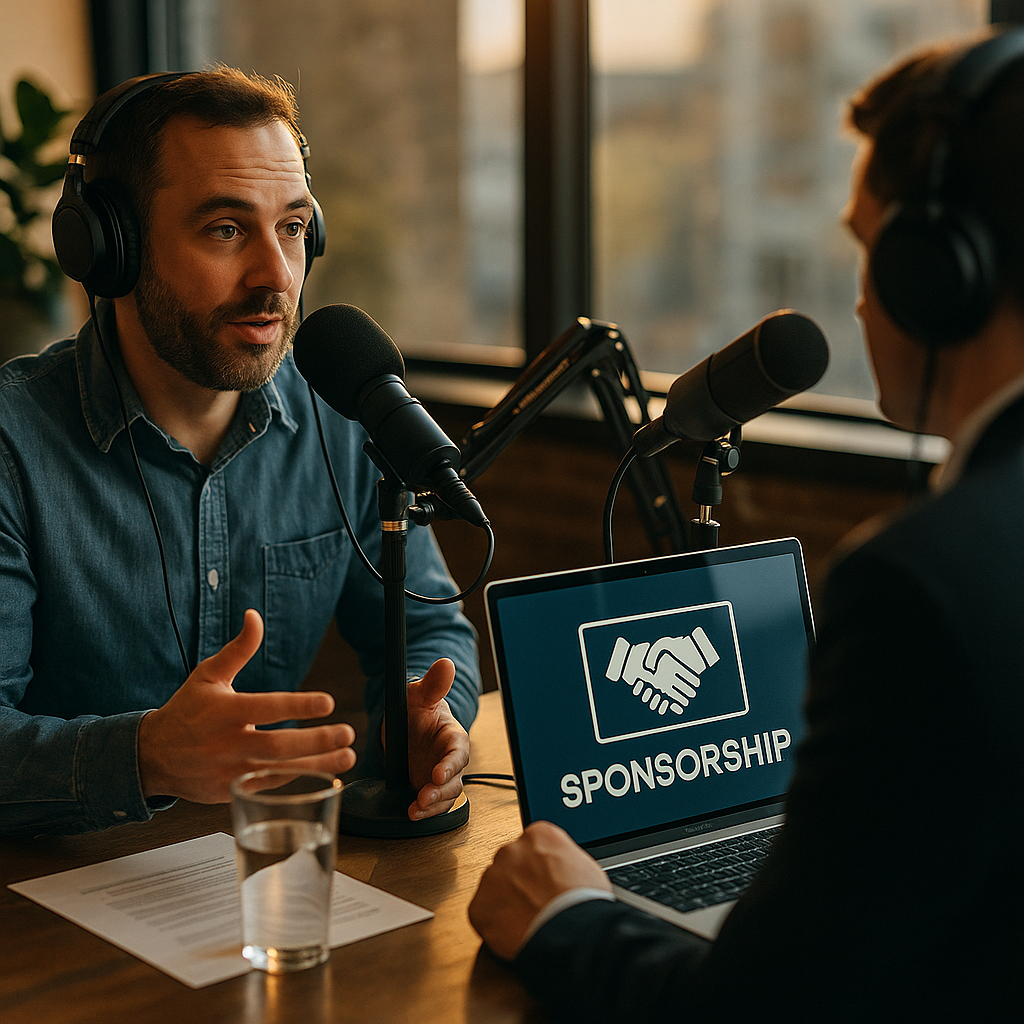
A Playbook For Sponsoring Industry-Specific Podcasts For High-Intent Leads helps B2B and niche brands turn trusted audio attention into measurable pipeline. In 2025, podcast ads can outperform broad channels because listeners self-select into specialist topics and stay engaged through long-form content. This guide shows how to pick the right shows, structure offers, and prove ROI without guesswork. Ready to sponsor smarter?
Podcast sponsorship strategy: start with intent, not impressions
Industry-specific podcasts are powerful because the audience arrives with a problem to solve and a vocabulary your buyers already use. A strong podcast sponsorship strategy begins by defining what “high-intent” means for your business and mapping that intent to podcast moments that naturally align with your solution.
Define your ideal lead in operational terms. Don’t start with “CFOs at mid-market SaaS.” Start with buying signals you can track:
- Role + urgency: “IT director tasked with reducing SaaS spend in the next quarter.”
- Trigger events: audits, compliance deadlines, platform migrations, funding rounds, leadership changes.
- Constraints: budget threshold, implementation timeline, security requirements.
Align sponsorship goals to funnel stages. Podcast ads can drive:
- Pipeline creation: demo requests, assessments, consult calls.
- Deal acceleration: retargeting audiences who heard the ad, using host-read credibility to reduce risk.
- Account penetration: reaching multiple stakeholders in the same niche community.
Match the show format to the intent you need. If you want immediate hand-raisers, sponsor shows with:
- Short, practical episodes where ads sit near “how-to” content.
- Recurring segments (e.g., “tool of the week”) where your offer fits.
- Listener communities (Slack/Discord/newsletters) that extend the conversion window.
Answer the follow-up question upfront: “Can podcasts really generate high-intent leads?” Yes—when the offer is specific and the path to conversion is frictionless. Generic “learn more” CTAs typically create soft traffic. Sponsor like you would run a high-performing search campaign: clear problem, clear outcome, clear next step.
Industry podcast sponsorship: how to choose shows that convert
Picking the right show is the biggest lever you control. In industry podcast sponsorship, relevance beats scale because niche trust travels farther than raw reach. Evaluate shows like you would evaluate a channel partner: audience fit, credibility, and repeatable performance.
Use a shortlist scorecard. Ask for (or infer) these elements:
- Audience composition: roles, seniority, company size, geography, and industry sub-verticals.
- Content adjacency: do recent episodes discuss the problems your product solves?
- Engagement signals: reviews quality, episode completion anecdotes, social/community activity, newsletter open rates if available.
- Ad load: too many sponsors can dilute recall; too few can indicate weak monetization maturity.
- Host authority: operator experience, credentials, and trust in the market.
Ask for proof, not promises. A professional show should provide:
- Average downloads per episode within 30 days and within 7 days.
- Ad placement options (pre-, mid-, post-roll) and typical read length.
- Category exclusions (to protect you from competitor adjacency).
- Past sponsor case studies or anonymized outcomes.
Prioritize buying committees. Many B2B purchases involve multiple stakeholders. A smaller show that reliably reaches both implementers and decision-makers can outperform a larger show that reaches only enthusiasts.
Red flags that hurt conversion:
- Vague audience claims with no supporting data.
- Inconsistent publishing schedule that interrupts frequency.
- Hosts who refuse to collaborate on message testing or landing page alignment.
Practical rule: If you can name three recent episodes where your product would have been a natural recommendation, you likely found a strong fit.
High-intent lead generation: craft offers and CTAs listeners actually use
Podcast listeners rarely click in the moment. They remember, then act later. High-intent lead generation from podcasts depends on an offer that is easy to recall, high-value to the niche, and tightly connected to a next step your sales team can handle.
Build “listener-native” offers. Good podcast offers sound like help, not an ad. Examples:
- Diagnostic: “Get a 10-minute benchmark: compare your security controls to peers in your industry.”
- Template: “Download the vendor evaluation scorecard we use with compliance teams.”
- Assessment call: “Book a 20-minute teardown of your current workflow; leave with three quick wins.”
- Private demo: “Request the ‘podcast walkthrough’ that skips basics and focuses on your use case.”
Make the CTA memorable. Use a short vanity URL and a spoken-friendly promo code:
- Vanity URL: yourbrand.com/showname
- Code: SHOWNAME or HOSTNAME
Reduce friction on the landing page. A high-intent landing page should:
- Repeat the exact promise the host said, above the fold.
- Offer one primary action (book, request, download), not three.
- Pre-qualify with 3–5 form fields that signal fit without killing conversion.
- Include a short “Who this is for” and “Who it’s not for” section.
Expect delayed conversions and design for them. Add “reminder” mechanics:
- Deliver the asset via email and include a calendar link for the next step.
- Use retargeting audiences based on landing page visits and video views.
- Send a concise follow-up sequence that references the episode topic.
Follow-up question: “Should we gate content?” If your sales motion needs qualification, gate with a clear value exchange and a fast delivery. If you sell low-touch or want broader reach, consider ungated content paired with a strong scheduling CTA for qualified visitors.
Host-read podcast ads: scripts, placements, and brand safety
Host-read podcast ads often convert better than generic spots because the host transfers credibility. But that only works when you protect authenticity and give the host enough structure to stay accurate. Treat host-read podcast ads like a co-created endorsement with guardrails.
Choose the right placement for your goal.
- Pre-roll: best for broad awareness and simple CTAs; lower drop-off risk.
- Mid-roll: best for conversions; the listener is already invested.
- Post-roll: best as a secondary reminder; lower volume but can be cost-effective.
Provide a “talking points” doc, not a rigid script. Include:
- One clear problem: the pain the audience recognizes.
- One clear outcome: what improves after using you.
- Two proof points: credible, verifiable claims (avoid exaggeration).
- One CTA: vanity URL + what they’ll get.
- Compliance notes: regulated language, claims to avoid, required disclosures.
Make the ad sound like the show. Ask the host to connect your message to:
- The guest’s theme (without implying endorsement by the guest unless explicit).
- A listener story or common scenario in the niche.
- A tool/workflow the audience already uses.
Brand safety matters more in niche markets. Add basic protections to your agreement:
- Category exclusivity for a defined window.
- Content adjacency controls: right to move placements away from sensitive episodes.
- Approval process: you approve final talking points; host keeps delivery autonomy.
Answer the follow-up question: “Should we do founder reads instead?” Founder-read ads can work when the founder is a recognized expert and can deliver crisp, niche-specific insight. If not, host-read usually wins because the trust is already banked.
Podcast ad attribution: tracking, ROI, and pipeline influence
Podcast ad attribution is rarely a single-click story. You need a measurement stack that captures direct response while also crediting influence on deals already in motion. In 2025, the teams that win with podcasts treat measurement as a system, not a report.
Set expectations with the right KPIs. Track three layers:
- Direct response: vanity URL visits, promo code usage, form fills, booked calls.
- Sales-qualified impact: qualification rate, meeting-to-opportunity rate, sales cycle velocity.
- Influence: self-reported attribution, multi-touch paths, branded search lift.
Use clean tracking infrastructure.
- Dedicated landing page per show and, if possible, per campaign flight.
- UTM discipline for any clickable placements in show notes and newsletters.
- Call tracking only if phone leads matter; otherwise keep it simple.
- CRM fields for “Podcast heard” and “Show name” captured on forms and by SDRs.
Build a reliable “how did you hear about us?” workflow. The highest-signal method is human confirmation:
- Make it a required question on high-intent forms.
- Train SDRs to ask the same question verbatim on first contact.
- Standardize dropdown options so data isn’t lost to free-text chaos.
Model ROI with conservative assumptions. Create a simple view:
- Sponsorship cost per month
- Qualified meetings sourced
- Opportunity creation rate
- Average opportunity value and win rate
- Time-to-close expectations (podcasts can have longer tails)
Follow-up question: “What if we can’t attribute deals cleanly?” Then measure lift. Compare:
- Branded search and direct traffic in the sponsored niche.
- Win rates for accounts that match the audience profile before vs. after sponsorship.
- Inbound quality changes during campaign flights.
B2B podcast sponsorship: negotiation, scaling, and long-term partnerships
B2B podcast sponsorship works best when you move from one-off buys to a repeatable portfolio. Negotiation should protect performance, while scaling should protect message-market fit. Treat podcasting as a relationship channel: trust compounds when you stay consistent.
Negotiate for outcomes, not just CPM. In addition to rate, negotiate:
- Flight structure: commit to 6–12 episodes to allow learning and frequency.
- Creative testing: two ad angles and rotating CTAs to find what converts.
- Inventory: mid-roll priority, episode category alignment, and avoidance of competitor adjacency.
- Bonus value: inclusion in newsletter, community posts, or a short host social clip.
Add integration layers that raise trust. Once the ad is working, expand into:
- Host interview or founder episode focused on education, not a product pitch.
- Sponsored segment (e.g., “listener teardown”) where your expertise shows.
- Webinar or live event co-hosted with the podcast community.
Scale with a portfolio approach. Build three tiers:
- Tier 1: 1–2 anchor shows with the best fit and consistent flights.
- Tier 2: 3–6 niche shows that hit sub-verticals and specific job roles.
- Tier 3: test shows for new segments with short, measured experiments.
Protect your team from lead quality surprises. Before scaling spend, confirm:
- Sales accepts the leads as relevant and actionable.
- Offers and landing pages match the audience’s maturity level.
- You have a follow-up SLA so leads don’t go stale.
EEAT note: The most credible sponsorships keep claims precise, use verifiable proof points, and respect the audience’s time. Trust is the asset you’re renting—treat it carefully.
FAQs
How much should we budget for sponsoring an industry-specific podcast?
Budget around what you can sustain for at least 6–12 episodes on a small set of shows. Consistency improves recall and attribution. Start with a test that funds one anchor show plus one or two niche tests, then scale only after you confirm qualified meetings and acceptable sales feedback.
What ad length performs best for high-intent leads?
60–90 seconds often works well for conversion because it allows a clear problem, proof, and a single CTA. If your offer needs context (assessment, audit, complex product), a 90–120 second mid-roll can perform better than a rushed short read.
Are promo codes necessary for B2B podcast sponsorships?
They help, but they are not enough on their own. Many listeners won’t use a code, especially in B2B where the buying path involves multiple stakeholders. Combine a promo code with a dedicated landing page, CRM capture, and SDR confirmation.
Should we sponsor one big show or several small niche shows?
For high-intent leads, several niche shows usually outperform one broad show because relevance drives qualified action. Use one anchor show if it is tightly aligned with your niche and consistently delivers the right roles, then add smaller shows to cover sub-verticals and job functions.
How long does it take to see results from podcast sponsorship?
You can see direct-response leads within days, but pipeline impact often appears over weeks as listeners return, share episodes internally, and act when a trigger event occurs. Plan measurement windows that capture both immediate conversions and delayed influence.
What’s the biggest mistake brands make with podcast ads?
Using a generic CTA and sending listeners to a generic homepage. High-intent listeners respond to specificity. Match the ad to a single problem, send them to a dedicated page, and offer a next step that feels worth their time.
Conclusion
Sponsoring industry-specific podcasts works in 2025 when you treat it like a performance channel built on trust: define intent, pick shows for fit, craft a listener-native offer, and track outcomes across direct response and influence. Commit to enough episodes to learn, then scale with a portfolio. The takeaway: relevance plus measurement turns audio attention into qualified pipeline.