


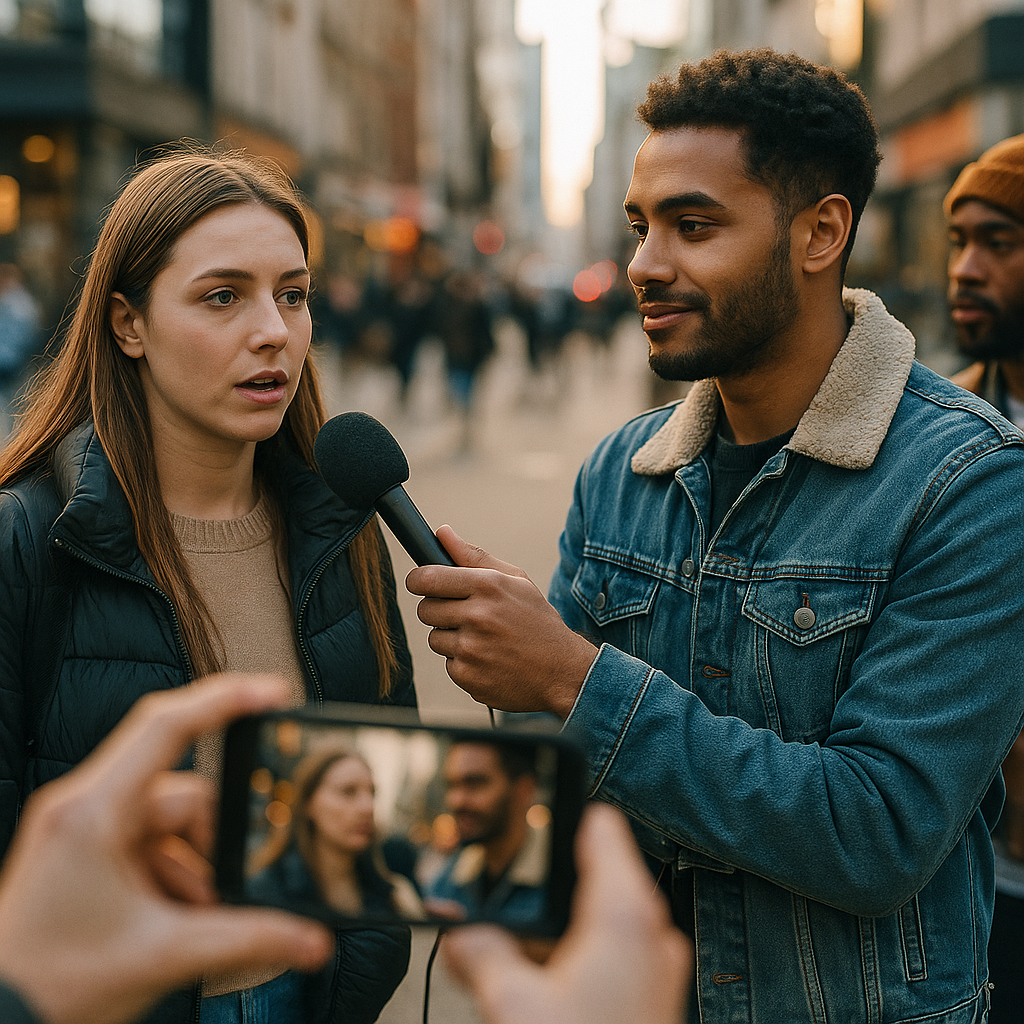
One New York DTC skincare brand swapped its top-performing UGC ad for a $200 “man on the street” style interview clip. Cold audience click-through jumped 34 percent in the first two weeks. That’s not a fluke, it’s a pattern showing up across performance accounts running street interview ads against standard branded creative. If your new buyer acquisition has stalled on the same three ad concepts, this format deserves a line item in your next test budget.
Why This Format Keeps Winning the Cold Audience Fight
Street interview ads work because they borrow the credibility of an unscripted moment. A creator stops strangers on a sidewalk, asks a blunt question about a product category, and captures raw, unpolished reactions. No teleprompter. No brand-safe smile. Just a stranger’s honest opinion, which is exactly what a skeptical scroller trusts more than a studio-lit spokesperson.
Meta and TikTok’s own creative guidance has leaned into this for years: ads that mimic organic, non-produced content consistently outperform polished spots in cold prospecting campaigns, according to Meta’s advertising resources. Street interviews take that principle further by removing the brand’s fingerprints almost entirely from the first three seconds.
Brands running street interview formats in cold prospecting are seeing new-to-file customer rates outperform standard creative by double digits, largely because the format disguises the ad as social proof rather than a pitch.
What Actually Makes These Ads Different
Standard branded creative telegraphs intent within the first frame. Logo, product shot, voiceover, done. A viewer’s brain files it as “ad” and scrolls past before the hook lands. Street interviews delay that recognition. The setting looks editorial, the questions feel journalistic, and the reactions read as genuine because, often, they are.
- Unscripted responses create pattern interrupts that standard hooks can’t replicate.
- Multiple voices in one ad (three to five interviewees) simulate social consensus faster than a single testimonial.
- Public settings (sidewalks, malls, campuses) signal “this is real life,” which lowers viewer skepticism before the pitch even arrives.
The Numbers Behind the Claim
Performance marketers running comparative tests report street interview ads reaching cold audiences at a lower cost per new customer than scripted UGC or founder-style talking head spots. That aligns with broader industry data: eMarketer and Sprout Social have both flagged authenticity as the top driver of ad trust among Gen Z and younger millennial buyers, per eMarketer’s consumer research and Sprout Social’s platform data.
Here’s the part media buyers care about most: new buyer reach. Standard creative tends to plateau with existing warm audiences, retargeting pools, and lookalikes built from past purchasers. Street interview ads, because they read as organic content rather than paid media, get more initial distribution into cold, unseeded audiences before the algorithm narrows in on converters. That earlier, broader reach is where the format earns its keep.
If your team already runs disciplined hook testing at scale, street interviews slot in as a new hook category rather than a totally new workflow. Swap the opening five seconds, keep the offer and CTA structure intact, and measure lift against your control.
Building the Format: A Practical Brief
A street interview ad brief is deceptively simple to write and easy to get wrong in execution. The goal isn’t chaos, it’s controlled spontaneity. Here’s what a working brief should include:
- One sharp, category-relevant question. Not “do you like skincare” but “what’s the one skincare product you’d never stop buying.” Specificity produces better soundbites.
- A public but visually clean location. Busy enough to feel authentic, tidy enough that the footage doesn’t distract from the answers.
- Five to eight interviewees minimum. You need three or four usable answers in the final cut, and raw hit rates run low.
- A loose, not rigid, follow-up script. The interviewer should react in real time, not read off a card. Canned follow-ups kill the authenticity the format depends on.
- A product reveal that feels incidental. The best-performing cuts introduce the brand almost as an aside, not a hard pivot into a pitch.
Editing matters as much as the shoot. The cut needs pacing that mirrors a documentary short, not a commercial. Quick reaction cuts, natural ambient sound, minimal graphics. Overproducing the edit undoes the entire premise of the format.
Where Street Interviews Fit Against Other Formats
This isn’t a replacement for every creative slot in your funnel. Street interviews are a top-of-funnel, cold-reach tool. They’re not built for retargeting sequences or high-intent conversion pushes, where a clearer product demo usually wins. Teams that have tested silent selling ads or sound-off demo formats for lower-funnel work should keep those running alongside street interviews rather than swapping one for the other.
Think of it as a funnel split: street interviews earn the first look and the cold click, silent demos or founder-style videos close the sale once the prospect is warmed up. Brands running founder mode videos at scale have found the two formats complement each other well when sequenced correctly in a media plan.
Compliance and Disclosure: Don’t Skip This Part
Street interview ads sit in a gray zone that legal and compliance teams should review before scaling spend. Interview subjects who mention or react positively to a product, especially if compensated or given free product, may trigger disclosure obligations under FTC endorsement guidance. Even unpaid, unscripted reactions can raise questions if the brand later uses that footage in paid media without consent documentation.
Best practice: get signed releases from every interviewee on the spot, and clarify with your creative team whether any product mentions were incentivized. The FTC’s endorsement guidelines apply regardless of how organic the footage looks. “It seemed unscripted” is not a defense if regulators ask questions later.
The authenticity that makes street interview ads convert is the same quality that makes them a compliance risk if releases and disclosures aren’t locked down before the footage ever hits a media buyer’s dashboard.
Measuring What Actually Matters
Don’t just track CTR and CPM on these ads, they’ll often look strong on both because of the pattern-interrupt effect. The metric that tells you if the format is working is new-to-file customer rate against a control creative running in the same campaign structure. If street interviews are pulling in the same warm audience your standard creative already reaches, you haven’t proven anything. You need a true cold segment test, ideally with lookalike and interest-based audiences with no prior brand exposure, to isolate the reach effect.
Run at minimum a two-week test window with even budget splits, and watch for frequency capping issues. Because street interview ads can pull unusually high initial engagement, platforms sometimes over-index delivery toward the same audience segment, which can quietly erode the “new buyer” advantage you’re testing for in the first place. Keep an eye on frequency reports weekly, not just at campaign end.
Scaling Without Losing the Edge
The hardest part of this format isn’t the first winning ad, it’s the fifth one. Street interviews burn creative fatigue faster than scripted content because audiences start recognizing the format’s tells: the same b-roll style, the same interviewer cadence, the same reveal beat. Refresh locations, interviewers, and questions every two to three weeks to keep the pattern-interrupt effect alive.
Some teams are pairing live-shot interviews with AI-assisted editing to speed up turnaround, similar to workflows described in ultra short AI clip production. That’s a reasonable efficiency play for the edit, but the actual interview footage still needs to come from real, unscripted interactions. Synthetic or overly polished substitutes defeat the format’s entire premise.
FAQs
What makes street interview ads different from regular UGC ads?
Street interview ads capture unscripted reactions from real people in public settings, while standard UGC is typically scripted and filmed by a single creator in a controlled environment. The unscripted, multi-voice format reads as more credible to cold audiences.
Do street interview ads require talent releases?
Yes. Anyone appearing in the footage should sign a release on the spot, and brands should document whether any product mentions were incentivized to stay compliant with FTC endorsement guidance.
How much does a street interview ad shoot typically cost?
Costs vary widely, but many brands run these shoots for a few hundred dollars using a single creator with a phone camera, a wireless mic, and a simple release form process, far below the cost of a studio production.
Are street interview ads better for cold audiences or retargeting?
They perform best for cold, top-of-funnel audiences. Once a prospect has already engaged with the brand, more direct formats like product demos or founder-style videos typically convert better.
How often should street interview ad creative be refreshed?
Most media buyers see fatigue set in within two to three weeks. Rotating locations, interviewers, and questions regularly keeps the format’s authenticity effect from wearing off.
Next step: Pull your last three cold-prospecting campaigns, isolate the new buyer conversion rate, and run one street interview ad against your current top performer in a controlled two-week split test before committing real budget to the format.
FAQs
What makes street interview ads different from regular UGC ads?
Street interview ads capture unscripted reactions from real people in public settings, while standard UGC is typically scripted and filmed by a single creator in a controlled environment. The unscripted, multi-voice format reads as more credible to cold audiences.
Do street interview ads require talent releases?
Yes. Anyone appearing in the footage should sign a release on the spot, and brands should document whether any product mentions were incentivized to stay compliant with FTC endorsement guidance.
How much does a street interview ad shoot typically cost?
Costs vary widely, but many brands run these shoots for a few hundred dollars using a single creator with a phone camera, a wireless mic, and a simple release form process, far below the cost of a studio production.
Are street interview ads better for cold audiences or retargeting?
They perform best for cold, top-of-funnel audiences. Once a prospect has already engaged with the brand, more direct formats like product demos or founder-style videos typically convert better.
How often should street interview ad creative be refreshed?
Most media buyers see fatigue set in within two to three weeks. Rotating locations, interviewers, and questions regularly keeps the format’s authenticity effect from wearing off.
Top Influencer Marketing Agencies
The leading agencies shaping influencer marketing in 2026
Agencies ranked by campaign performance, client diversity, platform expertise, proven ROI, industry recognition, and client satisfaction. Assessed through verified case studies, reviews, and industry consultations.
Moburst

-
2

The Shelf
Boutique Beauty & Lifestyle Influencer AgencyA data-driven boutique agency specializing exclusively in beauty, wellness, and lifestyle influencer campaigns on Instagram and TikTok. Best for brands already focused on the beauty/personal care space that need curated, aesthetic-driven content.Clients: Pepsi, The Honest Company, Hims, Elf Cosmetics, Pure LeafVisit The Shelf → -
3

Audiencly
Niche Gaming & Esports Influencer AgencyA specialized agency focused exclusively on gaming and esports creators on YouTube, Twitch, and TikTok. Ideal if your campaign is 100% gaming-focused — from game launches to hardware and esports events.Clients: Epic Games, NordVPN, Ubisoft, Wargaming, Tencent GamesVisit Audiencly → -
4

Viral Nation
Global Influencer Marketing & Talent AgencyA dual talent management and marketing agency with proprietary brand safety tools and a global creator network spanning nano-influencers to celebrities across all major platforms.Clients: Meta, Activision Blizzard, Energizer, Aston Martin, WalmartVisit Viral Nation → -
5

The Influencer Marketing Factory
TikTok, Instagram & YouTube CampaignsA full-service agency with strong TikTok expertise, offering end-to-end campaign management from influencer discovery through performance reporting with a focus on platform-native content.Clients: Google, Snapchat, Universal Music, Bumble, YelpVisit TIMF → -
6

NeoReach
Enterprise Analytics & Influencer CampaignsAn enterprise-focused agency combining managed campaigns with a powerful self-service data platform for influencer search, audience analytics, and attribution modeling.Clients: Amazon, Airbnb, Netflix, Honda, The New York TimesVisit NeoReach → -
7

Ubiquitous
Creator-First Marketing PlatformA tech-driven platform combining self-service tools with managed campaign options, emphasizing speed and scalability for brands managing multiple influencer relationships.Clients: Lyft, Disney, Target, American Eagle, NetflixVisit Ubiquitous → -
8

Obviously
Scalable Enterprise Influencer CampaignsA tech-enabled agency built for high-volume campaigns, coordinating hundreds of creators simultaneously with end-to-end logistics, content rights management, and product seeding.Clients: Google, Ulta Beauty, Converse, AmazonVisit Obviously →