


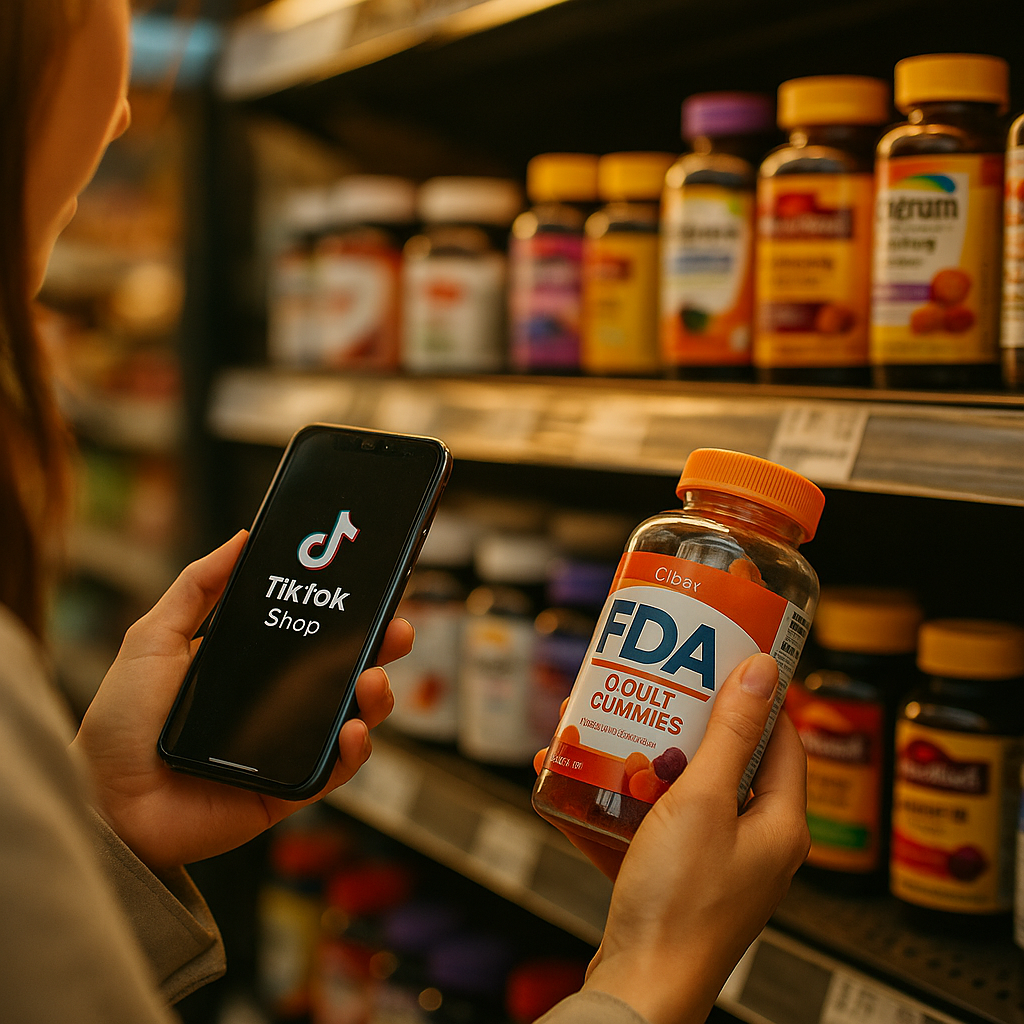
TikTok Shop Is Closed to You. The Sales Lift It Drives Isn’t.
TikTok Shop has generated billions in GMV, and CPG and healthcare brands are watching from the sideline. FDA regulations governing drug facts labeling, structure/function claims, and off-label promotion make native TikTok commerce a legal minefield. But American Eagle’s documented in-store sales lift from TikTok creator campaigns tells a different story: the platform is moving product off physical shelves even when no checkout button exists. If your legal team has blocked TikTok Shop, that does not mean you are locked out of the sales lift. It means you need a smarter infrastructure.
Why FDA-Regulated Brands Face a Unique TikTok Commerce Problem
The restriction is specific and worth naming precisely. TikTok Shop’s affiliate program and in-app checkout require product listings that include claims. For OTC pharmaceuticals, dietary supplements, medical devices, and even certain personal care items classified as drugs (think SPF moisturizers and anti-dandruff shampoos), those claims trigger FDA oversight. A creator saying “this clears up my acne overnight” on a product page is not just a compliance risk. It is a potential enforcement action.
That is before you layer in FTC disclosure requirements, which demand clear material connection labeling on any sponsored commerce content. Managing both FDA and FTC compliance simultaneously inside TikTok Shop’s fast-moving affiliate ecosystem is operationally brutal. Most regulated brands have made the right call to step back from the shop layer entirely.
The mistake is stepping back from TikTok creator investment altogether.
American Eagle’s experience shows TikTok creator content can drive measurable in-store foot traffic and purchase lift even without a native commerce integration. The platform influences the purchase decision. The transaction just happens somewhere else.
What American Eagle Actually Proved (and What It Means for Regulated Categories)
American Eagle ran creator campaigns that were not tied to TikTok Shop transactions and still documented meaningful in-store sales lift. The mechanism is straightforward: TikTok content functions as top-of-funnel discovery and mid-funnel consideration. Consumers see the product in context, develop intent, and convert in a physical or DTC environment where the brand controls the claim environment completely.
For a CPG brand selling an OTC allergy medication or a protein supplement with nuanced label claims, this is the exact path you want. You keep the FDA-compliant purchase environment. You still access TikTok’s unmatched discovery engine. You just need to build the right creator infrastructure to make the attribution visible.
The challenge is that most regulated brand marketers are measuring this wrong. They are looking for last-click digital attribution and finding nothing, then concluding TikTok creator investment has no ROI. That conclusion is structurally incorrect.
Restructuring Creator Investment Around Retail Attribution
Here is the operational reframe: stop treating TikTok creator spend as a performance channel and start treating it as a retail influence channel with a delayed, distributed conversion signal. That shift changes how you brief creators, how you measure, and how you allocate budget.
Brief for discovery, not click-through. Creators in regulated categories cannot make the claims that drive immediate purchase intent anyway. Lean into this. Brief them to create authentic use-occasion content: the morning routine, the gym bag, the medicine cabinet reveal. This is content that builds category and brand familiarity, which is exactly what drives the in-store lift American Eagle documented. For a detailed look at how brief architecture shapes this kind of outcome, the framework at creator brief architecture is directly applicable.
Build a geo-matched creator roster. In-store lift is only measurable if your creator audience overlaps with your retail distribution footprint. A TikTok creator with 200,000 followers concentrated in markets where you have strong CVS or Walgreens distribution is worth more to a regulated CPG brand than a creator with 2 million followers in markets where you have no shelf presence. Geographic audience vetting needs to be a mandatory pre-flight check for every creator in this program.
Use micro-creators as your primary vehicle. The in-store lift mechanic works best with high-trust, community-embedded creators. A 15,000-follower TikTok creator whose audience is concentrated in one metro area and who reviews products honestly has more retail influence per dollar than a macro influencer with diluted geographic reach. The micro-influencer benchmarks for engagement and conversion efficiency support this allocation heavily.
Route UGC into paid media immediately. Organic creator content that performs should be whitelisted and pushed into paid TikTok and Meta placements targeting retail catchment areas. This is where compliance-reviewed content delivers scale without the TikTok Shop claims problem. Your legal team has already reviewed the content. Your media team runs it as a dark post. For the mechanics of accelerating this process, the UGC-to-paid media workflow covers the 24-hour routing cycle in detail.
Measuring Lift Without a Native Commerce Signal
This is where most regulated brands stall. Without a TikTok Shop transaction ID, how do you prove the creator campaign drove retail sales?
Three measurement approaches are operational today. First, geo-lift studies: run creator content in matched market pairs, suppress in control markets, and measure Nielsen or IRI panel data for velocity differences at retail. Second, retailer sales data correlation: if you have access to Walmart Connect, Kroger Precision Marketing, or CVS Media Exchange data, you can correlate creator flight timing against POS velocity in specific DMAs. Third, branded search lift: creator campaigns drive branded search spikes that precede in-store purchase. Google Trends and your paid search impression share data give you a leading indicator before the retail data catches up.
None of these are perfect. All of them are better than assuming zero ROI because TikTok Shop is off the table.
Retail media network data from Walmart Connect and Kroger Precision Marketing is increasingly being used to close the attribution gap between creator-driven awareness and in-store conversion. If your brand has a retail media relationship, it should be integrated into your creator measurement stack now.
Compliance Infrastructure That Does Not Slow You Down
Regulated brands often sacrifice speed to compliance. That is a false trade-off when you design the system correctly upfront.
Build a pre-approved claims library that creators can pull from. Structure your briefs around benefit-adjacent language (“part of my morning routine,” “helps me feel ready”) rather than structure/function claims. Establish a 48-hour legal review SLA for creator content before it goes live, not after. For brands running ongoing programs, this becomes a repeatable process within two campaign cycles.
The UGC brand safety review framework outlines where human checkpoints need to sit in an otherwise automated workflow. For regulated categories, the human checkpoint is non-negotiable, but it does not need to be a bottleneck if you have staged it correctly.
Compensation structure also matters here. Flat-fee contracts with revision rights built in give you more compliance leverage than pure performance deals. Creators who are paid per post and own approval timelines have less incentive to iterate on claim language. For the full breakdown of how to structure these deals, see the guidance on hybrid flat fee and performance bonus contracts.
The Strategic Advantage in Being Blocked
Here is the counterintuitive read: FDA-regulated brands that cannot participate in TikTok Shop are being forced to build the more durable creator infrastructure. They cannot rely on affiliate commission incentives to motivate creators. They have to develop genuine brand affinity, better brief architecture, and measurement systems that actually connect creator spend to retail outcomes.
That infrastructure will outlast TikTok Shop’s current dominance. Platforms change. The ability to use creator content to drive retail consideration, measure it against POS data, and route it into paid media efficiently is a transferable capability. Brands building it now, under compliance pressure, will have a structural advantage when the next commerce platform emerges.
Your next step: Audit your current TikTok creator roster for geographic overlap with your top retail DMAs. If fewer than 60% of your creators have audience concentration in markets where you hold meaningful shelf space, your program is generating awareness you cannot convert. Fix that first.
Frequently Asked Questions
Why can’t FDA-regulated brands participate in TikTok Shop?
TikTok Shop’s affiliate and in-app checkout system requires product listings and creator content that includes product claims. For FDA-regulated products — including OTC drugs, dietary supplements, medical devices, and drug-cosmetic hybrids like SPF products — those claims are subject to strict FDA oversight. Managing compliant labeling and off-label promotion restrictions inside TikTok Shop’s fast-moving, creator-driven affiliate ecosystem is operationally and legally high-risk for most regulated brands, leading legal teams to restrict participation in the shop layer.
What is “in-store sales lift” and how does TikTok creator content drive it?
In-store sales lift refers to measurable increases in retail POS velocity attributable to a specific marketing activity. TikTok creator content drives in-store lift by functioning as a discovery and consideration engine. Consumers encounter a product in authentic use-occasion content, develop purchase intent, and then convert at a physical retailer where the brand controls the claim environment. American Eagle documented this mechanism in campaigns where no TikTok Shop integration existed — the content influenced the purchase decision, and the transaction happened in-store.
How do you measure TikTok creator ROI without a native commerce signal?
Three primary methods are operational for regulated brands: geo-lift studies using matched market pairs with retail panel data (Nielsen, Circana/IRI), POS velocity correlation using retail media network data from platforms like Walmart Connect or Kroger Precision Marketing, and branded search lift tracking using Google Trends and paid search impression share as a leading indicator. None replicate the precision of a TikTok Shop transaction ID, but combining two or three of these approaches builds a defensible attribution picture for finance and leadership review.
What types of creators work best for this retail-lift strategy?
Micro-creators (roughly 10,000 to 100,000 followers) with geographically concentrated audiences that overlap with your retail distribution footprint perform best. Their higher engagement rates and community trust drive more authentic consideration behavior than macro creators with diffuse, national audiences. The critical pre-flight check is geographic audience vetting: confirming that a creator’s follower concentration matches the DMAs where your brand holds meaningful shelf presence.
Can FDA-regulated brands still use TikTok for influencer marketing at all?
Yes. The restriction applies specifically to TikTok Shop’s commerce layer, not to TikTok as a creator marketing platform. Regulated brands can and should invest in TikTok creator content structured around use-occasion storytelling, brand familiarity, and lifestyle integration. This content can then be whitelisted and pushed into paid TikTok placements with compliance-reviewed copy, giving you reach and frequency without the claims liability of the shop integration.
Top Influencer Marketing Agencies
The leading agencies shaping influencer marketing in 2026
Agencies ranked by campaign performance, client diversity, platform expertise, proven ROI, industry recognition, and client satisfaction. Assessed through verified case studies, reviews, and industry consultations.
Moburst

-
2

The Shelf
Boutique Beauty & Lifestyle Influencer AgencyA data-driven boutique agency specializing exclusively in beauty, wellness, and lifestyle influencer campaigns on Instagram and TikTok. Best for brands already focused on the beauty/personal care space that need curated, aesthetic-driven content.Clients: Pepsi, The Honest Company, Hims, Elf Cosmetics, Pure LeafVisit The Shelf → -
3

Audiencly
Niche Gaming & Esports Influencer AgencyA specialized agency focused exclusively on gaming and esports creators on YouTube, Twitch, and TikTok. Ideal if your campaign is 100% gaming-focused — from game launches to hardware and esports events.Clients: Epic Games, NordVPN, Ubisoft, Wargaming, Tencent GamesVisit Audiencly → -
4

Viral Nation
Global Influencer Marketing & Talent AgencyA dual talent management and marketing agency with proprietary brand safety tools and a global creator network spanning nano-influencers to celebrities across all major platforms.Clients: Meta, Activision Blizzard, Energizer, Aston Martin, WalmartVisit Viral Nation → -
5

The Influencer Marketing Factory
TikTok, Instagram & YouTube CampaignsA full-service agency with strong TikTok expertise, offering end-to-end campaign management from influencer discovery through performance reporting with a focus on platform-native content.Clients: Google, Snapchat, Universal Music, Bumble, YelpVisit TIMF → -
6

NeoReach
Enterprise Analytics & Influencer CampaignsAn enterprise-focused agency combining managed campaigns with a powerful self-service data platform for influencer search, audience analytics, and attribution modeling.Clients: Amazon, Airbnb, Netflix, Honda, The New York TimesVisit NeoReach → -
7

Ubiquitous
Creator-First Marketing PlatformA tech-driven platform combining self-service tools with managed campaign options, emphasizing speed and scalability for brands managing multiple influencer relationships.Clients: Lyft, Disney, Target, American Eagle, NetflixVisit Ubiquitous → -
8

Obviously
Scalable Enterprise Influencer CampaignsA tech-enabled agency built for high-volume campaigns, coordinating hundreds of creators simultaneously with end-to-end logistics, content rights management, and product seeding.Clients: Google, Ulta Beauty, Converse, AmazonVisit Obviously →