


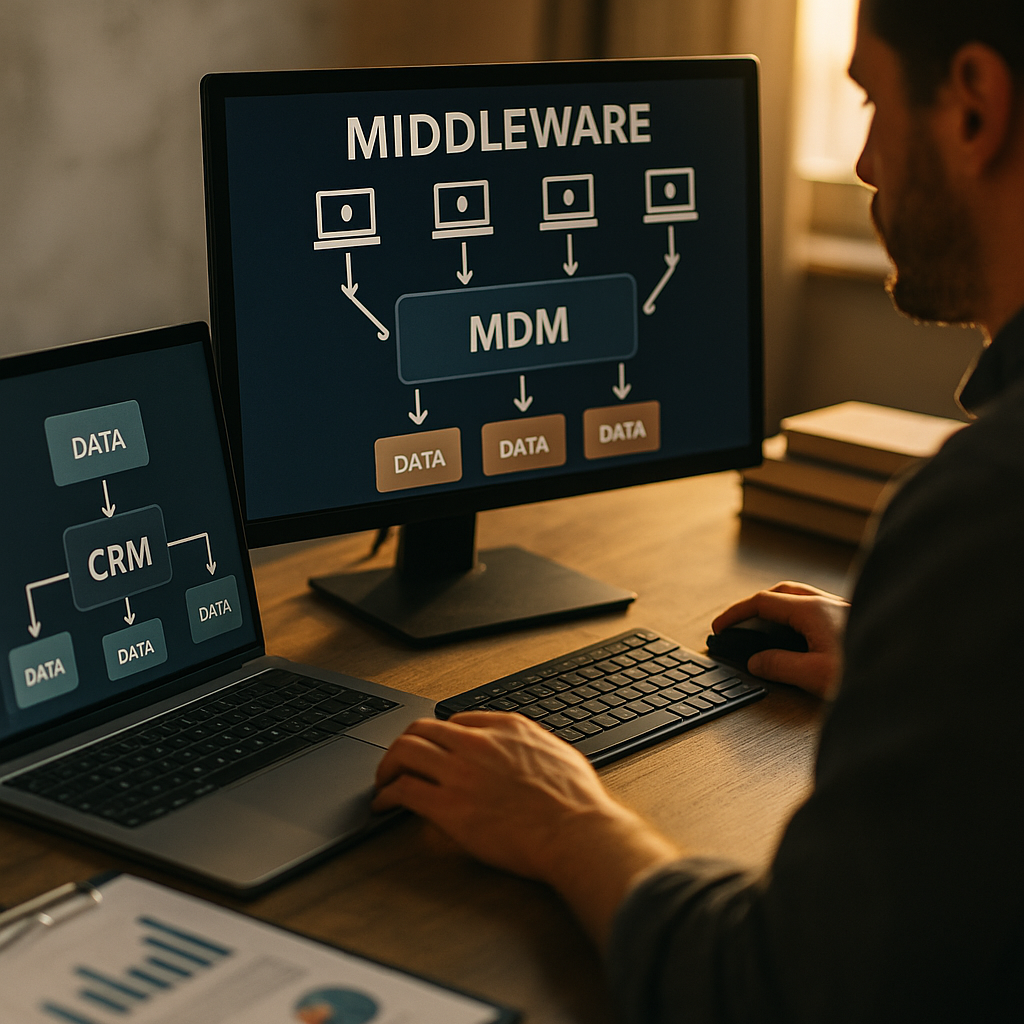
Choosing the right middleware solutions for connecting CRM to internal data can determine whether your customer records stay accurate, secure, and useful across the business. In 2026, teams need more than basic syncs. They need resilient integration that supports analytics, automation, governance, and scale. The real question is not whether to integrate, but which approach delivers lasting value?
Why CRM integration platforms matter for internal data access
Most organizations run their customer operations across multiple systems: ERP, billing, support, product databases, identity tools, data warehouses, and custom internal applications. A CRM may act as the system of engagement, but it rarely holds the full truth on its own. That is why CRM integration platforms have become central to sales, service, finance, and operations.
When middleware is chosen well, it creates a controlled path between the CRM and internal data sources. That path can support real-time lookups, bidirectional syncs, event-triggered workflows, and master-data governance. When it is chosen poorly, the result is duplicated records, broken workflows, API bottlenecks, and teams losing trust in the CRM.
From an EEAT perspective, this topic deserves practical evaluation rather than hype. Buyers should assess tools based on architecture, operational fit, and long-term maintainability. A middleware product that looks impressive in a demo may still fail if it cannot handle your internal security model, custom objects, or data volume.
In 2026, the strongest platforms typically support:
- API-based and event-driven integration for fast, reliable data movement
- Prebuilt connectors for common CRMs, databases, and enterprise systems
- Low-code tooling for speed, with developer options for complex logic
- Observability including logs, retries, alerts, and usage monitoring
- Governance controls such as role-based access, audit trails, and data policies
- Scalable deployment models across cloud, hybrid, and sometimes on-prem environments
The goal is not simply moving data. It is enabling trustworthy customer context without creating a fragile web of one-off integrations.
Top middleware software categories: iPaaS, ESB, reverse ETL, and custom API layers
There is no single category of top middleware software that fits every CRM integration challenge. The right choice depends on whether your priority is transactional sync, operational workflow automation, analytics activation, or strict enterprise control.
Integration Platform as a Service (iPaaS) is often the default choice for modern CRM connectivity. These platforms provide visual workflow builders, reusable connectors, and managed infrastructure. They work well when teams need to connect CRM data with finance, support, HR, or internal apps quickly. iPaaS is especially strong for mid-market and enterprise organizations that want speed without building every integration from scratch.
Enterprise Service Bus (ESB) remains relevant in large enterprises with legacy systems, complex service orchestration, and strict internal standards. ESB tools can provide centralized routing, transformation, and service mediation. However, they may require more specialized skills and longer implementation cycles than newer cloud-native tools.
Reverse ETL and data activation tools have become more important as companies centralize customer data in warehouses and lakehouses. These tools push modeled data from analytics environments back into CRM records and workflows. They are valuable when the warehouse is the trusted source of scoring, segmentation, product usage, or lifecycle data. Still, they usually complement, not replace, broader middleware.
Custom API layers and internal integration services make sense when organizations have unique security, latency, or domain logic requirements. A custom layer can expose normalized internal data to the CRM while abstracting the underlying complexity. This offers flexibility, but it also creates maintenance burden and depends heavily on internal engineering capacity.
For many teams, the best answer is a hybrid model:
- Use iPaaS for standard operational integrations
- Use reverse ETL for warehouse-to-CRM enrichment
- Use custom APIs for proprietary business logic or sensitive systems
- Keep ESB only where legacy enterprise architecture requires it
This mix reduces risk because each integration pattern serves the job it handles best.
How data integration tools compare on architecture, speed, and governance
When comparing data integration tools, buyers should move past surface-level feature lists. The most important differences usually appear in architecture, performance, supportability, and compliance readiness.
Architecture comes first. Some middleware platforms are workflow-centric, meaning they excel at triggering actions between applications. Others are API-led, making them better for reusable services and composable architectures. Still others focus on data pipelines and warehouse activation. If your CRM must query internal systems in real time, a batch-oriented tool will not be enough. If your use case is nightly enrichment, a heavy real-time architecture may be unnecessary and expensive.
Speed and latency matter because CRM users expect current information while they work. Sales teams may need immediate access to credit status, contract terms, or product telemetry. Support teams may need entitlement and order data in seconds, not hours. Middleware should be tested against real workflow requirements, including burst traffic, retries, and third-party API rate limits.
Transformation capability is another major differentiator. Internal data rarely matches CRM schema cleanly. A strong middleware layer can map, enrich, deduplicate, and validate records before they hit the CRM. That reduces downstream cleanup and improves trust in dashboards and automations.
Governance is where many projects succeed or fail after launch. The best platforms provide:
- Granular access controls for builders, admins, and auditors
- Versioning for flows and configurations
- Detailed run history and error diagnostics
- Support for data residency and secure credential handling
- Policy enforcement for personally identifiable information and regulated fields
Total cost of ownership also deserves close scrutiny. License fees are only part of the story. Consider implementation time, connector availability, support quality, developer requirements, and the effort needed to maintain changes when CRM objects or internal schemas evolve.
A practical shortlist should score each platform against actual scenarios such as account creation, product usage enrichment, invoice visibility, support escalation, and territory updates. Real use cases reveal trade-offs much faster than vendor feature matrices.
CRM middleware best practices for security, reliability, and scale
Adopting CRM middleware best practices helps teams avoid the common failure modes of integration projects. These include overloading the CRM with noisy updates, exposing sensitive internal data too broadly, and creating brittle processes that break every time a field changes.
Start with clear data ownership. Decide which system is the source of truth for each field and object. Without this, bidirectional integrations can create endless conflicts. For example, finance may own payment status, while the CRM owns opportunity stage and account hierarchy.
Next, design for minimum necessary data exposure. Not every internal attribute should appear in the CRM. Limit syncs to the fields needed for business decisions and workflows. This improves performance and supports privacy compliance.
Use event-driven patterns where possible. Polling can work for low-frequency updates, but event-based integration is usually more efficient and timely. It reduces lag and unnecessary API calls, especially when CRM records must reflect operational changes quickly.
Build resilience into every flow. Reliable middleware should support retries, dead-letter handling, fallback logic, and alerting. Internal systems go down. APIs timeout. Records fail validation. The right platform should make recovery manageable rather than manual.
Document mappings and business rules in language that both technical and business teams understand. This helps with onboarding, audits, and troubleshooting. It also reduces risk when staff changes occur.
Test at production-like scale. A flow that works for one thousand records may fail at one million. Include high-volume scenarios, duplicate prevention checks, and downstream dependency testing before launch.
Plan for change management. CRM admins, RevOps leaders, IT, security, and data teams should all be involved. Middleware sits between business-critical systems, so unmanaged changes can have wide impact.
Finally, define what success means. Typical KPIs include sync reliability, data freshness, duplicate reduction, workflow completion rates, support ticket resolution time, and user trust in CRM data quality.
Choosing enterprise middleware based on use case and team structure
The best enterprise middleware is not necessarily the most feature-rich option. It is the one that fits your company’s operational maturity, integration complexity, and team model.
If your organization has a small operations team and needs fast deployment, a low-code iPaaS with strong CRM and database connectors may be ideal. It allows non-developer specialists to manage routine workflows while keeping engineering involvement focused on exceptions.
If you run a highly regulated environment with hybrid infrastructure, you may need deeper control over deployment, identity, encryption, and auditability. In that case, an enterprise-grade platform with strong governance and optional self-hosted runtimes may be the safer choice.
If your business relies heavily on analytics-modeled customer data, a warehouse-centric pattern may provide more value. Reverse ETL can enrich CRM records with calculated lifetime value, churn risk, product adoption, or account health. But it should be paired with operational middleware if you also need transactional workflows.
A useful selection framework includes these questions:
- What CRM use cases matter most? Real-time support context, sales enrichment, quote-to-cash visibility, service automation, or executive reporting?
- Where does trusted data live? In transactional systems, internal services, a warehouse, or across all three?
- Who will build and maintain integrations? RevOps, IT, data engineering, enterprise architecture, or a shared team?
- What are the compliance requirements? Consider role-based access, auditability, regional controls, and data minimization.
- How often will schemas and processes change? Fast-moving businesses need tools that can adapt without large redevelopment cycles.
- What level of observability is required? Mission-critical integrations need strong monitoring, error handling, and support.
Running a proof of concept is often the smartest next step. Choose two or three critical use cases and test them with realistic data volume, real stakeholders, and clear evaluation criteria. That gives a far more accurate picture than relying on generic demos.
Future-ready CRM data synchronization trends shaping 2026 decisions
Several CRM data synchronization trends are influencing middleware decisions in 2026. Understanding them helps buyers avoid investing in approaches that will feel outdated too quickly.
Composable integration architecture is gaining traction. Instead of one platform doing everything, organizations are combining workflow automation, API management, event streaming, and warehouse activation in a more modular stack. This approach improves flexibility, though it requires stronger governance.
AI-assisted mapping and monitoring is becoming more useful, especially for schema changes, anomaly detection, and error triage. These features can speed implementation and reduce operational load, but they should support human review rather than replace it. Data quality and access control still require careful oversight.
Real-time customer context is now expected across sales and service functions. Teams want product usage, billing state, support history, and risk indicators visible inside the CRM at the moment of action. Middleware that cannot support near real-time processing may struggle to meet modern workflow expectations.
Governance by design is also moving higher on the priority list. Security teams increasingly expect integration projects to include field-level controls, auditability, and policy enforcement from the start. Middleware selection is now as much a governance decision as a technical one.
Internal data products are changing how integration is planned. Instead of treating every source system as a separate custom project, more companies are exposing curated internal data services for CRM and other business apps to consume. Middleware then acts as the orchestration and policy layer around those services.
The practical takeaway is simple: pick a solution that supports current requirements but does not lock your business into a rigid pattern. CRM integration should strengthen your architecture over time, not become the next legacy problem.
FAQs about CRM middleware and internal data integration
What is middleware for CRM integration?
Middleware is software that connects a CRM to other systems, databases, and internal applications. It moves, transforms, and governs data so teams can access accurate customer information without manual re-entry.
Which is better for connecting CRM to internal data: iPaaS or custom APIs?
It depends on the use case. iPaaS is usually faster for standard integrations and easier to manage for business and IT teams. Custom APIs are better when you need unique business logic, tighter security control, or specialized performance requirements. Many organizations use both.
Can reverse ETL replace CRM middleware?
Not fully. Reverse ETL is excellent for sending modeled data from a warehouse into a CRM, such as health scores or segment labels. But it usually does not replace broader middleware needed for operational workflows, transactional syncs, or system-to-system orchestration.
How do I keep CRM integrations secure?
Use role-based access, encrypt credentials, limit field exposure, maintain audit logs, and define source-of-truth rules. You should also test failure scenarios, monitor integration activity, and review permissions regularly.
What is the biggest mistake companies make when choosing middleware?
A common mistake is selecting a tool based on connectors alone. Connector count matters, but architecture fit, governance, observability, and long-term maintainability matter more. A platform that connects quickly but becomes hard to manage will create bigger problems later.
Should CRM data sync be real time or batch?
Use real time when users need immediate context for decisions or automated actions. Use batch when latency is acceptable and efficiency matters more than immediacy. Many companies combine both based on the specific business process.
How long does it take to implement CRM middleware?
Simple integrations can launch in weeks, while complex enterprise programs may take several months. The timeline depends on data quality, security review, source system complexity, ownership alignment, and testing requirements.
What teams should be involved in middleware selection?
Include CRM admins, RevOps or sales operations, IT, security, data engineering, and business stakeholders from sales, service, or finance. Middleware decisions affect multiple teams, so cross-functional input reduces rework and adoption problems.
Comparing middleware options works best when you focus on business outcomes, not just technical features. The right platform connects CRM to internal data in a way that is secure, observable, and adaptable. Prioritize architecture fit, governance, and operational ownership. If a solution supports your key use cases today and scales with change, it is likely the right investment.