


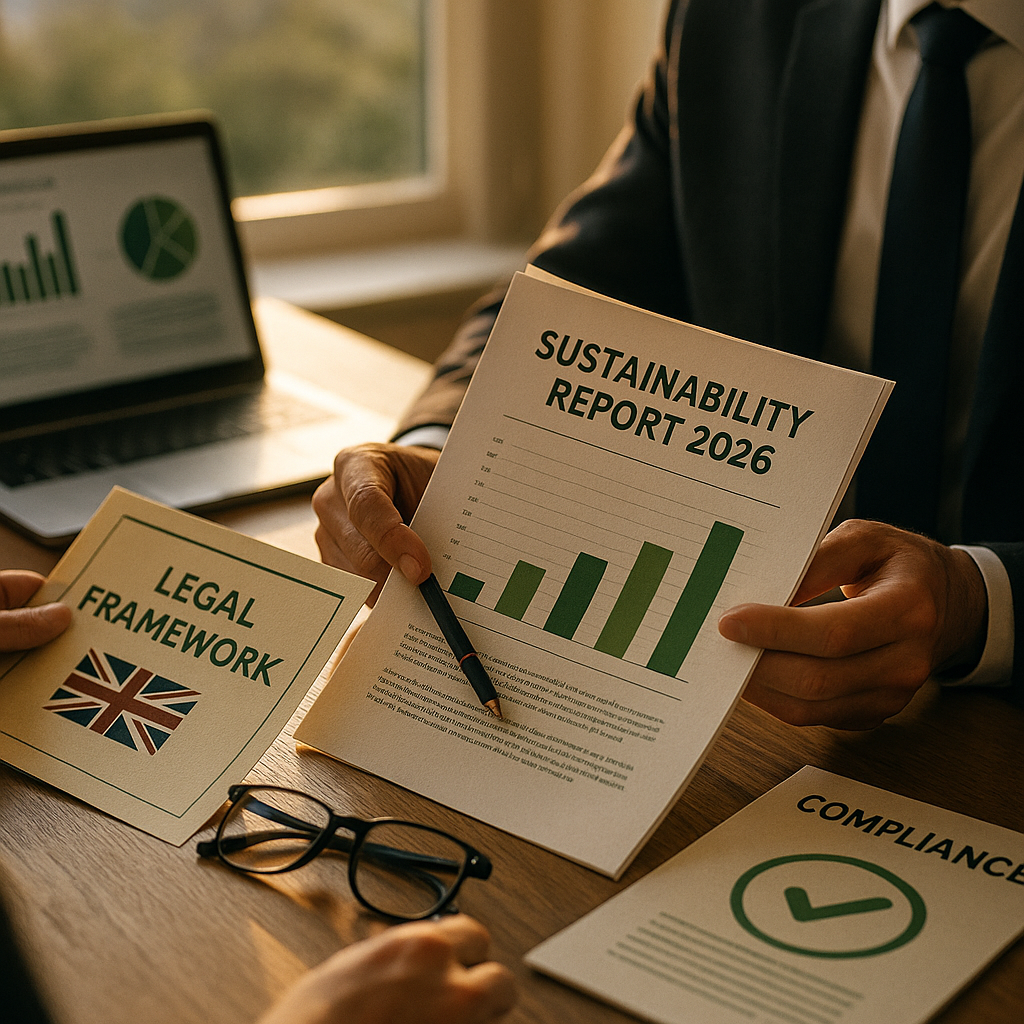
Legal disclosure requirements for sustainability in the UK have become a board-level priority in 2026. Companies now face tighter expectations from regulators, investors, lenders, customers, and employees to explain climate risk, ESG governance, and environmental claims with precision. Getting disclosures wrong can trigger penalties, litigation, and reputational damage. So what does compliant, credible reporting actually require?
UK sustainability reporting rules: the current legal framework
The UK does not rely on a single sustainability law. Instead, businesses must navigate a layered framework made up of company law, financial reporting obligations, sector-specific regulation, listing rules, anti-greenwashing standards, and supply chain transparency requirements. The exact duties depend on a company’s size, legal structure, industry, and whether it is listed, FCA-regulated, or part of an international group.
For many organisations, the starting point is to identify which of the following categories apply:
- Companies subject to mandatory climate-related financial disclosures under UK regulations for certain large companies and LLPs.
- Premium or standard listed issuers expected to report against climate-related disclosure expectations under Financial Conduct Authority rules.
- Asset managers, insurers, pension providers, and other FCA-regulated firms subject to sustainability disclosure and anti-greenwashing requirements.
- Businesses making environmental marketing claims that must comply with consumer protection and advertising rules.
- Commercial organisations caught by modern slavery legislation that must publish annual transparency statements covering supply chain risks.
The legal focus has also shifted from broad ESG narratives to decision-useful, evidence-based disclosure. Regulators increasingly expect companies to explain governance, risk management, targets, metrics, transition planning, and material impacts in a way that aligns with actual business activity. Boilerplate wording and unsupported ambition statements now create obvious legal risk.
In practice, many UK organisations must manage sustainability disclosure across annual reports, strategic reports, websites, investor materials, product claims, supplier statements, and internal governance documents. Consistency across these channels matters. A claim that appears harmless on a landing page can undermine the credibility of formal reporting if the wording overstates performance or omits important qualifications.
Climate-related financial disclosures UK: what large companies must report
Climate disclosure remains the most developed area of sustainability reporting in the UK. Large companies and LLPs within scope are generally required to include climate-related financial disclosures in their non-financial reporting. These disclosures are built around the well-known pillars of governance, strategy, risk management, and metrics and targets.
Boards should expect to disclose:
- How directors and senior management oversee climate-related risks and opportunities.
- How climate issues affect business model, strategy, and resilience.
- How climate-related risks are identified, assessed, and managed.
- Which climate metrics and targets the business uses, and how performance is tracked.
Many companies also need to report energy use and greenhouse gas emissions under separate carbon and energy reporting requirements. The legal challenge is not simply gathering data, but making sure the numbers, narrative, assumptions, and boundaries all match. If emissions data excludes certain operations, the report should say so clearly. If targets depend on future technology, offsets, or supplier decarbonisation, those assumptions should be explained rather than implied.
A common board question is whether scenario analysis is always required. The safe answer is to assess materiality carefully and document the reasoning. Where climate risk is material, decision-makers should be ready to explain how resilience has been evaluated and whether different climate pathways could alter financial outcomes. Investors and auditors increasingly look for evidence that climate has been embedded into enterprise risk management rather than treated as a separate ESG exercise.
Another common question is whether private companies can ignore investor-grade climate reporting. Often they cannot. Lenders, procurement teams, and multinational customers now ask for detailed climate information during due diligence. Even where a regulation does not directly apply, commercial pressure can create a de facto disclosure obligation. Businesses that prepare early usually reduce legal and operational friction later.
FCA sustainability disclosure requirements: anti-greenwashing and regulated firms
For FCA-regulated firms, sustainability claims now attract far more scrutiny. The FCA’s sustainability disclosure requirements framework, together with the anti-greenwashing rule, pushes firms to ensure that sustainability-related references are fair, clear, and not misleading. This applies not just to formal disclosures, but also to customer communications, website copy, fund naming, product descriptions, and promotional materials.
The anti-greenwashing standard effectively requires firms to test every sustainability statement against evidence. That means asking:
- Is the claim specific? Vague terms such as “green,” “responsible,” or “sustainable” can mislead without context.
- Can the claim be substantiated? Internal data, methodologies, and governance records should support it.
- Are important limitations disclosed? If a product excludes only a narrow set of investments, say so.
- Is the presentation balanced? Benefits should not be highlighted while trade-offs are hidden.
- Will the average audience understand it? Technical jargon does not cure a misleading message.
Senior managers should also remember that sustainability disclosure failures can spill into broader conduct, governance, and systems-and-controls issues. If a firm lacks documented approval workflows for ESG claims, weak oversight may become as important as the wording itself. Good practice includes legal review, compliance sign-off, version control, source documentation, and periodic testing of disclosures already in the market.
Although the FCA framework directly targets regulated firms, its influence reaches further. Unregulated businesses often adopt similar controls because investor and commercial counterparties increasingly expect equivalent discipline. In short, if a company talks about sustainability to win trust or capital, it should expect that message to be tested.
Greenwashing laws UK: marketing claims, consumer protection, and litigation risk
Outside formal reporting, one of the fastest-growing legal risks is greenwashing. In the UK, environmental claims can trigger action under consumer protection law, advertising regulation, competition scrutiny, and private litigation. The Competition and Markets Authority’s Green Claims Code remains a practical benchmark for assessing whether statements are likely to mislead.
The key principles are straightforward but demanding. Environmental claims should be:
- Truthful and accurate
- Clear and unambiguous
- Supported by robust evidence
- Meaningful across the full lifecycle where relevant
- Not misleading by omission or comparison
- Fair when considering the overall product or business impact
Companies often create avoidable exposure by using absolute claims where a qualified statement would be safer. For example, saying a product is “carbon neutral” without explaining the role of offsets, calculation methodology, and scope exclusions can invite challenge. The same applies to claims such as “100% recyclable,” “net zero,” or “sustainably sourced” if the underlying evidence is partial or conditional.
In-house teams should align legal, compliance, sustainability, and marketing functions before publication. That alignment is essential because many disputes arise from mixed messaging: the sustainability team uses technical definitions, while marketing shortens them into broad claims that overpromise. Once such statements are published, they can be cited by regulators, activists, customers, investors, and claimant firms.
A practical approach is to build a claims register. This should record each public environmental claim, the evidence supporting it, the approval owner, relevant qualifications, and review dates. If challenged, a company can then show that the statement was not improvised and that governance existed at the time of publication.
Streamlined energy and carbon reporting UK: emissions, governance, and audit readiness
For many organisations, emissions reporting is the operational core of sustainability disclosure. Streamlined energy and carbon reporting requires qualifying entities to disclose energy use, emissions, and at least one intensity ratio, together with energy efficiency action where relevant. While the framework sounds technical, the legal issue is credibility. If the calculation boundaries or methodologies are weak, the disclosure becomes vulnerable.
Boards should focus on four practical questions:
- What is included? Confirm the reporting perimeter across subsidiaries, leased assets, and overseas operations.
- How is the data collected? Document source systems, estimation methods, and control weaknesses.
- Which methodology is used? Apply a recognised approach consistently and explain departures.
- Who verifies the output? Internal review is the minimum; external assurance may be appropriate for higher-risk disclosures.
Businesses frequently underestimate the legal importance of internal controls. Sustainability data is now used in financing, procurement, remuneration design, and public commitments. That means errors can move beyond reporting into contract, investor, and employment issues. A missing utility dataset or a flawed emissions factor can seem minor until a transition target, loan covenant, or executive incentive depends on it.
Audit readiness is therefore no longer optional for mature businesses. Even where external assurance is not legally required, companies should prepare as though their disclosures will be tested line by line. Good evidence includes board minutes, methodology papers, supplier confirmations, spreadsheets with version history, and internal challenge records. If assumptions changed from the prior reporting cycle, explain why. Transparent corrections usually cause less damage than silent inconsistencies.
Supply chain due diligence UK: modern slavery, human rights, and broader ESG transparency
Sustainability disclosure in the UK is not limited to climate and carbon. Supply chain transparency remains a major legal concern, especially under modern slavery rules. Commercial organisations above the relevant threshold must publish an annual statement describing steps taken to address slavery and human trafficking risks in operations and supply chains. Even where a company falls outside the strict legal threshold, customers may still require equivalent disclosures through procurement terms.
Strong statements usually address:
- Organisational structure and supply chain profile
- Policies on modern slavery and human rights
- Due diligence processes for suppliers and high-risk geographies
- Risk assessment and prioritisation methods
- Training for staff and suppliers
- Effectiveness measures and remediation steps
The legal mistake many organisations make is treating the statement as a standalone website obligation. In reality, it should align with supplier contracts, onboarding questionnaires, whistleblowing channels, grievance mechanisms, and procurement governance. If the public statement promises supplier audits or contractual controls that do not exist in practice, the company creates obvious exposure.
More broadly, stakeholders increasingly expect disclosure on biodiversity impacts, waste, packaging, water use, and social value. Not every topic is mandatory for every business, but materiality must be assessed honestly. If a company has significant environmental dependency or social risk in its value chain, silence can become hard to justify. The right question is not “Can we avoid mentioning this?” but “Would a reasonable stakeholder consider this important to understanding our business?”
For legal teams, the most effective response is to create a disclosure map. This map should identify every sustainability-related legal statement the organisation makes, who owns it, what evidence supports it, and how often it is reviewed. That process reduces duplication, exposes gaps, and helps the board demonstrate active oversight.
FAQs
Who must comply with sustainability disclosure rules in the UK?
There is no single answer. Duties depend on whether the organisation is a large company or LLP, a listed issuer, an FCA-regulated firm, or a business making environmental claims or publishing supply chain statements. The first step is a legal scoping exercise based on size, sector, structure, and activities.
Are sustainability disclosures mandatory for private companies?
Some are. Certain large private companies and LLPs must make climate-related disclosures, and qualifying entities may face carbon and energy reporting duties. Even when a specific legal requirement does not apply, investors, lenders, and major customers often require equivalent disclosure as a commercial condition.
What is the biggest legal risk in sustainability reporting?
For many businesses, it is inconsistency between public claims and underlying evidence. That includes overstated net-zero messaging, unsupported product claims, weak emissions data, and governance statements that do not reflect actual board oversight. Regulators focus closely on whether communications are fair, clear, balanced, and substantiated.
How can a company reduce greenwashing risk?
Use specific language, keep evidence on file, explain assumptions and limitations, align legal and marketing review, and refresh claims regularly. Avoid absolute statements unless they are fully supportable. If a claim depends on offsets, future plans, or narrow criteria, disclose that context clearly.
Do companies need external assurance for sustainability disclosures?
Not in every case, but assurance expectations are growing. Even where it is not mandatory, external review can improve governance, strengthen investor confidence, and reduce the risk of material errors. At minimum, companies should maintain audit-ready records and internal controls.
What should directors do now?
Directors should confirm which disclosure regimes apply, assign ownership, test material sustainability risks, approve a claims governance process, and ensure that annual report disclosures match website, product, and investor communications. Board minutes should show active scrutiny rather than passive receipt of ESG updates.
Navigating UK sustainability disclosure in 2026 means more than publishing an ESG report. Businesses need a clear legal scoping exercise, reliable data, disciplined governance, and evidence-backed claims across every public channel. The strongest approach is simple: disclose what matters, substantiate every statement, explain limits honestly, and treat sustainability reporting with the same rigor as financial reporting.
Top Influencer Marketing Agencies
The leading agencies shaping influencer marketing in 2026
Agencies ranked by campaign performance, client diversity, platform expertise, proven ROI, industry recognition, and client satisfaction. Assessed through verified case studies, reviews, and industry consultations.
Moburst

-
2

The Shelf
Boutique Beauty & Lifestyle Influencer AgencyA data-driven boutique agency specializing exclusively in beauty, wellness, and lifestyle influencer campaigns on Instagram and TikTok. Best for brands already focused on the beauty/personal care space that need curated, aesthetic-driven content.Clients: Pepsi, The Honest Company, Hims, Elf Cosmetics, Pure LeafVisit The Shelf → -
3

Audiencly
Niche Gaming & Esports Influencer AgencyA specialized agency focused exclusively on gaming and esports creators on YouTube, Twitch, and TikTok. Ideal if your campaign is 100% gaming-focused — from game launches to hardware and esports events.Clients: Epic Games, NordVPN, Ubisoft, Wargaming, Tencent GamesVisit Audiencly → -
4

Viral Nation
Global Influencer Marketing & Talent AgencyA dual talent management and marketing agency with proprietary brand safety tools and a global creator network spanning nano-influencers to celebrities across all major platforms.Clients: Meta, Activision Blizzard, Energizer, Aston Martin, WalmartVisit Viral Nation → -
5

The Influencer Marketing Factory
TikTok, Instagram & YouTube CampaignsA full-service agency with strong TikTok expertise, offering end-to-end campaign management from influencer discovery through performance reporting with a focus on platform-native content.Clients: Google, Snapchat, Universal Music, Bumble, YelpVisit TIMF → -
6

NeoReach
Enterprise Analytics & Influencer CampaignsAn enterprise-focused agency combining managed campaigns with a powerful self-service data platform for influencer search, audience analytics, and attribution modeling.Clients: Amazon, Airbnb, Netflix, Honda, The New York TimesVisit NeoReach → -
7

Ubiquitous
Creator-First Marketing PlatformA tech-driven platform combining self-service tools with managed campaign options, emphasizing speed and scalability for brands managing multiple influencer relationships.Clients: Lyft, Disney, Target, American Eagle, NetflixVisit Ubiquitous → -
8

Obviously
Scalable Enterprise Influencer CampaignsA tech-enabled agency built for high-volume campaigns, coordinating hundreds of creators simultaneously with end-to-end logistics, content rights management, and product seeding.Clients: Google, Ulta Beauty, Converse, AmazonVisit Obviously →