


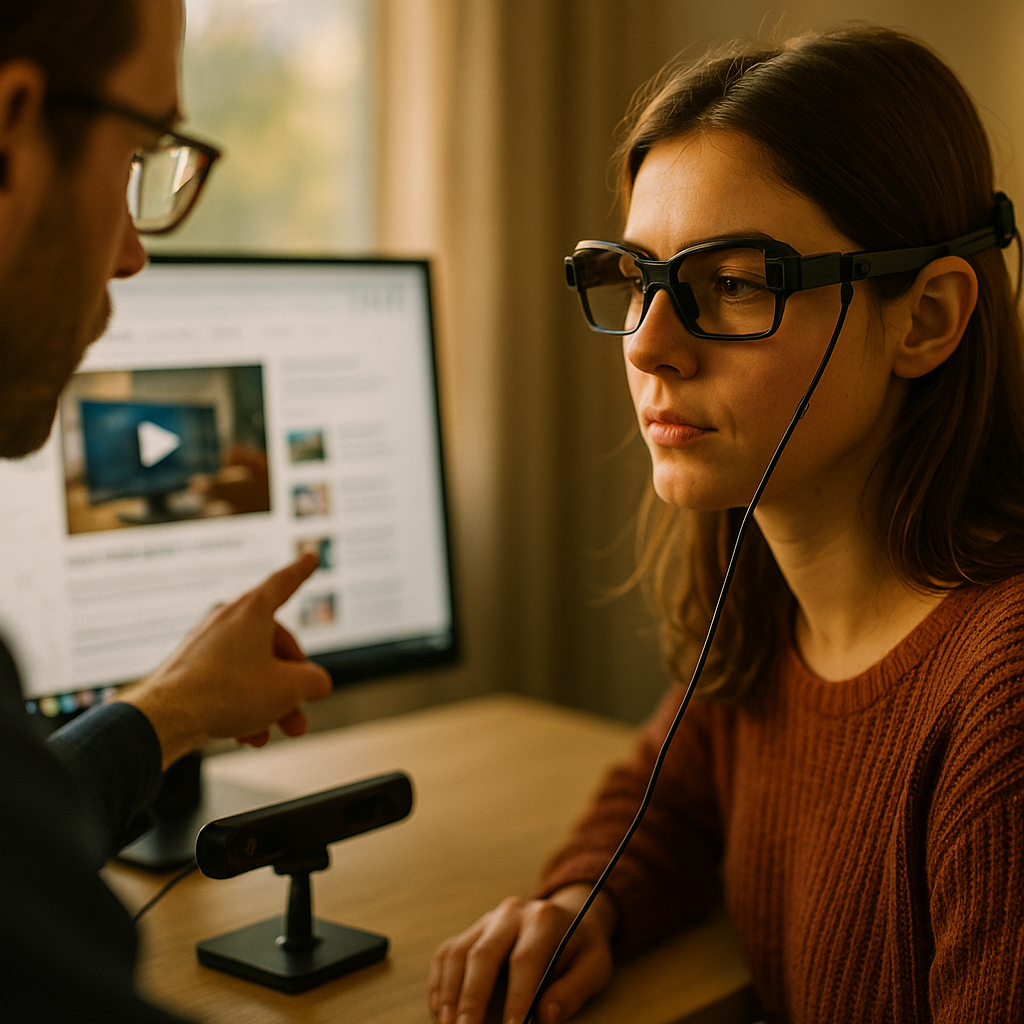
Marketers and UX teams want feedback that reflects real attention, not just clicks. This review of eye-tracking tools focuses on options that support real-time content performance: what people look at, what they miss, and how quickly they decide. In 2025, fast experiments matter because audiences scroll faster and platforms change weekly—so which tools truly help you act today?
Eye-tracking software: what “real-time” means for content teams
Eye tracking is no longer limited to lab studies and academic research. Modern systems can capture gaze points, fixations (where the eyes pause), saccades (quick jumps), and pupil changes. For content performance, the practical question is simpler: can the tool tell you during a session whether your headline, hero image, offer, or CTA is being seen and understood?
In 2025, “real-time” typically falls into three tiers:
- True live monitoring (seconds): You can see gaze streams as a participant browses. This is most common with hardware-based trackers in moderated tests.
- Rapid processing (minutes): The session runs, then heatmaps and metrics render almost immediately. This is common in research platforms that automate analysis.
- Continuous insight (hours/days): You can repeatedly test variations and get aggregated results quickly enough to guide weekly production, even if not “live.” Many webcam-based solutions sit here.
When evaluating “real-time content performance,” prioritize these outputs:
- Time to first fixation on headline, price, or CTA (a clarity proxy).
- Fixation duration on key blocks (depth of processing).
- Attention distribution across layout modules (what wins and what gets ignored).
- Scroll and fold behavior paired with attention (what is never even seen).
Also confirm that the tool supports your reality: responsive pages, localization, different devices, and fast iteration with designers and editors. “Real-time” is only useful if it fits your workflow.
Real-time UX research: hardware trackers vs webcam-based tools
Your first decision is capture method. Hardware trackers (e.g., infrared devices) usually deliver higher accuracy and stability. Webcam-based tools trade precision for scale and speed, enabling more participants without shipping equipment. For real-time performance work, each has a clear place.
Hardware-based eye tracking typically offers:
- Higher spatial accuracy (better for small UI elements, dense navs, and comparisons).
- More reliable calibration across lighting conditions.
- Better suitability for moderated sessions where you want to react live.
Trade-offs: Higher cost, smaller sample sizes, and more logistics. You may need a dedicated setup and participants who can join a controlled environment (in-house or via a research facility).
Webcam-based eye tracking typically offers:
- Faster recruiting and larger samples for content and creative comparisons.
- Remote, unmoderated testing that fits agile teams and tight timelines.
- Lower cost per study, making ongoing measurement feasible.
Trade-offs: Lower accuracy, variable lighting and camera quality, and more noise in the data. These tools excel at directional insights (what draws attention, what doesn’t) rather than pixel-perfect gaze positions.
Practical guidance: If your question is “Do readers notice the CTA within 2 seconds?” webcam-based can be enough. If your question is “Which of these three inline links gets attention in a dense paragraph?” hardware-based will be more dependable.
Gaze analytics: core metrics, dashboards, and reporting that matter
Eye-tracking value depends less on pretty heatmaps and more on interpretable, decision-ready metrics. In content performance, you want analysis that connects attention to outcomes like comprehension, recall, and conversion intent—without over-claiming causality.
Look for tools that provide:
- Areas of Interest (AOIs): Define headline, deck, hero, CTA, price, trust badges, navigation, and related content modules.
- Time to First Fixation (TTFF): How quickly an AOI is noticed.
- Total Fixation Duration: How much attention an AOI receives.
- Revisits: Whether users return to price, terms, or key claims (often a sign of uncertainty).
- Gaze paths: Common viewing sequences; helpful for above-the-fold hierarchy.
- Attention vs scroll mapping: Especially important for long-form pages and mobile layouts.
Dashboards should support both specialists and stakeholders. A strong platform offers:
- Role-based summaries for editors and marketers (what to change) plus deep dives for researchers (why it happened).
- Segment comparisons (new vs returning visitors, region/language, device types).
- Export options for design reviews and evidence packs (images, clips, CSV).
Follow-up question teams often ask: “Can we use attention as a KPI?” Use it as a diagnostic KPI. Attention helps explain underperformance (e.g., a CTA not seen), but it doesn’t replace business metrics. The best workflow pairs eye tracking with click, form, and revenue data to confirm impact.
Conversion rate optimization: integrating eye tracking with A/B tests and analytics
To influence real-time content performance, eye tracking must integrate with your experimentation stack. The goal is to shorten the loop between “we think this is the problem” and “we proved a better variant.”
Prioritize tools that support these integration patterns:
- Experiment-friendly creative testing: Compare multiple hero treatments, headline structures, CTA placements, and trust elements with consistent AOIs.
- Behavioral context: Session recordings, clicks, and scroll depth alongside gaze to avoid misinterpretation.
- Fast iteration: Upload new variants quickly, reuse AOI templates, and rerun studies without rebuilding everything.
How to connect eye tracking to A/B decisions:
- Start with a failure mode: “Readers don’t reach the offer,” “They miss the CTA,” or “They fixate on irrelevant visuals.”
- Define attention targets: TTFF under a threshold for the CTA, increased fixation duration on value props, reduced fixation on distracting elements.
- Use eye tracking to choose candidates: Pick 1–2 strongest layout changes, then validate with A/B tests using conversion and engagement metrics.
- Document the chain of evidence: Attention improved, comprehension improved (via a short question), then conversions improved.
Answering the common objection: “Why not just use heatmaps from click tools?” Click maps show interaction, not attention. Many users read, compare, and decide without clicking. Eye tracking fills the blind spot: what they considered before acting or abandoning.
Privacy and compliance: biometric data handling and consent in 2025
Eye tracking can involve biometric signals and sensitive inferences (attention, fatigue, cognitive load). In 2025, teams must treat this data carefully to maintain trust and reduce legal risk. Even when you use webcam-based estimation rather than medical-grade biometrics, you still collect behavioral signals that require clear governance.
Choose tools and processes that demonstrate strong compliance hygiene:
- Explicit, informed consent: Explain what is captured (gaze estimation, video, screen), why, and how long it’s stored.
- Data minimization: Collect only what you need. If heatmaps and gaze coordinates suffice, avoid storing raw face video.
- Retention controls: Set default deletion windows and allow study-level overrides with approval.
- Access controls and audit logs: Ensure only authorized roles can view raw recordings.
- Secure processing: Encryption in transit and at rest, plus clear subprocessors disclosure.
From an EEAT standpoint, your credibility improves when you document your methodology and ethics: calibration steps, participant criteria, known limitations, and the boundaries of interpretation. Stakeholders trust findings more when you’re transparent about uncertainty.
Follow-up question: “Can we run eye tracking on live website visitors?” That’s typically much harder to justify ethically and legally than running opt-in research studies. Most content teams use opt-in panels, customer advisory groups, or moderated sessions with clear consent.
Buying guide for eye-tracking platforms: choosing tools for content performance
Rather than naming a single “best” tool, the most useful review approach is mapping tool types to job-to-be-done. Eye-tracking platforms in 2025 generally fall into four categories, each with strengths for real-time content performance.
1) Hardware eye-tracking systems (lab or portable)
- Best for: High-stakes UX changes, dense UIs, detailed visual hierarchy work, and moderated “watch it live” sessions.
- Key features to demand: Strong calibration, AOI tooling, robust gaze path visualizations, and reliable exports for research reports.
- Watch-outs: Setup time, sample size constraints, and the risk of overfitting decisions to a small group.
2) Webcam-based remote eye-tracking platforms (unmoderated)
- Best for: Rapid content comparisons, headline and hero testing, CTA placement, and iterative creative work across segments.
- Key features to demand: Quality checks (camera/lighting), confidence scoring, automated heatmaps, and fast turnaround.
- Watch-outs: Lower spatial accuracy; treat results as directional and validate with A/B tests.
3) UX research suites with eye-tracking add-ons
- Best for: Teams that want one workflow for recruitment, consent, tasks, surveys, recordings, and attention analytics.
- Key features to demand: Study templates, task-based analysis, integrations with design tools, and stakeholder-friendly reporting.
- Watch-outs: Add-on pricing and limits on raw data access depending on plan.
4) Ad and creative attention measurement tools
- Best for: Above-the-fold attention, brand assets, social creatives, and comparing multiple ad variants quickly.
- Key features to demand: Variant testing at scale, segment breakdowns, and clear guidance for creative edits.
- Watch-outs: May be optimized for ads rather than complex web pages; confirm support for long-form content and scroll behavior.
Procurement checklist (practical and non-negotiable):
- Validity evidence: Ask how accuracy is tested, what confidence metrics you receive, and what conditions reduce quality.
- Methodology transparency: Clear definitions for fixations, attention scoring, and filtering rules.
- Workflow speed: Time from study launch to decision-ready outputs; AOI reuse saves hours.
- Collaboration: Commenting, shareable reports, and stakeholder summaries.
- Compliance: Consent flows, retention controls, security posture, and regional data handling options.
- Support and expertise: Access to research guidance, not just technical support. This is where many teams gain or lose time.
If you need results within a sprint, favor tools with strong templates, automated QA, and fast processing. If you need high-precision gaze mapping for product UX, invest in hardware-grade accuracy and skilled moderation.
FAQs about eye-tracking tools for real-time content performance
What can eye tracking tell me that analytics can’t?
Eye tracking shows what users look at and in what order. Analytics shows what users do (click, scroll, convert). When conversions drop, eye tracking can reveal whether people missed the offer, got stuck reading fine print, or focused on distracting visuals.
Is webcam-based eye tracking reliable enough for decision-making?
Yes for directional content and creative decisions: headline prominence, hero dominance, CTA discoverability, and obvious distractions. For precise comparisons of small UI elements or dense layouts, rely on hardware tracking or validate with additional methods.
How many participants do we need for useful insights?
For qualitative diagnosis in moderated sessions, small samples can uncover major hierarchy issues. For unmoderated comparisons across variants and segments, use larger samples to reduce noise. Most teams start with a smaller pilot to confirm the method, then scale once metrics stabilize.
Can eye tracking improve SEO content performance?
Indirectly. Eye tracking can help you structure pages so readers notice the main promise, supporting points, internal links, and trust elements quickly. Better clarity and engagement can improve user satisfaction signals and conversion outcomes, which supports SEO strategy.
How do we avoid misinterpreting heatmaps?
Use defined AOIs, compare variants under the same tasks, and pair attention data with outcomes like comprehension questions, task success, or conversions. Heatmaps are summaries; decisions should rely on metrics (TTFF, duration, revisits) and session context.
What’s the fastest way to operationalize eye tracking for weekly publishing?
Standardize a test template: consistent tasks, fixed AOIs for common modules (headline, hero, CTA, trust), and a simple decision rule (e.g., CTA TTFF target). Run quick studies on 1–2 variants, then validate winning changes in your experimentation platform.
Eye tracking can turn “we think this layout works” into measurable attention evidence—fast enough to steer content decisions without waiting for weeks of conversion data. In 2025, the best tools combine usable accuracy, rapid reporting, and responsible data handling. Choose hardware for precision, webcam platforms for scale, and always connect attention metrics to outcomes through experiments. That’s the path to confident, real-time improvements.