


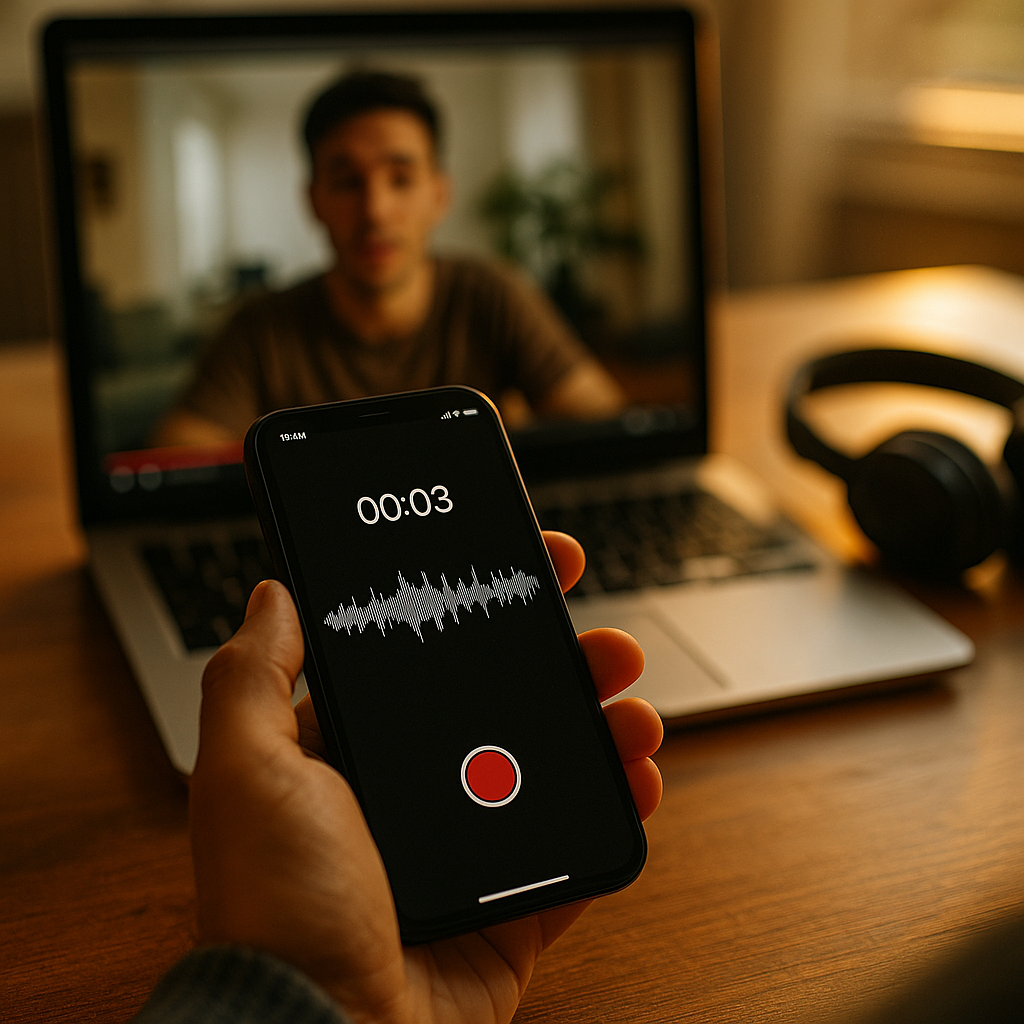
Skip rates on polished vertical video ads now top 70% in the first two seconds, according to eMarketer benchmarks. Meanwhile, a scratchy 40-second audio clip that sounds like a friend forwarding a tip is getting full listens. Welcome to voice note style audio ads, the format that trades production value for the one thing every feed is starving for: intimacy.
What Voice Note Style Audio Ads Actually Are
Strip away the jargon and it’s simple. A voice note style audio ad mimics the sound and pacing of a personal voice memo, the kind you’d send a friend from a group chat. Think slightly compressed audio, ambient room tone, a natural pause before the point lands, maybe a stumble that doesn’t get edited out. It’s the opposite of a radio spot. No jingle, no announcer voice, no studio reverb.
The format works because it borrows credibility from a context we already trust: private messaging. When Sarah forwards you a voice note about a skincare serum, you don’t assume she’s being paid. Brands are now engineering that same sonic signature into paid placements, running them as Spotify audio ads, podcast pre-rolls, Instagram Stories with waveform visuals, and even WhatsApp-style creator drops.
The format’s power isn’t the message, it’s the delivery mechanism. A voice note bypasses the ad-detection instinct because our brains file it under “personal correspondence,” not “marketing.”
Why This Is Landing Now
Three forces converged to make this the moment for voice note ads. First, audio consumption is exploding: podcast ad spend keeps climbing according to Statista data, and platforms like Spotify and Amazon have built out programmatic audio inventory that didn’t exist five years ago. Second, feed fatigue with hyper-produced content has pushed audiences toward rawness, a pattern we’ve already tracked in throwback content formats that outperform polish. Third, and this is the underrated driver, AI voice cloning and editing tools have made it cheap to produce dozens of “spontaneous sounding” variants without booking a studio.
That last point matters for anyone running budget math. A single creator can record twenty voice note variations in an afternoon, no lighting, no b-roll, no reshoots for a flubbed line. Compare that to the cost structure behind vertical documentary shorts, and the efficiency case writes itself.
The ROI Case Brands Are Making
Completion rate is the metric turning heads internally. Audio ads under 30 seconds that mimic voice notes are reportedly seeing completion rates 20 to 35% higher than standard pre-roll audio, based on early campaign data shared by agency partners running Spotify and podcast buys. Nobody skips a voice note the way they skip a banner. There’s a social contract embedded in the format: you listen because it sounds like it was meant for you specifically.
For brands, that translates into a lower cost-per-completed-listen and, more importantly, higher recall. Recall is the whole game in audio, since there’s no visual retargeting hook. If the voice, the tone, and the specific phrasing stick, the brand sticks.
- Lower production cost: no set, no camera crew, minimal editing beyond noise-gating.
- Faster iteration: creators can turn around a batch of variants in hours, not days.
- Higher perceived authenticity: listeners rate voice-note-style ads as “less salesy” in informal creator agency surveys.
- Cross-platform flexibility: the same audio file works as a podcast spot, an Instagram Story waveform post, or a WhatsApp Business broadcast.
Where the Format Actually Fits in a Media Plan
Voice note ads aren’t a replacement for your hero video or your always-on UGC pipeline. They’re a mid-funnel intimacy play, best deployed where a listener has already shown some interest: retargeting audiences, podcast listeners in a relevant niche, or as a companion asset to a broader creator campaign. Pair one with a founder story and you get something close to the trust-building effect documented in founder-led video content, except audio-only and cheaper to scale.
Some brands are also testing the format at the top of funnel for category education, using a “friend explaining a product” tone instead of a feature list. That’s a deliberate echo of the silent, understated shift covered in silent vlog content trends, where subtlety outperforms volume.
Casting and Creative Direction: What Actually Works
The biggest mistake brands make is scripting a voice note ad like a traditional spot and then asking the creator to “sound more casual.” That backfires. Casual can’t be bolted on after the fact, it has to be built into the brief.
Better approach: give the creator a real scenario, not a script. “You just tried this for the first time and you’re texting your sister about it” produces a wildly different read than “read this 40-word paragraph naturally.” The former gets genuine pauses, genuine word choice, genuine enthusiasm or skepticism. The latter gets an actor reading copy slowly.
- Brief the emotional context, not the exact wording.
- Allow one imperfection per take (a laugh, a restart, a “wait, let me say that better”).
- Keep total runtime between 20 and 45 seconds, longer starts to feel performative.
- Record in a real environment, a kitchen or a car, not a padded booth.
- Avoid direct calls to action mid-note, save it for a tag line or on-screen caption.
This is the same discipline behind the messier content movement we’ve documented in brand safety without rigid rules. Controlled imperfection, not chaos.
Compliance: The Part Nobody Wants to Slow Down For
Here’s where legal and brand safety teams need to get involved early, not after launch. A voice note style ad, by design, mimics a personal, unpaid message. That’s precisely the territory the FTC has flagged repeatedly around disclosure. If a format’s entire appeal is “this doesn’t sound like an ad,” you have a heightened obligation to make clear that it is one.
The more a format is engineered to feel private, the more explicit your disclosure needs to be. Intimacy and ambiguity are not the same thing, and regulators are watching the gap between them.
Practical fixes that don’t kill the format’s effectiveness:
- Open or close with a brief, audible “this is a paid partnership with [Brand]” line, delivered in the same natural tone.
- Use on-screen text disclosure for any video-adjacent version (Stories, TikTok waveform posts) per TikTok’s ad guidelines and Meta’s branded content policies.
- Keep records of creator contracts specifying the disclosure language was approved, not improvised.
- Check UK-market campaigns against ICO guidance on personal data implied by “message-style” targeting.
Legal teams that treat this as a checkbox instead of a design constraint will end up with creative that either gets flagged or, worse, gets a warning letter after it’s already spent budget. Build disclosure into the take, not into an afterthought caption nobody reads.
Measurement: What to Actually Track
Standard video metrics don’t map cleanly onto audio-first intimacy formats. Focus on:
- Completion rate over view count, since intent to listen fully is the real signal.
- Brand recall lift via post-campaign surveys, not just click-through.
- Save and share rate where the platform supports it, similar to the save-rate logic covered in recipe carousel content.
- Cost per completed listen, benchmarked against your existing podcast and Stories spend.
If you’re running this alongside broader creator programs, cross-reference it against retention data the way you’d evaluate episodic creator series performance. The formats share a common thread: familiarity compounds over repeated exposure, so don’t judge a voice note campaign off a single flight.
Where This Goes Next
Expect voice note ads to merge with AI dubbing and localization tools next, letting a single authentic-sounding take get regionalized without re-recording. Expect platforms to build native “voice memo” ad units the way Stories built native polls. And expect the first wave of enforcement actions once regulators catch up to how effectively this format blurs the personal-commercial line.
None of that should scare you off the format. It should just push you to build disclosure and creative direction into the brief from day one, not bolt them on after a campaign underperforms or draws a complaint.
Frequently Asked Questions
What makes voice note style audio ads different from regular audio ads?
Standard audio ads use polished scripts, professional voiceover talent, and studio-quality sound. Voice note style ads intentionally sound like a personal, unedited message, complete with ambient noise, natural pauses, and casual phrasing, which triggers a different psychological response from listeners.
Do voice note ads require special FTC disclosure?
Yes, arguably more than standard ads. Because the format is designed to feel private and personal, the FTC guidance around clear and conspicuous disclosure applies with extra weight. Brands should include an audible, natural-sounding disclosure rather than relying solely on small text.
Which platforms currently support this format best?
Spotify and podcast pre-roll inventory are the most mature channels, followed by Instagram Stories using waveform visuals and WhatsApp Business broadcast messages. TikTok and Meta both allow the creative style but require standard branded content disclosure tools.
How long should a voice note style ad run?
Most high-performing versions sit between 20 and 45 seconds. Longer runtimes start to feel performative and lose the “this was meant for me” effect that drives completion rates.
Can AI voice tools be used to scale this format?
Yes, and many brands already do, using AI voice cloning to localize or generate variants quickly. The tradeoff is authenticity risk: over-processed AI voices can undercut the raw quality that makes the format effective, so human-recorded originals still perform best as the source take.
Frequently Asked Questions
Start small: brief one creator for a scenario-based voice note, add an audible disclosure line, and run it against your existing Stories or podcast placement for two weeks before scaling the budget.
Top Influencer Marketing Agencies
The leading agencies shaping influencer marketing in 2026
Agencies ranked by campaign performance, client diversity, platform expertise, proven ROI, industry recognition, and client satisfaction. Assessed through verified case studies, reviews, and industry consultations.
Moburst

-
2

The Shelf
Boutique Beauty & Lifestyle Influencer AgencyA data-driven boutique agency specializing exclusively in beauty, wellness, and lifestyle influencer campaigns on Instagram and TikTok. Best for brands already focused on the beauty/personal care space that need curated, aesthetic-driven content.Clients: Pepsi, The Honest Company, Hims, Elf Cosmetics, Pure LeafVisit The Shelf → -
3

Audiencly
Niche Gaming & Esports Influencer AgencyA specialized agency focused exclusively on gaming and esports creators on YouTube, Twitch, and TikTok. Ideal if your campaign is 100% gaming-focused — from game launches to hardware and esports events.Clients: Epic Games, NordVPN, Ubisoft, Wargaming, Tencent GamesVisit Audiencly → -
4

Viral Nation
Global Influencer Marketing & Talent AgencyA dual talent management and marketing agency with proprietary brand safety tools and a global creator network spanning nano-influencers to celebrities across all major platforms.Clients: Meta, Activision Blizzard, Energizer, Aston Martin, WalmartVisit Viral Nation → -
5

The Influencer Marketing Factory
TikTok, Instagram & YouTube CampaignsA full-service agency with strong TikTok expertise, offering end-to-end campaign management from influencer discovery through performance reporting with a focus on platform-native content.Clients: Google, Snapchat, Universal Music, Bumble, YelpVisit TIMF → -
6

NeoReach
Enterprise Analytics & Influencer CampaignsAn enterprise-focused agency combining managed campaigns with a powerful self-service data platform for influencer search, audience analytics, and attribution modeling.Clients: Amazon, Airbnb, Netflix, Honda, The New York TimesVisit NeoReach → -
7

Ubiquitous
Creator-First Marketing PlatformA tech-driven platform combining self-service tools with managed campaign options, emphasizing speed and scalability for brands managing multiple influencer relationships.Clients: Lyft, Disney, Target, American Eagle, NetflixVisit Ubiquitous → -
8

Obviously
Scalable Enterprise Influencer CampaignsA tech-enabled agency built for high-volume campaigns, coordinating hundreds of creators simultaneously with end-to-end logistics, content rights management, and product seeding.Clients: Google, Ulta Beauty, Converse, AmazonVisit Obviously →