


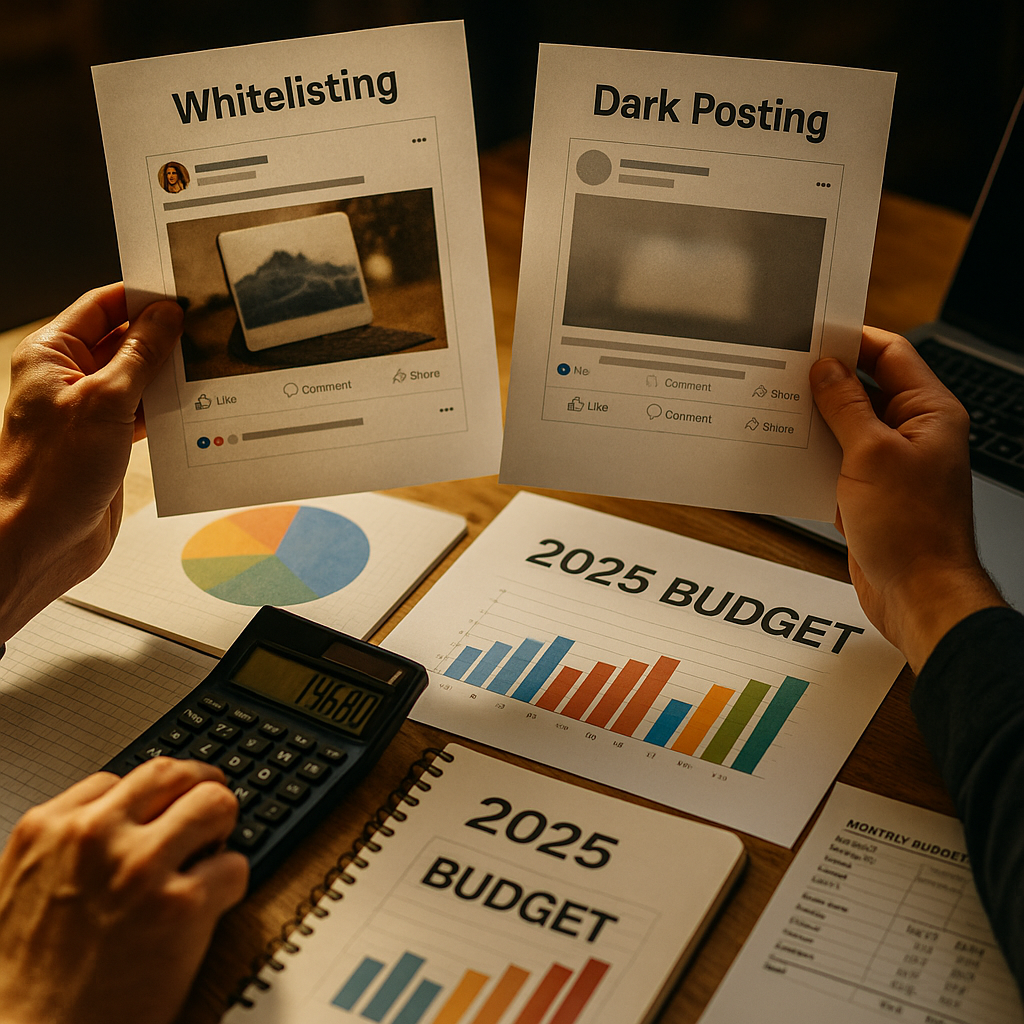
Budgeting for “whitelisting” vs. “dark posting” fees is crucial for businesses leveraging influencer and social media advertising in 2025. Both strategies offer unique pricing structures and benefits. Understanding the true costs empowers you to maximize your return on ad spend. Ready to discover which method fits your marketing budget and goals?
Understanding the Basics: Whitelisting vs. Dark Posting in Social Media Marketing
As digital marketing becomes more sophisticated in 2025, brands often debate between whitelisting influencers and investing in dark posts. Whitelisting enables brands to run ads through an influencer’s account, giving advertisers access to their audience while allowing full control over targeting and spend. In contrast, dark posting involves creating social media ads that don’t appear on your public feed, often appearing only to specific audience segments. Knowing how these approaches differ lays the foundation for accurate budgeting.
- Whitelisting: Grants brands access to the influencer’s account for controlled ad deployment.
- Dark Posting: Lets advertisers publish targeted content that isn’t publicly visible on profiles.
Both offer granular targeting, but understanding each method’s cost structure is the first step toward effective budgeting.
Exploring Influencer Collaboration Fees: Hidden Costs of Whitelisting
One of the core secondary keywords here is influencer collaboration fees. Whitelisting typically involves more than a standard influencer partnership. Beside the influencer’s content creation fee, expect additional charges for:
- Platform Access Fees: Some influencers charge for account access, citing privacy, risk, and control over their personal brand.
- Usage Rights Fees: Brands often pay extra for the legal right to repurpose content or for extended campaign periods.
- Performance Bonuses: Whitelisted campaigns sometimes involve tiered fees based on results, such as engagement or conversions.
Be wary of hidden costs. Experts report that in 2025, influencer whitelisting fees can be between 20-50% higher than a standard sponsored post. Building a transparent fee structure upfront is essential for every successful collaboration.
Budget Allocation Strategies: Calculating Paid Social Media Promotion Costs
Mapping a winning paid social media strategy means calculating total fees upfront. Dark posting, often called paid social media promotion, typically revolves around platform ad spend and creative production costs—but is usually more predictable than whitelisting.
- Ad Spend: This is your core budget. Industry data in 2025 suggests most businesses allocate around 60-70% of their paid social budget here.
- Content Creation: Budget for video, graphics, or copywriting—especially since highly optimized creative drives better results.
- Management and Optimization: Factor in labor costs and fees for agencies or freelancers who monitor and tweak campaigns for best performance.
With no influencer access fees or legal complexities, dark posting provides budget reliability. This helps both small businesses and seasoned marketers keep financial risks minimized.
Performance Measurement: Analyzing ROI for Whitelist and Dark Post Campaigns
For brands and agencies asking about analyzing ROI, comparing these approaches is essential. Whitelisting can deliver higher returns due to influencer endorsement and native audience reach, but this often comes at a premium. In contrast, dark posting’s targeted delivery can yield strong performance for well-defined audiences, with cleaner cost-per-click (CPC) and cost-per-acquisition (CPA) metrics.
- Whitelisting: Best measured via attributed conversions, reach, and influencer-led engagement metrics.
- Dark Posting: Focuses on click-through rates (CTR), leads, and direct sales linked to audience segments.
Data from digital marketing platforms in early 2025 indicates that companies using both methods strategically often outperform those relying on one alone. Blending techniques can optimize reach, credibility, and efficiency—if budgets are managed wisely.
Negotiating With Partners: Best Practices for Transparent Fee Management
Influencer and agency negotiations in 2025 often determine the success of your fee management. Here’s how to ensure transparency and value:
- Request Detailed Proposals: Always ask for a breakdown of all whitelisting and dark posting costs—creation, distribution, and performance-based fees.
- Clarify Access Terms: Specify what permissions are required for whitelisting, and ensure the influencer is comfortable with the scope.
- Align on Reporting: Make sure both parties agree on which results will be measured and how bonuses or penalties are structured.
- Build Relationships: Treat influencer and agency partners as collaborators, fostering trust and cost efficiency over time.
Clear agreements help avoid budget overruns and promote ongoing partnerships that can deliver better rates and greater creative freedom.
Optimizing Your Marketing Spend: Balancing Whitelisting and Dark Posting in 2025
The secret to effective budget management is balancing whitelisting and dark posting in line with your campaign goals. Brands in 2025 increasingly allocate separate budgets for influencer-driven and purely paid campaigns. This dual approach maximizes audience trust while tapping into the precision of modern social platforms.
- If your aim is rapid trust and awareness, whitelisting’s fees may be justified by influencer authority and higher engagement.
- If you need predictable, targeted, and scalable results, dark posting can offer exact audience calibration with lower ancillary costs.
Determine your split based on prior campaign data and evolving KPIs, refining allocations quarterly to match shifts in audience behavior and marketing technology.
Conclusion: Maximizing Value From Whitelisting and Dark Posting Fees
Budgeting for “whitelisting” vs. “dark posting” fees in 2025 requires a clear understanding of cost structures, performance metrics, and transparent collaboration. Choose your strategy—or a combination—based on your goals, relationships, and data. Smart allocation unlocks more effective campaigns, stronger ROI, and scalable success across diverse audiences.
FAQs: Budgeting for Whitelisting vs. Dark Posting Fees
-
What’s the primary difference between whitelisting and dark posting fees?
Whitelisting fees often include influencer access charges and additional usage rights fees, while dark posting costs are more straightforward—mainly ad spend and creative production. -
Are whitelisting fees negotiable with influencers?
Yes, many influencers in 2025 are open to negotiation, especially for longer campaigns or multiple-platform deals. Always clarify terms and expectations upfront. -
How should I divide my budget between the two strategies?
Analyze past campaign data and set goals. Many brands in 2025 allocate 30-50% for influencer-driven whitelisting and the rest for targeted dark posts. -
Do dark posts require influencer collaboration?
Not always. Dark posts can be brand-only or may use influencer content depending on the creative strategy. Costs will shift accordingly. -
Which strategy delivers a better ROI?
The answer depends on your KPIs. Whitelisting often brings higher engagement, while dark posting offers cost efficiency and precision targeting. Combining them can yield the best results.