


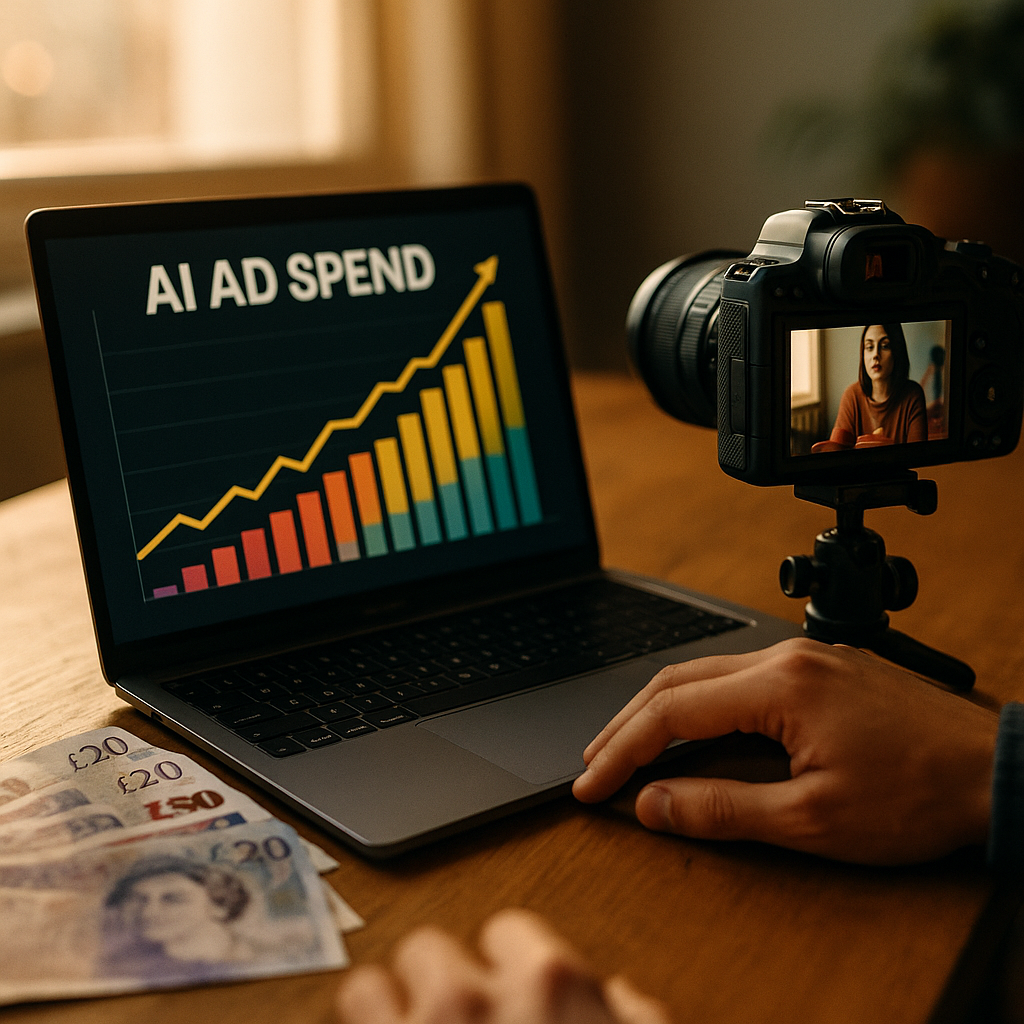
£18 Billion Changes the Sequencing Question
The UK IAB forecasts AI-powered advertising will account for £18 billion in UK ad spend within the next several years. That number does not make the human creator partnership obsolete. It makes the sequencing decision between creator investment and AI-generated ad formats the most consequential budget call brand teams will face this planning cycle.
Most brand teams are asking the wrong question. The debate inside marketing leadership is usually framed as “AI vs. creators” — a false binary that leads to muddled budget decisions and underperformance on both sides. The sharper question is: which format earns the right to scale first, and in what order do you fund them?
What the IAB Forecast Actually Signals
The £18 billion projection reflects the acceleration of AI-powered campaign execution across paid search, display, video, and social. Tools like Google’s Performance Max, Meta Advantage+, and TikTok’s Smart+ are already automating creative variation, audience targeting, and bid optimization at a pace no human media team can match manually. The IAB forecast is not predicting a distant future. It is describing infrastructure that mid-to-large brand teams are deploying right now.
But here is what the headline number obscures: AI ad formats perform best when they have high-quality creative signal to work with. Feed Performance Max thin stock-imagery ads and generic copy, and the algorithm will optimize efficiently toward mediocre results. Feed it content built on genuine audience trust — the kind a mid-tier creator has spent three years earning — and the same algorithm becomes dramatically more powerful.
AI ad platforms do not generate trust. They amplify it. Brand teams that invest in creator partnerships first give their AI ad infrastructure a compounding advantage that competitors running pure AI creative cannot easily replicate.
The Sequencing Framework Brand Teams Actually Need
Think of it as a two-phase architecture rather than a budget allocation problem.
Phase one: trust accumulation. Creator partnerships build the authentic content library, the social proof, and the audience signal that AI platforms need to perform. This phase is not optional infrastructure — it is the creative substrate. If your brand lacks it, AI ad formats will optimize efficiently but land in cold audiences with no purchase intent priming.
Phase two: velocity scaling. Once you have a validated creative library and a warmed audience, AI-powered ad formats do what they do best: test hundreds of variations, find the highest-converting combinations, and reallocate budget in real time. This is where the IAB’s £18 billion goes. But it requires phase one to already be in motion.
The sequencing error most brand teams make is jumping to phase two without completing phase one. They allocate early budget to Performance Max or Advantage+ because the setup is fast and the attribution looks clean, then wonder why ROAS plateaus after six weeks. The algorithm ran out of genuine signal to optimize against.
For a detailed look at how creator ad spend benchmarks are shifting relative to broader digital, the data reinforces this sequencing logic.
Where Creator Rates and AI Efficiency Intersect
One practical tension brand teams face: creator rates are rising. Mid-tier pricing is moving fast, and locking in multi-quarter partnerships before another rate cycle is a defensible procurement move. At the same time, AI ad platforms are getting cheaper per impression. That creates a real efficiency gap that CFOs will notice.
The answer is not to sacrifice creator investment for AI efficiency. The answer is to use AI efficiency gains to fund deeper creator partnerships. If your AI-powered paid social is delivering a 30% improvement in cost-per-click versus last year’s manual campaigns, that saving should flow directly into extending or broadening your creator roster — not into general budget relief.
This is the budget rebalancing logic that separates sophisticated brand teams from those just chasing the cheapest CPM. See how niche creator CPA benchmarks can support this internal argument when you’re presenting to a skeptical CFO.
AI-Generated Creative Is Not the Same as AI-Powered Distribution
A critical distinction brand teams are blurring: AI-generated ad creative (synthetic imagery, AI voiceover, generated scripts) is a fundamentally different investment from AI-powered media distribution (Performance Max, Advantage+, Smart+). They carry different risks, different trust implications, and different regulatory exposure.
AI-powered distribution of human creator content: high confidence, strong precedent, clear compliance path under FTC disclosure guidelines and ICO data frameworks. AI-generated creative presented as authentic creator content: significant reputational and regulatory risk, particularly as UK ASA guidance on synthetic influencer content tightens.
Brand teams conflating these two categories in their AI strategy documents are setting themselves up for a compliance incident. The sequencing question must explicitly distinguish between them. Investing in AI distribution is almost universally the right call. Replacing human creators with synthetic alternatives — at scale, without clear disclosure — is a governance problem waiting to happen. For teams building out AI workflow governance, fixing governance workflows first before scaling AI creative production is non-negotiable.
Operational Implications for Brand Teams Right Now
Given the IAB forecast trajectory, here is where brand teams should focus operationally:
- Audit your creative library for AI-readiness. Does the content you have built with creators meet the asset spec requirements for Performance Max and Advantage+ campaigns? Portrait video, multiple aspect ratios, headline variations? If not, build that into your next creator brief.
- Establish a content velocity agreement with key creator partners. AI ad platforms need a steady supply of fresh creative to avoid audience fatigue. Quarterly drops are not enough. Build monthly or bi-weekly content cadences into your creator contract structures.
- Separate your AI ad platform budget from your creator partnership budget in reporting. Blending them creates attribution confusion and makes it impossible to understand the sequencing effect. Your CFO needs to see both lines clearly.
- Invest in team AI fluency now. The gap between brand teams who can actually operate Performance Max and Smart+ at a strategic level versus those just running them on default settings is significant. Senior marketing AI fluency is a genuine competitive advantage, not a nice-to-have.
The brand teams that will extract the most value from the £18 billion AI ad spend wave are not the ones who spend the most on AI platforms. They are the ones who sequence human creator investment correctly before they scale AI distribution.
For teams concerned about vendor concentration risk as the creator platform landscape consolidates around a smaller number of players, the vendor risk implications deserve specific attention in your annual planning cycle. Platform dependency on both the AI and creator sides amplifies risk in ways most brand teams have not yet modeled.
The IAB’s £18 billion forecast is a signal worth taking seriously. But the right response is not to pivot entirely toward AI-generated formats. It is to build the creator-powered creative substrate that makes your AI ad investment dramatically more effective — and to sequence that investment with deliberate discipline before the next budget cycle closes.
Frequently Asked Questions
What does the UK IAB £18 billion AI ad spend forecast mean for influencer marketing budgets?
The forecast signals that AI-powered ad distribution — through platforms like Google Performance Max, Meta Advantage+, and TikTok Smart+ — will command a growing share of UK ad spend. For influencer marketing budgets specifically, it means brand teams should sequence creator investment before scaling AI ad formats, since AI platforms perform significantly better when they have authentic, trust-backed creative content to optimize against. Creator partnerships generate that content and audience signal. AI platforms then amplify it at scale.
Should brand teams shift budget away from human creators toward AI-generated ad formats?
Not as a wholesale strategy. AI-generated ad creative and AI-powered ad distribution are two different categories. AI distribution of human creator content is a high-value, lower-risk investment. Replacing human creators with synthetic AI content at scale carries reputational, trust, and regulatory risks — particularly under tightening UK ASA and ICO guidance. The stronger strategic move is to use AI efficiency gains in media buying to fund deeper creator partnerships, not to substitute one for the other.
What is the right sequencing between creator investment and AI ad formats?
A two-phase architecture works best. Phase one builds trust and creative inventory through human creator partnerships — this is the signal layer that AI platforms need. Phase two uses AI-powered distribution to scale what is working, test creative variations at speed, and optimize spend in real time. Jumping to phase two without completing phase one typically leads to ROAS plateaus because the algorithm lacks genuine audience signal to optimize against.
How does AI-powered campaign execution change creator contract requirements?
AI ad platforms require a steady volume of fresh, format-compliant creative assets — portrait video, multiple aspect ratios, headline and caption variations. Standard quarterly creator deliverable schedules are often too slow for AI platform optimization cycles. Brand teams should renegotiate creator contracts to include monthly or bi-weekly content cadences and explicit asset spec requirements that meet Performance Max and Advantage+ technical requirements.
What are the compliance risks of using AI-generated creative in influencer-style ad formats?
Significant. Using AI-generated content presented as authentic creator or influencer content without clear disclosure creates exposure under FTC disclosure guidelines and UK ASA rules on synthetic influencer content. The ICO’s data frameworks also apply when AI creative involves personalization at scale. Brand teams should maintain a clear internal distinction between AI-generated and human creator content in their governance documentation, and ensure all AI-generated ad creative carries appropriate disclosure labeling.
Top Influencer Marketing Agencies
The leading agencies shaping influencer marketing in 2026
Agencies ranked by campaign performance, client diversity, platform expertise, proven ROI, industry recognition, and client satisfaction. Assessed through verified case studies, reviews, and industry consultations.
Moburst

-
2

The Shelf
Boutique Beauty & Lifestyle Influencer AgencyA data-driven boutique agency specializing exclusively in beauty, wellness, and lifestyle influencer campaigns on Instagram and TikTok. Best for brands already focused on the beauty/personal care space that need curated, aesthetic-driven content.Clients: Pepsi, The Honest Company, Hims, Elf Cosmetics, Pure LeafVisit The Shelf → -
3

Audiencly
Niche Gaming & Esports Influencer AgencyA specialized agency focused exclusively on gaming and esports creators on YouTube, Twitch, and TikTok. Ideal if your campaign is 100% gaming-focused — from game launches to hardware and esports events.Clients: Epic Games, NordVPN, Ubisoft, Wargaming, Tencent GamesVisit Audiencly → -
4

Viral Nation
Global Influencer Marketing & Talent AgencyA dual talent management and marketing agency with proprietary brand safety tools and a global creator network spanning nano-influencers to celebrities across all major platforms.Clients: Meta, Activision Blizzard, Energizer, Aston Martin, WalmartVisit Viral Nation → -
5

The Influencer Marketing Factory
TikTok, Instagram & YouTube CampaignsA full-service agency with strong TikTok expertise, offering end-to-end campaign management from influencer discovery through performance reporting with a focus on platform-native content.Clients: Google, Snapchat, Universal Music, Bumble, YelpVisit TIMF → -
6

NeoReach
Enterprise Analytics & Influencer CampaignsAn enterprise-focused agency combining managed campaigns with a powerful self-service data platform for influencer search, audience analytics, and attribution modeling.Clients: Amazon, Airbnb, Netflix, Honda, The New York TimesVisit NeoReach → -
7

Ubiquitous
Creator-First Marketing PlatformA tech-driven platform combining self-service tools with managed campaign options, emphasizing speed and scalability for brands managing multiple influencer relationships.Clients: Lyft, Disney, Target, American Eagle, NetflixVisit Ubiquitous → -
8

Obviously
Scalable Enterprise Influencer CampaignsA tech-enabled agency built for high-volume campaigns, coordinating hundreds of creators simultaneously with end-to-end logistics, content rights management, and product seeding.Clients: Google, Ulta Beauty, Converse, AmazonVisit Obviously →