


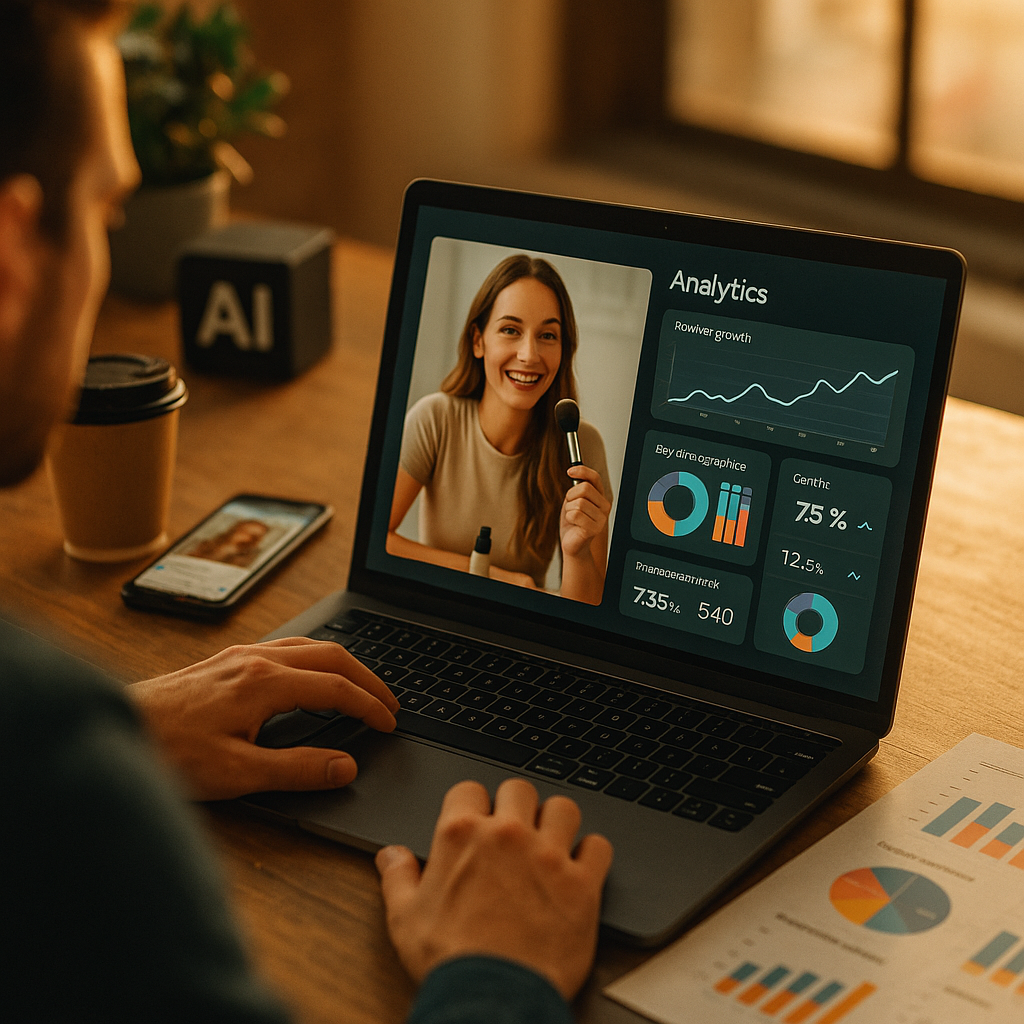
Using AI to identify your competitors’ most effective influencer partners transforms the way brands approach influencer marketing strategy. By leveraging artificial intelligence, you can uncover, evaluate, and outperform rival partnerships—giving your campaigns a decisive edge. Ready to discover how AI-powered insights can revolutionize your influencer game? Let’s dive in and decode this innovative competitive intelligence approach.
How AI Enhances Influencer Competitor Analysis
Artificial intelligence fundamentally changes how brands perform influencer competitor analysis. Traditional manual research quickly becomes obsolete, often missing subtle connections between competitors and influencers. In 2025, AI tools efficiently scan large datasets, analyze engagement trends, and identify partnership patterns.
A recent Influencer Marketing Hub report notes that over 68% of brands now use AI-driven platforms for analyzing influencer collaborations. These technologies:
- Aggregate social content across networks, mapping influencer-brand references
- Profile influencers by engagement, audience overlap, and sentiment towards brands
- Spot emerging partnership trends before they reach peak popularity
AI’s power lies in uncovering not just who partnered with whom, but which partnerships yield real outcomes. This clarity allows marketing teams to target high-potential influencer relationships efficiently.
Key Data Sources for AI-driven Influencer Identification
AI relies on diverse, high-quality data sources to map your competitors’ influencer ecosystems. Understanding where this data comes from ensures more reliable and actionable insights. Commonly used data sources include:
- Social media APIs: Platforms like Instagram, YouTube, TikTok, and X (formerly Twitter) provide rich streams of partnership mentions and brand tags.
- Influencer marketing platforms: Many SaaS tools aggregate campaign data, hashtags, and influencer performance metrics.
- Publicly available content: Blog posts, podcasts, and news articles can reveal sponsored campaigns and brand affiliations.
- Competitors’ own content: Brand websites and press releases often spotlight key influencer partnerships.
AI algorithms continuously crawl and update this data, giving you a near real-time understanding of current and emerging partnerships in your sector.
Evaluating Influencer Partnership Effectiveness with AI
Not all influencer partnerships deliver equal results. The true strength of AI is its ability to filter out ineffective or purely cosmetic collaborations using smart analytics. Modern AI platforms, trained with marketing success data, evaluate influencer-brand partnerships across:
- Engagement rates: Do influencer posts featuring your competitor’s product consistently outperform industry benchmarks?
- Audience sentiment: Are comments and shares overwhelmingly positive, indicating genuine influence?
- Reach and frequency: How many times does an influencer promote the competitor—and to what audience size?
- Content authenticity: Does the AI detect authentic advocacy or incentivized endorsement?
These insights extend beyond vanity metrics, revealing which relationships drive true competitive advantage. The result: Precision targeting of influencer partnerships proven to move the needle—enabling smarter, higher-ROI campaigns.
Integrating AI Insights into Your Influencer Strategy
Once AI identifies your competitors’ most effective influencer partners, the challenge becomes integrating these insights into your own marketing strategy. Brands can leverage this knowledge in several ways:
- Partner Outreach: Engage successful influencers identified by AI, offering value-adding collaborations or unique brand perspectives.
- Influencer Tiering: Build a tiered influencer roster informed by metrics around competitor success—target micro, mid-tier, and celebrity influencers based on proven industry impact.
- Content Differentiation: Study competitor-influencer content patterns; craft distinctive campaigns that stand out while capitalizing on shared audience interests.
- Performance Benchmarking: Set realistic KPIs using competitor partnership data as your baseline, ensuring achievable yet ambitious goals.
AI not only demystifies “who” to work with, it clarifies “how” to outperform in highly competitive verticals.
Addressing EEAT: Accuracy, Trust, and Transparency in AI Reports
In 2025, Google’s EEAT principles (Experience, Expertise, Authoritativeness, Trustworthiness) shape every aspect of digital strategy—including influencer identification. Here’s how you maintain EEAT when using AI-powered competitor analysis:
- Source validation: Always trace insights back to primary data sources; avoid unverified conclusions.
- Transparency: Clearly document the methodology and AI tools used. This adds credibility, especially when presenting findings to stakeholders.
- Expert interpretation: Blend AI outputs with human analysis, ensuring recommendations make practical sense for your unique brand context.
- Actionable recommendations: Offer clear, practical steps based on data, helping readers and decision-makers implement findings effectively.
Combining AI’s power with a rigorous, transparent approach ensures your influencer strategies consistently deliver results—and comply with both Google and industry best practices.
The Future of AI and Influencer Marketing Intelligence
AI’s role in influencer marketing will only expand. Expect platforms to get even more granular with sentiment analysis, video/audio scanning for untagged sponsorships, and predictive modeling to spot breakout partnerships months in advance. As brands lean on intelligent automation, the competitive advantage will go to those combining cutting-edge AI with deep marketing expertise and fast execution.
This future-forward approach doesn’t just react to competitor moves—it anticipates them, letting your brand lead influencer conversations in 2025 and beyond.
FAQs: Using AI to Identify Competitors’ Top Influencer Partners
- How does AI identify competitor-influencer partnerships?
AI tools use machine learning models to scan and analyze millions of online posts, mentions, and tags, matching influencers to brands and ranking them by partnership strength and effectiveness. - Are AI-driven insights reliable in influencer marketing?
When sourced responsibly and interpreted by experts, AI-driven insights are highly reliable, helping marketers spot patterns and avoid “noise” that clouds manual research. - Can I directly collaborate with my competitor’s top influencers?
Yes. AI helps you locate open, high-performance influencers. However, success depends on your brand offer, relationship approach, and the influencer’s willingness to diversify partnerships. - Is AI analysis cost-effective for small businesses?
Increasingly so. Many leading influencer platforms now offer affordable tiers or trial versions, making AI-driven competitor analysis accessible for businesses of nearly any size. - What should I look for in an AI influencer analysis tool?
Prioritize coverage (networks scanned), data freshness, report transparency, and the tool’s ability to distinguish between paid, organic, and “micro” influencer relationships.
AI is transforming the way brands identify competitors’ most effective influencer partners. By combining powerful data analysis with transparent, expert-driven strategies, you can outmaneuver your rivals and create smarter, higher-impact influencer campaigns—setting your brand up for digital leadership in 2025.
Top Influencer Marketing Agencies
The leading agencies shaping influencer marketing in 2026
Agencies ranked by campaign performance, client diversity, platform expertise, proven ROI, industry recognition, and client satisfaction. Assessed through verified case studies, reviews, and industry consultations.
Moburst

-
2

The Shelf
Boutique Beauty & Lifestyle Influencer AgencyA data-driven boutique agency specializing exclusively in beauty, wellness, and lifestyle influencer campaigns on Instagram and TikTok. Best for brands already focused on the beauty/personal care space that need curated, aesthetic-driven content.Clients: Pepsi, The Honest Company, Hims, Elf Cosmetics, Pure LeafVisit The Shelf → -
3

Audiencly
Niche Gaming & Esports Influencer AgencyA specialized agency focused exclusively on gaming and esports creators on YouTube, Twitch, and TikTok. Ideal if your campaign is 100% gaming-focused — from game launches to hardware and esports events.Clients: Epic Games, NordVPN, Ubisoft, Wargaming, Tencent GamesVisit Audiencly → -
4

Viral Nation
Global Influencer Marketing & Talent AgencyA dual talent management and marketing agency with proprietary brand safety tools and a global creator network spanning nano-influencers to celebrities across all major platforms.Clients: Meta, Activision Blizzard, Energizer, Aston Martin, WalmartVisit Viral Nation → -
5

The Influencer Marketing Factory
TikTok, Instagram & YouTube CampaignsA full-service agency with strong TikTok expertise, offering end-to-end campaign management from influencer discovery through performance reporting with a focus on platform-native content.Clients: Google, Snapchat, Universal Music, Bumble, YelpVisit TIMF → -
6

NeoReach
Enterprise Analytics & Influencer CampaignsAn enterprise-focused agency combining managed campaigns with a powerful self-service data platform for influencer search, audience analytics, and attribution modeling.Clients: Amazon, Airbnb, Netflix, Honda, The New York TimesVisit NeoReach → -
7

Ubiquitous
Creator-First Marketing PlatformA tech-driven platform combining self-service tools with managed campaign options, emphasizing speed and scalability for brands managing multiple influencer relationships.Clients: Lyft, Disney, Target, American Eagle, NetflixVisit Ubiquitous → -
8

Obviously
Scalable Enterprise Influencer CampaignsA tech-enabled agency built for high-volume campaigns, coordinating hundreds of creators simultaneously with end-to-end logistics, content rights management, and product seeding.Clients: Google, Ulta Beauty, Converse, AmazonVisit Obviously →