


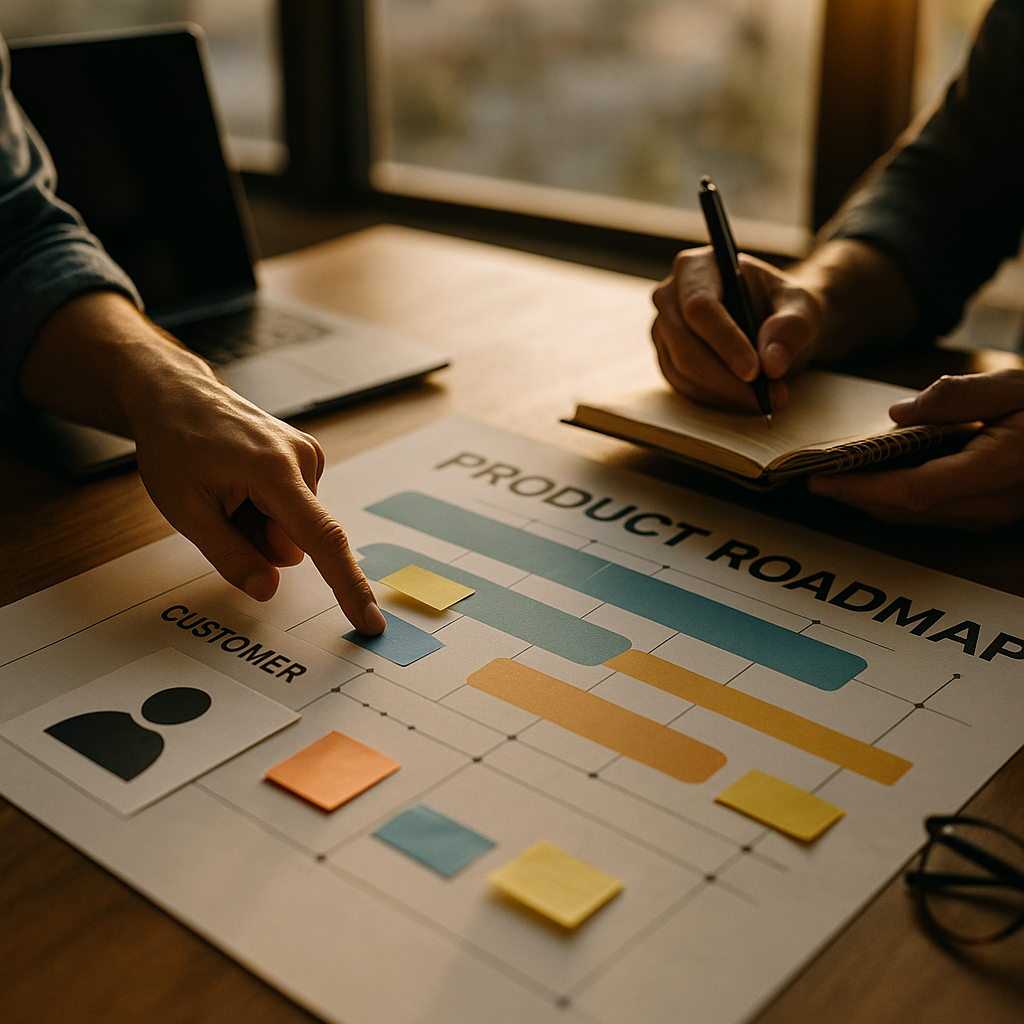
To excel in today’s competitive market, businesses must focus on developing a customer-centric product roadmap with their product and engineering teams. Aligning these key stakeholders around customer needs leads to lasting value, improved user satisfaction, and business growth. Read on to discover actionable strategies for building a product roadmap your customers—and your teams—will champion.
Why Customer-Centric Product Roadmaps Drive Results
Companies with a customer-centric mindset are 60% more profitable than those that aren’t, according to recent Deloitte studies. Placing customers at the heart of your roadmap ensures you prioritize features, improvements, and technologies that meet real-world needs. But what does a truly customer-centric product roadmap look like, and why should product and engineering teams collaborate closely in the process?
Customer-centric roadmaps:
- Reflect actual user pain points, preferences, and evolving expectations
- Guide teams to deliver features that matter most, reducing wasted resources
- Increase customer retention and attract new users through tailored experiences
Challenges often arise around conflicting priorities, limited resources, and unclear decision-making frameworks. Close collaboration between product and engineering eliminates silos, aligns effort, and balances customer needs with technical feasibility.
Integrating Customer Feedback into Your Product Prioritization
Customer feedback provides a goldmine of insights for your product and engineering teams. In 2025, leading companies don’t just collect feedback—they act on it systematically. Adopt these EEAT-driven best practices to harness customer input effectively:
- Establish Continuous Feedback Loops: Use in-app surveys, beta programs, and community forums to gather real user opinions at every stage.
- Segment and Analyze Feedback: Employ natural language processing tools to categorize feedback by theme, urgency, and user profile for actionable insights.
- Prioritize Based on Value: Score features and fixes based on customer impact, business value, and technical complexity.
- Close the Loop: Transparently communicate how customer feedback shapes your roadmap, fostering trust and engagement.
Gather feedback from both quantitative sources (usage analytics, NPS scores) and qualitative insights (user interviews, support tickets) to get a full picture of customer needs. Incorporate these findings into regular roadmap reviews with your product and engineering teams.
Aligning Product and Engineering Teams for Roadmap Success
Strong alignment between product and engineering is essential for executing a customer-centric product roadmap. According to a 2024 Product Management Institute survey, organizations with high alignment deliver 30% faster and with greater customer satisfaction.
Key strategies for alignment include:
- Unified Vision Workshops: Host kickoff sessions where both teams define the customer problem, business objectives, and success metrics together.
- Shared Roadmap Platforms: Use collaborative tools that keep everyone informed of priorities, dependencies, and milestones.
- Regular Syncs: Schedule weekly or bi-weekly standups where cross-functional teams review progress, surface blockers, and recalibrate priorities.
- Technical Feasibility Assessments: Integrate engineering input early to evaluate what’s possible, estimate effort, and anticipate challenges.
Fostering empathy between teams is crucial. Product managers should understand engineering constraints, while engineers should be encouraged to share customer-focused solutions. This dual perspective (technical + customer) leads to smarter, faster decision-making and higher-quality outcomes.
Balancing Customer Needs with Technical Constraints
An ideal roadmap balances what customers want with what’s technically achievable. While it’s important to champion voice-of-customer features, you must also address technical debt, scalability, and infrastructure.
Consider these steps:
- Value vs. Effort Scoring: For every potential roadmap item, assess customer value against technical effort. Visualize with a value/effort matrix to spotlight “quick wins” and high-impact improvements.
- Transparent Trade-off Discussions: Clearly communicate the “why” behind tough prioritization decisions, referencing customer data and technical evaluations.
- Resilience Planning: Dedicate roadmap space to address architectural needs (like reliability and scalability) that ultimately support better customer experiences.
- Pilot and Iterate: Launch features to a subset of users, collect data, and iterate based on both customer feedback and engineering insights.
Remember, customers appreciate transparency and reliability as much as new functionality. Regularly re-assess priorities as technologies evolve and customer feedback shifts.
Establishing Data-Driven Roadmap Success Metrics
What gets measured gets managed. To know if your customer-centric roadmap delivers results, define clear, data-backed metrics that reflect both user value and engineering effectiveness.
- Customer Success Metrics: Measure user retention, engagement (DAU/MAU), satisfaction (CSAT, NPS), and feature adoption rates.
- Delivery Metrics: Track cycle time, lead time, release frequency, and quality benchmarks (defect rates, uptime).
- Learning Metrics: Review feedback loop closure rates—how quickly customer suggestions go from insight to delivered solution.
Share these metrics transparently between product and engineering teams during regular roadmap reviews. Use real-world KPIs to inform roadmap adjustments and demonstrate how team efforts connect to customer and business outcomes.
Scaling Customer-Centricity Across Distributed Teams
For global or remote-first organizations in 2025, scaling customer-centricity takes deliberate effort. How can you keep teams unified on roadmaps when working across locations and time zones?
- Single Source of Truth: Utilize cloud-based roadmap tools (like Productboard or Jira) to provide consistent visibility, documentation, and communication threads.
- Asynchronous Collaboration: Encourage transparent documentation, asynchronous updates, and centralized discussion boards so everyone’s voice is heard, regardless of location.
- Inclusive Customer Research: Empower distributed product, engineering, and support teams to participate in customer calls, journey mapping, and usability testing.
- Global Feedback Channels: Localize feedback mechanisms to capture needs from diverse user segments and adapt the product roadmap accordingly.
Embrace a continuous improvement mindset and nurture a culture where customer insight and technical expertise are valued equally, wherever your teams may be.
Conclusion: Putting Customer-Centric Product Roadmaps into Practice
Building a customer-centric product roadmap with your product and engineering teams requires structured feedback loops, data-driven prioritization, and relentless cross-functional alignment. By working together, teams deliver experiences that customers love—and that drive measurable business success. Start iterating today; a more customer-focused, agile product future is within your reach.
FAQs About Developing a Customer-Centric Product Roadmap with Product and Engineering Teams
-
What is a customer-centric product roadmap?
A customer-centric product roadmap prioritizes features, improvements, and fixes based on direct customer needs and feedback, ensuring that the product evolves in ways that maximize user value and satisfaction.
-
How do you collect effective customer feedback for roadmap planning?
Use multiple channels such as in-app surveys, customer interviews, analytics, and user forums. Regularly analyze and segment this feedback to identify high-impact opportunities for the roadmap.
-
Why should product and engineering teams collaborate on roadmaps?
Close collaboration ensures that customer priorities are balanced with what’s technically feasible. This prevents misalignment, accelerates delivery, and leads to solutions that satisfy both business and technical requirements.
-
How do you balance customer requests with technical limitations?
Score roadmap items by customer value and technical effort, involve engineering early in planning, and maintain transparency about trade-offs. Iteratively pilot solutions and refine based on feedback and feasibility.
-
What tools support customer-centric product roadmaps?
Popular tools in 2025 include Productboard, Jira, Aha!, and Feedback Management Platforms. These facilitate collaborative prioritization, shared tracking, and seamless integration of customer insights into roadmap reviews.
Top Influencer Marketing Agencies
The leading agencies shaping influencer marketing in 2026
Agencies ranked by campaign performance, client diversity, platform expertise, proven ROI, industry recognition, and client satisfaction. Assessed through verified case studies, reviews, and industry consultations.
Moburst

-
2

The Shelf
Boutique Beauty & Lifestyle Influencer AgencyA data-driven boutique agency specializing exclusively in beauty, wellness, and lifestyle influencer campaigns on Instagram and TikTok. Best for brands already focused on the beauty/personal care space that need curated, aesthetic-driven content.Clients: Pepsi, The Honest Company, Hims, Elf Cosmetics, Pure LeafVisit The Shelf → -
3

Audiencly
Niche Gaming & Esports Influencer AgencyA specialized agency focused exclusively on gaming and esports creators on YouTube, Twitch, and TikTok. Ideal if your campaign is 100% gaming-focused — from game launches to hardware and esports events.Clients: Epic Games, NordVPN, Ubisoft, Wargaming, Tencent GamesVisit Audiencly → -
4

Viral Nation
Global Influencer Marketing & Talent AgencyA dual talent management and marketing agency with proprietary brand safety tools and a global creator network spanning nano-influencers to celebrities across all major platforms.Clients: Meta, Activision Blizzard, Energizer, Aston Martin, WalmartVisit Viral Nation → -
5

The Influencer Marketing Factory
TikTok, Instagram & YouTube CampaignsA full-service agency with strong TikTok expertise, offering end-to-end campaign management from influencer discovery through performance reporting with a focus on platform-native content.Clients: Google, Snapchat, Universal Music, Bumble, YelpVisit TIMF → -
6

NeoReach
Enterprise Analytics & Influencer CampaignsAn enterprise-focused agency combining managed campaigns with a powerful self-service data platform for influencer search, audience analytics, and attribution modeling.Clients: Amazon, Airbnb, Netflix, Honda, The New York TimesVisit NeoReach → -
7

Ubiquitous
Creator-First Marketing PlatformA tech-driven platform combining self-service tools with managed campaign options, emphasizing speed and scalability for brands managing multiple influencer relationships.Clients: Lyft, Disney, Target, American Eagle, NetflixVisit Ubiquitous → -
8

Obviously
Scalable Enterprise Influencer CampaignsA tech-enabled agency built for high-volume campaigns, coordinating hundreds of creators simultaneously with end-to-end logistics, content rights management, and product seeding.Clients: Google, Ulta Beauty, Converse, AmazonVisit Obviously →