


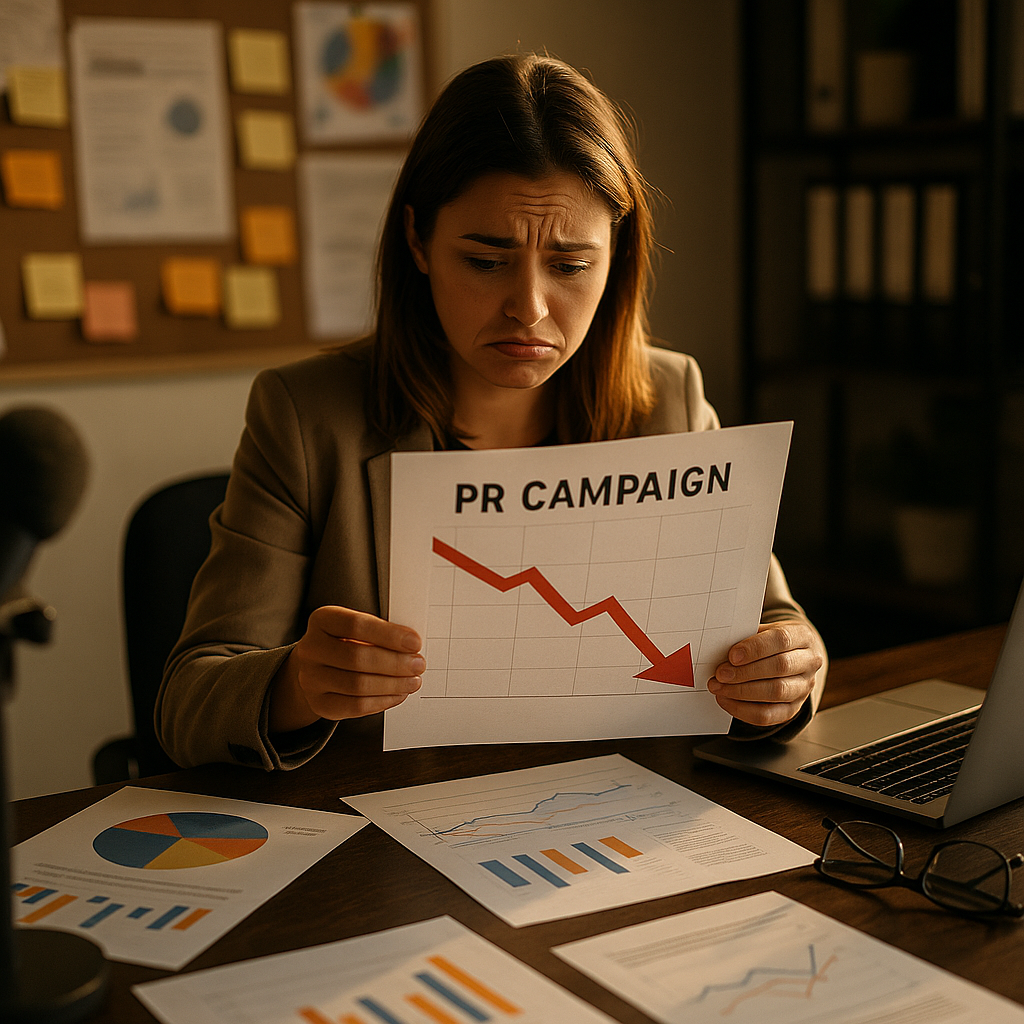
When a PR campaign fails to get any media attention, marketers are left questioning what went wrong. Drawing from industry insights and proven strategies, this post-mortem explores why even well-funded campaigns can flop. Discover common pitfalls, ways to diagnose breakdowns, and actionable tips to boost future PR performance—because every failure is a chance to refine your approach.
Analyzing the Roots of a Failed Public Relations Campaign
Addressing a failed public relations campaign starts with understanding the critical missteps. Media silence isn’t random: it often signals overlooked misalignments. In many cases, campaigns lack news value, target the wrong outlets, or have ill-timed releases.
Recent research by PR Week highlights that 73% of journalists receive pitches irrelevant to their beat. This means many campaigns flounder due to poor media targeting and messaging. To embrace Google’s EEAT guidelines, rigorously assess each step of your campaign planning and execution for credibility and expertise.
The Impact of Message and Timing on Media Attention
A PR launch’s message must be both clear and compelling for journalists and audiences in 2025. If your primary pitch isn’t timely or doesn’t offer a fresh angle, it simply gets ignored.
- Message relevance: Is your story truly newsworthy, or merely promotional?
- Timing: Did your release coincide with bigger industry news or public distractions?
Media outlets are inundated with hundreds of pitches daily. If you fail to deliver an exclusive narrative or actionable data, editors are unlikely to respond.
Media Relationship Building: The Missing Link in Failed PR
Modern media relations hinge on more than a well-written press release. Journalists value ongoing, authentic connections. Relying solely on mass emails and generic outreach rarely yields meaningful results.
For a campaign that gains traction, PR professionals must:
- Research and personalize every communication
- Provide assets or quotes that add context
- Engage with journalists’ content long before the pitch
Lack of relationship-building is a primary reason campaigns get zero pickups. Earning trust translates into better story placement and sustained media visibility.
Strategic Targeting: Avoiding the “Spray and Pray” Approach
Many failed campaigns adopt a broad, unfocused outreach known as “spray and pray.” However, precision targeting is essential for success in 2025’s fragmented media landscape. Gone are the days when you could blast a press release to every inbox and hope for coverage.
Instead, high-impact PR campaigns:
- Segment journalists based on their coverage history and audience
- Curate outreach lists using recent journalist bylines and social profiles
- Adjust messages to fit differing editorial voices
Effective targeting increases the chance your story will not just be read, but covered and amplified.
Learning from the Campaign Post-Mortem: Data-Driven Improvements
In line with Google’s EEAT, transparency and reflection are vital after a campaign underperforms. Conducting a thorough post-mortem involves:
- Reviewing open and response rates for email pitches
- Gathering qualitative feedback from media contacts
- Benchmarking coverage results against similar industry campaigns
These data points can reveal flaws in distribution, messaging, or list-building. Use insights to update your newsroom assets, refine your pitch templates, and retrain teams. Treat each failure as an iterative learning step, not a permanent setback.
Turning Lessons into Action for Future PR Success
What actionable steps close the gap between a failed campaign and next-level PR success?
- Invest in media research: Stay current on journalists’ changing beats and interests.
- Prioritize newsworthiness: Tie your stories to market trends or recent industry data.
- Nurture genuine connections: Cultivate relationships months before your next pitch.
- Focus on exclusivity and value: Offer unique insights, embargoed news, or expert interviews.
- Test, measure, and adapt: Analyze every outcome and regularly refresh your PR strategy.
The most successful PR teams in 2025 are those who treat every campaign—win or fail—as feedback for refinement and growth.
FAQs
- What are the most common reasons a PR campaign fails to get media coverage?
PR campaigns typically miss the mark due to irrelevant pitching, lack of timely or newsworthy angles, poor targeting, and insufficient relationship building with journalists.
- How long should you wait before re-pitching a story to the media?
Wait at least two to three months, and only re-pitch if you’ve developed a new angle or supporting data that addresses the initial lack of interest.
- Is it worth following up with journalists after no response?
Yes, but limit follow-ups to one or two polite reminders. Include new details or offer exclusive quotes to reignite interest.
- How can I measure the effectiveness of my PR campaign if there is no media coverage?
Analyze open and response rates, social media activity, website traffic changes, and qualitative feedback from journalists—even negative responses can inform future improvements.
Every failed PR campaign is a growth opportunity. By embracing targeted messaging, stronger media relationships, and diligent post-mortem analysis, communicators can boost their odds of gaining media attention. The key takeaway: treat every campaign as a data point and build on your learnings to achieve future PR wins.
Top Influencer Marketing Agencies
The leading agencies shaping influencer marketing in 2026
Agencies ranked by campaign performance, client diversity, platform expertise, proven ROI, industry recognition, and client satisfaction. Assessed through verified case studies, reviews, and industry consultations.
Moburst

-
2

The Shelf
Boutique Beauty & Lifestyle Influencer AgencyA data-driven boutique agency specializing exclusively in beauty, wellness, and lifestyle influencer campaigns on Instagram and TikTok. Best for brands already focused on the beauty/personal care space that need curated, aesthetic-driven content.Clients: Pepsi, The Honest Company, Hims, Elf Cosmetics, Pure LeafVisit The Shelf → -
3

Audiencly
Niche Gaming & Esports Influencer AgencyA specialized agency focused exclusively on gaming and esports creators on YouTube, Twitch, and TikTok. Ideal if your campaign is 100% gaming-focused — from game launches to hardware and esports events.Clients: Epic Games, NordVPN, Ubisoft, Wargaming, Tencent GamesVisit Audiencly → -
4

Viral Nation
Global Influencer Marketing & Talent AgencyA dual talent management and marketing agency with proprietary brand safety tools and a global creator network spanning nano-influencers to celebrities across all major platforms.Clients: Meta, Activision Blizzard, Energizer, Aston Martin, WalmartVisit Viral Nation → -
5

The Influencer Marketing Factory
TikTok, Instagram & YouTube CampaignsA full-service agency with strong TikTok expertise, offering end-to-end campaign management from influencer discovery through performance reporting with a focus on platform-native content.Clients: Google, Snapchat, Universal Music, Bumble, YelpVisit TIMF → -
6

NeoReach
Enterprise Analytics & Influencer CampaignsAn enterprise-focused agency combining managed campaigns with a powerful self-service data platform for influencer search, audience analytics, and attribution modeling.Clients: Amazon, Airbnb, Netflix, Honda, The New York TimesVisit NeoReach → -
7

Ubiquitous
Creator-First Marketing PlatformA tech-driven platform combining self-service tools with managed campaign options, emphasizing speed and scalability for brands managing multiple influencer relationships.Clients: Lyft, Disney, Target, American Eagle, NetflixVisit Ubiquitous → -
8

Obviously
Scalable Enterprise Influencer CampaignsA tech-enabled agency built for high-volume campaigns, coordinating hundreds of creators simultaneously with end-to-end logistics, content rights management, and product seeding.Clients: Google, Ulta Beauty, Converse, AmazonVisit Obviously →