


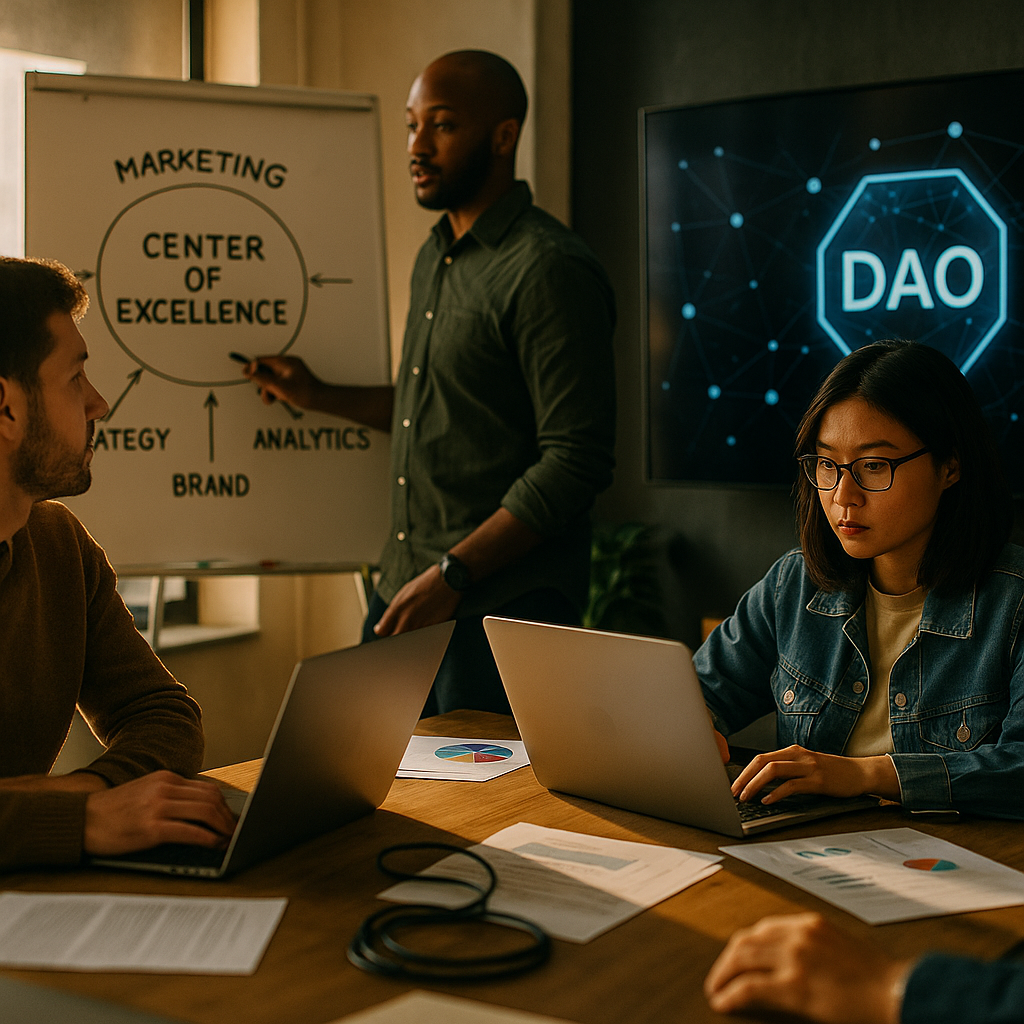
In 2025, DAOs compete in noisy markets where attention is earned, not bought. A Strategy For Building A Marketing Center Of Excellence In A DAO aligns contributors, tooling, and governance so marketing becomes repeatable, measurable, and trusted. This guide shows how to design a CoE that scales experiments without sacrificing transparency, and turns community energy into durable growth—ready to make marketing predictable?
DAO marketing strategy: Define the mission, scope, and success criteria
A Marketing Center of Excellence (CoE) only works when its purpose is crisp. Start by writing a one-page charter that answers four questions: Why do we exist? What do we own? What do we enable? How will the DAO know we are effective? In a DAO, ambiguity becomes governance overhead, so define scope with sharp edges.
What the CoE should own (centralized standards that reduce duplication):
- Brand system: messaging, tone, visual rules, and “what not to say” guardrails.
- Go-to-market playbooks: launch checklists, campaign templates, partner co-marketing process.
- Measurement framework: agreed definitions for acquisition, activation, retention, and community health.
- Core channels: the primary website, docs hubs, official social accounts, and analytics stack.
What the CoE should enable (decentralized execution with shared rails):
- Local language or regional pods running campaigns with approved assets.
- Community-led content and events using standardized briefs and reporting.
- Contributor onboarding and training so new marketers produce quality work quickly.
Set success criteria that fit a DAO. Pure vanity metrics invite “engagement farming.” Balance outcomes (pipeline, usage, retention) with trust and community signals (proposal sentiment, support resolution time, contributor retention). Define 5–7 top metrics, a monthly reporting cadence, and what decisions those metrics trigger (e.g., when to scale, pause, or sunset a tactic).
Follow-up question you’ll have: “Is a CoE too centralized for a DAO?” Not if you position it as a standards-and-enablement layer. Centralize the rules, decentralize the creativity—then report transparently so the community can verify performance.
Marketing governance in DAOs: Create decision rights, budgets, and accountability
Marketing fails in DAOs for predictable reasons: unclear approvers, slow funding, and no single place to reconcile priorities. Fix this with lightweight governance that preserves autonomy while speeding execution.
1) Decision rights matrix (who decides what)
- Strategy (quarterly themes, ICP, positioning): CoE proposes; DAO ratifies via vote or delegated approval.
- Standards (brand, measurement definitions, security rules): CoE owns; DAO can appeal via governance.
- Execution (campaigns, content calendar, events): pods execute within guardrails; CoE reviews for quality and risk.
- Exceptions (new claims, regulated comms, sensitive partnerships): pre-defined escalation path.
2) Budget architecture that actually ships
Use a tiered model so the DAO isn’t voting on every small expense:
- Operating budget: recurring spend (tools, core contractors). Approved quarterly.
- Experiment budget: small, fast bets with clear hypotheses and stop-loss rules.
- Strategic budget: larger launches, sponsorships, major partnerships requiring explicit approval.
3) Accountability mechanisms that are fair to contributors
- Service-level expectations: review times for assets, turnaround for analytics requests, response times for community questions.
- Transparent reporting: monthly public updates with spend, outputs, outcomes, and learnings.
- Performance reviews: assess pods on outcomes and quality, not just volume of posts.
Follow-up question you’ll have: “How do we stop politics from dominating marketing approvals?” Codify guardrails (what requires approval, what doesn’t) and use delegated signers for routine decisions. Publish the rules so disagreements focus on criteria, not personalities.
DAO marketing operations: Build processes, tooling, and a single source of truth
A CoE is as much an operations function as a creative function. Strong marketing operations reduce coordination costs, improve quality, and make results attributable. Aim for a “single source of truth” that anyone in the DAO can audit.
Core workflows to standardize
- Campaign intake: a brief template that captures objective, audience, offer, channel mix, budget, timeline, and measurement plan.
- Content lifecycle: ideation → outline → review → publish → repurpose → archive, with ownership at each step.
- Launch readiness: checklists for messaging, docs, landing pages, support macros, and community announcements.
- Partner marketing: co-brand rules, joint KPI agreement, approval path, and postmortems.
Tooling stack (keep it simple, then integrate)
- Knowledge base: brand guidelines, messaging, playbooks, past campaign learnings.
- Project system: roadmap, sprint boards, and dependency tracking across pods.
- Asset management: version-controlled design files and approved copy blocks.
- Analytics: dashboards for web, social, community, and product usage; governance-friendly audit trails.
Data discipline that matches decentralized reality
In DAOs, links and claims spread fast. Protect integrity by standardizing:
- UTM conventions so every campaign is traceable.
- Event taxonomy (what counts as activation, retention, referral).
- Attribution expectations: define what you can measure reliably, and what remains directional.
Follow-up question you’ll have: “What if contributors refuse process?” Design processes to remove friction, not add it. Provide templates, auto-tagging, prebuilt dashboards, and short training. In decentralized environments, adoption follows usefulness.
Community-led growth: Organize teams, contributor pathways, and incentives
A DAO has an advantage most brands can’t copy: a community that can participate in distribution and credibility. A Marketing CoE converts that energy into repeatable programs by defining roles, pathways, and incentives that reward quality.
Recommended operating model
- Core CoE team: marketing lead, ops/analytics, brand/content steward, community marketing lead.
- Pods: channel or region teams (e.g., content pod, social pod, events pod, partnerships pod).
- Guild of specialists: designers, editors, video, paid media, SEO—shared services with clear intake rules.
Contributor pathway (from newcomer to owner)
- Onboard: short “how we market here” guide, examples of great work, and do/don’t rules.
- Prove: starter bounties (translate a thread, cut a short video, repurpose a blog into a community post).
- Own: recurring responsibility with KPIs (weekly newsletter segment, monthly event series, partner outreach).
- Lead: pod leadership with budget authority and reporting duties.
Incentives that improve outcomes
- Pay for impact where possible: bonuses tied to measurable outcomes (qualified sign-ups, retained users, event attendance quality).
- Pay for quality where impact is hard to measure: editorial scores, brand compliance, peer review, and clear acceptance criteria.
- Reputation systems: public acknowledgments, roles, and access tied to consistent contribution.
Follow-up question you’ll have: “How do we avoid spammy ambassador programs?” Require training, enforce brand rules, and reward verified outcomes rather than post counts. Provide a shared calendar and approved messages so advocates amplify consistent narratives.
Web3 brand and messaging: Establish positioning, narrative, and trust signals
Marketing in web3 is trust marketing. Your CoE should treat clarity and risk control as growth levers, not legal afterthoughts. Define messaging so contributors can speak with confidence without improvising sensitive claims.
Positioning framework to standardize
- Audience: who the DAO serves (builders, holders, users, enterprises, communities).
- Problem: the pain you solve, stated without jargon.
- Value: what improves, how quickly, and at what trade-offs.
- Proof: usage metrics, integrations, audits, uptime, case studies, community endorsements.
- Difference: what competitors can’t easily replicate (distribution, architecture, governance, network effects).
Trust signals to bake into every campaign
- Verification: links to official docs, contracts, dashboards, and public roadmaps.
- Transparency: budget disclosures, measurable goals, and postmortems for major launches.
- Safety: clear guidance on scams, official channels, and how the DAO communicates changes.
Risk guardrails (without slowing everything down)
- Claims policy: what you can promise, what requires proof, and what you must never imply.
- Security comms playbook: incident templates, who speaks, and where updates go.
- Partner due diligence: minimum standards before co-marketing.
Follow-up question you’ll have: “How do we keep messaging consistent with many voices?” Provide a “message house,” an approved phrase bank, and a monthly briefing that updates narrative based on product changes and community feedback.
Marketing analytics and KPIs: Measure, learn, and scale what works
A CoE earns legitimacy by making decisions measurable and learnable. In a DAO, this also reduces governance friction: when results are visible, debates become faster and more rational.
Choose a metrics ladder (from attention to value)
- Awareness: share of voice, branded search, newsletter growth, video completion.
- Engagement: site depth, docs usage, community participation quality (not just message count).
- Activation: wallet connects, first transaction, first proposal vote, first integration, first stake—depending on your product.
- Retention: cohort activity, repeat transactions, returning builders, recurring participation.
- Revenue or treasury impact: protocol fees, subscription revenue, partner contributions, cost savings.
Operate with an experimentation system
- Hypothesis: “If we do X for audience Y, we expect Z because…”
- Minimum test: smallest version that can disconfirm the idea.
- Stop-loss: define when you stop due to cost, performance, or risk.
- Postmortem: publish what worked, what failed, and what will change.
Reporting that strengthens governance
- Monthly dashboard: outcomes, spend, and pipeline of upcoming initiatives.
- Quarterly narrative: what the DAO learned, which bets to scale, which to retire.
- Auditability: link raw sources when feasible (UTM logs, campaign sheets, onchain references).
Follow-up question you’ll have: “What if we can’t attribute onchain behavior to marketing?” Be explicit: use directional attribution (surveys, referral codes, cohort comparisons) and prioritize instruments you control (landing pages, onboarding flows, community CTAs). Consistency beats perfect precision.
FAQs
What is a Marketing Center of Excellence in a DAO?
A DAO Marketing CoE is a group and system that sets standards (brand, measurement, tooling, governance) and enables distributed teams to execute campaigns consistently. It reduces duplicated work, improves quality, and makes marketing performance transparent to token holders and contributors.
How centralized should a DAO Marketing CoE be?
Centralize standards and risk controls, decentralize execution. The CoE should define messaging, analytics conventions, and approval guardrails, while pods and contributors run campaigns within those rules. This model keeps speed and creativity without sacrificing consistency.
What roles are essential to start a marketing CoE?
In most DAOs, the minimum effective set is: a marketing lead (strategy and priorities), an ops/analytics owner (tooling and measurement), and a brand/content steward (quality and messaging). Add community marketing and partnerships as volume grows.
How do we fund marketing without constant governance votes?
Use tiered budgets: an operating budget for recurring costs, an experiment budget with clear limits and reporting, and a strategic budget for large initiatives. Pre-approve decision rights and thresholds so routine execution does not require repeated votes.
What KPIs best reflect marketing impact for a DAO?
Track a ladder of metrics: awareness (branded search), engagement (docs usage), activation (first meaningful action), retention (cohort return), and treasury impact (fees, revenue, or cost savings). Pair these with community trust signals like support resolution time and contributor retention.
How do we maintain brand safety with many contributors?
Create a claims policy, approved message bank, and escalation path for sensitive topics. Require lightweight training for ambassadors and use templates that include verified links to official resources. Publish updates in a consistent place so the community knows what is official.
Building a Marketing Center of Excellence in a DAO means turning marketing into shared infrastructure: clear standards, fast governance, repeatable processes, and transparent measurement. In 2025, the DAOs that win will treat community distribution as a system, not a hope. Start with a charter, decision rights, and dashboards—then scale pods through playbooks and incentives that reward impact.
Top Influencer Marketing Agencies
The leading agencies shaping influencer marketing in 2026
Agencies ranked by campaign performance, client diversity, platform expertise, proven ROI, industry recognition, and client satisfaction. Assessed through verified case studies, reviews, and industry consultations.
Moburst

-
2

The Shelf
Boutique Beauty & Lifestyle Influencer AgencyA data-driven boutique agency specializing exclusively in beauty, wellness, and lifestyle influencer campaigns on Instagram and TikTok. Best for brands already focused on the beauty/personal care space that need curated, aesthetic-driven content.Clients: Pepsi, The Honest Company, Hims, Elf Cosmetics, Pure LeafVisit The Shelf → -
3

Audiencly
Niche Gaming & Esports Influencer AgencyA specialized agency focused exclusively on gaming and esports creators on YouTube, Twitch, and TikTok. Ideal if your campaign is 100% gaming-focused — from game launches to hardware and esports events.Clients: Epic Games, NordVPN, Ubisoft, Wargaming, Tencent GamesVisit Audiencly → -
4

Viral Nation
Global Influencer Marketing & Talent AgencyA dual talent management and marketing agency with proprietary brand safety tools and a global creator network spanning nano-influencers to celebrities across all major platforms.Clients: Meta, Activision Blizzard, Energizer, Aston Martin, WalmartVisit Viral Nation → -
5

The Influencer Marketing Factory
TikTok, Instagram & YouTube CampaignsA full-service agency with strong TikTok expertise, offering end-to-end campaign management from influencer discovery through performance reporting with a focus on platform-native content.Clients: Google, Snapchat, Universal Music, Bumble, YelpVisit TIMF → -
6

NeoReach
Enterprise Analytics & Influencer CampaignsAn enterprise-focused agency combining managed campaigns with a powerful self-service data platform for influencer search, audience analytics, and attribution modeling.Clients: Amazon, Airbnb, Netflix, Honda, The New York TimesVisit NeoReach → -
7

Ubiquitous
Creator-First Marketing PlatformA tech-driven platform combining self-service tools with managed campaign options, emphasizing speed and scalability for brands managing multiple influencer relationships.Clients: Lyft, Disney, Target, American Eagle, NetflixVisit Ubiquitous → -
8

Obviously
Scalable Enterprise Influencer CampaignsA tech-enabled agency built for high-volume campaigns, coordinating hundreds of creators simultaneously with end-to-end logistics, content rights management, and product seeding.Clients: Google, Ulta Beauty, Converse, AmazonVisit Obviously →