


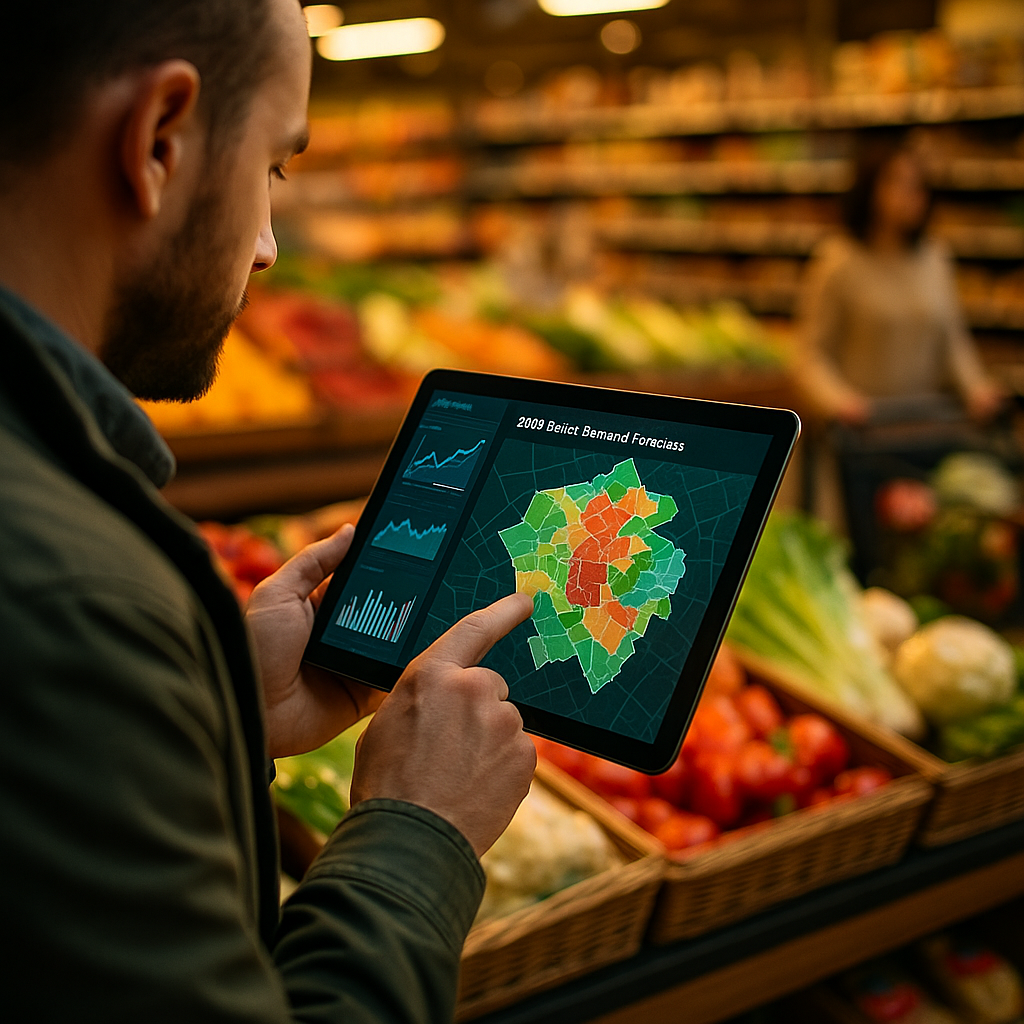
Using AI To Forecast Seasonal Demand For Hyper-Local Products is no longer a luxury in 2025; it is a practical way for retailers, brands, and marketplaces to cut waste, avoid stockouts, and serve neighborhoods with precision. When demand shifts block by block, traditional forecasting breaks. This guide shows how to build forecasts that respect local context, data privacy, and real-world constraints—so you can act faster than the season.
Why hyperlocal demand forecasting matters for seasonal retail
Seasonal demand is rarely uniform across a city. A “summer spike” may mean sunscreen near beaches, iced coffee near transit hubs, and picnic-ready produce near parks—each with different timing and intensity. Hyper-local products amplify this effect: local bakery items, regional produce, neighborhood-specific apparel, community-event merchandise, and store-made prepared foods. The closer the product is tied to place, the more sensitive it is to micro-conditions.
In practice, teams often rely on last year’s sales curves plus a manager’s intuition. That approach fails when:
- Weather patterns change within the same metro area (coastal fog vs. inland heat) and shift demand by day.
- Local events and construction reroute foot traffic and change basket size.
- Assortment and pricing change due to supplier availability, promotions, or shrink control.
- New customers arrive via delivery apps, housing turnover, or tourism pockets.
AI helps because it can learn patterns across many signals simultaneously and update forecasts frequently. The goal is not “perfect predictions.” The goal is better decisions: how much to buy, where to place inventory, when to mark down, and how to staff, with clear confidence ranges.
AI demand forecasting models: choosing the right approach
Not every “AI forecasting” tool fits hyper-local seasonal demand. You get the best results when you match model complexity to the decision you need to make and the data you can reliably collect. Three practical tiers cover most use cases:
- Baseline statistical models (seasonal decomposition, exponential smoothing, ARIMA-style methods): strong for stable items and quick deployment, but they struggle with sparse store-level data and sudden local shocks.
- Machine learning regression models (gradient-boosted trees, random forests): strong for combining many features (weather, promos, events) and handling non-linear effects; they often perform well for SKU-store-day forecasting when engineered carefully.
- Deep learning time-series models (sequence models, temporal convolution, transformer-style forecasters): powerful for multi-horizon forecasting and learning shared patterns across stores and SKUs, especially when you have many locations or a long sales history.
For hyper-local forecasting, the most effective pattern in 2025 is typically a hybrid: a global model that learns broad seasonal shapes, plus local adjustments that account for neighborhood-specific behavior. This reduces overfitting while still respecting micro-markets.
To follow Google’s helpful-content expectations, keep the output interpretable. Your planners and store teams need to know why the forecast moved. Prefer models that support:
- Feature attribution (what drove the change: weather, event, price, stockouts)
- Prediction intervals (best case / expected / worst case)
- Bias checks (systematically under-forecasting certain neighborhoods or store formats)
Also decide whether you need forecasting or forecasting plus optimization. Forecasting estimates demand; optimization converts it into orders, transfers, production plans, and markdown timing under constraints like case packs, lead times, and shelf capacity.
Local data sources and feature engineering for micro-seasonality
AI forecasts are only as useful as the signals you feed them. Hyper-local seasonality depends on local context, so you should blend internal and external data in a disciplined way. Focus on signals that are reliable, explainable, and legally usable.
Core internal signals (usually the highest value):
- Sales and returns at SKU-store-day (or hour) level
- On-hand inventory, receipts, and transfers to detect stockouts and phantom demand
- Price and promotions, including markdown depth and promo placement
- Substitutions (what customers bought when the preferred item was unavailable)
- Operational variables such as store hours, staffing, delivery cutoff times
External signals that often improve seasonal accuracy:
- Hyper-local weather (temperature, precipitation, humidity, wind, alerts). Many seasonal categories respond to thresholds (first heatwave, first heavy rain) rather than calendar dates.
- Local events (sports, concerts, festivals, school calendars, farmers’ markets). Encode events by distance, attendance size, time-of-day, and whether the event historically increases or decreases store traffic.
- Mobility and footfall proxies where legally and ethically sourced (aggregated, not personally identifiable). In many cases, your own store traffic counters and delivery demand can be safer than third-party sources.
- Neighborhood context (commercial vs. residential mix, proximity to transit, office occupancy). Use stable, aggregate descriptors rather than sensitive personal attributes.
Feature engineering makes the difference between “generic seasonality” and micro-seasonality:
- Lag features: sales 1, 7, 14, 28 days ago; same weekday last month; rolling averages.
- Seasonal markers: week-of-year, holiday proximity, school term flags, pay-cycle effects.
- Weather thresholds: “temp above 30°C,” “rainy weekend,” “first sunny weekend after prolonged rain.”
- Spatial features: distance to event venues, parks, waterfronts; store cluster IDs that group similar neighborhoods.
Answering a common follow-up question: What if my store-level data is sparse? Use hierarchical approaches: learn shared patterns at city/cluster level and then allocate down to stores based on recent ratios, footfall, and assortment differences. Also consider modeling at a slightly higher aggregation (category-store-day) and then distributing to SKUs using recent mix.
Seasonal inventory planning with AI: from forecast to action
Forecasts create value only when they change decisions. Seasonal hyper-local products often have short shelf lives, limited replenishment windows, and localized suppliers—so your planning system must translate predicted demand into actions that work on the ground.
Key operational decisions AI can improve:
- Pre-season buys: how much to commit before the season starts, by store cluster.
- In-season replenishment: when to reorder and how to allocate scarce supply across locations.
- Fresh production planning: daily bake/prep quantities for store-made or local-supplier items.
- Markdown timing: when to reduce price to prevent waste while protecting margin.
- Staffing and picking capacity: aligning labor with forecasted peaks in store and delivery orders.
Make uncertainty usable. For seasonal items, build plans from prediction intervals rather than a single number. For example:
- Base order using the median forecast
- Flex capacity using the upper bound (backup supplier, optional production shift)
- Risk controls using the lower bound (minimum commitments, earlier markdown triggers)
Correct for stockouts and lost sales. Hyper-local items often sell out in a few hours, which makes raw sales look lower than true demand. Use inventory-aware models or post-process adjustments that detect “capped sales” patterns (flat sales at low inventory, frequent zero-on-hand). Without this, AI will learn that selling out means “demand is low,” and forecasts will spiral downward.
Manage substitution explicitly. If a local strawberry pack sells out, shoppers may buy raspberries or a different brand. If you only forecast each SKU independently, you will overreact to the “drop” in strawberries and miss the cross-effects. Practical approach: forecast at a “choice set” level (variety/category) and then allocate within it, using availability and price.
Close the loop with store teams. Planners should provide an override workflow with accountability: require a reason code (event insight, supplier constraint, local construction) and track whether the override improved results. This blends expertise with AI instead of treating them as competitors.
MLOps and data governance for retail AI forecasting systems
In 2025, the hardest part is rarely the first model. It is maintaining accuracy as products, neighborhoods, and operations change. Strong MLOps (machine learning operations) and governance keep the system reliable and auditable.
Data quality controls should be automated:
- Outlier detection (POS glitches, double-counted receipts, negative sales)
- Promotion normalization (consistent promo flags, start/end times, discount depth)
- Inventory integrity (phantom inventory, late receiving, shrink adjustments)
Model monitoring must focus on business impact:
- Forecast accuracy by segment (store cluster, SKU type, fresh vs. ambient)
- Bias and drift (model error increasing in certain neighborhoods or after assortment changes)
- Service-level outcomes (in-stock rate, waste, markdown spend, fill rate)
Privacy and compliance are non-negotiable for hyper-local work. Use aggregated and anonymized data where possible; avoid sensitive personal attributes; document data lineage and retention policies; and ensure vendors provide clear terms for data usage. If you use location-based external data, validate that it is collected with appropriate consent and that your use aligns with your privacy policy.
Explainability for trust. Decision-makers need to understand drivers, not just numbers. Provide “forecast narratives” that surface the top contributors (e.g., “temperature threshold crossed,” “stadium event within 1 km,” “promo increased expected demand by X”). This supports EEAT by making the system transparent and verifiable.
Measuring forecast accuracy and ROI for hyper-local products
Accuracy metrics alone can mislead. A forecast can be statistically “good” but operationally useless if it does not reduce waste or improve availability. Build a scorecard that ties model performance to outcomes.
Recommended forecasting metrics (use more than one):
- WAPE (weighted absolute percentage error): stable for comparing across stores and SKUs.
- MAE (mean absolute error): easy to interpret in units (cases, items).
- Bias: average over-forecast vs. under-forecast; critical for perishables.
- Service-level accuracy: whether you hit the right range to stay in stock without overbuying.
Operational ROI metrics that executives care about:
- Waste reduction for fresh and short-dated items
- Stockout reduction during seasonal peaks
- Gross margin improvement through fewer panic markdowns and better allocation
- Labor efficiency through better staffing and picking schedules
- Supplier performance (fewer expedite fees, more stable ordering cadence)
Run controlled tests. When possible, evaluate with store clusters: keep a comparable group on the legacy method and shift another group to AI-driven ordering. Ensure both groups face similar promos and constraints. This is often the fastest way to answer the follow-up question, “Is the model really causing the improvement?”
Common pitfalls to avoid:
- Ignoring availability: judging forecasts on sales when shelves were empty.
- One-size-fits-all horizons: daily fresh needs short horizons; pre-season buys need longer ones.
- Overreacting to noise: hyper-local data is volatile; use smoothing and confidence bands.
- Not versioning decisions: track which forecast version drove which order to learn correctly.
FAQs about AI forecasting for seasonal hyper-local products
What counts as a hyper-local product?
A hyper-local product is one whose demand is strongly tied to a specific neighborhood or micro-market. Examples include locally sourced produce, store-made prepared foods, event-based merchandise, and items that sell primarily near certain venues or commuter routes.
How much historical data do I need for AI seasonal forecasting?
You can start with months of store-level history if you use a global or hierarchical model that learns patterns across stores and similar SKUs. More history helps with rare seasonal peaks, but feature-rich models can compensate by using weather, events, and inventory signals.
How do AI models handle sudden local events that were not planned?
They handle them best when you ingest near-real-time signals such as weather alerts, traffic/footfall indicators, and rapid sales trends. You should also support human-in-the-loop overrides with reason codes so teams can react immediately while the model learns afterward.
Is weather data enough to forecast seasonal demand?
Weather is often a major driver, but it is rarely sufficient alone. Promotions, availability, local events, school calendars, and neighborhood context can be equally important—especially for hyper-local products where foot traffic patterns change demand as much as temperature does.
How do I prevent AI forecasts from reinforcing stockout patterns?
Use inventory-aware features and lost-sales adjustments. Detect periods where sales were constrained by low on-hand inventory and treat them differently during training, so the model learns underlying demand rather than “sold-out equals low demand.”
Should I buy an AI forecasting tool or build in-house?
If you need speed and standard workflows, a proven vendor can work well—especially if they support explainability, data governance, and integration with ordering. Build in-house when your hyper-local edge depends on proprietary signals, unusual operations, or you need tight control over customization and model updates.
AI-driven hyper-local forecasting in 2025 works when it connects neighborhood signals to operational decisions, not when it chases abstract accuracy. Combine clean internal data, selective external context, and models that quantify uncertainty, then close the loop with inventory constraints and measurable outcomes. The takeaway is simple: treat forecasting as a decision system, and seasonal demand becomes manageable—one micro-market at a time.
Top Influencer Marketing Agencies
The leading agencies shaping influencer marketing in 2026
Agencies ranked by campaign performance, client diversity, platform expertise, proven ROI, industry recognition, and client satisfaction. Assessed through verified case studies, reviews, and industry consultations.
Moburst

-
2

The Shelf
Boutique Beauty & Lifestyle Influencer AgencyA data-driven boutique agency specializing exclusively in beauty, wellness, and lifestyle influencer campaigns on Instagram and TikTok. Best for brands already focused on the beauty/personal care space that need curated, aesthetic-driven content.Clients: Pepsi, The Honest Company, Hims, Elf Cosmetics, Pure LeafVisit The Shelf → -
3

Audiencly
Niche Gaming & Esports Influencer AgencyA specialized agency focused exclusively on gaming and esports creators on YouTube, Twitch, and TikTok. Ideal if your campaign is 100% gaming-focused — from game launches to hardware and esports events.Clients: Epic Games, NordVPN, Ubisoft, Wargaming, Tencent GamesVisit Audiencly → -
4

Viral Nation
Global Influencer Marketing & Talent AgencyA dual talent management and marketing agency with proprietary brand safety tools and a global creator network spanning nano-influencers to celebrities across all major platforms.Clients: Meta, Activision Blizzard, Energizer, Aston Martin, WalmartVisit Viral Nation → -
5

The Influencer Marketing Factory
TikTok, Instagram & YouTube CampaignsA full-service agency with strong TikTok expertise, offering end-to-end campaign management from influencer discovery through performance reporting with a focus on platform-native content.Clients: Google, Snapchat, Universal Music, Bumble, YelpVisit TIMF → -
6

NeoReach
Enterprise Analytics & Influencer CampaignsAn enterprise-focused agency combining managed campaigns with a powerful self-service data platform for influencer search, audience analytics, and attribution modeling.Clients: Amazon, Airbnb, Netflix, Honda, The New York TimesVisit NeoReach → -
7

Ubiquitous
Creator-First Marketing PlatformA tech-driven platform combining self-service tools with managed campaign options, emphasizing speed and scalability for brands managing multiple influencer relationships.Clients: Lyft, Disney, Target, American Eagle, NetflixVisit Ubiquitous → -
8

Obviously
Scalable Enterprise Influencer CampaignsA tech-enabled agency built for high-volume campaigns, coordinating hundreds of creators simultaneously with end-to-end logistics, content rights management, and product seeding.Clients: Google, Ulta Beauty, Converse, AmazonVisit Obviously →