


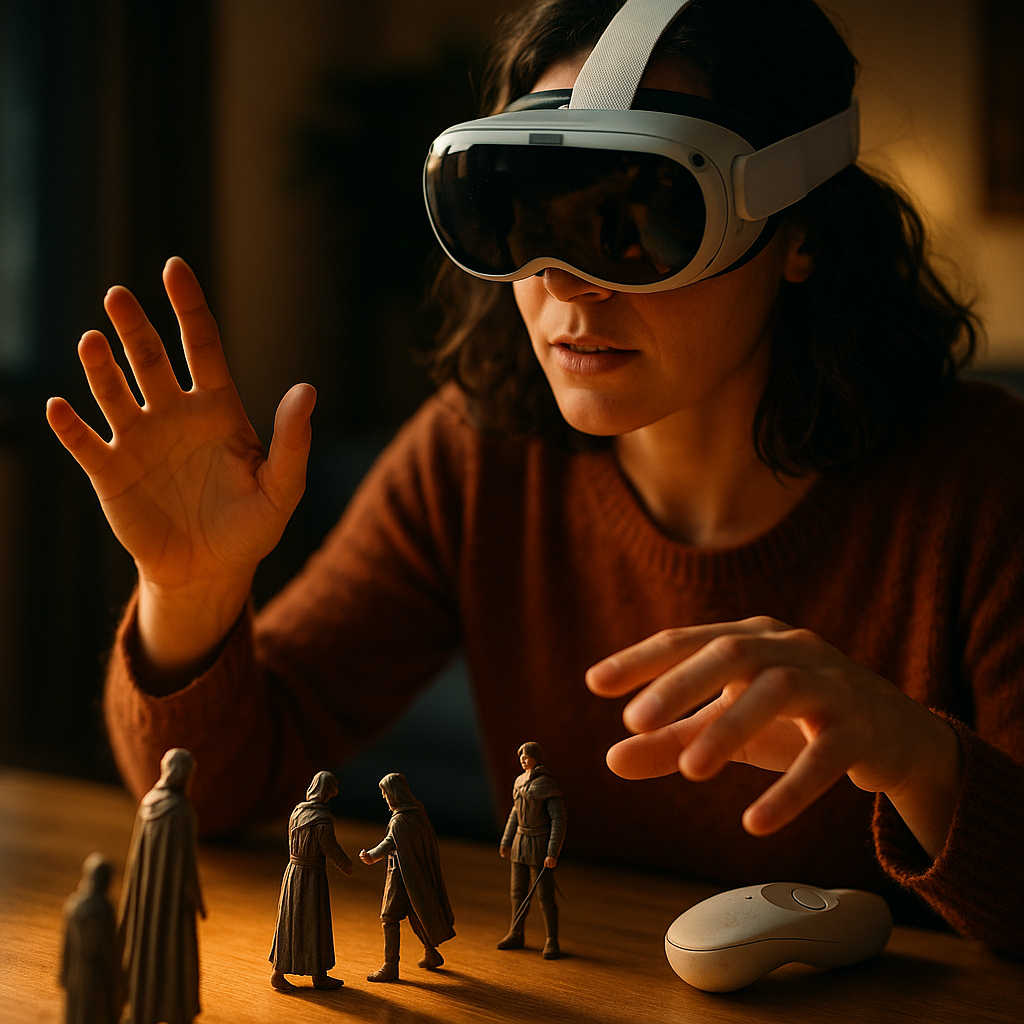
In 2025, storytellers face a shift bigger than widescreen or streaming. The Impact Of Spatial Computing On Future Narrative Content is changing how audiences experience plot, character, and place. Instead of watching a story, people increasingly step inside it—moving, choosing, and perceiving meaning through space. What happens when narrative becomes a world you inhabit rather than a file you play?
What is spatial computing for storytelling (secondary keyword: spatial computing storytelling)
Spatial computing storytelling describes narrative experiences that merge digital content with the physical world or place the audience inside a simulated environment where space, depth, and presence matter. It includes augmented reality (AR), virtual reality (VR), mixed reality (MR), and “world-locked” content that anchors to surfaces, rooms, or real locations.
Unlike traditional film or games where the frame defines what matters, spatial computing treats environment as a primary narrative channel. The audience can inspect objects, notice details at their own pace, and even trigger scenes based on proximity or gaze. That changes authorship: creators don’t only write dialogue and edit shots; they design paths, attention cues, and discoverable story fragments.
In practice, spatial narratives often rely on three building blocks:
- Spatial context: Where the user is and what they can see, reach, or hear.
- Interactive agency: Choices that influence sequence, perspective, or outcomes.
- Embodied perception: Meaning created through movement, scale, and closeness.
Readers usually ask: “Is this just gaming?” Not exactly. Games optimize for challenge and systems; spatial narrative optimizes for meaning, emotional pacing, and theme—often with lighter interaction and stronger authorial intent.
Immersive narrative design changes pacing and perspective (secondary keyword: immersive narrative design)
Immersive narrative design forces creators to replace the language of cuts and close-ups with the language of attention. In spatial experiences, the audience can look away, walk closer, or linger. If a key plot point only exists in one “shot,” many users will miss it.
Effective spatial pacing uses:
- Spatial beats: Story moments tied to entering zones, opening objects, or turning corners.
- Guided attention: Light, sound, motion, and character blocking that naturally pulls the gaze without feeling like a UI prompt.
- Layered storytelling: A clear main path plus optional details for curious users.
Perspective also becomes dynamic. Instead of selecting one camera angle, you design for “infinite cameras” where the user decides. That raises a common follow-up: “How do you preserve emotional intimacy without close-ups?” You build intimacy through proximity, voice, eye contact cues, and environment. A character’s whispered confession feels more personal when the audience has to step closer to hear it, but it must be paired with consentful design to avoid discomfort.
Creators should also plan for replays and variability. Two users might experience the same narrative with different timing and discoveries, so the story must remain coherent even when consumed out of order. This pushes writers toward modular scenes, redundant cues for critical information, and consistent character goals that remain legible across paths.
Mixed reality storytelling blends physical context with fiction (secondary keyword: mixed reality storytelling)
Mixed reality storytelling ties narrative to real spaces and objects, making the audience’s home, neighborhood, or workplace part of the set. This can create a powerful “it’s happening here” effect, but it also introduces practical and ethical constraints.
To keep stories reliable across varied rooms and lighting conditions, many MR narratives use a “content-flex” approach:
- Adaptive staging: Characters and props reposition to fit available floor space.
- Semantic anchoring: Scenes attach to categories (wall, table, doorway) rather than exact coordinates.
- Scalable set dressing: Visual complexity increases on capable devices and simplifies when needed.
Users often wonder whether MR will replace cinema. More likely, it becomes a parallel format with its own strengths: intimacy, presence, and personalization. A thriller can place clues on your desk. A family drama can unfold across your living room, making emotional distance literal when two characters stand on opposite ends of your space.
However, MR storytelling must handle safety and privacy carefully. Designers should avoid encouraging users to run, obscure real hazards, or record bystanders without clear permission flows. EEAT-aligned content practice here means showing your process: disclose what sensors are used, minimize data collection, and keep core experiences available even when users deny optional permissions.
XR content creation workflows evolve across teams (secondary keyword: XR content creation)
XR content creation changes who makes narrative and how they collaborate. A spatial production resembles a hybrid of film, theater, game development, and product design. Writers, directors, level designers, 3D artists, sound designers, and UX specialists must align early because story structure depends on interaction and environment.
Expect these workflow shifts to matter most in 2025:
- Previsualization becomes mandatory: Teams block scenes in 3D early to test sightlines, comfort, and pacing.
- Branch management and narrative logic: Scripts link to states, triggers, and fail-safes so the story never stalls.
- Performance capture and spatial acting: Actors perform for a viewer who may stand inches away, changing the level of detail required.
- Spatial audio as story: Directional sound guides attention and communicates off-screen action without forcing UI arrows.
A frequent follow-up: “Does this mean writers need to code?” Not necessarily, but writers should understand interactive structure and collaborate with technical narrative designers. A practical approach is to write in “story atoms”: short scenes with clear prerequisites, emotional purpose, and what changes in the world state afterward.
To strengthen credibility and maintain quality, teams should document assumptions and testing outcomes: comfort targets (session length, locomotion type), accessibility decisions, and content moderation policies if user-generated input is allowed. This kind of transparent process supports EEAT by demonstrating expertise and responsible handling of user experience.
User agency and emotional engagement in interactive stories (secondary keyword: interactive storytelling)
Interactive storytelling in spatial formats increases agency, but agency is not the same as freedom. Most audiences want meaningful influence, not unlimited options. The key is to let users shape interpretation and participation while keeping the narrative emotionally guided.
High-performing patterns include:
- Choice of viewpoint: The user decides where to stand, what to inspect, and which character to follow, while the core events remain consistent.
- Micro-agency: Small actions (handing an object, opening a letter, lighting a candle) that deepen empathy without derailing plot.
- Consequences that clarify theme: Branches that reveal different sides of a conflict rather than wildly different endings that dilute meaning.
Spatial computing also enables embodied empathy. When a scene asks you to kneel to see a child’s drawing or step back to take in a ruined landscape, the body participates in comprehension. That said, designers must avoid manipulative intensity. Provide comfort settings, content warnings when appropriate, and clear exits. Trust drives retention, and retention drives the medium’s long-term viability.
Readers often ask: “Will agency reduce authorial voice?” It can, unless you design agency around the author’s intent. The strongest interactive narratives treat choices as a way to explore the same thematic question from multiple angles, keeping voice consistent while giving the audience ownership of their journey.
Distribution, ethics, and monetization of spatial media (secondary keyword: spatial media)
Spatial media faces a familiar challenge with new constraints: discovery, device fragmentation, and sustainable business models. In 2025, audiences are selective about installing new platforms, and creators need realistic paths to reach them.
Distribution strategies that fit spatial content include:
- Format tiering: Offer a core experience on widely available devices, plus enhanced features on advanced headsets.
- Short-form entry points: Publish a 5–10 minute “chapter zero” that sells the world and teaches interaction.
- Location-based releases: Museums, festivals, and pop-ups that match narrative with curated spaces and guided onboarding.
Monetization tends to cluster around:
- Premium episodes: Serialized spatial narratives with season arcs.
- Brand-supported storyworlds: When brand integration is clearly disclosed and thematically aligned.
- Licensing and IP expansion: Spatial side stories that deepen a franchise without replacing the main medium.
Ethics must stay central. Spatial experiences can map rooms, infer behaviors, and create intense psychological effects through presence. EEAT-aligned creators should publish clear privacy explanations, avoid unnecessary data retention, and design for consent—especially around recording, hand tracking, eye tracking, and shared spaces. If your story includes user-generated content or live social interaction, moderation policies and reporting tools are part of narrative stewardship.
FAQs
What types of narratives benefit most from spatial computing?
Mysteries, environmental dramas, historical reconstructions, and character-driven intimacy pieces often excel because they use space as a clue system or emotional amplifier. Stories that depend on atmosphere, proximity, or discovery gain more than plots that rely on rapid cutting or dense exposition.
Do audiences need a headset to experience spatial narratives?
Not always. Some experiences run on phones or tablets using AR, while others use headsets for full immersion. Many creators design tiered versions so the story remains accessible while offering deeper presence on advanced devices.
How do creators ensure users don’t miss key plot points?
Use redundant cues for critical information: audio lines that play when users enter a zone, visual highlights that feel natural, and character actions that draw attention. Keep essential beats on the main path and place optional lore in side spaces.
What are the biggest production risks in XR narrative?
Comfort issues (motion sickness), unclear interaction design, and over-scoped branching are common risks. Mitigate them with early prototypes, consistent locomotion options, usability testing, and narrative structures built from modular scenes rather than sprawling decision trees.
How should spatial stories handle privacy?
Collect the minimum sensor data required, explain why permissions are needed, and provide meaningful opt-outs without breaking the core experience. Avoid storing room scans or personally identifiable information unless it is essential, and state retention policies in plain language.
Will spatial computing replace film and TV?
It will more likely expand the narrative ecosystem. Film and TV remain efficient for mass distribution and tightly authored pacing, while spatial narratives offer presence, personalization, and embodied emotion. Many IPs will use both formats to serve different audience needs.
Spatial computing is reshaping narrative by turning space into a storytelling instrument: pacing becomes environmental, perspective becomes user-driven, and emotion becomes embodied. The strongest projects in 2025 combine authorial intent with guided agency, rigorous testing, and responsible data practices. Build stories as worlds that reward curiosity, respect comfort, and remain coherent across paths—then audiences won’t just watch your narrative; they’ll inhabit it.
Top Influencer Marketing Agencies
The leading agencies shaping influencer marketing in 2026
Agencies ranked by campaign performance, client diversity, platform expertise, proven ROI, industry recognition, and client satisfaction. Assessed through verified case studies, reviews, and industry consultations.
Moburst

-
2

The Shelf
Boutique Beauty & Lifestyle Influencer AgencyA data-driven boutique agency specializing exclusively in beauty, wellness, and lifestyle influencer campaigns on Instagram and TikTok. Best for brands already focused on the beauty/personal care space that need curated, aesthetic-driven content.Clients: Pepsi, The Honest Company, Hims, Elf Cosmetics, Pure LeafVisit The Shelf → -
3

Audiencly
Niche Gaming & Esports Influencer AgencyA specialized agency focused exclusively on gaming and esports creators on YouTube, Twitch, and TikTok. Ideal if your campaign is 100% gaming-focused — from game launches to hardware and esports events.Clients: Epic Games, NordVPN, Ubisoft, Wargaming, Tencent GamesVisit Audiencly → -
4

Viral Nation
Global Influencer Marketing & Talent AgencyA dual talent management and marketing agency with proprietary brand safety tools and a global creator network spanning nano-influencers to celebrities across all major platforms.Clients: Meta, Activision Blizzard, Energizer, Aston Martin, WalmartVisit Viral Nation → -
5

The Influencer Marketing Factory
TikTok, Instagram & YouTube CampaignsA full-service agency with strong TikTok expertise, offering end-to-end campaign management from influencer discovery through performance reporting with a focus on platform-native content.Clients: Google, Snapchat, Universal Music, Bumble, YelpVisit TIMF → -
6

NeoReach
Enterprise Analytics & Influencer CampaignsAn enterprise-focused agency combining managed campaigns with a powerful self-service data platform for influencer search, audience analytics, and attribution modeling.Clients: Amazon, Airbnb, Netflix, Honda, The New York TimesVisit NeoReach → -
7

Ubiquitous
Creator-First Marketing PlatformA tech-driven platform combining self-service tools with managed campaign options, emphasizing speed and scalability for brands managing multiple influencer relationships.Clients: Lyft, Disney, Target, American Eagle, NetflixVisit Ubiquitous → -
8

Obviously
Scalable Enterprise Influencer CampaignsA tech-enabled agency built for high-volume campaigns, coordinating hundreds of creators simultaneously with end-to-end logistics, content rights management, and product seeding.Clients: Google, Ulta Beauty, Converse, AmazonVisit Obviously →