


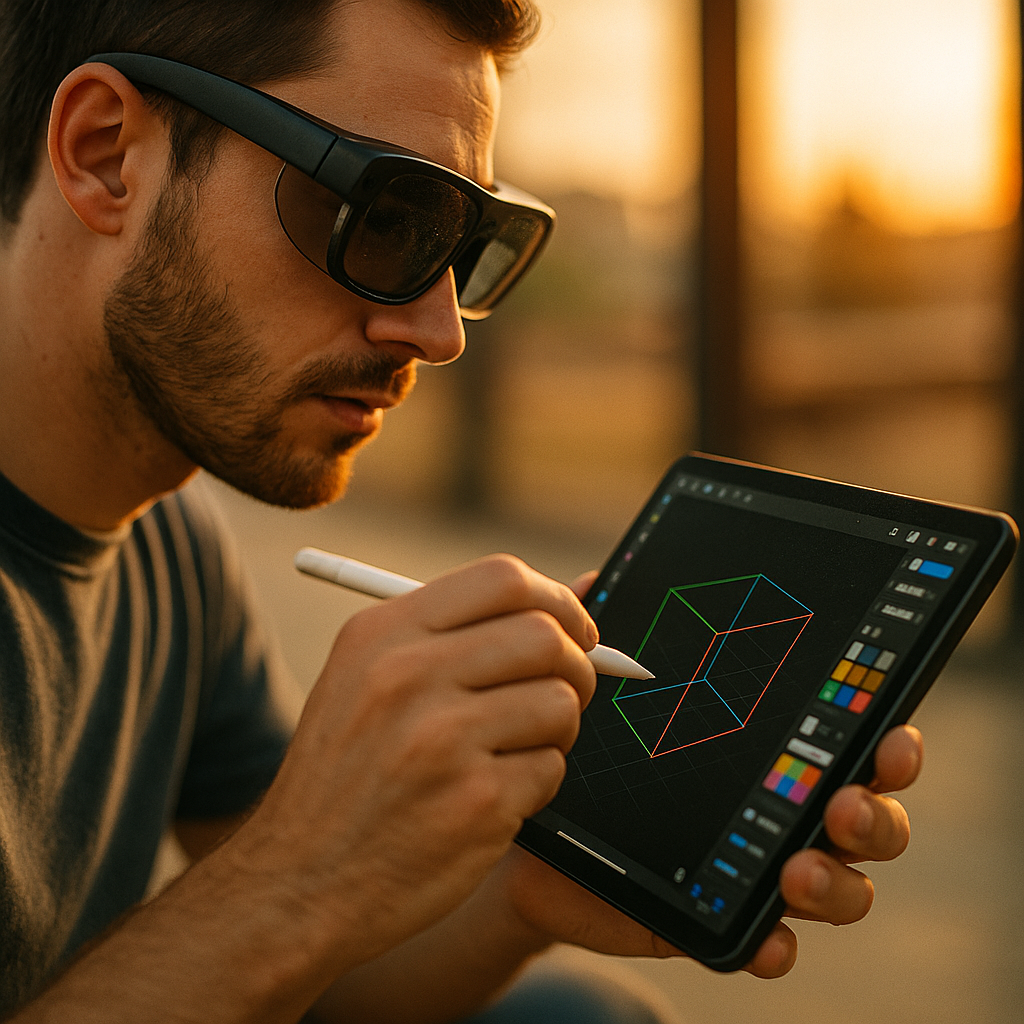
In 2025, augmented reality glasses are shifting AR from phone screens to always-available, hands-free views that blend digital information with the real world. That change will reshape how creators plan, produce, and distribute media across industries. As wearables move toward mainstream use, content formats must adapt to new constraints and opportunities—and the winners will design for reality first. What will audiences expect next?
AR content formats and spatial publishing
Augmented reality glasses turn content into a layer on top of lived environments. Instead of asking people to open an app, creators can publish information that appears where it is most useful: on objects, in rooms, along streets, or around people (with permission). This shift pushes media away from rectangular frames and toward spatial publishing, where context, location, and intent matter as much as visuals.
Expect several AR content formats to become standard:
- World-anchored overlays: persistent labels, instructions, art, or navigation tied to physical coordinates. Example: museum exhibits that reveal interactive layers when you stand near an artifact.
- Object-anchored content: callouts and animations bound to recognized products or machinery. Example: maintenance steps that snap to the exact bolt or panel a technician is viewing.
- Proximity-triggered stories: content that unfolds as the wearer moves through a space. Example: a retail “try-and-learn” experience that changes by aisle, not by page.
- Mixed-focus microcontent: short, glanceable bursts designed to be consumed in seconds without taking full attention from the environment.
For publishers, a key follow-up question is: How do we distribute content when there is no feed? In AR glasses, distribution shifts toward intent and context (what the user is doing and where they are), plus trusted “layers” or channels a user opts into. That increases the importance of brand trust, accurate metadata, and clear user permissions.
Creators should also plan for limited visual real estate. Even when displays improve, the best AR experiences avoid clutter. The format that wins is often the one that adds the smallest amount of information that produces the biggest real-world benefit.
Spatial UX design for glanceable, hands-free media
AR glasses introduce new interaction patterns. People will not tolerate long onboarding flows or dense interfaces floating in front of their eyes. Spatial UX design prioritizes comfort, legibility, and minimal cognitive load while preserving safety. For content teams, this changes both storytelling and information design.
Practical design expectations in 2025 include:
- Glance-first layouts: key points surfaced in 1–3 seconds; deeper details available only on demand.
- Adaptive typography and contrast: text that stays readable across bright outdoor scenes and dim interiors.
- Diegetic placement: information appears near the thing it describes (e.g., price near a product, step near a component) rather than in a detached panel.
- Comfort boundaries: content avoids excessive motion, jitter, or frequent pop-ups that cause fatigue.
Readers often ask whether AR glasses will replace video. The more realistic outcome is video evolves. Traditional full-screen video remains valuable for deep viewing, but glasses push creators toward contextual video snippets: short clips attached to objects or tasks, plus “picture-in-context” playback that doesn’t block situational awareness.
Interaction methods will also diversify. Voice, subtle gestures, gaze, and controller-free hand tracking may coexist. Content must remain robust across input differences, meaning the safest approach is multimodal UX: a voice command and a tap alternative; captions and audio cues; visual plus haptic confirmation where supported.
Finally, accessibility becomes central. AR can empower users with real-time captions, translation, wayfinding, and object identification, but only if designers treat these as core features instead of add-ons. That is also aligned with EEAT: helpful, inclusive experiences build lasting credibility.
Immersive storytelling and 3D content pipelines
When a medium becomes spatial, storytelling becomes spatial too. Immersive storytelling on AR glasses relies less on linear timelines and more on branching, situational narratives shaped by place, movement, and user choice. For creators, that means developing new grammar: what does a “scene” look like when the set is the user’s living room or a city street?
Common narrative patterns likely to scale:
- Layered annotation: a real-world setting with optional explainers, character notes, or historical context revealed as the user looks around.
- Spatial chapters: the story advances when users reach specific locations or complete actions.
- AR characters and guides: virtual presenters who appear at appropriate moments, staying out of the way when not needed.
- Collaborative moments: shared AR experiences where multiple viewers see the same anchored content, useful for events and education.
The follow-up question is: What happens to production workflows? Teams will need a reliable 3D content pipeline, even if they are not building “games.” That includes:
- Asset standards: consistent scale, performance budgets, and lighting assumptions for 3D models.
- Versioning and governance: tracking changes to assets and text overlays the same way you manage web content.
- Performance optimization: low-latency rendering, lightweight meshes, compressed textures, and smart occlusion choices.
- Editorial review: validating accuracy for overlays that may influence real actions (repairs, medical guidance, navigation).
EEAT matters strongly here. If content can influence what someone does in the physical world, accuracy and provenance become non-negotiable. Cite qualified experts internally, keep review logs, and clearly separate informational guidance from marketing claims. When users can see content “on reality,” trust is the product.
AR advertising and commerce experiences
AR advertising will move from interruptive placements to situational utility. Glasses create new inventory, but the most effective formats will be those that help users accomplish goals: compare products, understand features, find items, or visualize fit. Commerce shifts from browsing pages to experiencing products in context.
High-intent formats likely to grow include:
- Spatial product cards: minimal, anchored info that appears when a user opts in (price, reviews, availability).
- Try-on and fit visualization: eyewear, cosmetics, apparel sizing cues, and accessory placement with realistic occlusion and lighting.
- Guided shopping paths: navigation overlays inside stores, plus real-time substitutions and dietary or compatibility filters.
- Post-purchase support layers: setup guidance, warranty info, and troubleshooting steps anchored to the product.
A key concern is whether AR will amplify “ad overload.” In a face-worn medium, tolerance is lower. Expect platforms and users to demand permission-based advertising, clear labeling, and frequency limits. Brands that treat AR as a way to “own the view” will lose access as users disable layers and regulators scrutinize practices.
Measurement also changes. Instead of clicks, success may be defined by dwell time near an object, opted-in interactions, saved comparisons, store navigation completion, or reductions in returns due to better visualization. To keep EEAT strong, marketers should disclose when product overlays are sponsored and avoid manipulative placement that could distract users in safety-critical settings.
Privacy, ethics, and trust for wearable AR
AR glasses rely on sensors: cameras, microphones, location data, and environment mapping. That enables compelling content, but it also creates privacy risk for wearers and bystanders. Trust will determine adoption, and content formats will evolve under stricter expectations about consent and data minimization.
In practice, responsible wearable AR content should follow principles that users can feel immediately:
- Visible recording cues: clear indicators when capture is active and easy ways to pause.
- On-device processing where possible: reduce cloud uploads for sensitive environment data.
- Bystander respect: avoid persistent identification, face tagging, or covert profiling; support “no-capture” zones.
- Data minimization: collect only what is needed for the experience; define retention limits.
- Explainable personalization: users should understand why they are seeing a recommendation or overlay.
Creators and publishers should anticipate the follow-up question: How do we build trust while still personalizing? Make personalization opt-in, give users controls that are easy to find in the moment, and offer “privacy-first modes” that keep basic functionality without intensive tracking. Transparency statements should be written in plain language and connected to in-product prompts, not buried in legal pages.
EEAT best practices apply directly: demonstrate expertise with safety reviews, document editorial standards for real-world guidance, and show accountability with update histories and user reporting tools. When content lives on top of reality, ethical missteps become instantly visible.
Creator economy and interoperability standards
AR glasses will reshape who can publish and what “publishing” means. In addition to major studios and platforms, smaller creators will produce spatial tutorials, local guides, and interactive art layers. The creator economy grows when tools get simpler, but sustainable growth depends on interoperability standards that prevent every experience from being locked into a single ecosystem.
Expect pressure toward:
- Portable assets: creators want to reuse models, animations, and text across devices and platforms with minimal rework.
- Consistent anchoring methods: reliable ways to place content in the world so it stays stable across sessions.
- Rights management: clear licensing for 3D assets, scanned environments, and branded objects.
- Moderation and safety layers: tools to prevent harassment, spatial graffiti in sensitive locations, or misleading overlays.
For businesses asking where to start, the most resilient strategy is to build content primitives that can be remixed: short instructional steps, modular 3D assets, structured product data, and verified location metadata. That reduces risk as platforms evolve and lets you publish quickly when new devices and standards mature.
To support EEAT, creators should label sources, provide update notes, and separate opinion from instruction. In AR, credibility is not just a brand attribute—it is an interface feature.
FAQs on augmented reality glasses and future content formats
-
Will AR glasses replace smartphones for content consumption?
No. In 2025, AR glasses are better viewed as a complementary layer for hands-free, context-driven moments. Phones remain important for deep reading, long video, typing, and private interactions, while glasses win at quick guidance, navigation, and in-the-moment discovery.
-
What new content format should publishers prioritize first?
Start with glanceable, location- or object-anchored microcontent: short explainers, step-by-step instructions, and contextual prompts. These formats deliver clear value without requiring heavy 3D production from day one.
-
How do you design AR content that is safe to use?
Use minimal overlays, avoid blocking central vision, respect motion and comfort boundaries, and require explicit user actions for disruptive content. For high-stakes domains (health, industrial work), add expert review, clear warnings, and validation testing in real environments.
-
What skills will content teams need for AR glasses?
In addition to editorial and UX fundamentals, teams benefit from spatial information design, basic 3D asset literacy, interaction writing for voice and gaze, accessibility planning, and governance processes that keep overlays accurate and up to date.
-
How will SEO work when content appears as overlays?
Discovery will lean on structured data, entity metadata, trusted channels, and platform search inside AR ecosystems. Brands should invest in accurate knowledge graph-style information, consistent naming, and permissions-based distribution rather than relying only on traditional webpage rankings.
-
What are the biggest privacy concerns with AR glasses content?
Unclear recording, bystander capture, persistent environment mapping, and personalized overlays driven by sensitive data. The best mitigation is transparent indicators, data minimization, opt-in personalization, and strong controls users can access instantly.
Augmented reality glasses will redefine content formats by moving media from screens into lived spaces. In 2025, the most effective experiences are glanceable, context-aware, and anchored to real objects, supported by strong spatial UX and trustworthy editorial standards. Creators who build modular assets, respect privacy, and design for utility will earn adoption as AR distribution matures. The clear takeaway: publish for reality, not rectangles.
Top Influencer Marketing Agencies
The leading agencies shaping influencer marketing in 2026
Agencies ranked by campaign performance, client diversity, platform expertise, proven ROI, industry recognition, and client satisfaction. Assessed through verified case studies, reviews, and industry consultations.
Moburst

-
2

The Shelf
Boutique Beauty & Lifestyle Influencer AgencyA data-driven boutique agency specializing exclusively in beauty, wellness, and lifestyle influencer campaigns on Instagram and TikTok. Best for brands already focused on the beauty/personal care space that need curated, aesthetic-driven content.Clients: Pepsi, The Honest Company, Hims, Elf Cosmetics, Pure LeafVisit The Shelf → -
3

Audiencly
Niche Gaming & Esports Influencer AgencyA specialized agency focused exclusively on gaming and esports creators on YouTube, Twitch, and TikTok. Ideal if your campaign is 100% gaming-focused — from game launches to hardware and esports events.Clients: Epic Games, NordVPN, Ubisoft, Wargaming, Tencent GamesVisit Audiencly → -
4

Viral Nation
Global Influencer Marketing & Talent AgencyA dual talent management and marketing agency with proprietary brand safety tools and a global creator network spanning nano-influencers to celebrities across all major platforms.Clients: Meta, Activision Blizzard, Energizer, Aston Martin, WalmartVisit Viral Nation → -
5

The Influencer Marketing Factory
TikTok, Instagram & YouTube CampaignsA full-service agency with strong TikTok expertise, offering end-to-end campaign management from influencer discovery through performance reporting with a focus on platform-native content.Clients: Google, Snapchat, Universal Music, Bumble, YelpVisit TIMF → -
6

NeoReach
Enterprise Analytics & Influencer CampaignsAn enterprise-focused agency combining managed campaigns with a powerful self-service data platform for influencer search, audience analytics, and attribution modeling.Clients: Amazon, Airbnb, Netflix, Honda, The New York TimesVisit NeoReach → -
7

Ubiquitous
Creator-First Marketing PlatformA tech-driven platform combining self-service tools with managed campaign options, emphasizing speed and scalability for brands managing multiple influencer relationships.Clients: Lyft, Disney, Target, American Eagle, NetflixVisit Ubiquitous → -
8

Obviously
Scalable Enterprise Influencer CampaignsA tech-enabled agency built for high-volume campaigns, coordinating hundreds of creators simultaneously with end-to-end logistics, content rights management, and product seeding.Clients: Google, Ulta Beauty, Converse, AmazonVisit Obviously →