


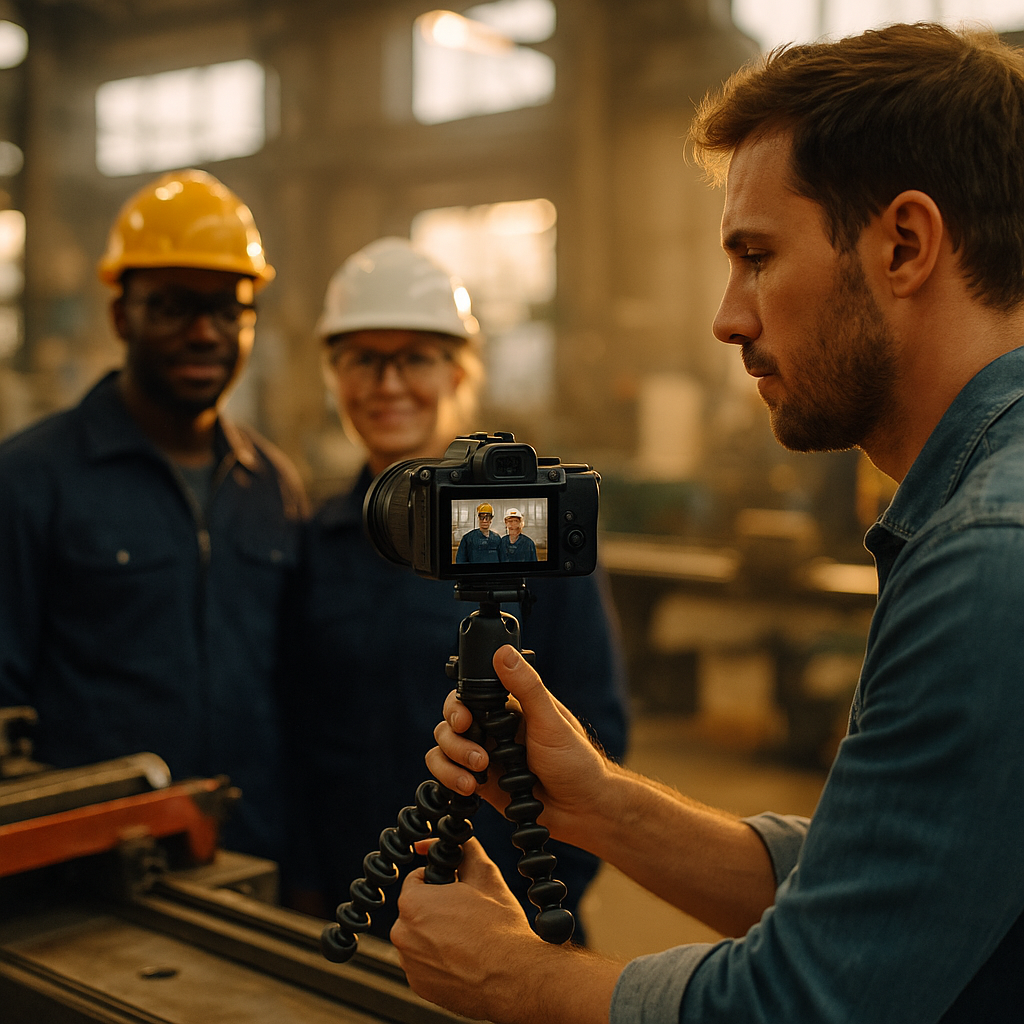
In 2025, manufacturers face a familiar challenge: people outside the plant understand products, not the teams behind them. This case study: a traditional manufacturer using video to humanize internal teams shows how one legacy company shifted perceptions, improved communication, and increased pride across locations. The approach wasn’t flashy—it was deliberate, repeatable, and measurable. Here’s what happened when cameras met shop-floor reality.
Background and goals: internal video communication in manufacturing
Northbridge Components is a 40-year-old industrial manufacturer with three plants, a central engineering office, and a distribution hub. The business had strong quality metrics, a loyal customer base, and modern equipment investments—but internally, it struggled with the “invisible work” problem. Most employees knew their own cell or department well, yet had limited insight into how other teams operated. Leaders described recurring issues:
- Siloed problem-solving: quality and maintenance learned different lessons from the same failures.
- Low visibility for support teams: scheduling, engineering change control, and purchasing were perceived as “slow” without context.
- Onboarding gaps: new hires received training documents but lacked a clear picture of how the organization fit together.
- Change fatigue: initiatives landed as memos, not stories—employees saw “what” but not “why.”
The executive team set a straightforward aim: humanize internal teams so employees understood each other’s constraints, priorities, and expertise. They wanted improvements in cross-department trust and speed of coordination, not viral content. Video became the chosen format because it captured tone, intent, and craft better than text and reached frontline employees who rarely read long intranet posts.
Success criteria were defined before filming began. Northbridge targeted measurable outcomes that leaders could review quarterly:
- Higher engagement with internal updates (view rate and completion rate).
- Faster cross-team resolution for recurring defects and downtime categories.
- Better onboarding outcomes (time-to-independence for new operators and technicians).
- Improved sentiment in short pulse surveys focused on trust, clarity, and recognition.
Strategy and content plan: employee storytelling videos
Northbridge avoided launching with a “corporate channel” full of leadership speeches. Instead, it designed an editorial plan around roles and relationships. The guiding principle was: make every video answer one practical question employees already ask. That requirement kept content helpful and prevented it from turning into branding.
The team created three video series, each with a distinct job to do:
- “Meet the Team” (3–5 minutes): short profiles of departments that were frequently misunderstood (maintenance, planning, quality, EHS, purchasing). Each episode covered what the team is responsible for, what inputs they need, and what “good requests” look like.
- “How We Solve” (5–8 minutes): a walkthrough of a real cross-functional problem (for example, a recurring defect) showing how data moves from operator to quality to engineering to supplier. The focus stayed on process, not blame.
- “Shift Notes” (60–90 seconds): weekly updates for frontline staff—one change, one reason, one action. These were designed for high completion rates and easy playback in break areas.
To make storytelling credible, Northbridge used a consistent structure for most videos:
- Context: “Here’s what we’re working on and why it matters.”
- Constraints: “Here’s what makes this hard in our environment.”
- Collaboration: “Here’s what we need from other teams to succeed.”
- Call to action: one simple next step (a form, a process change, a best contact path).
Leaders also decided what not to film. They avoided sensitive customer details, protected proprietary processes, and set strict rules around safety demonstrations. If a video could unintentionally teach unsafe behavior, it didn’t get made. That choice mattered for trust: employees saw that safety and confidentiality were not sacrificed for content.
Production and governance: industrial video production workflow
Northbridge didn’t build a studio or hire a full-time crew. It formed a small internal “video pod” with clear roles:
- Program owner (Internal Comms): manages editorial calendar, approvals, distribution.
- Safety reviewer (EHS): checks filming plans and final cuts for safety compliance.
- Technical reviewer (Quality/Engineering): validates terminology and process accuracy.
- Plant champions: one per site to coordinate schedules and identify stories.
This governance model supported Google’s helpful-content expectations: accuracy, real expertise, and accountability. Northbridge documented decisions in a one-page standard:
- Consent: everyone on camera signs an internal release; participation is optional.
- Access: filming does not interfere with production schedules; no cameras near controlled areas without approval.
- Review SLA: reviewers have 48 hours to approve or request changes to prevent endless delays.
- Accessibility: every video includes captions; key points are summarized in text below the video.
Equipment stayed simple: a phone with stabilization, a clip-on microphone, and basic lighting for offices. What improved quality wasn’t gear—it was discipline. Each shoot used a short checklist: confirm background noise, frame the subject in their work context, capture a process shot, and record a closing line that states the takeaway.
Distribution followed real work patterns. Breakroom screens and QR codes on shift boards drove awareness for frontline teams. Office and engineering staff received the same videos in the collaboration tool with a short summary and links to any referenced forms or SOPs. Importantly, Northbridge avoided “mandatory watching” except for safety-critical updates, because forced viewing would reduce authenticity and inflate unhelpful metrics.
Building trust and authenticity: leadership visibility video
Humanizing internal teams fails when video feels staged. Northbridge earned credibility by letting employees speak in plain language and by showing the work as it is—noise, gloves, and all. Leaders appeared too, but with constraints: no scripts longer than a few bullet points, no filming in spotless conference rooms when the story belonged on the floor, and no claims that couldn’t be backed by data.
The most effective episodes shared “invisible decisions” that often frustrate other teams. For example, purchasing explained how supplier lead times, minimum order quantities, and compliance requirements shape material availability. Maintenance described how prioritization works during high downtime and what details make a work order actionable. Quality walked through containment steps and why “just ship it” can create larger customer issues later.
These episodes answered follow-up questions inside the content. Instead of stopping at “what we do,” each team addressed:
- What we wish other teams knew (one misconception corrected).
- What to include in a request (photos, part numbers, timestamps, defect codes).
- What success looks like (examples of strong collaboration).
Leadership visibility supported the program without dominating it. The plant manager introduced the series with a brief statement: the goal was mutual understanding and better work, not surveillance. That reassurance reduced the fear that video was a performance review tool. Leaders reinforced this stance by celebrating learning moments, including times when a process change didn’t work as planned and needed adjustment.
To protect trust, Northbridge established a simple rule: video is for learning, not for discipline. If performance issues existed, they were handled through existing HR and coaching processes, not through public content. This boundary kept employees willing to participate and speak honestly.
Results and metrics: video engagement metrics for internal teams
Northbridge tracked results with a mix of quantitative metrics (views, completion, search terms, ticket resolution time) and qualitative signals (comments, survey responses, supervisor feedback). The company avoided vanity numbers and focused on whether video improved coordination.
After the first two quarters of consistent publishing, three outcomes stood out:
- Higher completion rates on short operational updates: “Shift Notes” consistently outperformed longer formats, which guided future planning. Employees preferred concise updates tied to a single action.
- Fewer incomplete maintenance work orders: maintenance reported that requests included better details after the “Meet the Team: Maintenance” episode. Better inputs reduced back-and-forth and improved scheduling.
- Improved onboarding confidence: new hires reported higher clarity on “who does what” and when to escalate issues, especially after watching department profiles during their first two weeks.
One unexpected benefit was search behavior. Employees began using the internal video hub like a practical knowledge base—looking up “how to request tooling,” “engineering change,” and “containment.” That shift indicated the content was solving real problems, not just generating clicks.
Northbridge also watched for negative signals to maintain content quality:
- Drop-off points: if viewers left at the same moment, the intro was rewritten or the video was shortened.
- Confusion in comments: if a video sparked repeated questions, the team added a pinned clarification and updated the text summary.
- Uneven representation: if only one site appeared regularly, participation rotated to prevent “headquarters bias.”
The strongest indicator of humanization came from pulse surveys: employees were more likely to agree with statements such as “I understand how other departments make decisions” and “Other teams respect the realities of my work.” These perceptions matter because they predict smoother collaboration during disruptions—rush orders, supplier issues, equipment failures, and process changes.
Lessons learned and playbook: change management video in factories
Northbridge documented a playbook so the program didn’t rely on one enthusiastic coordinator. The playbook focused on repeatable behaviors and guardrails, not creative inspiration. Key lessons:
- Start with friction points: choose teams and topics where misunderstanding creates real delays or resentment. Humanization follows usefulness.
- Keep videos short and specific: one problem, one takeaway, one action. Longer “all-hands” formats work only when they are rare and truly significant.
- Show work context: film in the actual environment—tools, boards, parts, and processes—so viewers trust what they see.
- Build in review, not bureaucracy: safety and accuracy review are non-negotiable, but approval must be fast to keep content timely.
- Pair video with text: captions and summaries support accessibility, make content searchable, and help employees who can’t play audio.
- Measure outcomes tied to operations: track the impact on ticket quality, cycle times for cross-team decisions, and onboarding speed—not just views.
Northbridge also refined how it handled common follow-up questions from managers:
- “What if people don’t want to be on camera?” Offer off-camera options (voiceover, hands-only process shots) and never pressure participation.
- “How do we prevent misinformation?” Use a technical reviewer and keep claims grounded in the documented process; link to the relevant SOP or form.
- “Will this distract from production?” Schedule short filming blocks during low-impact windows; plan shots in advance; keep setups minimal.
The program’s long-term value came from consistency. A single strong video can spark interest, but a steady cadence builds a shared language across teams. When employees repeatedly see each other solving problems, they stop assuming bad intent—and start assuming constraints, tradeoffs, and professionalism.
FAQs: internal video for traditional manufacturers
- What types of videos work best to humanize internal teams in manufacturing?
Short team profiles, real problem-solving walkthroughs, and quick shift updates work well. They connect people to roles, show decision logic, and reinforce daily priorities without adding noise.
- How long should internal videos be for frontline employees?
Keep most updates between 60 and 120 seconds. Team profiles can run 3–5 minutes if they stay practical and include a clear “what we need from you” takeaway.
- How do you ensure safety and confidentiality when filming inside a plant?
Require EHS review, limit filming in controlled areas, avoid customer-identifying details, and don’t show unsafe behavior. Use a standard checklist and final-cut approval before publishing.
- What metrics should leaders track beyond views?
Track completion rate, repeat views, search terms, and operational outcomes such as fewer incomplete work orders, faster cross-team issue resolution, and improved onboarding time-to-independence.
- Do you need professional equipment to start an internal video program?
No. A modern phone, a clip-on mic, and consistent scripting discipline are enough. Clarity, accuracy, and relevance matter more than cinematic production.
- How often should a manufacturer publish internal videos?
Publish small updates weekly or biweekly and deeper stories monthly, depending on capacity. Consistency builds trust, but only if each video has a specific job to do.
Northbridge proved that video doesn’t need to be glossy to be effective. By focusing on practical stories, clear governance, and measurable operational outcomes, the company used video to help employees see each other as skilled partners rather than distant departments. The key takeaway is simple: humanization follows usefulness. When internal video answers real questions, trust rises and collaboration speeds up.
Top Influencer Marketing Agencies
The leading agencies shaping influencer marketing in 2026
Agencies ranked by campaign performance, client diversity, platform expertise, proven ROI, industry recognition, and client satisfaction. Assessed through verified case studies, reviews, and industry consultations.
Moburst

-
2

The Shelf
Boutique Beauty & Lifestyle Influencer AgencyA data-driven boutique agency specializing exclusively in beauty, wellness, and lifestyle influencer campaigns on Instagram and TikTok. Best for brands already focused on the beauty/personal care space that need curated, aesthetic-driven content.Clients: Pepsi, The Honest Company, Hims, Elf Cosmetics, Pure LeafVisit The Shelf → -
3

Audiencly
Niche Gaming & Esports Influencer AgencyA specialized agency focused exclusively on gaming and esports creators on YouTube, Twitch, and TikTok. Ideal if your campaign is 100% gaming-focused — from game launches to hardware and esports events.Clients: Epic Games, NordVPN, Ubisoft, Wargaming, Tencent GamesVisit Audiencly → -
4

Viral Nation
Global Influencer Marketing & Talent AgencyA dual talent management and marketing agency with proprietary brand safety tools and a global creator network spanning nano-influencers to celebrities across all major platforms.Clients: Meta, Activision Blizzard, Energizer, Aston Martin, WalmartVisit Viral Nation → -
5

The Influencer Marketing Factory
TikTok, Instagram & YouTube CampaignsA full-service agency with strong TikTok expertise, offering end-to-end campaign management from influencer discovery through performance reporting with a focus on platform-native content.Clients: Google, Snapchat, Universal Music, Bumble, YelpVisit TIMF → -
6

NeoReach
Enterprise Analytics & Influencer CampaignsAn enterprise-focused agency combining managed campaigns with a powerful self-service data platform for influencer search, audience analytics, and attribution modeling.Clients: Amazon, Airbnb, Netflix, Honda, The New York TimesVisit NeoReach → -
7

Ubiquitous
Creator-First Marketing PlatformA tech-driven platform combining self-service tools with managed campaign options, emphasizing speed and scalability for brands managing multiple influencer relationships.Clients: Lyft, Disney, Target, American Eagle, NetflixVisit Ubiquitous → -
8

Obviously
Scalable Enterprise Influencer CampaignsA tech-enabled agency built for high-volume campaigns, coordinating hundreds of creators simultaneously with end-to-end logistics, content rights management, and product seeding.Clients: Google, Ulta Beauty, Converse, AmazonVisit Obviously →