


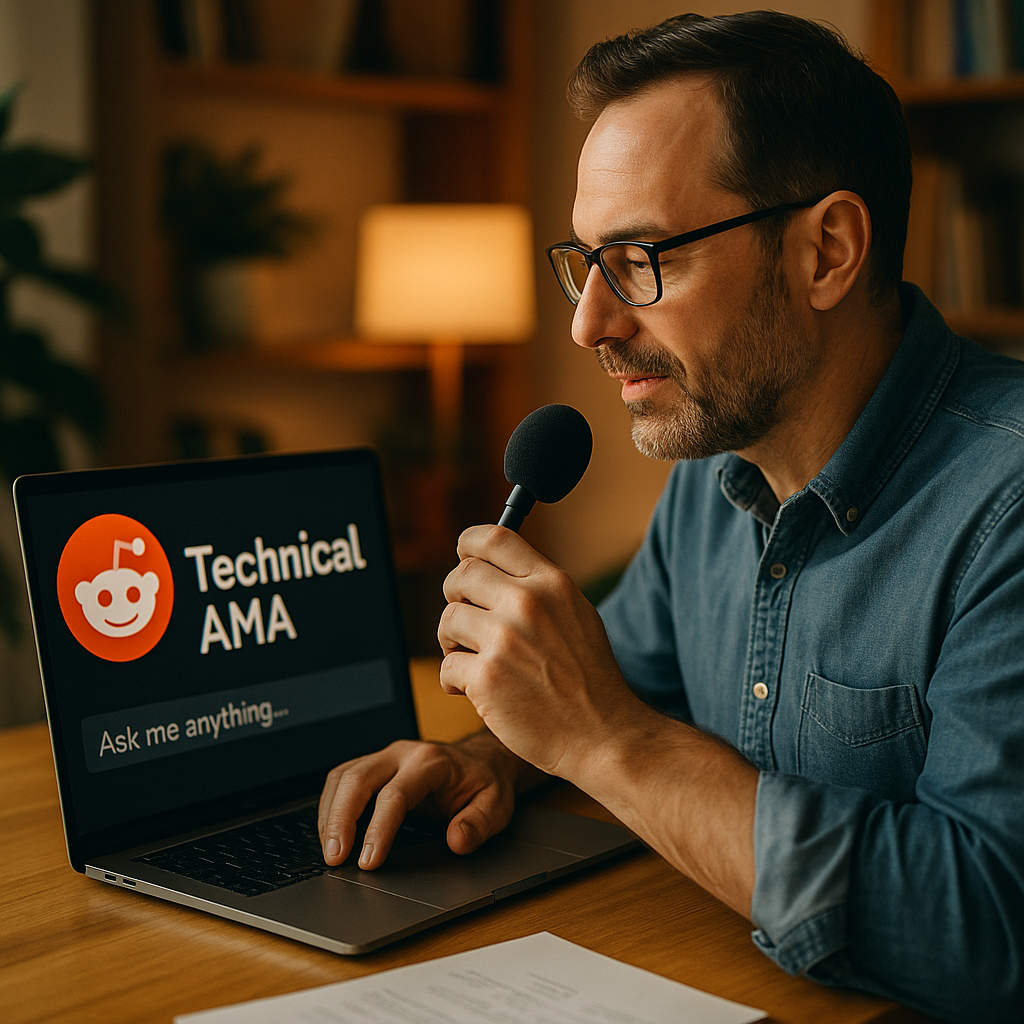
In 2025, trust is earned in public, and technical communities reward substance. This playbook shows how to build credibility with Technical AMA Sessions On Reddit by combining deep expertise, transparent proof, and respectful engagement. You’ll learn how to choose the right subreddit, prepare defensible answers, avoid common missteps, and turn one AMA into long-term authority. Ready to earn attention the hard way?
Reddit technical AMA strategy: set the right goal and pick the right room
An AMA can build authority fast, but only when your intent matches the community’s expectations. Start by defining a single primary outcome: product trust, hiring pipeline, thought leadership, incident transparency, or developer education. If you try to do all of them at once, your answers will feel like marketing and get downvoted.
Next, choose the subreddit based on technical fit and moderation culture, not just subscriber count. A smaller, high-signal subreddit can outperform a massive general one if the audience matches your niche. Before you request approval, review:
- Rule set and promo limits: Many subs allow AMAs only with strict no-sales language and may require pre-approval.
- What gets upvoted: Look for posts with detailed troubleshooting, benchmarks, architecture diagrams (described), and reproducible experiments.
- Moderator expectations: Some subs require identity verification, credentials, and a structured outline.
- Timing: If your users are global, schedule for overlap windows and commit to follow-ups the next day.
Define a scope that aligns with your expertise. Examples: “I maintain a Rust networking library used in production,” “I led a post-incident redesign of our rate-limiting,” or “I built a privacy-preserving analytics pipeline.” Concrete scope reduces hostile “gotcha” questions because readers know what you’re claiming and what you’re not.
Finally, make a promise you can keep: how long you’ll be live, whether teammates will answer, and what you will not discuss (e.g., customer-identifying details, ongoing legal matters). Clear boundaries signal professionalism and protect trust.
AMA verification and credibility: prove who you are without oversharing
Authority on Reddit comes from evidence and consistency, not status. Still, technical AMAs require a baseline of identity confirmation. Work with moderators on verification that respects privacy while meeting community standards. Typical options include a moderator-only email from a company domain, a photo with a handwritten note (shared privately if allowed), or links to established profiles.
Build credibility with an “evidence pack” you can reference throughout the thread:
- Role clarity: Your title and what you personally own (e.g., “I designed the ingestion service,” not “we built everything”).
- Public artifacts: Docs, RFCs, relevant open-source repos, changelogs, or conference slides. Link sparingly and only when it answers the question.
- Reproducible examples: Minimal code snippets, test commands, or pseudo-benchmarks readers can validate.
- Constraints and trade-offs: What you optimized for and what you knowingly accepted as cost.
EEAT in technical communities means you show experience. When you describe a design decision, include the context: traffic patterns, latency SLOs, security model, or compliance constraints. When you cite performance, state the environment and methodology: instance type, data set shape, warm/cold cache behavior, and measurement tools.
Be explicit about uncertainty. If you don’t know, say so and commit to checking. Then return with the answer. Following up is one of the strongest credibility signals on Reddit because it’s rare and measurable.
Reddit AMA preparation checklist: engineer the thread like a production launch
Great AMAs feel spontaneous, but the best ones are engineered. Preparation protects you from the two things that kill authority: vague answers and avoidable mistakes.
Use this practical checklist before you go live:
- Draft a tight opening post: Include who you are, what you built, what you can answer, and the time window. Keep it technical, not promotional.
- Create 10–15 “seed answers”: Pre-write responses to predictable questions: architecture overview, security posture, scaling bottlenecks, data retention, pricing philosophy (if relevant), and incident learnings.
- Assemble a response team: One person answering, one person fetching links/logs/metrics, one person watching for duplicate questions and summarizing.
- Prepare safe disclosures: A list of what you can share publicly (redacted diagrams, sanitized metrics ranges, generalized incident timelines).
- Decide your stance on competitors: Don’t dunk. Compare on trade-offs and use-cases. “X is better for Y, we’re better for Z” reads as mature engineering.
- Write “bridging lines”: Short phrases that keep you helpful under pressure, such as “I can’t share customer data, but here’s the pattern we see and how we mitigated it.”
Anticipate the hardest questions: privacy, security, layoffs, outages, vendor lock-in, licensing, and AI/ML data usage. If you can’t address a topic, say it early. If you can address it, do it with specifics: threat model, audit process, incident response steps, and how you validate fixes.
Format matters. Use short paragraphs, numbered steps, and explicit headings inside your answers (even within a comment). Readers scan. Scannable answers get upvoted and quoted later, which is how authority compounds.
Answering technical questions on Reddit: earn trust with clarity, evidence, and humility
Your answers are the product. Treat each response like a mini design review. The goal is not to “win” the thread; the goal is to become a reliable reference.
Use a repeatable structure:
- State the direct answer first: One sentence that resolves the question.
- Explain the reasoning: The constraints, alternatives considered, and why you chose the path you did.
- Provide verification hooks: Commands, links to docs, or measurable indicators readers can check.
- Call out limitations: Known issues, edge cases, and what you’re changing next.
When someone challenges you, respond like an engineer, not a spokesperson. Ask clarifying questions: “Are you seeing this in Kubernetes with conntrack limits?” or “What’s your payload size distribution?” This shifts the interaction from accusation to diagnosis.
Handle “gotchas” with calm transparency. If you made a mistake, acknowledge it, describe impact, and share what you changed. Technical audiences often respect a well-owned failure more than a polished success story.
Keep promotional language out of the thread. If users ask about pricing or product availability, answer plainly and then return to technical depth. If you must link, link to a single canonical resource and summarize the key details in the comment so the answer stands on its own.
Be careful with security. Never share exploit paths, internal endpoints, or sensitive configuration. You can still be helpful by describing principles: key rotation process, least privilege design, monitoring signals, and incident response timelines. Authority comes from disciplined disclosure.
Post-AMA content repurposing: turn one thread into months of authority
The AMA is not the end; it’s your highest-quality raw material. Reddit threads contain real questions in users’ language. That’s ideal for search, documentation, and product education—if you repurpose ethically and accurately.
Within 48 hours, do a structured post-mortem:
- Extract the top questions: Especially those repeated or heavily upvoted.
- Identify knowledge gaps: Where users misunderstood your system or where your docs failed to answer common concerns.
- Capture “proof moments”: Comments where you provided a benchmark, a fix, or a nuanced trade-off discussion.
Then repurpose in ways that preserve context:
- Documentation upgrades: Add FAQs, troubleshooting, and architectural rationale sections that mirror real AMA questions.
- Engineering blog posts: Convert a strong answer into a standalone deep dive with diagrams described in text, code, and reproducible steps.
- Internal enablement: Train support and sales engineering using the thread’s objections and best responses.
- Follow-up Reddit post: If allowed, post a “What we learned and what we changed” update. That follow-through builds durable trust.
Be explicit about attribution. If you quote a commenter, ask permission or paraphrase without identifying details. Avoid scraping and publishing user content outside Reddit without consent. Ethical handling of community content is part of EEAT because it signals integrity.
Measuring AMA success: metrics, feedback loops, and risk control
Authority is measurable, but not only by upvotes. Define metrics that reflect trust and downstream outcomes. Track results over the weeks following the AMA, not just the day-of spike.
Useful indicators include:
- Quality engagement: Ratio of technical questions to meta arguments, and the depth of comment threads your answers generate.
- Saved and shared signals: Users referencing your answers later in other threads (watch for citations and cross-links).
- Documentation lift: Increased usage of linked docs, reduced support tickets on the questions you addressed, and improved time-to-resolution.
- Recruiting impact: Inbound from engineers who mention the AMA as a reason they trust your team.
- Brand search and direct traffic: A gradual rise indicates broader awareness, but interpret carefully—spikes can also come from controversy.
Build a feedback loop. Tag questions by theme (performance, security, pricing, roadmap, governance) and map them to actions: doc updates, product fixes, new tests, or clearer messaging. When you publicly ship an improvement that came from AMA feedback, mention it in a later Reddit update if the subreddit permits. This demonstrates responsiveness without turning the community into a marketing channel.
Control risk with pre-defined escalation paths. Decide who handles legal questions, press inquiries, and sensitive security reports. If a vulnerability report appears in the AMA, acknowledge receipt, move it to an appropriate channel, and avoid discussing exploit details publicly.
FAQs: Technical AMA Sessions On Reddit
How do I get moderator approval for a technical AMA?
Message moderators with a clear topic scope, your credentials, proposed date/time, and a short outline. Offer verification privately and confirm you’ll follow subreddit rules on promotion, civility, and disclosures.
What should I include in the AMA opening post?
State who you are, what you built, what you can answer, and your live response window. Add 3–5 example topics (performance, security model, architecture choices) and one line on boundaries (e.g., no customer-specific data).
How do I handle hostile or bad-faith questions?
Answer the technical core if possible, ask clarifying questions, and avoid personal arguments. If a thread becomes abusive, disengage and let moderators enforce rules. Your calm tone signals competence to onlookers.
Is it okay to link to my product or company?
Link only when it directly answers the question and summarize the key information in your comment. Avoid repeated calls-to-action. If the subreddit prohibits links, comply and offer neutral explanations instead.
How long should a technical AMA run?
Plan for 2–4 hours of real-time responses and commit to returning for follow-ups within 24 hours. Depth beats endurance; a shorter AMA with strong answers outperforms a long session with shallow replies.
What makes an AMA answer “EEAT-friendly”?
It shows firsthand experience, states assumptions and constraints, provides verifiable details, acknowledges limitations, and avoids exaggeration. Following up with corrections or additional evidence strengthens trust.
Can a solo founder or individual engineer run an effective AMA?
Yes, if you choose a precise scope and prepare evidence. Solo AMAs often feel more authentic, but you must manage time carefully and avoid speculating outside your expertise.
Technical AMAs work when you treat Reddit like a peer review, not a stage. Choose the right subreddit, verify credibly, prepare evidence, and answer with clarity and constraints. Follow up, ship improvements, and repurpose the best discussions into documentation and education. In 2025, authority is built by showing your work in public—consistently. Execute this playbook and let the thread speak for you.
Top Influencer Marketing Agencies
The leading agencies shaping influencer marketing in 2026
Agencies ranked by campaign performance, client diversity, platform expertise, proven ROI, industry recognition, and client satisfaction. Assessed through verified case studies, reviews, and industry consultations.
Moburst

-
2

The Shelf
Boutique Beauty & Lifestyle Influencer AgencyA data-driven boutique agency specializing exclusively in beauty, wellness, and lifestyle influencer campaigns on Instagram and TikTok. Best for brands already focused on the beauty/personal care space that need curated, aesthetic-driven content.Clients: Pepsi, The Honest Company, Hims, Elf Cosmetics, Pure LeafVisit The Shelf → -
3

Audiencly
Niche Gaming & Esports Influencer AgencyA specialized agency focused exclusively on gaming and esports creators on YouTube, Twitch, and TikTok. Ideal if your campaign is 100% gaming-focused — from game launches to hardware and esports events.Clients: Epic Games, NordVPN, Ubisoft, Wargaming, Tencent GamesVisit Audiencly → -
4

Viral Nation
Global Influencer Marketing & Talent AgencyA dual talent management and marketing agency with proprietary brand safety tools and a global creator network spanning nano-influencers to celebrities across all major platforms.Clients: Meta, Activision Blizzard, Energizer, Aston Martin, WalmartVisit Viral Nation → -
5

The Influencer Marketing Factory
TikTok, Instagram & YouTube CampaignsA full-service agency with strong TikTok expertise, offering end-to-end campaign management from influencer discovery through performance reporting with a focus on platform-native content.Clients: Google, Snapchat, Universal Music, Bumble, YelpVisit TIMF → -
6

NeoReach
Enterprise Analytics & Influencer CampaignsAn enterprise-focused agency combining managed campaigns with a powerful self-service data platform for influencer search, audience analytics, and attribution modeling.Clients: Amazon, Airbnb, Netflix, Honda, The New York TimesVisit NeoReach → -
7

Ubiquitous
Creator-First Marketing PlatformA tech-driven platform combining self-service tools with managed campaign options, emphasizing speed and scalability for brands managing multiple influencer relationships.Clients: Lyft, Disney, Target, American Eagle, NetflixVisit Ubiquitous → -
8

Obviously
Scalable Enterprise Influencer CampaignsA tech-enabled agency built for high-volume campaigns, coordinating hundreds of creators simultaneously with end-to-end logistics, content rights management, and product seeding.Clients: Google, Ulta Beauty, Converse, AmazonVisit Obviously →