


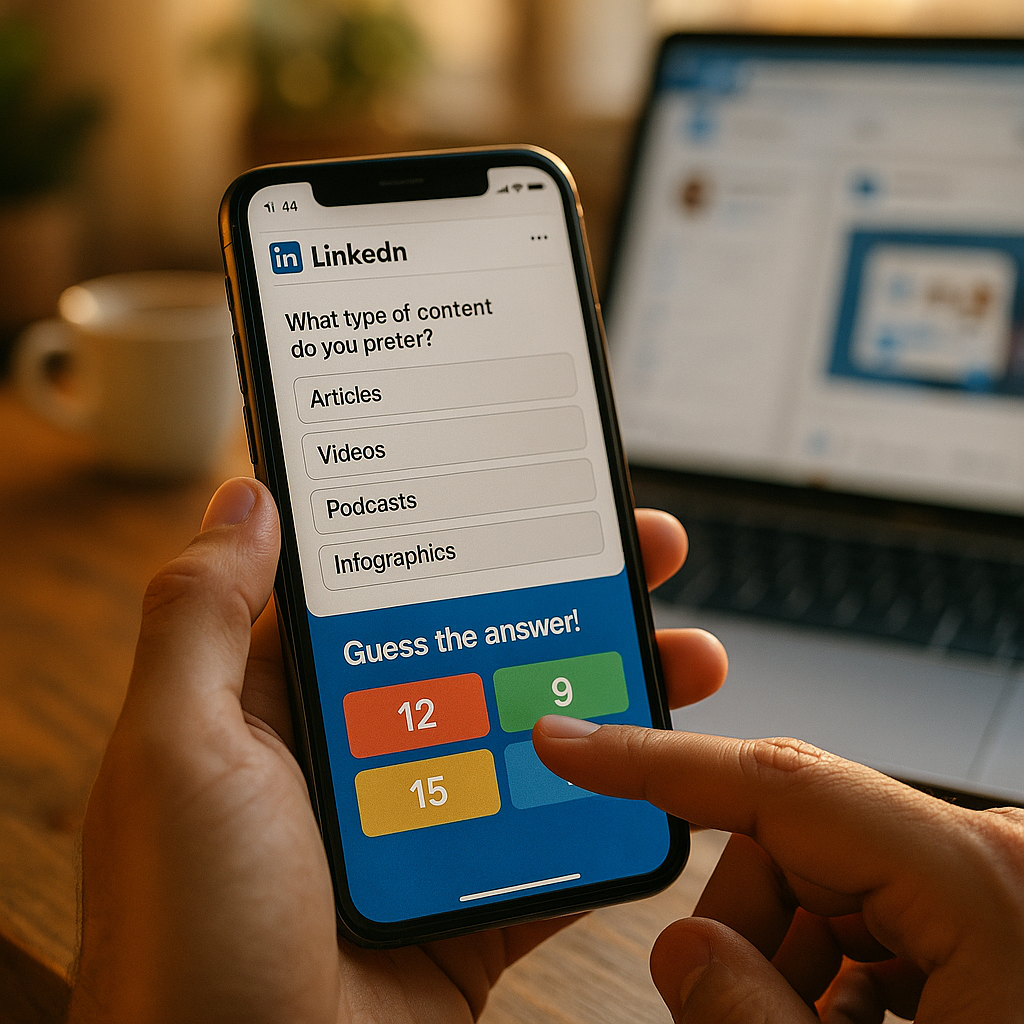
Interactive polls and gamified posts are no longer “nice-to-have” tactics on LinkedIn; they’re reliable attention engines when built with intention. This playbook for Interactive Polls and High Engagement Gamification on LinkedIn gives you repeatable formats, question frameworks, and measurement habits that protect credibility while improving reach. Use it to turn passive scrollers into active participants—and keep them coming back for more.
LinkedIn Poll Strategy: choose a goal, not a gimmick
High-performing polls start with clarity: what action should a reader take after voting? If you can’t answer that, the poll becomes a vanity metric generator. In 2025, LinkedIn audiences are quick to reward relevance and just as quick to ignore bait. Set a single primary goal before you write the question:
- Market insight: validate messaging, pricing sensitivity, pain points, or feature priorities.
- Demand creation: attract the right audience by naming a specific problem and inviting a point of view.
- Lead qualification: identify segments (without asking for personal data) and follow up with tailored resources.
- Community building: create shared language, recurring rituals, and inside references that make people feel “in.”
Next, match the goal to a poll type:
- Diagnostic polls (“What’s the biggest blocker?”) work best for insight and leads.
- Preference polls (“Which approach wins?”) fit demand creation and positioning battles.
- Prediction polls (“What happens next?”) are strong for industry commentary and returning engagement.
- Benchmark polls (“What’s your current baseline?”) attract peers and generate credible discussion when you share results.
Build trust by stating who the poll is for in the first line (e.g., “For RevOps leaders at B2B SaaS…”). That single sentence improves response quality because it gives the wrong audience permission to skip—and signals expertise to the right one.
Finally, decide what you’ll do with the results. Will you publish a follow-up post, a short report, or a carousel breakdown? Promise a specific takeaway (not “insights soon”). When you reliably close the loop, your next poll earns more votes.
Audience Engagement Tactics: write questions people can answer fast
LinkedIn is a low-friction environment. Your poll should feel like a quick decision, not homework. Use these constraints to increase completion without sacrificing usefulness:
- One idea per poll: avoid “A vs B vs C, and why, and in which scenario.” You can sequence those into a series.
- Clear stakes: tie the question to an outcome people care about: pipeline, hiring, efficiency, reputation, risk.
- Concrete language: prefer “outbound email” over “top-of-funnel motion.” Precision invites better comments.
- Neutral framing: reduce social desirability bias by avoiding moral judgment in the options.
Use a proven question blueprint that prompts both votes and thoughtful replies:
- Context line: one sentence explaining the situation and audience.
- The question: make it answerable in under three seconds.
- The options: mutually exclusive, collectively sensible.
- The comment prompt: ask for a detail that improves learning (“Comment your role + what you tried”).
Option design is where most polls fail. Treat options as mini-hypotheses, not random choices. Keep each option under eight words when possible and avoid overlap. Add an “It depends” option only if you plan to unpack dependencies in the comments; otherwise it becomes a vote sink that hides signal.
To prevent shallow engagement, guide the comments with a structured prompt. Examples:
- “Vote, then comment: industry + team size.”
- “If you picked B, what tool or process made it work?”
- “What would change your vote?” (great for objections and buyer research)
Answer the reader’s natural follow-up—“How do I get higher-quality comments?”—by replying first. Add your own take as a comment (not the post), including a specific example, so people can respond to something concrete. Then engage early: reply to the first 10–20 comments with real questions. That interaction trains the thread toward depth.
LinkedIn Gamification Ideas: build participation loops without hurting credibility
Gamification works on LinkedIn when it amplifies learning, identity, and momentum—not when it feels like a trick. The goal is a participation loop: a small action now that creates anticipation for the next post. Here are formats that consistently drive high engagement while supporting authority:
- “Pick one” challenges: two strong options, both defensible; reveal your reasoning in comments.
- Bracket polls: run semifinals across two polls, then a final; summarize results in a recap post.
- Scenario quests: “You have 30 days and $0 budget—what’s step one?” Follow with a breakdown from experts in the comments.
- Myth-busting rounds: poll the belief, then publish a clear explanation with sources or firsthand evidence.
- “Guess the outcome” case studies: present a real project (sanitized), ask what you’d do, then share what happened.
To keep gamification aligned with EEAT (Experience, Expertise, Authoritativeness, Trustworthiness), anchor it in your real work:
- Experience: state the context you’ve personally seen (e.g., “In enterprise renewals…”), and what you observed.
- Expertise: define terms, avoid vague claims, and offer practical next steps.
- Authoritativeness: cite credible sources when referencing external data, and tag collaborators only when relevant.
- Trustworthiness: disclose limitations (“Sample skews toward SaaS”) and avoid manipulating outcomes.
Gamification also benefits from consistent “reward delivery.” The reward doesn’t need to be a giveaway; it can be clarity. If people vote, they should get a payoff: a checklist, a decision tree, a template, or a short lesson. This is how you turn a one-off spike into a content habit.
If you’re worried about seeming unserious, use a simple rule: make the game about decisions, not popularity. Decision-oriented games (“Which would you ship first?”) signal leadership. Popularity games (“Which logo is nicer?”) rarely build durable authority unless you’re in brand design.
Poll Optimization and Timing: increase reach without chasing the algorithm
Poll performance is influenced by timing, early interactions, and the clarity of your targeting. You don’t need to obsess over “perfect” posting windows, but you do need a repeatable routine that creates strong early signals.
Use this posting checklist:
- Write the post text first: if the setup isn’t compelling, the poll can’t save it.
- Front-load relevance: make the first sentence specify audience and stakes.
- Keep options clean: remove jargon, shorten phrases, avoid overlapping categories.
- Commit to engagement: schedule 30 minutes after posting to reply quickly and thoughtfully.
Early engagement matters because it sets the tone of the thread. Seed quality by asking two or three trusted peers to add substantive comments (not generic praise). Do not ask for “votes”—ask them to add an example, counterpoint, or nuance that improves learning.
As for timing, choose consistency over guessing. Post polls on the same two days each week so your audience learns the rhythm. Keep the cadence realistic; if you can’t reliably deliver follow-ups, reduce frequency and improve payoff.
Optimize based on evidence:
- Low votes, high impressions: your question isn’t clear or the options aren’t compelling. Tighten wording.
- High votes, weak comments: add a structured comment prompt and lead with your own example.
- Good engagement, wrong audience: refine the first line (“For…”) and shift topics toward your ideal buyer’s daily problems.
- Strong comments, low conversions: add a next-step CTA that fits the discussion (template, guide, short consult, or newsletter).
Answer the follow-up—“Should I include a link?”—with a practical guideline: keep the initial poll post link-free if your priority is participation. If you need to share a resource, add it in the first comment and reference it in the post (“I’ll drop a template in the comments”). That preserves focus while still providing value.
LinkedIn Analytics for Polls: measure what matters and prove ROI
Polls feel easy to publish, which is why they often go unmeasured. To keep them as a serious growth lever, track three layers: engagement quality, audience fit, and business outcomes.
1) Engagement quality
- Comment depth: are people sharing context, examples, and constraints?
- Unique commenters: a small number of heavy commenters can distort perceived impact.
- Save/share signals: if your poll sparks saves or shares, the topic likely has enduring value.
2) Audience fit
- Role and seniority: scan commenters and reactors—are they the people you want?
- Industry concentration: does the conversation match your market, or is it drifting?
- Follower growth quality: are new followers relevant, or just broadly interested?
3) Business outcomes
- Profile actions: profile views, connection requests, newsletter signups.
- Conversation starts: inbound DMs that reference the poll topic.
- Pipeline influence: meetings booked, demo requests, or content downloads tied to the poll series.
Use a simple tracking sheet per poll: topic, goal, audience line used, options, votes, comments, top themes, and next follow-up content. This becomes your “message testing engine.” Over a month, you’ll see which questions attract your ideal audience and which angles create action.
To strengthen EEAT, publish a short recap after each poll closes: what won, what surprised you, what you’d test next, and the biggest caveat (sample bias, audience skew). This transparent analysis builds trust and positions you as someone who thinks beyond engagement.
Ethical Gamification and Trust: protect your brand while scaling engagement
Engagement tactics can backfire when they feel manipulative, polarizing for attention, or disconnected from real expertise. Ethical gamification keeps your brand safe and improves long-term performance because people trust your intent.
Follow these guardrails:
- Avoid rage bait: if the post requires outrage to perform, it will attract the wrong audience.
- Don’t mislead with options: “Obviously correct” options depress discussion and reduce learning.
- Disclose context: when you share results, state who voted and what might be missing.
- Respect privacy: never ask for confidential company data or personally identifying information.
- Deliver on promised follow-ups: trust compounds when you close loops consistently.
Also, don’t outsource your voice to templates alone. Templates help with speed, but your edge is lived experience: the nuanced trade-offs you’ve seen, the constraints that changed decisions, and the “here’s what I’d do differently” honesty. That’s what turns a poll into authority-building content.
If you run polls for a company page, align with brand and legal standards: avoid sensitive topics, clarify that results are informal, and ensure any incentives comply with platform rules and internal policies. Trust is an asset; treat it like one.
FAQs: Interactive polls and gamification on LinkedIn
How often should I post LinkedIn polls in 2025?
Start with one poll per week and one follow-up post per week. Increase frequency only if you can maintain quality comments, thoughtful replies, and consistent recaps.
What’s the best number of poll options?
Use four options unless a three-option structure is genuinely cleaner. Four gives enough range for signal without forcing “other” too often.
Should I add “Other” or “It depends” as an option?
Only if you plan to analyze and categorize those responses in comments. Otherwise, you’ll lose clarity and make results harder to interpret.
How do I turn poll voters into leads without being pushy?
Offer a specific, relevant next step based on the poll outcome (template, checklist, short teardown). Put the resource in a comment and invite people to reply with a keyword if they want it sent via DM.
Do polls hurt my brand if I’m in a serious industry?
No—if you make the “game” about decisions and learning. Use scenario-based questions, disclose context, and publish a recap that shows rigorous thinking.
What if my poll gets low votes?
Diagnose quickly: tighten the first line to target a clear audience, simplify the question, and rewrite options to remove overlap. Then re-run the concept with improved wording rather than abandoning the topic entirely.
How do I reduce bias in poll results?
Use neutral wording, avoid leading options, ask commenters to include role/company size, and disclose limitations in your recap. Treat polls as directional signals, not scientific samples.
Interactive polls and gamification work best when they serve a clear purpose: better insight, better conversations, and better next steps. In 2025, the winning approach is simple—ask sharper questions, design cleaner options, and deliver recaps that build trust. Commit to a repeatable loop of poll, discussion, and follow-up, and you’ll earn sustained engagement that supports real business outcomes.
Top Influencer Marketing Agencies
The leading agencies shaping influencer marketing in 2026
Agencies ranked by campaign performance, client diversity, platform expertise, proven ROI, industry recognition, and client satisfaction. Assessed through verified case studies, reviews, and industry consultations.
Moburst

-
2

The Shelf
Boutique Beauty & Lifestyle Influencer AgencyA data-driven boutique agency specializing exclusively in beauty, wellness, and lifestyle influencer campaigns on Instagram and TikTok. Best for brands already focused on the beauty/personal care space that need curated, aesthetic-driven content.Clients: Pepsi, The Honest Company, Hims, Elf Cosmetics, Pure LeafVisit The Shelf → -
3

Audiencly
Niche Gaming & Esports Influencer AgencyA specialized agency focused exclusively on gaming and esports creators on YouTube, Twitch, and TikTok. Ideal if your campaign is 100% gaming-focused — from game launches to hardware and esports events.Clients: Epic Games, NordVPN, Ubisoft, Wargaming, Tencent GamesVisit Audiencly → -
4

Viral Nation
Global Influencer Marketing & Talent AgencyA dual talent management and marketing agency with proprietary brand safety tools and a global creator network spanning nano-influencers to celebrities across all major platforms.Clients: Meta, Activision Blizzard, Energizer, Aston Martin, WalmartVisit Viral Nation → -
5

The Influencer Marketing Factory
TikTok, Instagram & YouTube CampaignsA full-service agency with strong TikTok expertise, offering end-to-end campaign management from influencer discovery through performance reporting with a focus on platform-native content.Clients: Google, Snapchat, Universal Music, Bumble, YelpVisit TIMF → -
6

NeoReach
Enterprise Analytics & Influencer CampaignsAn enterprise-focused agency combining managed campaigns with a powerful self-service data platform for influencer search, audience analytics, and attribution modeling.Clients: Amazon, Airbnb, Netflix, Honda, The New York TimesVisit NeoReach → -
7

Ubiquitous
Creator-First Marketing PlatformA tech-driven platform combining self-service tools with managed campaign options, emphasizing speed and scalability for brands managing multiple influencer relationships.Clients: Lyft, Disney, Target, American Eagle, NetflixVisit Ubiquitous → -
8

Obviously
Scalable Enterprise Influencer CampaignsA tech-enabled agency built for high-volume campaigns, coordinating hundreds of creators simultaneously with end-to-end logistics, content rights management, and product seeding.Clients: Google, Ulta Beauty, Converse, AmazonVisit Obviously →