


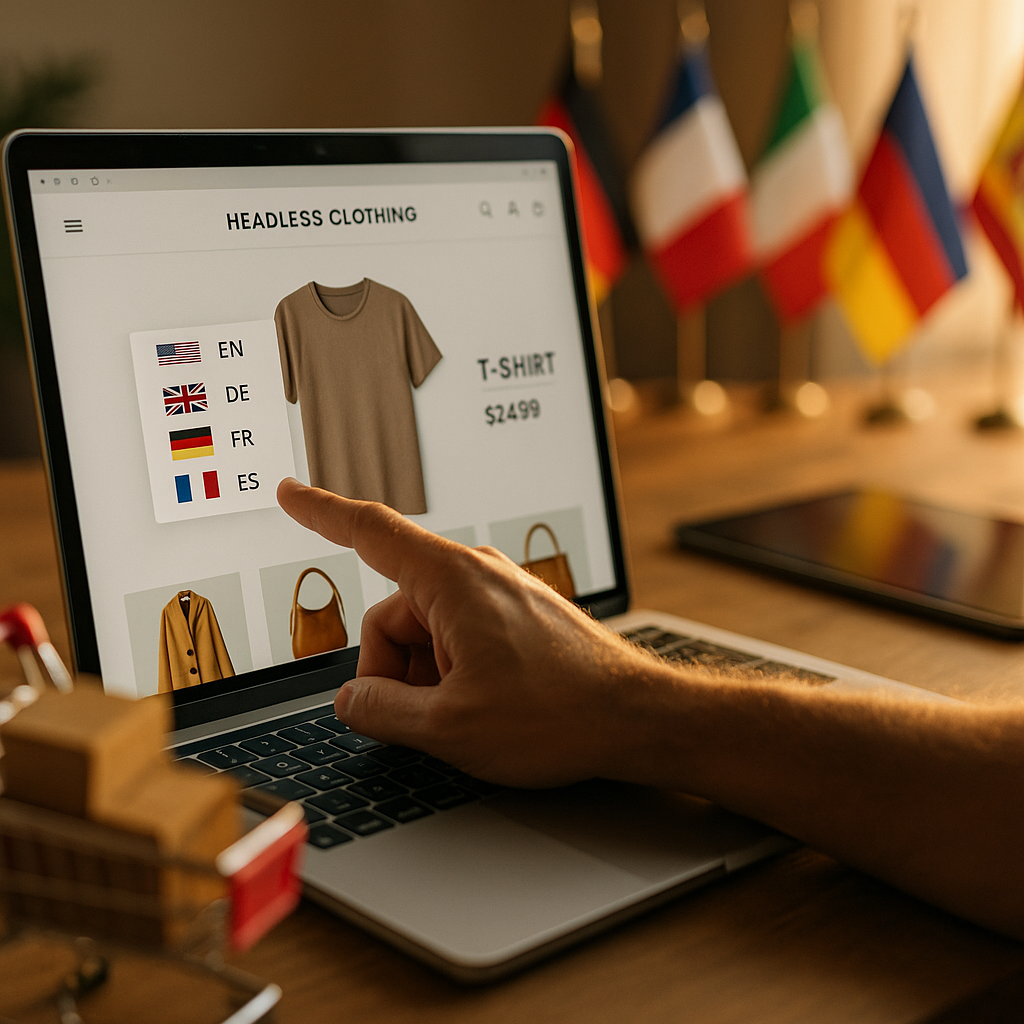
Choosing the right headless CMS solutions for multi-language e-commerce can determine how fast you launch new locales, how accurately you translate product data, and how reliably content reaches every channel in 2025. From catalog pages and promotions to transactional emails and in-app copy, your stack must support governance without slowing teams down. This review compares leading options and shows what matters most before you commit.
Key requirements for multilingual headless commerce
Multi-language e-commerce is rarely “just translation.” It is structured product content, legal pages, SEO metadata, and localized merchandising that must stay consistent across web, mobile, marketplaces, and in-store displays. A capable headless CMS must handle these requirements without creating bottlenecks.
- Localization model that matches reality: You need locale-specific fields, optional fallbacks (e.g., default language when a translation is missing), and the ability to localize only what changes (currency formatting, size charts, shipping notes).
- Structured content for product storytelling: Even if your product data lives in a PIM or commerce engine, your CMS should model buying guides, bundles, landing pages, and campaign modules as reusable components.
- Workflow and governance: Look for roles, approvals, scheduled publishing, audit logs, and “who changed what” traceability—especially for regulated markets and pricing/claims content.
- Translation workflow integration: A practical setup supports translation memory, glossary/term bases, and connectors to translation management systems (TMS) so you are not exporting spreadsheets and re-importing JSON.
- SEO across locales: You should store localized slugs, titles, meta descriptions, canonical/hreflang data, and prevent indexation mistakes when a locale is incomplete.
- Performance and reliability: Global delivery via CDN, predictable API limits, and stability under campaign traffic matter as much as authoring features.
- Composable fit: Most teams pair a headless CMS with a commerce platform, search, PIM, DAM, and analytics. Strong APIs, webhooks, and mature SDKs reduce integration risk.
Follow-up you might be asking: “Can my commerce platform CMS do this?” Some commerce suites include content tools, but they often struggle with rich, reusable components, complex workflows, and multi-channel delivery. Headless CMS tools typically provide stronger authoring, modeling, localization controls, and integration ecosystems.
Localization features to compare in headless CMS platforms
When vendors say “multi-language,” they can mean very different things. Compare platforms using concrete localization capabilities rather than marketing labels.
- Locale granularity: Can you localize at the field level (headline, CTA, disclaimer) and keep shared fields global (SKU, technical specs) to reduce translation work?
- Fallback rules: If French (CA) is missing a field, can it fall back to French (FR) or English without breaking the page?
- Variant management: Can you manage regional variations (EU vs US compliance copy) alongside language? Many stores need both language and market variants.
- In-context preview per locale: Editors should preview exactly what each locale will display, including personalization rules and feature flags.
- Translation workflow: Check for built-in translation jobs, connector marketplace, or a clean API for TMS automation. Also verify support for translation states (Draft, In Review, Approved).
- Content reuse without duplication: The best systems let you reuse components across locales and override only the localized parts.
Practical test to run: Model a product launch page with 10 reusable modules, then localize it into 5 locales with partial translation coverage. Time how long it takes to (1) assign translations, (2) review, (3) preview, (4) publish, and (5) roll back a mistake. This test reveals real friction quickly.
Best headless CMS for multi-language e-commerce: leading options reviewed
The platforms below are widely used in composable commerce stacks and offer serious multilingual capabilities. The “best” choice depends on your governance needs, editorial complexity, and integration maturity.
Contentful
- Strengths: Strong content modeling, mature APIs, robust app ecosystem, and reliable delivery at scale. Localization is well supported with per-locale fields and editorial controls.
- Watch-outs: Complex schemas can become difficult to govern without disciplined modeling. Costs can rise with scale (entries, users, bandwidth, apps), so forecast growth carefully.
- Best for: Teams needing a proven enterprise-grade platform with strong composable integration patterns and multiple digital properties.
Contentstack
- Strengths: Enterprise workflows, governance, and strong localization features. Often favored when teams want structured processes, approvals, and predictable editorial operations.
- Watch-outs: Some implementations lean heavily on professional services; ensure your internal team can maintain models and integrations.
- Best for: Multi-brand or multi-region retailers with complex publishing workflows and strong governance requirements.
Storyblok
- Strengths: Visual editing experience that non-technical marketers like, component-driven architecture, and solid localization support. Fast iteration for landing pages and campaigns.
- Watch-outs: Visual editing can encourage “page thinking” unless you maintain strict component standards. Validate how your developers want to manage schema evolution.
- Best for: E-commerce teams optimizing high-velocity campaigns across many locales with close marketing-developer collaboration.
Sanity
- Strengths: Extremely flexible, developer-friendly, and well-suited to complex content relationships (bundles, guides, editorial commerce). Real-time collaboration can be a plus for distributed teams.
- Watch-outs: Flexibility means you must design governance. Multilingual implementations are strong, but you need to architect localization patterns carefully to avoid inconsistency.
- Best for: Product-led teams with strong engineering resources that want a tailored editorial experience and custom localization flows.
Strapi (self-hosted or managed options)
- Strengths: Open-source foundation, customization control, and strong fit for teams that want to own infrastructure and extend features. Useful for integrating proprietary systems.
- Watch-outs: You own more of the operational burden (security, scaling, upgrades) depending on hosting choice. Ensure localization plugins/features meet your exact needs.
- Best for: Organizations that want code-level control, have DevOps capacity, and prefer to minimize vendor lock-in.
Hygraph (GraphQL-first)
- Strengths: GraphQL-first approach can simplify multi-channel delivery and reduce over-fetching. Works well when front-ends are heavily API-driven.
- Watch-outs: GraphQL expertise is helpful; validate how localization and preview workflows map to your editorial team’s daily work.
- Best for: Commerce stacks standardized on GraphQL where developers want a consistent query layer across locales.
Follow-up you might be asking: “Should I prioritize visual editing or modeling power?” For multi-language e-commerce, choose modeling power and governance first. Visual editing is valuable, but it should sit on top of a disciplined component library; otherwise, localization becomes inconsistent across pages and regions.
Translation workflow and TMS integration for global stores
Translation is a process, not a feature. In 2025, the most efficient teams automate handoffs, preserve terminology, and enforce review steps—especially for product claims, safety notes, and legal content.
- Connector strategy: Prefer a CMS with a mature marketplace or proven integrations to your TMS. If you rely on custom integration, confirm webhooks, content diffing, and idempotent updates to avoid duplications.
- Translation memory and glossary enforcement: Ensure your workflow supports consistent product naming and regulated terminology across locales. Consistency improves customer trust and reduces returns driven by misunderstanding.
- Partial updates: Your process should allow translating only changed fields. Re-translating entire entries wastes budget and delays launches.
- Human review gates: Machine translation can help with speed, but e-commerce needs human review for brand voice, legal claims, and culturally appropriate merchandising.
- Non-text localization: Plan for localized images, banners, PDFs, and size charts. Your CMS should link to a DAM or handle assets with locale variants and rights management.
Answering a common concern: “Will localization slow down campaigns?” It does if you treat every campaign as brand-new content. Use reusable modules with localized overrides, keep a translation-ready component library, and pre-approve standard disclaimers and shipping language per market.
SEO, compliance, and governance across languages
Multi-language e-commerce succeeds when it is discoverable and trustworthy. SEO and compliance are not separate from content operations; they are outcomes of good governance.
- Localized SEO fields: Store meta titles, descriptions, Open Graph data, and structured data inputs per locale. Make room for market-specific keyword intent rather than direct translation.
- URL and slug strategy: Support per-locale slugs and redirects. A CMS that forces one slug across locales can create awkward URLs or indexing issues.
- Hreflang and canonical rules: Your architecture should consistently generate hreflang tags and canonical URLs per locale and market variant. Validate this in previews and automated tests.
- Approval and audit trails: You need visible accountability for changes, especially for promotions, pricing claims, and regulated categories. Look for audit logs and role-based access control.
- Content lifecycle management: Add expiration dates for time-bound offers and region-specific legal text. Scheduled publishing and unpublishing prevents outdated promotions from lingering in smaller locales.
EEAT note for commerce teams: Build credibility into content templates: show clear shipping/returns policies, localized customer support information, and transparent product specifications. These elements reduce friction and improve on-site confidence signals that often correlate with conversion.
Implementation checklist and selection criteria for 2025
To choose confidently, evaluate your CMS the way you evaluate payment providers: through reliability, total cost, and operational fit—not just feature lists.
- Architecture fit: Confirm how the CMS integrates with your commerce engine, PIM, DAM, search, and personalization. Require a reference architecture diagram from vendors.
- Preview and environments: Ensure you can preview by locale, market, and channel, with multiple environments (dev/stage/prod) and safe content migrations.
- Rate limits and performance: Ask for documented API limits and caching patterns. Run load tests for peak events and ensure your CDN strategy is clear.
- Security and access controls: Demand SSO, fine-grained roles, and audit logs. If you operate in regulated markets, clarify data residency needs and incident response procedures.
- Content modeling governance: Establish a model review board: product marketing, localization, legal, and engineering. A strong CMS cannot compensate for uncontrolled schema growth.
- Total cost of ownership: Include licenses, environments, translation tooling, developer time, professional services, and ongoing maintenance.
- Vendor proof: Request customer references that match your scale and localization complexity, and ask what broke during peak campaigns and how it was handled.
Fast decision framework: If you prioritize enterprise workflows and governance, shortlist Contentstack and Contentful. If you need marketing speed with a strong visual editor, shortlist Storyblok. If you want maximum flexibility and custom workflows, shortlist Sanity. If you need more control over hosting and extensibility, shortlist Strapi. If your API strategy is GraphQL-first, shortlist Hygraph.
FAQs about headless CMS solutions for multi-language e-commerce
-
Do I need both a headless CMS and a PIM for multilingual e-commerce?
Often, yes. Use a PIM for authoritative product attributes (SKUs, dimensions, compliance data) and a headless CMS for storytelling, landing pages, guides, and localized marketing modules. You can also keep lightweight product marketing fields in the CMS, but avoid duplicating core product truth across systems.
-
How many locales can a headless CMS handle?
Most leading platforms can handle dozens of locales, but your real limit is operational: translation throughput, review capacity, and content modeling discipline. Validate locale performance in previews, publishing queues, and API responses under load.
-
What is the best localization approach: separate entries per language or localized fields?
Localized fields usually scale better because you keep one content object with multiple locales, enabling fallbacks and consistent relationships. Separate entries can work for markets that need fundamentally different content, but it increases duplication and governance overhead.
-
Can machine translation replace human translators for product pages?
Machine translation can accelerate first drafts, especially for long-tail catalogs, but human review remains essential for brand voice, regulated claims, and culturally sensitive merchandising. A hybrid workflow with clear review gates typically delivers the best balance of speed and accuracy.
-
How do I prevent SEO issues when a locale is incomplete?
Use locale fallbacks for customer experience, but control indexation. Mark incomplete locales as noindex, avoid publishing unfinished pages, and ensure canonical/hreflang rules reflect what is actually available. Your CMS workflow should include “translation complete” checks before publishing.
-
What should I prototype before selecting a CMS?
Prototype one product launch landing page with reusable modules, connect it to your commerce product data, and run a translation cycle across at least three locales. Measure time-to-publish, preview accuracy, rollback capability, and how easily translators work with your content structure.
Multi-language e-commerce in 2025 demands more than storing translations—it requires structured content, reliable delivery, and governance that supports rapid regional launches. The best headless CMS is the one that matches your localization model, integrates cleanly with commerce and translation tooling, and keeps SEO and compliance predictable at scale. Choose by piloting real workflows across locales, not by feature checklists alone.
Top Influencer Marketing Agencies
The leading agencies shaping influencer marketing in 2026
Agencies ranked by campaign performance, client diversity, platform expertise, proven ROI, industry recognition, and client satisfaction. Assessed through verified case studies, reviews, and industry consultations.
Moburst

-
2

The Shelf
Boutique Beauty & Lifestyle Influencer AgencyA data-driven boutique agency specializing exclusively in beauty, wellness, and lifestyle influencer campaigns on Instagram and TikTok. Best for brands already focused on the beauty/personal care space that need curated, aesthetic-driven content.Clients: Pepsi, The Honest Company, Hims, Elf Cosmetics, Pure LeafVisit The Shelf → -
3

Audiencly
Niche Gaming & Esports Influencer AgencyA specialized agency focused exclusively on gaming and esports creators on YouTube, Twitch, and TikTok. Ideal if your campaign is 100% gaming-focused — from game launches to hardware and esports events.Clients: Epic Games, NordVPN, Ubisoft, Wargaming, Tencent GamesVisit Audiencly → -
4

Viral Nation
Global Influencer Marketing & Talent AgencyA dual talent management and marketing agency with proprietary brand safety tools and a global creator network spanning nano-influencers to celebrities across all major platforms.Clients: Meta, Activision Blizzard, Energizer, Aston Martin, WalmartVisit Viral Nation → -
5

The Influencer Marketing Factory
TikTok, Instagram & YouTube CampaignsA full-service agency with strong TikTok expertise, offering end-to-end campaign management from influencer discovery through performance reporting with a focus on platform-native content.Clients: Google, Snapchat, Universal Music, Bumble, YelpVisit TIMF → -
6

NeoReach
Enterprise Analytics & Influencer CampaignsAn enterprise-focused agency combining managed campaigns with a powerful self-service data platform for influencer search, audience analytics, and attribution modeling.Clients: Amazon, Airbnb, Netflix, Honda, The New York TimesVisit NeoReach → -
7

Ubiquitous
Creator-First Marketing PlatformA tech-driven platform combining self-service tools with managed campaign options, emphasizing speed and scalability for brands managing multiple influencer relationships.Clients: Lyft, Disney, Target, American Eagle, NetflixVisit Ubiquitous → -
8

Obviously
Scalable Enterprise Influencer CampaignsA tech-enabled agency built for high-volume campaigns, coordinating hundreds of creators simultaneously with end-to-end logistics, content rights management, and product seeding.Clients: Google, Ulta Beauty, Converse, AmazonVisit Obviously →