


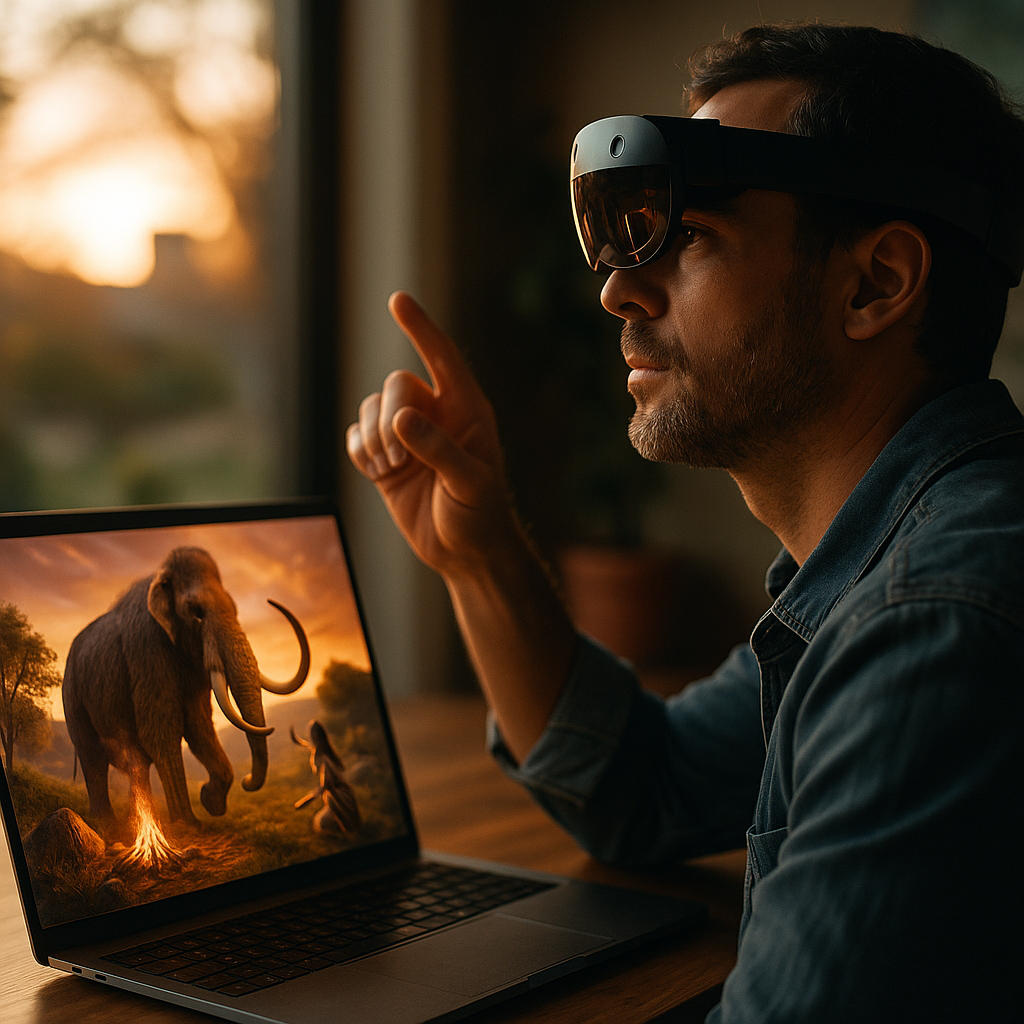
The impact of spatial computing on future brand storytelling formats is already reshaping how audiences discover, evaluate, and remember brands in 2025. Instead of passive viewing, people can step into interactive scenes, explore products at true scale, and share experiences from their own spaces. This shift changes creative, production, and measurement choices. The next question is simple: how do you design stories that earn attention?
Spatial computing storytelling: from linear narratives to lived experiences
Spatial computing moves brand storytelling from “watching” to “participating.” Traditional formats—video spots, static pages, even social reels—assume a fixed frame and a predictable sequence. Spatial formats assume a real environment, a moving user, and a story that adapts to context.
In practice, spatial storytelling often includes:
- Environment-aware scenes: content anchors to surfaces and rooms, so the story feels situated rather than overlaid.
- Explorable narrative structure: users choose what to inspect first, which requires designers to build meaning into multiple paths.
- Embodied interaction: gaze, gesture, voice, and movement become “inputs,” replacing clicks and taps.
- Scale and presence: products can appear life-size, oversized for emphasis, or miniaturized for comparison, changing how benefits are understood.
For brands, the strategic shift is clear: you’re no longer just telling a story; you’re staging conditions where the audience completes it. That demands tighter clarity on what must be learned, felt, and remembered, because users may skip the “middle” of your narrative entirely.
To keep coherence, treat the story like a museum exhibition: each “station” should work alone, but together they should build a consistent message. Build a narrative spine—three to five non-negotiable beats—and let the audience explore within it.
Immersive brand experiences: new formats that audiences will expect
Spatial computing expands the format menu beyond “AR try-on” and “VR demo.” The strongest emerging formats combine utility with emotion, giving users a reason to return—not just a novelty moment. In 2025, audiences increasingly expect experiences that are useful, shareable, and respectful of time and privacy.
High-performing spatial formats for brand storytelling include:
- Product-in-place narratives: users place a product in their real environment, then unlock story chapters tied to features (materials, craftsmanship, sustainability, care instructions).
- Guided spatial explainers: a short, structured experience where the user “walks” through benefits—ideal for complex categories like home tech, health, mobility, and financial services.
- Interactive character-led stories: brand characters or expert guides respond to user questions, creating conversational storytelling without losing brand guardrails.
- Event-layered worlds: pop-ups that combine physical venues with digital layers, so attendees unlock content, rewards, and behind-the-scenes narratives based on location.
- Collectible narrative objects: users earn or purchase digital objects tied to chapters of a brand story—useful for loyalty programs when done transparently.
To decide which format fits, start with the job-to-be-done. If the priority is conversion, emphasize confidence-building (fit, size, performance). If the priority is brand equity, emphasize meaning and memory (origin, mission, community impact). The best spatial work blends both: utility creates trust; emotion creates recall.
Follow-up question brands ask: “Will this replace video?” No. Spatial computing changes the mix. Video remains a scalable top-of-funnel tool; spatial becomes the high-intent layer where people explore, validate, and personalize.
AR brand storytelling: personalization, context, and the ethics of attention
AR is often the first spatial touchpoint because it reaches people where they already are—at home, in stores, or on the move. But AR brand storytelling succeeds only when it respects the user’s context. Intrusive overlays and gimmicky filters burn trust fast.
Three principles drive effective AR storytelling in 2025:
- Contextual relevance: trigger AR moments when they solve a real problem—comparison, sizing, setup, or guidance—not just to decorate the camera view.
- Personalization with restraint: personalize based on explicit inputs (preferences, selections) before inferred traits. Let users control what’s remembered.
- Time-to-value under 10 seconds: the first interaction must deliver a clear payoff quickly, then invite deeper exploration.
Brand leaders also need to manage the ethics of attention. Spatial experiences can be highly persuasive because they feel “real.” That’s a responsibility: avoid manipulative scarcity cues, misleading scale, or selective framing that obscures limitations. If an AR preview has constraints—lighting dependence, color variance, or partial product models—state it plainly inside the experience, not in a hidden link.
Answering a common follow-up: “How do we keep brand voice consistent in AR?” Define your spatial voice system: tone, pacing, interaction style, and visual language. For example, a premium brand might use minimal UI, calm audio, and slow reveals; a youth brand might use playful micro-interactions and faster progression. Consistency becomes especially important when experiences are shared across devices with different capabilities.
3D content marketing: production pipelines, cost control, and reuse
Spatial storytelling raises a practical question: how do you produce 3D content at brand scale without blowing budgets? The answer is to treat 3D assets as reusable content inventory, not one-off campaign files. In 2025, brands that win build modular libraries that serve product, commerce, support, and storytelling from the same foundation.
To make 3D content marketing sustainable:
- Standardize asset specs: define polygon budgets, texture sizes, lighting guidelines, naming conventions, and accessibility requirements.
- Design for multi-channel reuse: one product model should support AR placement, configurators, training, and web previews with appropriate optimization tiers.
- Create a “hero to lite” system: maintain a high-fidelity master asset and generate optimized variants for mobile, web, and in-store devices.
- Use procedural and template-based storytelling: instead of hand-building every scene, use templates for chapters like “unbox,” “how it works,” “care,” and “compare.”
- Governance and approvals: establish sign-off for claims, safety, and regulatory requirements—especially in health, finance, and children’s products.
Cost control improves when teams align early on what must be photoreal versus what can be stylized. Photorealism is powerful for fit and materials, but stylization can communicate benefits faster and reduce rendering complexity. Choose based on the truth you’re trying to convey.
Another common follow-up: “Do we need a game engine team?” Not always. Many experiences can be built with lightweight web-based 3D and platform tools. Reserve heavier engine builds for experiences that require advanced physics, multi-user interaction, or high-end visuals.
XR narrative design: interaction, emotion, and accessibility that scales trust
XR narrative design covers the craft of building stories that respond to user behavior without becoming confusing. The core challenge is balancing freedom with clarity: if users can do anything, they may do nothing meaningful. Strong XR storytelling uses constraints intentionally.
Key design patterns:
- Progressive disclosure: reveal complexity in layers—start with one clear action, then expand options after the user succeeds.
- Spatial cues: use sound, light, and motion to guide attention rather than relying on text instructions.
- Emotional pacing: alternate moments of wonder with moments of understanding; awe without comprehension rarely converts.
- Feedback loops: acknowledge user actions instantly (visual, haptic, audio) so interactions feel reliable.
Accessibility is central to EEAT-aligned brand storytelling. Spatial experiences must work for different abilities and comfort levels. In 2025, audiences judge brands by whether experiences are inclusive by default.
Practical accessibility moves include:
- Multiple input options: support voice, touch, and simplified gesture pathways where possible.
- Comfort settings: minimize motion sickness triggers, offer seated modes, and avoid forced camera movements.
- Readable UI and audio alternatives: provide captions, clear contrast, and adjustable text sizing.
- Content warnings and consent: warn before intense audio, flashing effects, or proximity-based surprises.
Trust also depends on authenticity. If you’re telling a sustainability story, show verifiable specifics: certifications, supply chain steps, or repair programs. If you’re telling a craftsmanship story, show process detail. Spatial computing makes “proof” more tangible—use that power to clarify, not to exaggerate.
Spatial analytics and brand measurement: proving value without breaking privacy
Spatial computing introduces new signals: dwell time in a scene, object interactions, gaze direction (when permitted), and pathing through a narrative. These signals can improve storytelling—if measured ethically and interpreted correctly.
To measure spatial storytelling responsibly:
- Define success by intent stage: awareness metrics (completion rate, replays), consideration metrics (feature interactions, comparisons), conversion metrics (add-to-cart, store visit, lead submission), and support metrics (setup completion, reduced returns).
- Use privacy-by-design defaults: collect the minimum needed, aggregate where possible, and clearly communicate what’s collected and why.
- Instrument story beats, not just clicks: track whether users reached key learning moments (e.g., “saw fit guide,” “tested configuration,” “viewed warranty”).
- Run controlled experiments: compare spatial experiences against best-in-class video or web experiences to quantify lift.
Brands also need to prepare for cross-platform fragmentation: different devices support different interaction methods and data permissions. Build measurement plans that degrade gracefully, so you can still learn even when certain sensors are unavailable.
Answering a likely follow-up: “What ROI should we expect?” In 2025, the strongest ROI cases tend to appear where spatial reduces uncertainty—high-consideration purchases, fit-sensitive items, products with setup friction, and categories where returns are costly. Tie the investment to these measurable business problems, not to “innovation” alone.
FAQs
- What is spatial computing in brand storytelling?
Spatial computing uses 3D content that understands or responds to physical space, enabling people to interact with brand stories through movement, gestures, voice, and object placement. It turns storytelling into an experience that can be explored rather than watched.
- How will spatial computing change future storytelling formats?
It will shift formats from linear videos and pages toward interactive scenes, product-in-place demos, guided explainers, and event-layered experiences. Stories will become modular, personalized, and context-aware, with users choosing their own path through key narrative beats.
- Is AR or VR better for brand storytelling?
AR is typically better for everyday, high-reach moments—try-ons, previews, in-store guidance—because it fits into real environments quickly. VR is better for deeper immersion—training, high-emotion launches, complex education—when the audience is willing to commit more time.
- What skills do teams need to produce spatial stories?
Successful teams combine brand strategy, UX/XR narrative design, 3D asset production, engineering or platform implementation, accessibility expertise, and measurement. Many brands start with a small cross-functional pod and scale through templates and reusable asset libraries.
- How do you ensure spatial experiences are trustworthy and compliant?
Use clear claims substantiation, disclose limitations inside the experience, apply privacy-by-design data practices, and include accessibility and comfort options. Establish governance for approvals, especially in regulated categories, and document what is measured and why.
- How do you measure success in spatial brand storytelling?
Measure completion and replay rates for awareness, feature interactions and comparisons for consideration, and business outcomes like add-to-cart, leads, store visits, reduced support tickets, or reduced returns. Instrument key story beats and validate impact with controlled tests.
Conclusion
Spatial computing is pushing brand storytelling in 2025 toward interactive, explorable formats that blend utility with emotion. The brands that win will treat 3D assets as reusable inventory, design narratives with clear beats and accessible interactions, and measure outcomes responsibly. Build experiences that prove value in seconds, then deepen trust with transparency. The takeaway: stage stories people can live, not just watch.
Top Influencer Marketing Agencies
The leading agencies shaping influencer marketing in 2026
Agencies ranked by campaign performance, client diversity, platform expertise, proven ROI, industry recognition, and client satisfaction. Assessed through verified case studies, reviews, and industry consultations.
Moburst

-
2

The Shelf
Boutique Beauty & Lifestyle Influencer AgencyA data-driven boutique agency specializing exclusively in beauty, wellness, and lifestyle influencer campaigns on Instagram and TikTok. Best for brands already focused on the beauty/personal care space that need curated, aesthetic-driven content.Clients: Pepsi, The Honest Company, Hims, Elf Cosmetics, Pure LeafVisit The Shelf → -
3

Audiencly
Niche Gaming & Esports Influencer AgencyA specialized agency focused exclusively on gaming and esports creators on YouTube, Twitch, and TikTok. Ideal if your campaign is 100% gaming-focused — from game launches to hardware and esports events.Clients: Epic Games, NordVPN, Ubisoft, Wargaming, Tencent GamesVisit Audiencly → -
4

Viral Nation
Global Influencer Marketing & Talent AgencyA dual talent management and marketing agency with proprietary brand safety tools and a global creator network spanning nano-influencers to celebrities across all major platforms.Clients: Meta, Activision Blizzard, Energizer, Aston Martin, WalmartVisit Viral Nation → -
5

The Influencer Marketing Factory
TikTok, Instagram & YouTube CampaignsA full-service agency with strong TikTok expertise, offering end-to-end campaign management from influencer discovery through performance reporting with a focus on platform-native content.Clients: Google, Snapchat, Universal Music, Bumble, YelpVisit TIMF → -
6

NeoReach
Enterprise Analytics & Influencer CampaignsAn enterprise-focused agency combining managed campaigns with a powerful self-service data platform for influencer search, audience analytics, and attribution modeling.Clients: Amazon, Airbnb, Netflix, Honda, The New York TimesVisit NeoReach → -
7

Ubiquitous
Creator-First Marketing PlatformA tech-driven platform combining self-service tools with managed campaign options, emphasizing speed and scalability for brands managing multiple influencer relationships.Clients: Lyft, Disney, Target, American Eagle, NetflixVisit Ubiquitous → -
8

Obviously
Scalable Enterprise Influencer CampaignsA tech-enabled agency built for high-volume campaigns, coordinating hundreds of creators simultaneously with end-to-end logistics, content rights management, and product seeding.Clients: Google, Ulta Beauty, Converse, AmazonVisit Obviously →