


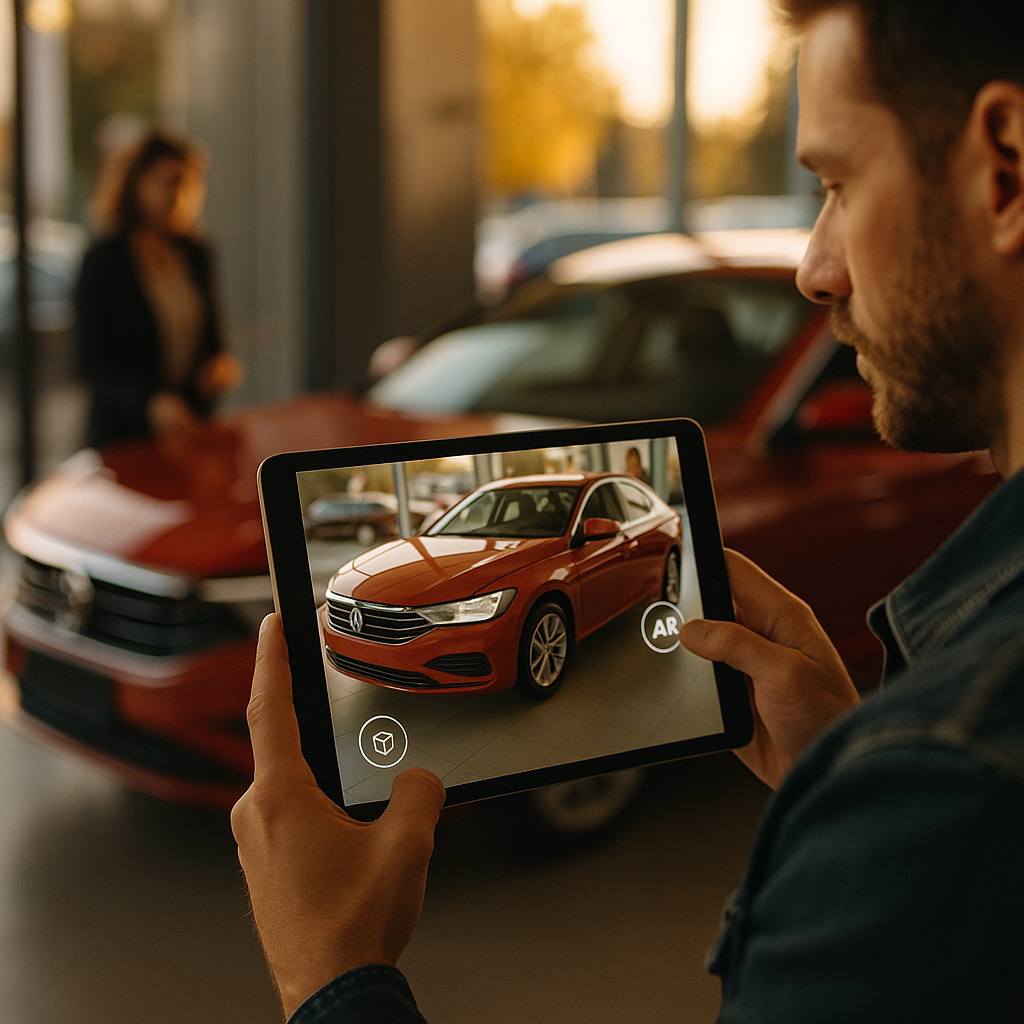
In 2025, car buyers expect clarity without committing to a showroom visit, and brands that remove friction win attention and revenue. This case study shows how one automaker applied augmented reality car sales to recreate the best parts of a dealership experience on a phone. You’ll see the strategy, execution, and measurable outcomes—and the practical lessons your team can use next.
Augmented reality automotive marketing: The business problem and buyer expectations
The brand in this case study (a mid-market automotive manufacturer with a national dealer network) faced a familiar set of constraints: inconsistent showroom footfall, rising digital lead costs, and long sales cycles caused by “I need to see it in person” hesitation. At the same time, their web analytics showed a steady increase in mobile traffic, especially on model pages, configurators, and trade-in tools.
Customer interviews revealed a clear pattern. Prospects wanted three things before they would schedule a test drive or place a deposit:
- Confidence in fit: Will the vehicle fit in my driveway/garage? Is cargo space enough for my gear? Can a child seat fit comfortably?
- Confidence in appearance: How does the color look in real light? How do wheels, trim, and accessories look together?
- Confidence in pricing: A transparent payment path that doesn’t reset when they switch channels or talk to a dealer.
The existing digital journey solved the third point reasonably well with finance and trade-in estimates, but it struggled on fit and appearance. Static photos and video walkarounds helped, yet buyers still needed a physical visit to answer spatial questions. That gap created drop-off between “configured” and “contacted,” and it increased the number of low-intent leads sent to dealers.
The brand’s leadership aligned on a goal: replicate the “walk around, open doors, picture it at home” moment remotely, without adding complexity for dealers. AR became the leading candidate because it could deliver spatial realism on mobile without requiring a headset.
Remote car buying experience: Goals, KPIs, and success criteria
To keep the initiative measurable and dealer-friendly, the brand defined a tight set of success criteria before building anything. They treated AR as a revenue system, not a novelty.
Primary business goals:
- Increase qualified leads from high-intent model and trim pages
- Reduce time-to-deposit for customers who prefer remote steps
- Improve close rates on digitally originated deals routed to dealers
Experience goals:
- Make AR effortless: no app required for first use, minimal loading, clear prompts
- Keep the journey coherent: AR should connect to inventory, pricing, and dealer contact without dead ends
- Support real decision tasks: size, color, key features, and “will it work for my life?” questions
Core KPIs were selected to capture both engagement and downstream sales impact:
- AR activation rate (sessions that launched AR from eligible pages)
- AR dwell time and feature interactions (doors, trunk, interior hotspots)
- Lead conversion rate from AR users vs. non-AR users
- Appointment rate, deposit rate, and close rate by channel
- Dealer response time and customer satisfaction on AR-assisted leads
The brand also agreed on guardrails that protected trust: AR would never distort proportions to “look better,” and any shown options (wheels, trims, accessories) would be tied to real orderability and inventory availability. That decision reduced creative freedom, but it strengthened credibility—an EEAT advantage when customers make a high-stakes purchase.
AR car showroom: Implementation, content pipeline, and tech stack
The brand launched an AR car showroom embedded directly into its mobile site and mirrored inside the existing brand app for returning users. The guiding principle was “one tap to place the car,” followed by “one tap to move to next step.”
What the AR experience included:
- True-to-scale exterior placement in driveways and parking spaces, with an on-screen scale indicator and reposition tool
- Trim-accurate visualization of wheels, badging, roof rails, and key exterior options
- Color and lighting guidance prompts encouraging users to view in shade and sunlight for better perception
- Interactive hotspots for cargo volume, rear-seat legroom, driver-assist sensors, and charging/fuel door location
- Interior “peek” mode with a 360 view and selectable features (seat materials, infotainment screen size)
- Shareable snapshot that generated a link tied to the exact configuration, enabling household decision-making
How it connected to commerce:
- Every AR session carried a configuration ID that fed the payment estimator and inventory search
- A persistent “Check local availability” button surfaced in AR and opened a pre-filtered inventory view
- A “Talk to a specialist” CTA offered chat and callback, routing to the nearest dealer or a centralized sales concierge depending on local capability
- When customers selected a VIN, AR could re-render the exact vehicle (matching wheel design and packages) where data was available
Content pipeline and governance mattered as much as the interface. The brand created a shared “digital product catalog” that linked each 3D model to:
- Official build combinations and constraints (what can be paired with what)
- Regional availability rules and package naming differences
- Legal and compliance notes (safety features, optional equipment disclaimers)
To maintain performance on mobile, the team optimized 3D assets for fast loading and progressive detail. They tested on a wide set of devices and networks, then implemented fallbacks: when AR wasn’t supported, users received a high-quality 3D viewer with the same configuration and the same commerce CTAs. This avoided breaking the buying flow and preserved measurement integrity across devices.
3D product visualization for cars: Customer journey and dealer enablement
The brand treated 3D product visualization for cars as a conversion lever across the whole journey, not just a top-of-funnel attraction. They mapped AR to specific decision points and created a “remote-ready” path that still respected dealer operations.
Where AR appeared in the journey:
- Model discovery: “View in your space” on model pages replaced a generic “Explore gallery” placement
- Configuration: after selecting trim and color, AR prompted “Place your exact build”
- Comparison: a “Swap models” control let users place two vehicles sequentially in the same spot and compare key dimensions
- Pre-appointment: confirmation emails included an AR link to revisit the chosen configuration, reducing no-shows
How dealers were brought along:
- AR lead summaries in the CRM: configuration, time in AR, features tapped, and whether the customer placed the vehicle at home
- Dealer scripts and training: short call guides focused on what AR users tend to ask next (cargo, seating, payments, delivery timing)
- Inventory alignment: dealers could send a “View this VIN in AR” link for vehicles on their lot, supporting remote follow-up
This dealer enablement was critical for EEAT. It ensured customers received consistent answers when they moved from self-serve exploration to human support. The brand also set a service-level target for responses to AR-originated leads and published it internally as a performance metric, which improved accountability and reduced customer frustration.
To address predictable follow-up questions, the AR interface itself answered them. For example, when users tapped cargo space, they saw both volume metrics and a “Try it with your items” prompt—encouraging a realistic placement at home rather than a generic claim. When users tapped driver assistance, the interface explained what features do and do not do, which reduced misinterpretation and supported safe, compliant messaging.
AR lead generation for dealerships: Results, attribution, and what changed
The brand ran a controlled rollout across regions to avoid confusing seasonality with impact. They used a mix of A/B testing on eligible pages and geo-based sequencing where dealer operations were stable. Attribution relied on first-party event data (AR usage, configuration choices, CTA clicks) tied to CRM outcomes (appointments, deposits, sales) with clear consent and privacy notices.
What improved after AR was introduced and promoted on high-intent pages:
- Higher-quality leads: AR users submitted fewer but stronger leads, with better completion of finance and trade-in steps
- More confident appointments: customers arrived with specific trims and options already validated visually
- Faster remote progression: customers who preferred remote steps moved from configuration to deposit with fewer back-and-forth questions
- Better dealer productivity: sales teams spent less time re-explaining basics and more time addressing availability and delivery
Three operational changes explained most of the gains:
- AR was positioned as a decision tool, not entertainment. CTAs emphasized fit and verification (“Will it fit?” “See your exact build”).
- Inventory and payments were integrated so AR sessions didn’t end in a dead end. Users could move directly from visualization to next steps.
- Dealer follow-up used AR context to personalize outreach. Conversations started with what the customer explored, not generic questions.
The brand also learned what did not move the needle. Overly complex AR animations increased load time and reduced activation. Likewise, pushing AR too early (before customers had chosen a trim) created curiosity clicks without downstream intent. The best performance came when AR appeared after a customer had narrowed choices but before they were ready to commit to a visit.
Automotive digital transformation: Practical lessons, risks, and a playbook
This initiative succeeded because it treated AR as part of automotive digital transformation—a connected system across product data, UX, analytics, and retail operations. If you want similar outcomes, the playbook is straightforward, but it requires discipline.
Lesson 1: Build trust with accuracy
AR must be true-to-scale and trim-accurate. If a customer places a vehicle in their driveway and later discovers the wheel design or trim details don’t match, the experience backfires. Establish a governance process that ties 3D assets to orderable configurations and validates them against official specs.
Lesson 2: Optimize for mobile performance
Speed is part of the product. Compress assets, use progressive loading, and avoid unnecessary effects. Provide a robust non-AR fallback so every user can continue the journey without friction.
Lesson 3: Design for the next question
After AR, customers ask: “Is this available near me?” and “What will I pay?” Make those steps persistent, not buried. Add shareable links so other decision-makers can review the exact configuration.
Lesson 4: Enable dealers with context
AR doesn’t replace sales teams; it makes their conversations sharper. Pass AR events into the CRM so the first call feels informed. Train staff on common AR-driven objections (fit, visibility, parking, seating) and provide quick answers.
Lesson 5: Measure outcomes, not applause
Track leads, appointments, deposits, and close rates—segmented by AR usage. Use controlled tests where possible. If you can’t link AR behavior to outcomes, you’re managing by opinion.
Risks to manage:
- Data privacy: clearly disclose what you track and why; limit retention to what supports the sale and service quality
- Compliance: ensure feature explanations are accurate and avoid overselling driver-assistance capabilities
- Operational mismatch: if dealers can’t support remote steps, offer a centralized concierge to prevent lead decay
FAQs
Do customers need to download an app to use AR for car shopping?
No. Most automotive AR experiences in 2025 can launch from a mobile browser for first-time use. A companion app can improve repeat engagement, but the highest conversion path typically starts with a no-download option to reduce friction.
What features matter most in an AR car shopping experience?
True-to-scale placement, trim-accurate styling (wheels, badges, packages), clear color viewing guidance, and practical hotspots (cargo, seating, key tech). The experience should connect directly to inventory and payment steps so customers can act immediately.
How do you prove AR actually increases sales?
Use controlled tests and tie first-party AR events to CRM outcomes. Compare AR users vs. non-AR users on lead conversion, appointment rate, deposit rate, and close rate. Avoid relying on engagement metrics alone, such as time-in-experience.
How can dealerships benefit from AR leads?
AR leads often arrive with higher intent and clearer preferences. When AR interaction data flows into the CRM, dealers can personalize outreach, recommend matching inventory faster, and reduce time spent answering basic configuration questions.
What are common mistakes automotive brands make with AR?
Overbuilding heavy visuals that slow load time, showing non-orderable combinations, placing AR too early in the funnel, and failing to connect AR to inventory and payments. Another frequent mistake is not training dealer teams to use AR context in follow-up.
Is AR still useful if a brand has limited inventory?
Yes, but AR must be paired with transparent availability messaging. Use AR to confirm fit and preference, then guide customers to the nearest matching units or factory-order paths. The key is to prevent AR from creating demand for configurations customers can’t obtain.
In 2025, this automotive brand proved AR can do more than impress—it can remove the last-mile doubts that stall remote purchases. By delivering true-to-scale visualization, connecting AR to inventory and payments, and equipping dealers with AR context, the brand improved lead quality and accelerated decisions. The takeaway: treat AR as a measurable commerce layer, not a standalone campaign.
Top Influencer Marketing Agencies
The leading agencies shaping influencer marketing in 2026
Agencies ranked by campaign performance, client diversity, platform expertise, proven ROI, industry recognition, and client satisfaction. Assessed through verified case studies, reviews, and industry consultations.
Moburst

-
2

The Shelf
Boutique Beauty & Lifestyle Influencer AgencyA data-driven boutique agency specializing exclusively in beauty, wellness, and lifestyle influencer campaigns on Instagram and TikTok. Best for brands already focused on the beauty/personal care space that need curated, aesthetic-driven content.Clients: Pepsi, The Honest Company, Hims, Elf Cosmetics, Pure LeafVisit The Shelf → -
3

Audiencly
Niche Gaming & Esports Influencer AgencyA specialized agency focused exclusively on gaming and esports creators on YouTube, Twitch, and TikTok. Ideal if your campaign is 100% gaming-focused — from game launches to hardware and esports events.Clients: Epic Games, NordVPN, Ubisoft, Wargaming, Tencent GamesVisit Audiencly → -
4

Viral Nation
Global Influencer Marketing & Talent AgencyA dual talent management and marketing agency with proprietary brand safety tools and a global creator network spanning nano-influencers to celebrities across all major platforms.Clients: Meta, Activision Blizzard, Energizer, Aston Martin, WalmartVisit Viral Nation → -
5

The Influencer Marketing Factory
TikTok, Instagram & YouTube CampaignsA full-service agency with strong TikTok expertise, offering end-to-end campaign management from influencer discovery through performance reporting with a focus on platform-native content.Clients: Google, Snapchat, Universal Music, Bumble, YelpVisit TIMF → -
6

NeoReach
Enterprise Analytics & Influencer CampaignsAn enterprise-focused agency combining managed campaigns with a powerful self-service data platform for influencer search, audience analytics, and attribution modeling.Clients: Amazon, Airbnb, Netflix, Honda, The New York TimesVisit NeoReach → -
7

Ubiquitous
Creator-First Marketing PlatformA tech-driven platform combining self-service tools with managed campaign options, emphasizing speed and scalability for brands managing multiple influencer relationships.Clients: Lyft, Disney, Target, American Eagle, NetflixVisit Ubiquitous → -
8

Obviously
Scalable Enterprise Influencer CampaignsA tech-enabled agency built for high-volume campaigns, coordinating hundreds of creators simultaneously with end-to-end logistics, content rights management, and product seeding.Clients: Google, Ulta Beauty, Converse, AmazonVisit Obviously →