


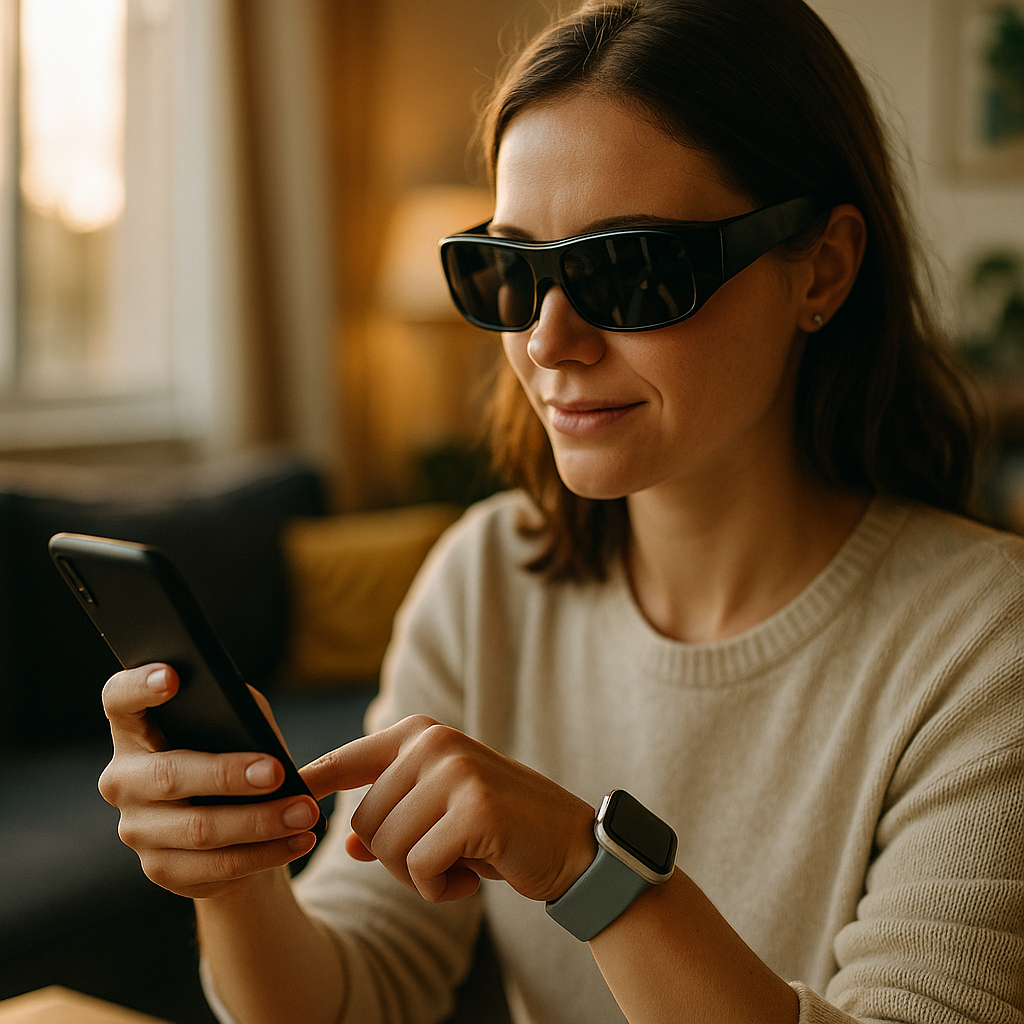
Wearable AI devices are moving content off the screen and into your day, reshaping when, where, and how people learn, shop, and relax. In 2025, smarter earbuds, glasses, rings, and watches deliver personalized media in short, high-intent moments—often without a phone in hand. That shift changes discovery, attention, and trust. What happens when content follows your body?
Wearable AI devices and ambient content delivery
Wearables are turning content consumption into an ambient experience: information arrives in context, triggered by location, activity, schedule, and even biometric signals. Instead of opening an app, people receive what they need as they move through tasks—directions while walking, a summary before a meeting, or a translation mid-conversation.
This changes the dominant unit of consumption from “sessions” to “moments.” A phone encourages browsing; wearables encourage micro-interactions: a short audio card, a glanceable prompt, a haptic cue, or a single question answered by voice. The practical impact is that creators and publishers must design content that works when the user’s hands, eyes, or attention are partially occupied.
What users will expect from ambient delivery:
- Immediate relevance: content tied to a clear need in the current context, not generic feeds.
- Low friction: one-tap, one-glance, or voice-first interactions with minimal UI.
- Continuity across devices: begin on earbuds, continue on laptop, finish on TV without losing place.
- Personalization with boundaries: helpful tailoring that still feels respectful and controllable.
For brands, “being present” will mean “being useful in the moment.” For audiences, it will mean fewer long browsing sessions and more frequent, intention-driven touchpoints.
Voice-first media consumption and AI narration
As wearables normalize always-available microphones and bone-conduction or in-ear audio, voice-first media consumption expands beyond podcasts. AI narration and summarization let users convert text into audio on demand, making commuting, chores, and workouts prime time for news, learning, and entertainment.
That does not mean everything becomes audio. It means audio becomes the default for situations where attention is split. Users will increasingly choose:
- AI readouts: “Read me the key points,” with optional deep dives.
- Conversational search: ask follow-ups and get sourced answers rather than scrolling.
- Adaptive pacing: speed changes based on noise, heart rate, or calendar pressure.
- Hands-free creation: dictation, voice notes, and quick replies that feed back into content ecosystems.
Creators should plan for “dual-format” delivery: content that works as both readable text and speakable audio. Write with clear structure, short sentences where possible, and explicit transitions. If a wearable assistant is summarizing your content, the first few paragraphs and headings become even more important because they influence what gets selected, quoted, and read aloud.
Follow-up readers often ask: will AI narration reduce traffic to original sources? It can, if content is designed as a closed loop. To stay discoverable, publishers can provide “audio-safe” excerpts plus a strong reason to continue: interactive tools, downloadable templates, deeper analysis, original data, or visual explainers that cannot be fully replaced by a spoken summary.
Personalized content algorithms and attention patterns
Wearables generate a richer stream of signals than phones alone: movement, sleep patterns, heart rate trends, ambient noise, and time-use habits. Combined with on-device AI, that enables personalized content algorithms to optimize not just for clicks, but for timing and cognitive load. In practice, this will reshape attention patterns in three ways.
1) Predictive timing beats “always on.” Instead of pushing content all day, systems will choose narrow windows when users are more receptive. A short explainer may arrive during a routine walk; long-form might be suggested when the calendar shows a free block.
2) Content becomes state-aware. People will increasingly see “modes” such as focus, recovery, commute, and social. Each mode implies different formats: quieter audio, fewer alerts, or higher-contrast visuals on glasses. The result is fewer endless feeds and more purpose-built queues.
3) Discovery shifts from browsing to delegation. Users will say: “Keep me updated on this topic, but only if it’s important.” Assistants then filter, summarize, and escalate. That changes the economics of attention: being the loudest matters less than being the most credible and useful.
What this means for content teams:
- Optimize for intent, not just keywords: answer the question completely, then offer a next best step.
- Make credibility machine-readable: clear author attribution, references, and update notes improve selection by assistants.
- Design modularly: create sections that can stand alone as summaries, checklists, or quick tips.
From an EEAT standpoint, personalization raises stakes: if an assistant recommends your content in high-trust moments, errors cost more. Invest in expert review, transparent sourcing, and fast corrections.
Augmented reality wearables and visual learning
Smart glasses and other augmented reality wearables are pushing consumption from “watching” to “doing.” Instead of reading instructions, users see step-by-step overlays while cooking, repairing equipment, training at the gym, or navigating unfamiliar places. This favors content that is procedural, spatial, and interactive.
Visual learning in AR changes habits in several concrete ways:
- Just-in-time education: tutorials appear at the exact step where mistakes happen.
- Shorter learning loops: users try, get feedback, and correct immediately rather than finishing a full video first.
- Higher tolerance for micro-content: a single overlay or 15-second prompt can be more valuable than a 10-minute explainer.
- Environment as interface: content anchors to objects and locations, not pages.
Publishers and educators will need to rethink what “a piece of content” is. A future “article” may be a set of AR cards, each tied to a real-world trigger, plus a reference hub for deeper reading. Brands should plan for product documentation and troubleshooting that can be consumed visually in context, with safety considerations front and center.
Likely follow-up: will AR replace screens? Not fully. AR wins for guidance and spatial tasks; screens remain better for long reading, editing, and high-density information. The habit shift is toward “AR for action, screens for reflection.”
Data privacy in wearables and consumer trust
Because wearables sit on the body, data privacy in wearables becomes central to future content habits. Users will only accept always-on assistants if they feel in control of what is collected, stored, and shared. Trust will directly influence engagement: people will disable features, restrict permissions, or abandon platforms that feel invasive.
In 2025, responsible experiences typically include:
- On-device processing: keeping sensitive signals local when possible.
- Clear consent flows: separate permissions for audio, location, biometrics, and ad personalization.
- Granular controls: “only during workouts,” “only for navigation,” or “never store voice recordings.”
- Meaningful explanations: why a recommendation appeared and which signals influenced it.
- Secure defaults: minimal data retention and strong encryption.
For content providers, EEAT is not only about expertise; it is also about trustworthy handling of user data. If you offer a wearable companion app, publish a plain-language privacy summary, name your data processors, explain retention periods, and provide a simple deletion path. If you personalize content, give users a way to view and edit their interests.
Reader question: will privacy constraints reduce personalization quality? Somewhat, but high-quality personalization does not require maximal data. It requires the right data, used transparently. Context can be inferred from user-declared preferences, time of day, and explicit goals without harvesting sensitive biometrics.
Future of content marketing with wearable AI assistants
The future of content marketing in a wearable-first world is less about pageviews and more about outcomes: did the user solve the problem, make a better decision, or learn something measurable? Wearable AI assistants will act as gatekeepers, selecting which sources to summarize, cite, or recommend. That creates new competition for “assistant visibility.”
Expect these shifts in strategy:
- Answer-first content: concise solutions upfront, followed by optional depth for credibility and conversion.
- Structured expertise signals: clear authorship, qualifications, editorial standards, and references.
- Multi-sensory assets: short audio explainers, glanceable visuals, and AR-ready step sequences.
- Brand as a utility: calculators, checklists, decision trees, and troubleshooting guides that assistants can surface.
- Measurement beyond clicks: completion, saves, repeat usage, and downstream actions (appointments booked, returns reduced, support tickets resolved).
To align with Google’s helpful-content and EEAT expectations, prioritize original value: firsthand testing, expert interviews, documented methodologies, and updated guidance when recommendations change. Assistants and search systems will increasingly reward sources that demonstrate real-world experience and maintain accuracy over time.
Actionable guidance for teams: build a “wearable adaptation layer” for your best content. Create a spoken summary, a 5-bullet quick guide, and a visual step card. Then link to a deep, well-referenced hub page that proves authority and supports conversion.
FAQs
What are wearable AI devices?
Wearable AI devices are body-worn products—such as smartwatches, smart rings, earbuds, and smart glasses—that use on-device or cloud AI to interpret context and deliver assistance like summaries, recommendations, translations, and proactive alerts.
How will wearable AI change content consumption in daily life?
It will shift habits from long browsing sessions to frequent micro-moments, with more voice and glanceable formats. People will delegate discovery to assistants, rely on context-aware prompts, and consume more content during activities where screens are inconvenient.
Will AI summaries reduce the need to read full articles?
For simple queries, yes. For complex decisions, users will still seek full sources—especially when content offers depth, original data, tools, visuals, and clear sourcing. Publishers can stay relevant by making summaries accurate while giving strong reasons to continue.
What content formats perform best on wearables?
Short audio briefings, structured checklists, step-by-step guides, and modular sections that can be summarized reliably. For AR wearables, procedural visual overlays and interactive troubleshooting perform especially well.
How can creators improve trust and EEAT for wearable-driven discovery?
Use clear author attribution and credentials, cite reputable sources, state update dates, separate facts from opinion, and correct errors publicly. Add practical experience—tests, case examples, and methods—so assistants and users can evaluate reliability quickly.
What are the biggest privacy risks with wearable AI?
Always-on sensors can expose sensitive data such as location, voice, and health signals. The main risks include unclear consent, excessive retention, third-party sharing, and weak security. Strong controls, on-device processing, and transparent explanations reduce these risks.
Wearable AI devices will push content toward contextual, voice-first, and action-oriented experiences, changing discovery from browsing to delegation. In 2025, the winners will be sources that deliver fast help without sacrificing accuracy, transparency, or privacy. Prepare by modularizing content, adding speakable and glanceable versions, and strengthening EEAT signals. When content meets users in the moment, attention follows.
Top Influencer Marketing Agencies
The leading agencies shaping influencer marketing in 2026
Agencies ranked by campaign performance, client diversity, platform expertise, proven ROI, industry recognition, and client satisfaction. Assessed through verified case studies, reviews, and industry consultations.
Moburst

-
2

The Shelf
Boutique Beauty & Lifestyle Influencer AgencyA data-driven boutique agency specializing exclusively in beauty, wellness, and lifestyle influencer campaigns on Instagram and TikTok. Best for brands already focused on the beauty/personal care space that need curated, aesthetic-driven content.Clients: Pepsi, The Honest Company, Hims, Elf Cosmetics, Pure LeafVisit The Shelf → -
3

Audiencly
Niche Gaming & Esports Influencer AgencyA specialized agency focused exclusively on gaming and esports creators on YouTube, Twitch, and TikTok. Ideal if your campaign is 100% gaming-focused — from game launches to hardware and esports events.Clients: Epic Games, NordVPN, Ubisoft, Wargaming, Tencent GamesVisit Audiencly → -
4

Viral Nation
Global Influencer Marketing & Talent AgencyA dual talent management and marketing agency with proprietary brand safety tools and a global creator network spanning nano-influencers to celebrities across all major platforms.Clients: Meta, Activision Blizzard, Energizer, Aston Martin, WalmartVisit Viral Nation → -
5

The Influencer Marketing Factory
TikTok, Instagram & YouTube CampaignsA full-service agency with strong TikTok expertise, offering end-to-end campaign management from influencer discovery through performance reporting with a focus on platform-native content.Clients: Google, Snapchat, Universal Music, Bumble, YelpVisit TIMF → -
6

NeoReach
Enterprise Analytics & Influencer CampaignsAn enterprise-focused agency combining managed campaigns with a powerful self-service data platform for influencer search, audience analytics, and attribution modeling.Clients: Amazon, Airbnb, Netflix, Honda, The New York TimesVisit NeoReach → -
7

Ubiquitous
Creator-First Marketing PlatformA tech-driven platform combining self-service tools with managed campaign options, emphasizing speed and scalability for brands managing multiple influencer relationships.Clients: Lyft, Disney, Target, American Eagle, NetflixVisit Ubiquitous → -
8

Obviously
Scalable Enterprise Influencer CampaignsA tech-enabled agency built for high-volume campaigns, coordinating hundreds of creators simultaneously with end-to-end logistics, content rights management, and product seeding.Clients: Google, Ulta Beauty, Converse, AmazonVisit Obviously →