


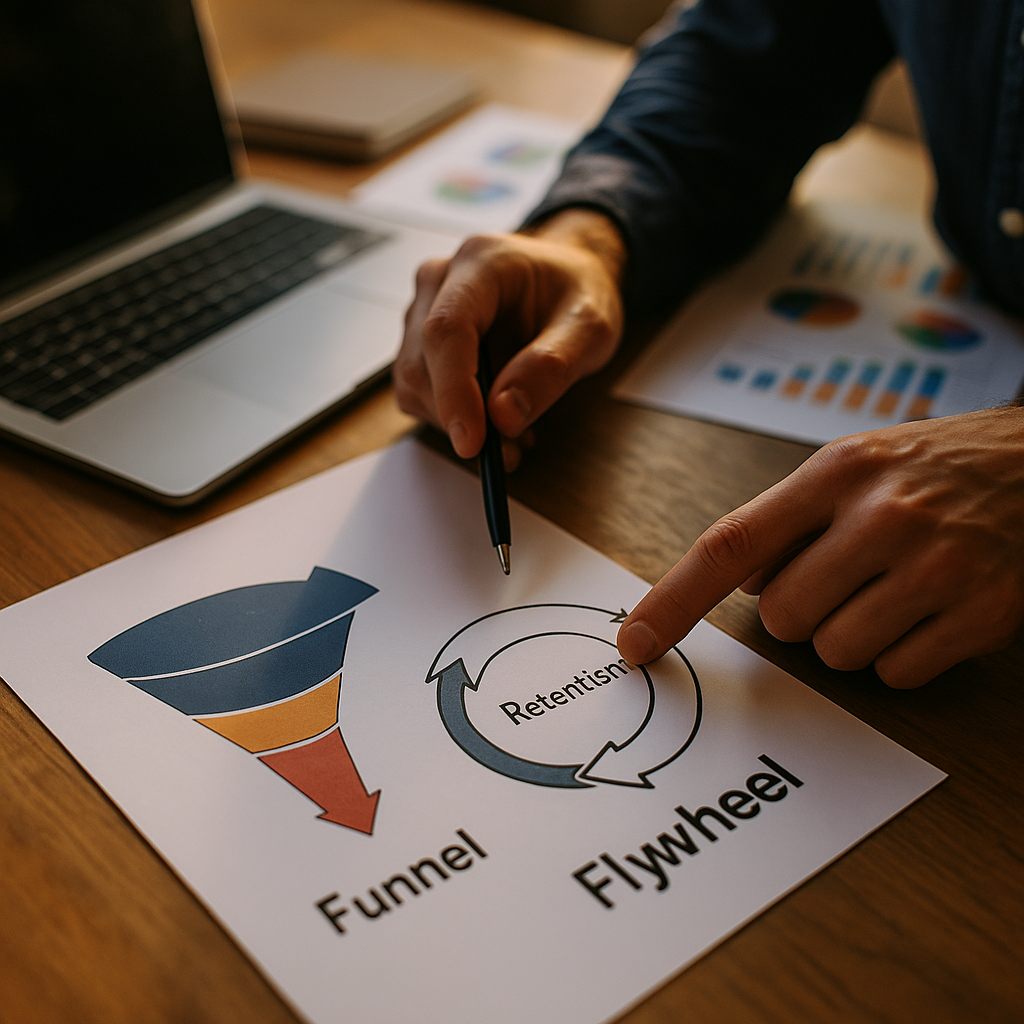
Transitioning From Traditional Funnels To A Customer-Centric Flywheel is no longer a trendy idea in 2025—it’s a practical response to rising acquisition costs, crowded channels, and customers who expect value before they buy. Funnels end at “conversion,” but growth rarely does. A flywheel keeps momentum through retention, advocacy, and expansion. The question is: how do you rebuild your system without losing revenue?
Traditional sales funnel limitations
The classic funnel—awareness, consideration, decision—helped teams organize campaigns and forecast pipeline. The problem is not that funnels are “wrong,” but that they reward short-term wins and often ignore what happens after the deal closes. In 2025, that gap shows up quickly as churn, refunds, poor reviews, and stalled referrals.
Where funnels commonly break down:
- They treat conversion as the finish line. Teams optimize to close, then hand off onboarding to another department with little accountability for outcomes.
- They create siloed metrics. Marketing is judged on leads, sales on close rate, support on ticket volume—yet customers experience one journey.
- They underinvest in existing customers. When budgets skew toward acquisition, retention programs become reactive instead of strategic.
- They amplify friction. Aggressive lead capture, repetitive forms, and opaque pricing can boost “MQLs” while eroding trust.
If you notice high customer acquisition cost (CAC), “leaky” onboarding, or low expansion revenue, the issue may not be your tactics—it may be the model. A flywheel reframes growth around compounding value: satisfied customers lower your cost-to-grow through repeat purchases, referrals, and social proof.
Customer-centric flywheel model
A customer-centric flywheel is a growth system designed to build momentum by reducing friction and increasing value at every stage of the relationship. Instead of moving people through a narrowing path, you create an experience that encourages customers to keep engaging—and to bring others with them.
The flywheel has three reinforcing motions:
- Attract: Earn attention with credible expertise, useful tools, transparent pricing, and proof of outcomes.
- Engage: Help buyers succeed with guidance, onboarding, enablement, and honest expectations.
- Delight: Create measurable results, proactive support, and reasons to advocate—reviews, referrals, community, and expansion.
The key shift is accountability. In a flywheel, marketing doesn’t stop at the lead, sales doesn’t stop at the signature, and service isn’t a cost center. Every team contributes to outcomes that customers can feel and quantify.
What “customer-centric” means in practice:
- Decisions start with customer success metrics, not just internal efficiency.
- Messaging aligns with real product value and common implementation constraints.
- Friction is measured and removed across the lifecycle: sales process, onboarding steps, time-to-value, renewals, and support handoffs.
If your organization sells to multiple segments, you can run more than one flywheel. The goal is to align motions to the customer’s context, not force every account into one generic journey.
Retention and advocacy strategy
Momentum comes from customers who stay, expand, and advocate. That requires designing retention and advocacy as an integrated strategy—not a set of isolated programs. In 2025, customer expectations are shaped by fast onboarding experiences, self-serve learning, and immediate value. If your time-to-value is slow, your churn risk is high.
Build retention into the first 30 days:
- Define “time-to-first-value” (TTFV) for each segment and make it a shared KPI across marketing, sales, and customer success.
- Use a guided onboarding path with milestones customers can complete (and celebrate) in under two weeks.
- Set expectations clearly in sales. Overpromising creates friction that no onboarding can fix.
Turn outcomes into advocacy:
- Ask at the right moment: Trigger review and referral requests after a measurable win (e.g., a KPI improvement, project launch, or successful renewal QBR).
- Make advocacy easy: Provide prewritten review prompts, short case study templates, and shareable assets customers can post with minimal effort.
- Reward participation without compromising trust: Offer perks like training credits, early access, or co-marketing—be transparent about any incentives.
Prevent churn with proactive signals: Identify risk through product usage drops, unresolved support patterns, stakeholder changes, and missed milestones. Then respond with an action plan: enablement, executive alignment, or a re-scoped success plan.
This is also where EEAT matters. Testimonials and case studies should be specific and verifiable. Use named roles where permitted, clarify baseline vs. result, and avoid vague claims. If you cite data, link it internally to methodology in your own reporting pages or customer success summaries.
Marketing and sales alignment
Moving to a flywheel requires a shared operating system across marketing, sales, and customer teams. Misalignment creates friction that slows momentum: marketing attracts the wrong accounts, sales closes deals that churn, and customer success inherits mismatched expectations.
Start with shared definitions and service-level agreements (SLAs):
- Define your Ideal Customer Profile (ICP) using firmographics plus “successability” factors such as implementation capacity, data maturity, and stakeholder access.
- Agree on qualification and handoff criteria (e.g., required fields, discovery notes, success metrics, and stakeholders identified).
- Document a single narrative that connects the problem, the approach, and the expected outcome—then train every customer-facing role on it.
Shift content strategy from lead capture to buyer enablement: In a flywheel, content reduces uncertainty and helps customers succeed. That includes onboarding guides, templates, ROI calculators, comparison pages that are fair, and implementation playbooks. These assets support both acquisition and retention because they continue to deliver value after purchase.
Update sales motions to support long-term success:
- Sell the right scope. A smaller initial package that achieves outcomes can outperform an oversized deal that fails.
- Introduce customer success early. Bring CS into late-stage conversations to confirm success criteria and timeline.
- Capture “success plans” in the CRM. Track objectives, milestones, and adoption blockers as first-class data.
If you’re wondering, “Will this slow down our pipeline?”—expect a short adjustment period. However, tighter qualification and better onboarding typically reduce downstream churn and support costs, which improves net growth over time.
Lifecycle metrics and customer experience
You can’t manage a flywheel with funnel-only metrics. Pageviews and MQLs won’t tell you if customers are achieving outcomes. In 2025, flywheel leaders track a balanced set of lifecycle metrics that connect customer experience to revenue.
Core flywheel metrics to adopt:
- Time-to-first-value (TTFV): How quickly customers reach a meaningful win after purchase.
- Activation rate: The percentage of customers completing key actions that predict long-term retention.
- Retention and churn: Logo churn, revenue churn, and cohort retention by segment.
- Net Revenue Retention (NRR): Expansion and contraction effects among existing customers.
- Customer effort score (CES) or friction score: How hard it is to complete common tasks across onboarding and support.
- Advocacy indicators: Review volume and quality, referral rate, community participation, and case study pipeline.
Map metrics to the customer journey: Build a lifecycle dashboard that shows where momentum accelerates or stalls. For example, if activation is strong but NRR is flat, your expansion motion may need clearer upgrade paths, better packaging, or more visible outcomes reporting.
Design a measurable customer experience:
- Standardize onboarding milestones by segment and integrate them into product checklists and CS workflows.
- Create an “outcome review” rhythm (e.g., 30/60/90-day check-ins, QBRs) with clear next steps.
- Make support part of growth: Turn top tickets into help center articles, product fixes, and training modules. This reduces friction and builds trust.
To meet Google’s helpful content expectations, keep experience signals visible: publish author credentials on educational resources, explain how recommendations were tested, and keep content updated when your product, policies, or best practices change.
Implementation roadmap for growth teams
Transitioning to a flywheel doesn’t require abandoning your funnel overnight. It requires reorganizing priorities so conversion feeds a system designed for retention and advocacy. Use a staged rollout to protect revenue while you retool operations.
Phase 1: Diagnose friction (2–4 weeks)
- Interview customers across segments: new wins, renewals, churned accounts. Ask what created confidence, what slowed results, and what nearly derailed the relationship.
- Audit handoffs between marketing → sales → CS → support. Identify missing information, duplicated steps, and broken expectations.
- Baseline lifecycle metrics (TTFV, activation, churn, NRR, CES) so you can prove impact.
Phase 2: Redesign the journey (4–8 weeks)
- Create a segment-based success plan template including milestones, owners, and timelines.
- Fix the highest-friction points first: onboarding confusion, unclear pricing/packaging, slow implementation, and recurring support issues.
- Build enabling content that supports both prospects and customers (setup guides, playbooks, ROI explanations, and troubleshooting).
Phase 3: Operationalize the flywheel (ongoing)
- Align incentives: Ensure marketing and sales are rewarded for retention-friendly deals (e.g., quality pipeline, activation, and early retention), not just volume.
- Automate signals: Trigger interventions when adoption drops or milestones are missed.
- Run monthly growth reviews across teams to remove friction and prioritize improvements based on impact.
Common obstacles and how to handle them:
- “We don’t have enough data.” Start with a few leading indicators (TTFV and activation). Add sophistication after you can act on signals.
- “Teams protect their metrics.” Add shared KPIs that span the lifecycle, and use joint planning to reduce blame.
- “We fear slowing lead flow.” Maintain top-of-funnel activity, but tighten ICP and improve conversion quality through better qualification and enablement.
FAQs about transitioning to a flywheel
What is the biggest difference between a funnel and a flywheel?
A funnel measures progress toward a purchase. A flywheel measures and improves momentum after purchase through retention, expansion, and advocacy. The flywheel makes customer outcomes a growth lever, not a support function.
Do we need to replace our CRM or marketing automation tools?
Not usually. Most teams can implement a flywheel using existing tools by adding lifecycle stages, success-plan fields, product usage signals, and shared dashboards. The bigger change is process and accountability, not software.
How do we prove ROI from a flywheel approach?
Track baseline vs. improved metrics: reduced time-to-first-value, higher activation, lower churn, and improved net revenue retention. Also measure cost-to-serve changes (fewer repeated tickets, faster resolutions) and increased referrals or reviews.
Is a flywheel only for SaaS businesses?
No. Any business with repeat purchase potential, renewals, service contracts, or word-of-mouth impact can benefit. The model works in B2B services, ecommerce with loyalty programs, and subscription or membership organizations.
What should we prioritize first if we’re resource-constrained?
Prioritize the fastest path to customer value: simplify onboarding, clarify expectations in sales, and fix the top recurring support issues. Improving early outcomes typically lifts retention and advocacy faster than launching new acquisition campaigns.
How long does the transition take?
You can see early indicators (TTFV and activation) improve in 30–90 days if you focus on onboarding and handoffs. Meaningful changes in churn, NRR, and advocacy typically require multiple customer cycles, depending on contract length and buying patterns.
Funnels still help you understand acquisition, but they can’t power sustainable growth alone. In 2025, the flywheel wins by turning customer outcomes into momentum—lower friction, faster value, and more advocacy. Start small: measure time-to-first-value, tighten handoffs, and build enablement that serves both buyers and customers. When every team owns the full lifecycle, growth becomes compounding rather than episodic.
Top Influencer Marketing Agencies
The leading agencies shaping influencer marketing in 2026
Agencies ranked by campaign performance, client diversity, platform expertise, proven ROI, industry recognition, and client satisfaction. Assessed through verified case studies, reviews, and industry consultations.
Moburst

-
2

The Shelf
Boutique Beauty & Lifestyle Influencer AgencyA data-driven boutique agency specializing exclusively in beauty, wellness, and lifestyle influencer campaigns on Instagram and TikTok. Best for brands already focused on the beauty/personal care space that need curated, aesthetic-driven content.Clients: Pepsi, The Honest Company, Hims, Elf Cosmetics, Pure LeafVisit The Shelf → -
3

Audiencly
Niche Gaming & Esports Influencer AgencyA specialized agency focused exclusively on gaming and esports creators on YouTube, Twitch, and TikTok. Ideal if your campaign is 100% gaming-focused — from game launches to hardware and esports events.Clients: Epic Games, NordVPN, Ubisoft, Wargaming, Tencent GamesVisit Audiencly → -
4

Viral Nation
Global Influencer Marketing & Talent AgencyA dual talent management and marketing agency with proprietary brand safety tools and a global creator network spanning nano-influencers to celebrities across all major platforms.Clients: Meta, Activision Blizzard, Energizer, Aston Martin, WalmartVisit Viral Nation → -
5

The Influencer Marketing Factory
TikTok, Instagram & YouTube CampaignsA full-service agency with strong TikTok expertise, offering end-to-end campaign management from influencer discovery through performance reporting with a focus on platform-native content.Clients: Google, Snapchat, Universal Music, Bumble, YelpVisit TIMF → -
6

NeoReach
Enterprise Analytics & Influencer CampaignsAn enterprise-focused agency combining managed campaigns with a powerful self-service data platform for influencer search, audience analytics, and attribution modeling.Clients: Amazon, Airbnb, Netflix, Honda, The New York TimesVisit NeoReach → -
7

Ubiquitous
Creator-First Marketing PlatformA tech-driven platform combining self-service tools with managed campaign options, emphasizing speed and scalability for brands managing multiple influencer relationships.Clients: Lyft, Disney, Target, American Eagle, NetflixVisit Ubiquitous → -
8

Obviously
Scalable Enterprise Influencer CampaignsA tech-enabled agency built for high-volume campaigns, coordinating hundreds of creators simultaneously with end-to-end logistics, content rights management, and product seeding.Clients: Google, Ulta Beauty, Converse, AmazonVisit Obviously →