


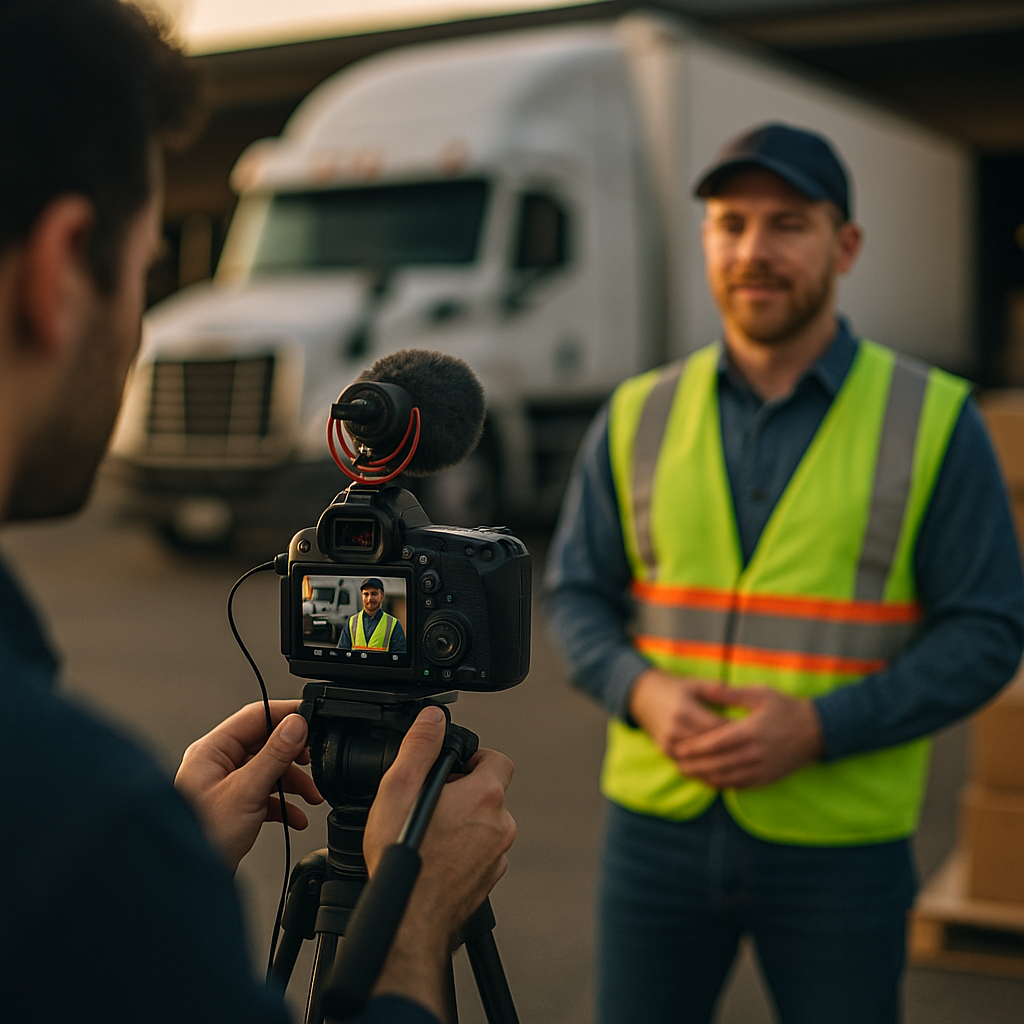
In 2025, recruiters in trucking and supply chain compete for attention as much as applicants compete for jobs. This case study shows how one legacy logistics firm used video recruiting to move beyond job boards and speak like real people. You’ll see what they filmed, how they distributed it, and what changed when candidates finally met the humans behind the brand—ready to borrow the playbook?
Employer branding video strategy: the recruiting problem a legacy logistics firm faced
The company in this case study—an established, multi-terminal logistics provider with decades of operating history—had a familiar set of constraints:
- Brand perception lagged reality. Internally, leaders were investing in newer equipment, modern safety standards, and upgraded dispatch tools. Externally, candidates still pictured “old school” operations.
- High-intent candidates were dropping off mid-funnel. Applicants started strong, then disappeared after the first scheduling text or before orientation.
- Word-of-mouth worked locally, not at scale. Referrals were quality, but they didn’t support expansion into adjacent markets.
- Recruiters were carrying the whole story. Hiring teams spent too much time explaining routes, pay structures, home-time realities, and culture—repeating the same points dozens of times per week.
Leadership set a clear goal: humanize the recruiting experience and improve candidate confidence before the first conversation. They also wanted an approach that was credible to drivers, warehouse associates, and fleet maintenance techs—audiences that can detect corporate gloss instantly.
They chose video because it could do three things text couldn’t: show the work environment, demonstrate respect, and reduce uncertainty. Most importantly, video could introduce real employees and leaders in their own words—without forcing candidates to “take the company’s word for it.”
Recruitment marketing with video: what they produced and why it worked
The firm built a small library of purpose-driven videos instead of one big “brand film.” Each video answered a specific candidate question, which made the content more useful and easier to distribute across the funnel.
1) The 60–90 second “Meet your team” series
- Who appeared: terminal manager, dispatcher, a tenured driver, a newer driver, and a shop lead
- What it covered: how loads are assigned, what support looks like after hours, what “good day” means at the terminal
- Why it worked: candidates could picture the people they’d actually interact with, not a generic corporate voice
2) “Day-in-the-life” role previews (3–5 minutes)
- Roles featured: local driver, linehaul driver, warehouse selector, diesel tech apprentice
- What it covered: start-of-shift routine, equipment checks, typical pace, break expectations, safety moments
- Why it worked: it reduced anxiety by making the job concrete, which also discouraged mismatched applicants (a hidden win)
3) A straightforward pay-and-schedule explainer (2–3 minutes)
- What it covered: how pay is calculated, what affects earnings, when pay changes (probation/training), examples of common schedules, and how home time is handled
- Why it worked: it replaced vague promises with clarity, improving trust and reducing repetitive recruiter calls
4) Candidate-first safety and equipment proof points (90 seconds)
- What it covered: maintenance workflow, how defects are reported, what happens when a driver says “no,” and the company’s expectations around safe operation
- Why it worked: safety claims are common; showing process made the claims believable
Production choices mattered. The team used real locations, natural lighting where possible, and minimal scripting. Leaders were coached to speak plainly: what the job is, what it isn’t, and what kind of person succeeds there. That honesty did more for recruiting than polish ever could.
Authentic recruiting content: how they kept trust high and avoided “corporate video”
Humanizing recruiting fails when video feels staged. This firm treated authenticity as a requirement, not a style.
They followed three rules:
- Employees spoke in their own language. Instead of feeding lines, the crew asked prompts: “What surprised you when you started?” “What do you wish candidates knew?” The best answers sounded like real conversations because they were.
- They addressed trade-offs directly. Some routes were early. Some days were physical. Peak season was busy. By naming the realities, they signaled respect for candidates’ time and improved fit.
- They validated claims with specifics. “We invest in equipment” became “here’s how pre-trip issues get handled, who signs off, and how fast.” “We support drivers” became “here’s the escalation path at 2 a.m.”
EEAT in action: The videos demonstrated lived experience (employees), operational expertise (supervisors explaining process), and trust (clear details, no inflated promises). They also added on-screen identifiers for credibility—job title, terminal, and tenure—so viewers could weigh the perspective appropriately.
They also implemented a simple consent-and-comfort process: employees volunteered, reviewed the final cut for accuracy, and could opt out. That protected trust internally and prevented awkward “performative” participation that audiences can sense immediately.
Candidate experience improvements: where video fit in the hiring funnel
Video worked because it was deployed intentionally—at the exact moments candidates tend to hesitate. The firm mapped its recruiting journey and placed video to answer questions before they became objections.
Top of funnel (attraction)
- Channels: paid social, job posts, Google Business Profiles for terminals, and local community pages
- Video use: short “Meet your team” clips with captions and a single clear call to action
- Goal: earn attention and build familiarity without asking for immediate commitment
Mid-funnel (consideration)
- Channels: career site role pages, retargeting ads, and recruiter follow-up texts/emails
- Video use: day-in-the-life previews and pay/schedule explainers embedded next to role requirements
- Goal: reduce uncertainty and help candidates self-qualify
Bottom of funnel (conversion)
- Channels: interview confirmation messages, “what to bring” reminders, and orientation prep
- Video use: a short “Here’s what happens next” walkthrough from the recruiter, plus a safety/equipment reassurance clip
- Goal: reduce no-shows and first-day anxiety by making the process predictable
Post-hire (retention support)
- Channels: onboarding portal and supervisor check-ins
- Video use: quick process explainers (how to report issues, who to call, how to request time off)
- Goal: accelerate confidence in the first 30 days and prevent early frustration
The operational impact was immediate for recruiters: fewer repetitive “basic” questions, more productive interviews, and better-prepared candidates. Candidates benefited too—especially those coming from employers where communication was inconsistent. The firm didn’t just “market” jobs; it reduced ambiguity.
Hiring metrics and ROI: what changed after launching recruiting video
Because leadership wanted a business case—not a creative project—the team defined measurement early. They treated video as a recruiting asset with performance expectations.
What they measured (and why it mattered):
- Apply-start to apply-complete rate: to see whether video reduced second-guessing during application
- Interview show rate: a direct indicator of candidate intent and confidence
- Offer acceptance rate: a proxy for trust and expectation alignment
- Early-tenure retention (first 30–90 days): whether the job matched what was portrayed
- Recruiter time per hire: whether video reduced repeated explanations and rescheduling
What improved (directionally) after rollout:
- Higher-quality conversations. Candidates arrived with better questions, not basic ones, which shortened screening and improved fit.
- Fewer surprises. Because schedules, physical demands, and support processes were visible upfront, fewer hires quit quickly due to “this isn’t what I expected.”
- More trust signals at the point of decision. Seeing the actual terminal and hearing directly from peers increased offer confidence, especially for candidates comparing multiple employers.
To keep the ROI defensible, the firm also tracked cost controls. They reused footage across multiple edits, updated only the sections likely to change (pay structure, benefits details), and avoided frequent reshoots by recording evergreen process content. That made the video library a long-lived asset rather than a one-time campaign.
If you want a practical starting benchmark: compare the cost of production and distribution against the cost of (1) unfilled seats, (2) recruiter overtime, and (3) early turnover. In logistics, those costs add up quickly, so even modest improvements in show rate and early retention can justify the program.
Logistics recruiting best practices: a repeatable playbook for 2025
This firm’s approach is replicable because it relies on fundamentals: credibility, clarity, and consistent distribution. Here’s the playbook they documented for ongoing use across terminals.
1) Build a “candidate question” content map
- What does a normal day look like?
- How does pay work and what affects it?
- What’s the schedule really like?
- Who supports me when something goes wrong?
- What kind of equipment and safety culture will I deal with?
2) Standardize formats, not scripts
- Use repeatable video templates (intro, role preview, pay explainer) while letting each terminal sound like itself.
- Capture b-roll once per site: yard, docks, shop, break areas, pre-trip inspections.
3) Make distribution part of recruiter workflow
- Add video links to text templates for first response, interview confirmation, and offer stage.
- Embed role videos on job pages above the “Apply” button.
- Train recruiters to ask: “Did you get a chance to watch the day-in-the-life?” and use the response to qualify fit.
4) Protect trust with governance
- Review pay/schedule videos whenever policies change.
- Label videos with location and role so candidates don’t confuse terminals.
- Keep promises conservative and verifiable; avoid “family” language unless employees use it naturally and consistently.
5) Refresh with small, frequent updates
- Quarterly: capture new employee stories and common Q&A clips.
- As needed: update benefits/pay specifics without re-filming the whole library.
The key insight: humanization isn’t a “tone.” It’s operational transparency delivered by real people, in the moments candidates need it.
FAQs
What types of recruiting videos work best for logistics roles?
Short “meet the team” introductions, day-in-the-life role previews, and clear pay/schedule explainers perform best because they reduce uncertainty. Add a safety/equipment process video to build credibility with experienced candidates.
How long should recruiting videos be in 2025?
Aim for 60–90 seconds for awareness content and 3–5 minutes for role previews. Longer is fine only when the video is tightly structured around a specific question, like “How does pay work?”
Do we need professional actors or a studio?
No. Real employees are more persuasive than actors in blue-collar and operations roles. Use simple production—clean audio, steady shots, captions—and focus on clarity and honesty over cinematic polish.
How do we use video to reduce interview no-shows?
Send a short video with the interview confirmation that explains where to go, who they’ll meet, how long it will take, and what to bring. Pair it with a day-in-the-life clip so candidates feel oriented before they arrive.
How do we ensure recruiting videos stay compliant and accurate?
Have HR review any pay, benefits, or policy claims before publishing. Use location and role labels, avoid guarantees, and set a review cadence so anything tied to compensation or schedules gets updated when changes occur.
What’s the fastest way to start if we have limited time?
Film two assets: a 90-second terminal “meet your team” video and a 3–5 minute day-in-the-life for your highest-need role. Embed them on job pages and add them to recruiter text/email templates immediately.
Recruiting in logistics improves when candidates can see the job and meet the people behind it before they commit. In this case study, a legacy firm used video to replace vague claims with clear, human proof—team faces, real workflows, and honest expectations. The takeaway is simple: build a small library, place it across the funnel, and measure what changes to keep trust high.
Top Influencer Marketing Agencies
The leading agencies shaping influencer marketing in 2026
Agencies ranked by campaign performance, client diversity, platform expertise, proven ROI, industry recognition, and client satisfaction. Assessed through verified case studies, reviews, and industry consultations.
Moburst

-
2

The Shelf
Boutique Beauty & Lifestyle Influencer AgencyA data-driven boutique agency specializing exclusively in beauty, wellness, and lifestyle influencer campaigns on Instagram and TikTok. Best for brands already focused on the beauty/personal care space that need curated, aesthetic-driven content.Clients: Pepsi, The Honest Company, Hims, Elf Cosmetics, Pure LeafVisit The Shelf → -
3

Audiencly
Niche Gaming & Esports Influencer AgencyA specialized agency focused exclusively on gaming and esports creators on YouTube, Twitch, and TikTok. Ideal if your campaign is 100% gaming-focused — from game launches to hardware and esports events.Clients: Epic Games, NordVPN, Ubisoft, Wargaming, Tencent GamesVisit Audiencly → -
4

Viral Nation
Global Influencer Marketing & Talent AgencyA dual talent management and marketing agency with proprietary brand safety tools and a global creator network spanning nano-influencers to celebrities across all major platforms.Clients: Meta, Activision Blizzard, Energizer, Aston Martin, WalmartVisit Viral Nation → -
5

The Influencer Marketing Factory
TikTok, Instagram & YouTube CampaignsA full-service agency with strong TikTok expertise, offering end-to-end campaign management from influencer discovery through performance reporting with a focus on platform-native content.Clients: Google, Snapchat, Universal Music, Bumble, YelpVisit TIMF → -
6

NeoReach
Enterprise Analytics & Influencer CampaignsAn enterprise-focused agency combining managed campaigns with a powerful self-service data platform for influencer search, audience analytics, and attribution modeling.Clients: Amazon, Airbnb, Netflix, Honda, The New York TimesVisit NeoReach → -
7

Ubiquitous
Creator-First Marketing PlatformA tech-driven platform combining self-service tools with managed campaign options, emphasizing speed and scalability for brands managing multiple influencer relationships.Clients: Lyft, Disney, Target, American Eagle, NetflixVisit Ubiquitous → -
8

Obviously
Scalable Enterprise Influencer CampaignsA tech-enabled agency built for high-volume campaigns, coordinating hundreds of creators simultaneously with end-to-end logistics, content rights management, and product seeding.Clients: Google, Ulta Beauty, Converse, AmazonVisit Obviously →