


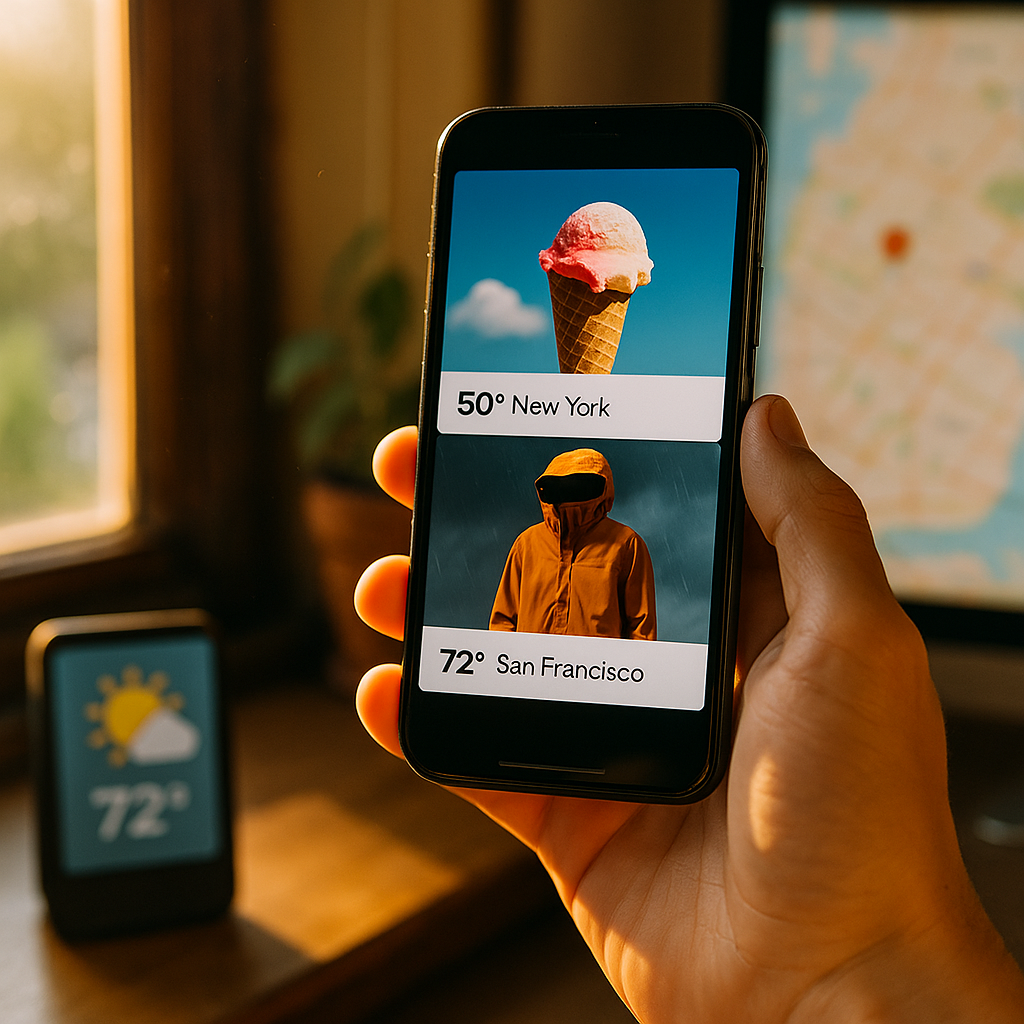
Using AI To Personalize Dynamic Creative Based On Weather And Location is changing how brands earn attention in 2025. Instead of running one generic ad for every viewer, marketers can tailor imagery, copy, offers, and timing to match real-world context—rain, heat, commute patterns, or local events—without manual rebuilds. Done well, this feels helpful, not intrusive, and it can lift performance quickly. Ready to see how it works?
Why weather-based advertising improves relevance and ROI
People make different choices when the environment changes. A cold snap pushes demand toward hot drinks, outerwear, and indoor activities. A heatwave shifts attention to hydration, cooling products, and evening delivery windows. Weather-based advertising turns those natural shifts into creative that matches intent in the moment, reducing wasted impressions and increasing message resonance.
In 2025, the core advantage is speed: AI can interpret incoming signals and select the right creative variant faster than any manual workflow. Instead of planning separate campaigns for “sunny,” “rainy,” and “snowy,” you can run one structured campaign with a library of modular assets, then let AI assemble and serve the most relevant version by conditions and location.
To make the business case internally, anchor ROI expectations in measurable mechanics:
- Higher engagement: Context-matched ads typically improve click and view-through rates because the message aligns with current needs.
- Better conversion quality: If the ad shows what’s actually useful right now (e.g., “same-day umbrella delivery” during rainfall), post-click behavior improves.
- Reduced creative fatigue: Rotating variants based on real-world triggers naturally diversifies exposure.
- More efficient spend: Budget can be weighted toward conditions that historically drive higher conversion probability.
Marketers often ask: “Will this just add complexity?” It can, but the point of AI is to move complexity behind the scenes. Your job becomes defining the rules, assets, and safeguards—then validating performance with disciplined testing.
How location-based personalization works with AI and dynamic creative optimization
Location-based personalization in 2025 goes beyond “city name insertion.” It blends geography, proximity, local inventory, and environmental context into one decision system. Combined with dynamic creative optimization (DCO), AI selects and assembles an ad from pre-approved building blocks to fit each impression.
At a practical level, a DCO setup usually includes:
- Modular creative components: Backgrounds, product shots, headlines, CTAs, offer badges, and legal text, each tagged with usage constraints.
- Context signals: Approximate location (e.g., DMA/region), language, time of day, device type, and weather conditions from trusted providers.
- Business data: Store hours, inventory status, delivery coverage, and pricing rules.
- Decision logic: A blend of rules (hard constraints) and models (probabilistic selection) to pick the best combination.
Example flows that readers typically want clarified:
- Retail: If the user is within 10 km of a store with in-stock rain jackets and rainfall is forecast within 3 hours, show “In stock nearby” plus a map-style visual and “Pick up today.”
- QSR/food delivery: If it’s cold and late afternoon, emphasize warm meals and “Delivered in 30–40 min,” while suppressing ice-cream creative.
- Travel: If conditions are sunny in the destination but rainy at origin, position “Escape the rain” messaging with flexible booking terms.
One more follow-up question tends to come up: “Do we need precise GPS?” Often, no. Many high-performing programs use coarse location (city/region) plus store coverage data. That approach lowers privacy risk and still delivers meaningful relevance.
AI-driven dynamic creative optimization: data sources, models, and triggers
AI-driven DCO depends on reliable inputs and clear triggers. The most effective programs treat context as a decision layer, not a gimmick. Start by defining which weather variables actually influence buying behavior for your category, then convert them into triggers your ad system can use.
Common weather and environment inputs include:
- Temperature bands: e.g., “below 5°C,” “5–18°C,” “above 28°C”
- Precipitation type and intensity: drizzle vs heavy rain; snow vs sleet
- Wind and humidity: useful for outdoor gear, beauty, and comfort products
- Air quality alerts: relevant for wellness and indoor activity positioning (use with caution and sensitivity)
- Forecast horizon: “current conditions” vs “next 3 hours” vs “next 24 hours”
Trigger design matters more than adding more variables. Too many triggers create fragmentation, low learning volume, and confusing analytics. A good baseline is 6–12 condition states per market (not hundreds), each mapped to a distinct creative intent.
Model approaches typically fall into three patterns:
- Rules-first with AI ranking: Rules ensure brand safety and compliance; AI ranks eligible creative combinations for performance.
- Multi-armed bandits: The system explores variants while rapidly shifting traffic to winners, useful when conditions change quickly.
- Incrementality-aware optimization: The model tries to optimize toward lift rather than raw conversions, using holdouts or geo-experiments where feasible.
To answer a frequent operational question—“How real-time is real-time?”—most brands target updates every 15–60 minutes, which balances freshness with platform latency and reporting stability. For flash events (sudden storms), you can add a high-priority override that switches messaging quickly while preserving pre-approved assets.
Contextual creative strategy: messaging, offers, and brand safety
Contextual personalization works when it feels like service, not surveillance. The creative strategy should focus on utility: what the audience needs because of the weather and where they are, not what the brand knows about them.
Messaging principles that hold up across industries:
- Be specific about the benefit: “Stay dry in heavy rain” outperforms vague lines like “Weather-ready style.”
- Keep the context subtle: “Rain on the way? Grab a compact umbrella” feels normal; “We see it’s raining at your exact address” feels invasive.
- Match the offer to constraints: If roads are icy, emphasize delivery scheduling and safety, not urgency pressure.
- Localize responsibly: Use local store availability and hours so you don’t promote closed locations or out-of-stock items.
Brand safety and sensitivity is non-negotiable with weather signals. Build a “do-not-personalize” list for severe situations. For example, avoid playful copy during extreme weather warnings in affected areas, and suppress categories that could appear exploitative (price-gouging optics, “panic buy” messaging). Create severity tiers and pre-approved fallback creative that is neutral and service-oriented.
Creative governance keeps teams aligned:
- Pre-approval matrix: Which headlines/images/offers are allowed for each condition tier and region.
- Legal and disclosure controls: Ensure necessary disclaimers render correctly across assembled variants.
- Accessibility checks: Maintain readable contrast, avoid text overload, and keep essential meaning in the primary message (not only in imagery).
If you’re wondering whether personalization will dilute brand consistency, the fix is modular design: keep brand anchors constant (logo, typography, tone), while swapping only the contextual elements (visual scene, product focus, CTA, and offer).
Measurement, attribution, and experimentation for dynamic creative
To follow EEAT best practices, treat performance claims as testable hypotheses and use measurement methods appropriate to dynamic systems. Dynamic creative can inflate vanity metrics if you only look at platform-reported conversions. You need a measurement stack that separates correlation from causation.
Core KPIs to track, segmented by condition and region:
- Incremental conversion lift: Measured via holdouts, geo-tests, or conversion lift studies.
- Cost efficiency: CPA/ROAS, but interpreted alongside incrementality.
- Engagement quality: Landing-page view rate, add-to-cart rate, qualified leads, or store visit proxies where permitted.
- Creative health: Frequency, fatigue curves, and variant-level performance stability.
Experimentation design that works in real conditions:
- Holdout by geography: Run DCO in matched regions while keeping control regions on static creative. This is often the cleanest for weather-triggered programs.
- PSA or neutral control creative: Keeps delivery mechanics similar while removing the contextual message.
- Variant caps: Limit the number of simultaneous variants so each reaches statistical learning volume.
- Weather normalization: Compare results within the same condition windows (e.g., rainy impressions vs rainy impressions), not across different weather days.
Attribution reality in 2025: Expect partial visibility due to privacy constraints and differing platform methodologies. Mitigate this by combining: platform reporting, server-side events where compliant, modeled conversions, and periodic incrementality tests. The goal is directional truth you can act on, not perfect precision.
Implementation checklist for scalable weather and location personalization
Most programs succeed or fail in implementation details: data quality, asset discipline, and operational ownership. Use this checklist to move from pilot to scalable system.
- Define use cases first: Choose 2–3 high-impact scenarios (e.g., rain, heat, cold) tied to clear product outcomes.
- Select trusted data providers: Document update frequency, geographic resolution, and uptime SLAs for weather feeds.
- Design a condition taxonomy: A small set of mutually exclusive states that your team can interpret and report on.
- Build a modular asset library: Create components that can be recombined without breaking brand standards or readability.
- Connect inventory and fulfillment signals: Prevent “available nearby” claims unless they are validated in near real time.
- Set safety tiers and fallbacks: Include severe weather suppression and neutral creative for edge cases.
- Establish ownership: Clarify who manages triggers, who approves assets, and who monitors anomalies daily.
- Run a controlled pilot: Start with one region and one channel, then expand once measurement shows incremental lift.
- Document learnings: Maintain a playbook: which conditions, messages, and offers work by category and region.
A practical follow-up question is “Which channels are best?” Start where you already have conversion tracking maturity and creative flexibility—typically paid social, programmatic display/video, and retail media. Then extend to email/app messaging if you can control timing and respect consent.
FAQs about AI personalization by weather and location
Is weather-based personalization considered “targeting” from a privacy standpoint?
It can be, depending on how location is derived and whether it is linked to an identifiable person. Use coarse location when possible, avoid storing precise coordinates unless necessary, honor consent frameworks, and ensure your privacy policy covers contextual personalization and data sharing with vendors.
Do I need real-time weather data, or is forecast data enough?
Forecast data is often enough for many categories because it supports planning and pre-positioning (e.g., “rain later today”). Real-time data helps when immediate conditions change behavior quickly (storms, sudden temperature drops). Many brands use both: forecast for planning, real-time for overrides.
How many creative variants should we start with?
Start with a small, high-quality set: 3–6 weather states multiplied by 2–3 offer/message angles. Keep variants large enough to learn, then expand based on observed winners. Too many variants early reduces learning speed and complicates reporting.
What’s the difference between rules and AI in DCO?
Rules enforce constraints (compliance, product availability, severe weather suppression). AI ranks or selects among eligible variants to maximize outcomes like incremental conversions. The most reliable systems use both: rules for safety, AI for performance.
How do we avoid coming across as creepy?
Keep references to location and weather general, focus on utility, and avoid language that implies you know someone’s exact whereabouts. Also avoid hyper-personal claims like “We noticed you’re in…” unless the user explicitly opted into that experience (e.g., a store-finder feature in an app).
Can this work for B2B marketing?
Yes, but the use cases differ. Weather and location can shape messaging around operations and urgency (e.g., facility readiness, logistics planning, field service scheduling). Keep the creative benefit-led and avoid forced connections if weather does not materially affect the buyer’s decision.
AI-powered dynamic creative tied to weather and location works best when it’s built on disciplined inputs, modular assets, and clear safeguards. In 2025, the winners treat context as a product experience: helpful messaging, accurate availability, and respectful localization. Start small, measure incrementality, and scale only what proves lift. When you align creative with real-world conditions, relevance stops being a buzzword and becomes repeatable growth.
Top Influencer Marketing Agencies
The leading agencies shaping influencer marketing in 2026
Agencies ranked by campaign performance, client diversity, platform expertise, proven ROI, industry recognition, and client satisfaction. Assessed through verified case studies, reviews, and industry consultations.
Moburst

-
2

The Shelf
Boutique Beauty & Lifestyle Influencer AgencyA data-driven boutique agency specializing exclusively in beauty, wellness, and lifestyle influencer campaigns on Instagram and TikTok. Best for brands already focused on the beauty/personal care space that need curated, aesthetic-driven content.Clients: Pepsi, The Honest Company, Hims, Elf Cosmetics, Pure LeafVisit The Shelf → -
3

Audiencly
Niche Gaming & Esports Influencer AgencyA specialized agency focused exclusively on gaming and esports creators on YouTube, Twitch, and TikTok. Ideal if your campaign is 100% gaming-focused — from game launches to hardware and esports events.Clients: Epic Games, NordVPN, Ubisoft, Wargaming, Tencent GamesVisit Audiencly → -
4

Viral Nation
Global Influencer Marketing & Talent AgencyA dual talent management and marketing agency with proprietary brand safety tools and a global creator network spanning nano-influencers to celebrities across all major platforms.Clients: Meta, Activision Blizzard, Energizer, Aston Martin, WalmartVisit Viral Nation → -
5

The Influencer Marketing Factory
TikTok, Instagram & YouTube CampaignsA full-service agency with strong TikTok expertise, offering end-to-end campaign management from influencer discovery through performance reporting with a focus on platform-native content.Clients: Google, Snapchat, Universal Music, Bumble, YelpVisit TIMF → -
6

NeoReach
Enterprise Analytics & Influencer CampaignsAn enterprise-focused agency combining managed campaigns with a powerful self-service data platform for influencer search, audience analytics, and attribution modeling.Clients: Amazon, Airbnb, Netflix, Honda, The New York TimesVisit NeoReach → -
7

Ubiquitous
Creator-First Marketing PlatformA tech-driven platform combining self-service tools with managed campaign options, emphasizing speed and scalability for brands managing multiple influencer relationships.Clients: Lyft, Disney, Target, American Eagle, NetflixVisit Ubiquitous → -
8

Obviously
Scalable Enterprise Influencer CampaignsA tech-enabled agency built for high-volume campaigns, coordinating hundreds of creators simultaneously with end-to-end logistics, content rights management, and product seeding.Clients: Google, Ulta Beauty, Converse, AmazonVisit Obviously →