


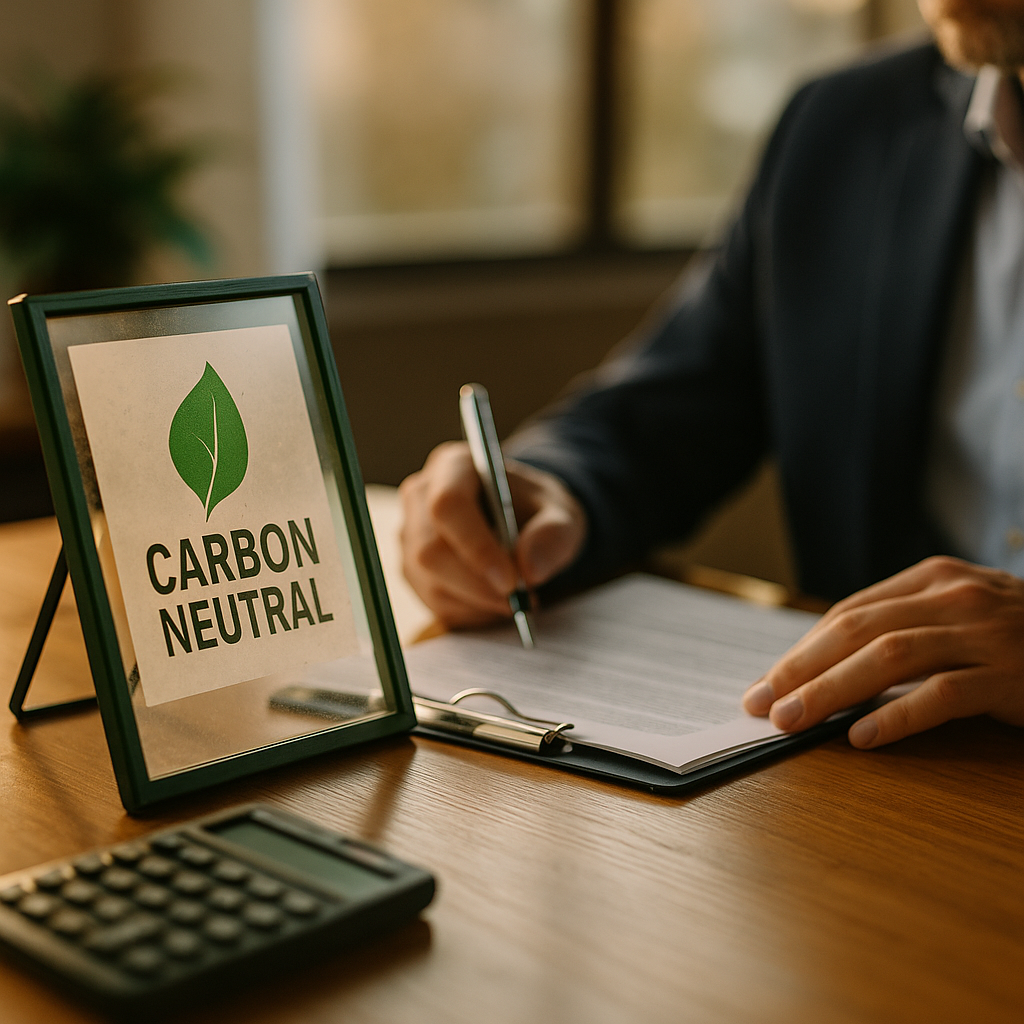
Brands face intensifying scrutiny when marketing climate credentials, especially as regulators and platforms demand evidence that consumers can verify. Navigating transparency requirements for carbon neutral ad claims now means documenting emissions, explaining boundaries, and proving how reductions and offsets work together. The goal is not just compliance; it is credibility that survives audits, media attention, and customer questions. What does “carbon neutral” really require in 2025?
Carbon neutral ad claims: define the claim before you defend it
Many compliance failures start with a vague promise. “Carbon neutral” can mean different things to different audiences, so you must define the claim in plain language and align it to what you can prove.
Start by stating the object of the claim. Is the claim about a specific product, a service line, a facility, a brand, or an entire corporate group? The narrower the object, the easier it is to substantiate. If your ad implies the whole company is carbon neutral, you must support the whole-company boundary—not just a flagship product or a single site.
Clarify the time boundary. Is the claim tied to a calendar year, a rolling 12-month period, or a specific campaign window? Consumers reasonably interpret “carbon neutral” as current, not historic. If you rely on past achievements, disclose the period prominently.
Explain the mechanism. A defensible carbon-neutral claim typically combines (1) measured emissions, (2) reductions within your operations and value chain, and (3) neutralization of residual emissions, commonly via high-quality carbon credits. If your neutrality depends heavily on credits, say so and quantify the split. Do not imply “zero emissions” if emissions still occur.
Avoid implied absolutes. Words like “clean,” “green,” or “zero impact” can expand the promise beyond neutrality and invite challenge. Keep the claim tight, measurable, and consistent across ad copy, landing pages, and customer support scripts.
Transparency requirements: what regulators and platforms expect you to disclose
Transparency requirements for environmental advertising now converge around a simple test: can a reasonable consumer quickly find the key qualifiers and evidence? To meet that standard, build disclosures that are easy to access and hard to misinterpret.
Make core qualifiers unavoidable. If the ad says “carbon neutral,” the ad or its immediate destination should also disclose the essentials: the scope of emissions included, whether credits were used, and where the methodology and results are published. Burying details in a PDF several clicks away increases risk.
Disclose emissions scopes and boundaries. Most audiences have heard of Scope 1, 2, and 3, but they do not assume you included all of them. If you exclude material categories (for example, downstream use, upstream logistics, or purchased goods), state that plainly. If the claim covers only certain scopes, use specific wording such as “carbon neutral for Scope 1 and 2 emissions from our operations.”
Provide a single source of truth. Create a public claim page that includes: boundary, period, calculation approach, emissions totals, reduction actions, credit details, and verification status. Link to it consistently from ads, product pages, and QR codes on packaging.
Match the disclosure to the channel. Short-form ads have limited space, but that does not eliminate your duty to qualify. Use brief on-ad qualifiers (“includes offsets,” “see method”) plus a direct link or QR to the full substantiation page.
Be ready for “show me” questions. Build your disclosures anticipating the first follow-ups: What was the footprint? What did you do to reduce it? What credits did you buy? Who verified it? How can I check them?
Substantiation and verification: build an audit-ready evidence trail
Transparency is only credible when the underlying substantiation holds up. Treat every carbon-neutral claim as if it will be challenged by a regulator, a competitor, or a journalist.
Use recognized accounting methods. Follow widely accepted greenhouse gas accounting frameworks and document any deviations. Your evidence pack should clearly describe data sources, emission factors, and estimation methods used for gaps. If you used supplier-specific data, explain how it was collected and validated.
Commission independent assurance where practical. Third-party verification is not a universal legal requirement, but it is a strong credibility signal and can materially reduce dispute risk. If you claim “verified,” specify who verified, what standard was applied, and what assurance level was provided. If assurance is limited, do not imply it is comprehensive.
Keep a defensible calculation file. Maintain an internal dossier that includes:
- Organizational and operational boundary decisions and rationale
- Activity data sources (energy bills, fuel receipts, logistics data, procurement records)
- Emission factor sources and versions
- Materiality thresholds and how you handled missing data
- Change log for methodology updates
Prevent “double counting” inside your own reporting. If a product is marketed as carbon neutral, ensure the same credits are not also used to support separate “company-wide neutral” claims unless your accounting explicitly prevents overlap. Use unique serial numbers and retirement records for credits, and tie them to the specific claim period and boundary.
Align marketing with sustainability and legal teams. A common failure mode is marketing language drifting beyond what the footprint study supports. Put a pre-launch review workflow in place so claim wording, visuals, and disclaimers match your substantiation.
Carbon offsets disclosure: how to explain credits without losing trust
Offsetting is where consumer skepticism concentrates. You can still use credits, but you must describe them precisely and avoid overstating what they achieve.
Quantify the role of credits. Disclose the total emissions covered and the portion neutralized with credits after reductions. Consumers respond better to honesty than to vague “we offset everything” statements.
Specify credit attributes that matter. A credible disclosure typically includes:
- Project type (e.g., renewable energy, avoided deforestation, reforestation, methane capture)
- Program/registry and credit standard
- Vintage (the period when reductions/removals occurred) if it is relevant to your claim integrity
- Geography and any co-benefits presented as secondary, not as proof of carbon impact
- Retirement evidence (serial numbers or public retirement links where available)
Differentiate avoidance vs. removals. Many audiences now expect you to distinguish between emissions avoided and carbon removed from the atmosphere. If your neutrality relies on avoided emissions credits, say so. If you use removals, clarify permanence assumptions and risks.
Avoid implying offsets eliminate your emissions. Use careful language such as “we measured and reduced our emissions, then purchased and retired carbon credits to neutralize remaining emissions.” Do not present credits as a substitute for reduction efforts.
Do not “bundle” environmental claims. If you state or imply additional benefits (biodiversity, community impacts), ensure those benefits are documented and do not distract from the carbon accounting. Unsupported co-benefit claims can trigger separate greenwashing allegations.
Consumer-friendly claim language: compliance that improves conversion
Transparent claims can still be persuasive, but only if they are understandable. Most consumers do not want a technical report; they want a clear explanation and a simple way to verify.
Use layered communication. Provide a short, plain-language claim in the ad, a slightly longer summary on the landing page, and a detailed methodology document behind it. This “layered” approach meets transparency expectations without overwhelming the reader.
Examples of safer phrasing. Adapt these patterns to your exact boundary and evidence:
- “Carbon neutral for our direct operations (Scope 1 and 2) in 2025, after reductions and retirement of carbon credits. See details.”
- “This product’s footprint was measured, reduced where possible, and the remaining emissions were neutralized with retired carbon credits. Learn how.”
Design disclosures for mobile. If key qualifiers require zooming or scrolling through dense text, they are not “clear and prominent.” Put the most important qualifiers near the claim, use readable font sizes, and avoid low-contrast text.
Train frontline teams. Sales and support staff should be able to answer, consistently, what is included, what is excluded, and how credits were chosen. Inconsistent answers can undermine trust even if your documentation is solid.
Build a correction protocol. If you discover an error in your footprint or credit retirement, update the public claim page promptly, document the fix, and adjust ads. Silent changes can look deceptive if screenshots circulate.
Risk management for greenwashing: governance that keeps claims defensible
In 2025, the highest-performing brands treat carbon-neutral advertising like any other regulated claim: governed, reviewed, and monitored. A practical governance system reduces risk without slowing campaigns to a crawl.
Create a claims register. Track every environmental claim you publish, including where it appears, the exact wording, the qualifying disclosures, and the substantiation documents. This speeds up responses to inquiries and prevents outdated claims from lingering.
Set internal approval thresholds. Require legal and sustainability review for “carbon neutral,” “net zero,” “climate positive,” and any claim referencing offsets. Establish a checklist so reviewers confirm boundary, period, data quality, and offset disclosures each time.
Monitor third-party expectations. Ad platforms, retailers, and procurement teams often impose their own documentation requirements. Keep a reusable evidence pack so you can respond quickly without rewriting disclosures for each partner.
Stress-test consumer interpretation. Ask: what will a reasonable customer think this means in five seconds? If the impression is broader than the substantiation, tighten the wording, add qualifiers, or narrow the claim scope.
Plan for evolving science and standards. Carbon accounting methods and offset quality benchmarks continue to mature. Build review cycles into your program so you can update methodologies, improve data quality, and retire older claims responsibly rather than defending them indefinitely.
FAQs: transparency requirements for carbon neutral ad claims
What information must be disclosed to make a carbon neutral claim credible?
At minimum, disclose the boundary (what is covered), the period (when), the emissions quantified (how much), the reduction actions taken, whether carbon credits were used, and where the supporting methodology and retirement evidence can be checked.
Can we say “carbon neutral” if we only cover Scope 1 and 2?
Yes, if the claim clearly states it is limited to Scope 1 and 2 and does not imply full value-chain neutrality. If Scope 3 is material for your category, expect more scrutiny and consider whether a narrower claim or additional Scope 3 work is needed.
Do carbon neutral claims require third-party verification?
Not always as a strict legal requirement, but independent assurance materially strengthens defensibility. If you use verification language, specify who verified, what they verified, and the standard and assurance level.
How specific do we need to be about carbon offsets?
Be specific enough for independent checking: the registry/standard, project type, quantity, and retirement evidence. If you highlight removals or permanence, ensure your credits and documentation support those points.
What is the difference between “carbon neutral,” “net zero,” and “climate positive” in advertising?
“Carbon neutral” usually means measured emissions are balanced for a defined boundary and period, often using credits for residual emissions. “Net zero” is commonly interpreted as a deeper, long-term pathway with substantial reductions and limited neutralization. “Climate positive” implies going beyond neutrality, which is harder to prove and easy to overstate; use it only with rigorous, clearly explained accounting.
Where should disclosures live if the ad is short (social, display, audio)?
Use an on-ad qualifier plus a direct link or QR to a dedicated claim page. The claim page should be stable, easy to read on mobile, and contain the full substantiation summary and links to detailed documents.
How often should we update our carbon neutral claim documentation?
Update at least every claim period and whenever your methodology, boundaries, suppliers, or credit strategy changes materially. Keep an archive of previous periods so you can show continuity and explain any changes transparently.
Carbon-neutral advertising in 2025 rewards brands that treat transparency as part of the product, not an afterthought. Define the claim tightly, disclose boundaries and credit use clearly, and back every statement with an audit-ready evidence trail. When disclosures are prominent and verification is easy, trust follows. The takeaway: if a consumer cannot quickly understand and check your claim, rewrite it before you run it.
Top Influencer Marketing Agencies
The leading agencies shaping influencer marketing in 2026
Agencies ranked by campaign performance, client diversity, platform expertise, proven ROI, industry recognition, and client satisfaction. Assessed through verified case studies, reviews, and industry consultations.
Moburst

-
2

The Shelf
Boutique Beauty & Lifestyle Influencer AgencyA data-driven boutique agency specializing exclusively in beauty, wellness, and lifestyle influencer campaigns on Instagram and TikTok. Best for brands already focused on the beauty/personal care space that need curated, aesthetic-driven content.Clients: Pepsi, The Honest Company, Hims, Elf Cosmetics, Pure LeafVisit The Shelf → -
3

Audiencly
Niche Gaming & Esports Influencer AgencyA specialized agency focused exclusively on gaming and esports creators on YouTube, Twitch, and TikTok. Ideal if your campaign is 100% gaming-focused — from game launches to hardware and esports events.Clients: Epic Games, NordVPN, Ubisoft, Wargaming, Tencent GamesVisit Audiencly → -
4

Viral Nation
Global Influencer Marketing & Talent AgencyA dual talent management and marketing agency with proprietary brand safety tools and a global creator network spanning nano-influencers to celebrities across all major platforms.Clients: Meta, Activision Blizzard, Energizer, Aston Martin, WalmartVisit Viral Nation → -
5

The Influencer Marketing Factory
TikTok, Instagram & YouTube CampaignsA full-service agency with strong TikTok expertise, offering end-to-end campaign management from influencer discovery through performance reporting with a focus on platform-native content.Clients: Google, Snapchat, Universal Music, Bumble, YelpVisit TIMF → -
6

NeoReach
Enterprise Analytics & Influencer CampaignsAn enterprise-focused agency combining managed campaigns with a powerful self-service data platform for influencer search, audience analytics, and attribution modeling.Clients: Amazon, Airbnb, Netflix, Honda, The New York TimesVisit NeoReach → -
7

Ubiquitous
Creator-First Marketing PlatformA tech-driven platform combining self-service tools with managed campaign options, emphasizing speed and scalability for brands managing multiple influencer relationships.Clients: Lyft, Disney, Target, American Eagle, NetflixVisit Ubiquitous → -
8

Obviously
Scalable Enterprise Influencer CampaignsA tech-enabled agency built for high-volume campaigns, coordinating hundreds of creators simultaneously with end-to-end logistics, content rights management, and product seeding.Clients: Google, Ulta Beauty, Converse, AmazonVisit Obviously →