


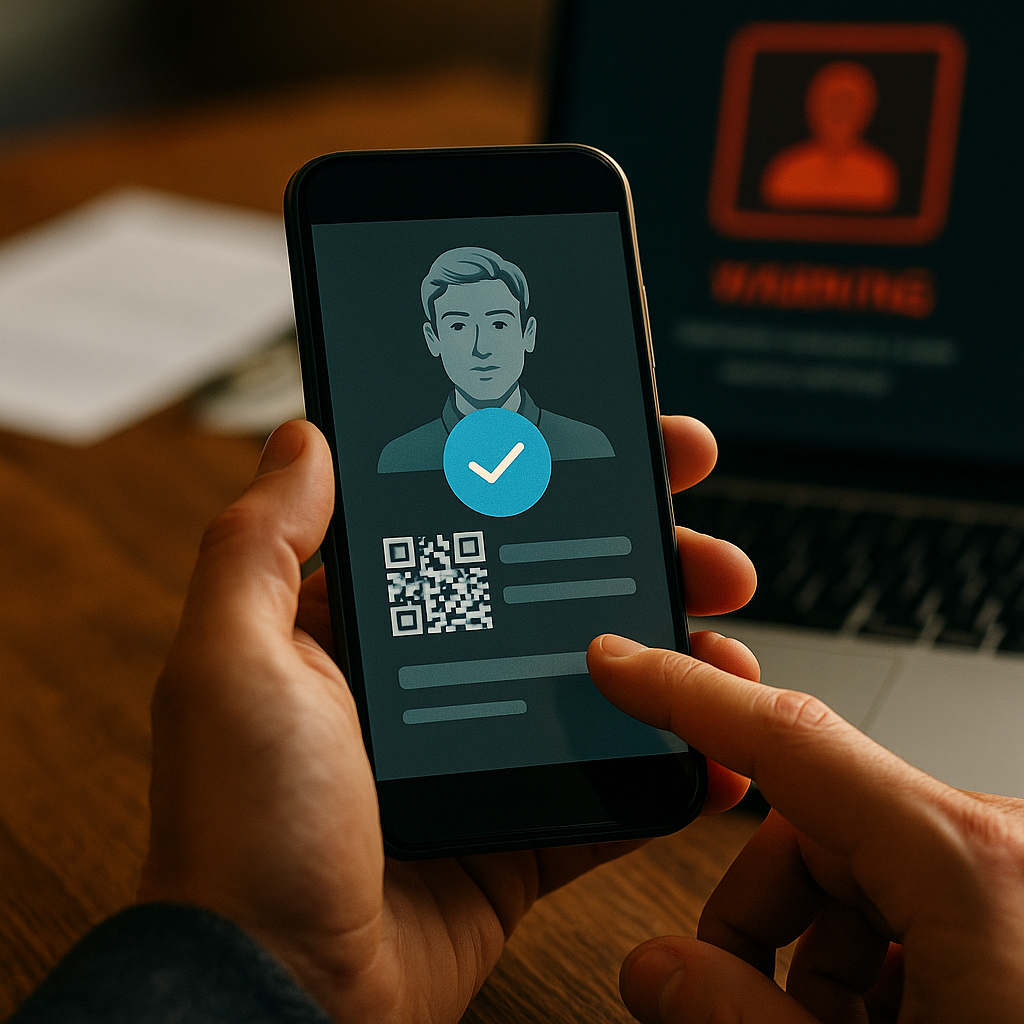
In 2025, customer data is both a competitive advantage and a liability. Brands face rising fraud, stricter privacy expectations, and growing dependence on identity providers they don’t control. That’s why many are evaluating decentralized identity solutions to streamline verification, reduce risk, and improve customer experiences. If identity is the new perimeter, who should own the keys?
Customer trust and privacy compliance with decentralized identity
Brands are moving toward decentralized identity because privacy has shifted from a legal checkbox to a customer expectation. People want to prove what’s necessary—age eligibility, account ownership, residency—without handing over full identity dossiers. Decentralized identity supports this by enabling users to store and share credentials (like a verified age claim) directly from a digital wallet, instead of repeatedly submitting sensitive documents to every site.
This architecture aligns with privacy-by-design principles: reduce what you collect, reduce what you store, reduce what you expose. For brands, that can translate into fewer regulated data assets and simpler compliance operations—especially when serving customers across multiple jurisdictions with different privacy requirements.
It also addresses a practical question many teams ask: “If we collect less data, can we still meet KYC or age-gating requirements?” In many cases, yes—because verifiable credentials can deliver proof without transferring raw data. For instance, a credential can confirm a customer is over the required age without revealing their date of birth. That reduces unnecessary exposure while still meeting policy needs.
Key takeaway: decentralized identity lets brands design experiences around “minimum necessary data,” which supports privacy compliance and strengthens trust at the moment customers decide whether to continue.
Fraud reduction and account security via verifiable credentials
Credential stuffing, synthetic identity fraud, and account takeover continue to strain security budgets. Traditional approaches—password resets, SMS one-time codes, knowledge-based questions—create friction and still fail at scale. Decentralized identity helps brands improve assurance by relying on cryptographically verifiable credentials issued by trusted parties (such as banks, governments, employers, or accredited identity providers).
Instead of asking customers to repeatedly upload documents (which can be forged) or answer questions (which can be guessed or stolen), a brand can request a credential that is:
- Cryptographically signed so tampering is detectable
- Bound to a wallet under the customer’s control
- Selective so only the needed attributes are shared
This approach also reduces the “shared secret” problem. Passwords and many MFA methods depend on secrets that can be phished or intercepted. With decentralized identity, authentication can be anchored in device-based keys and wallet-mediated consent, which is harder to steal at scale.
Brands commonly ask: “Will this stop fraud completely?” No system does. But it can raise the cost of attacks by reducing reliance on reusable credentials and by enabling stronger proofing when risk signals warrant it. Many implementations combine verifiable credentials with risk engines (device fingerprinting, behavioral analytics) so step-up verification is triggered only when necessary—keeping low-risk sessions fast.
Key takeaway: verifiable credentials can shift security from “knowledge and codes” to cryptographic proof, reducing both fraud exposure and customer friction.
Better UX and lower drop-off through self-sovereign identity wallets
Identity is now a conversion issue. Every extra field, upload step, or manual review increases abandonment—especially on mobile. Decentralized identity supports faster onboarding and sign-in by allowing customers to reuse trusted credentials across services, with explicit consent each time.
For example, instead of filling out a long registration form, a customer can share a pre-verified credential containing name and address, or confirm account ownership with a wallet signature. This reduces time-to-complete and cuts down on data entry errors that trigger failed checks and support tickets.
Brands also benefit from more consistent identity experiences across channels. In-store, call centers, and web apps often rely on different verification methods, creating gaps and workarounds. A wallet-based credential can unify identity proof across touchpoints, allowing a customer to prove the same claim in multiple contexts without repeating the entire process.
Teams often worry about adoption: “Will customers actually use wallets?” Adoption depends on thoughtful rollout and optionality. Many brands start with high-friction journeys—account recovery, high-value transactions, age-restricted purchases—where customers feel the pain today. They also keep alternative methods available while educating users on the benefits: fewer passwords, faster verification, and reduced data sharing.
Key takeaway: self-sovereign identity wallets can turn identity checks into a smoother, consent-driven flow that increases completion rates without weakening assurance.
Cost control and data minimization using decentralized identifiers (DIDs)
Identity operations are expensive: document verification fees, manual review queues, chargebacks, fraud losses, and customer support all add up. Decentralized identity can reduce costs by minimizing repeated verification and limiting the amount of sensitive data brands must store and protect.
Decentralized identifiers (DIDs) provide a way to reference an identity without relying on a single centralized directory. Rather than keeping large stores of personal data as the source of truth, a brand can verify credentials presented by a customer and store only what is needed for the business relationship—often a record that a check was completed, plus non-sensitive metadata.
This approach can lower:
- Breach impact by shrinking the volume of stored personal data
- Compliance overhead by reducing data retention complexity
- Reverification costs by reusing credentials for repeat interactions
- Support costs by simplifying account recovery and verification flows
A common follow-up question is: “Does this remove all responsibility for data protection?” No. Brands still need strong security, clear consent records, and safe handling of any data they do store. But data minimization changes the risk profile. If you don’t collect it, you can’t leak it.
Key takeaway: DIDs and data minimization can reduce both direct verification costs and downstream security liabilities.
Interoperability and ecosystem partnerships with digital identity standards
Brands increasingly operate in ecosystems—marketplaces, travel chains, fintech partnerships, healthcare networks—where customers move between services. Centralized identity models often create silos: each partner runs its own onboarding, identity proofing, and compliance checks. That duplication frustrates customers and increases cost.
Decentralized identity is gaining traction because it is built around interoperability. When brands use widely adopted digital identity standards, credentials issued in one context can be verified in another, assuming trust frameworks and policies align. This matters for:
- Partnership onboarding where a verified business credential can accelerate vendor approvals
- Cross-service login where customers can authenticate without creating yet another password
- Regulated workflows where eligibility or licensing claims must be validated quickly
Executives often ask: “Interoperability sounds great, but who do we trust?” Trust is not automatic. Brands must choose governance models and credential issuers carefully, define acceptable assurance levels, and establish rules for revocation and dispute handling. The strongest programs combine technical standards (for portability) with governance (for accountability).
Key takeaway: standards-based decentralized identity enables portable trust, helping brands scale partnerships and user experiences without duplicating verification.
Vendor risk and platform dependency reduction with decentralized identity architecture
Many brands have learned that identity decisions create long-term platform dependency. Relying on a single identity provider can introduce pricing risk, roadmap constraints, and single points of failure. Decentralized identity offers a different model: the customer holds credentials, multiple issuers can exist, and verifiers can validate proofs without depending on one central intermediary.
This does not mean brands eliminate vendors. Instead, they can design an architecture that avoids lock-in by:
- Supporting multiple credential issuers and verification services
- Using open standards for DIDs and verifiable credentials
- Separating wallet experiences from backend verification logic
- Maintaining portability of policies and audit evidence
Another follow-up question is: “Does decentralization mean losing control?” Brands still control their policies, risk thresholds, and customer experience. What changes is the locus of data storage and the ability to switch components without rebuilding the entire identity stack.
Key takeaway: decentralized identity architecture can reduce dependency on single providers and improve resilience without sacrificing governance.
FAQs
What is decentralized identity in simple terms?
Decentralized identity lets customers store digital credentials in a wallet and share verified proofs with brands when needed. Instead of each brand collecting and storing the same personal data, the customer presents cryptographic proof that a trusted issuer verified a claim.
Is decentralized identity the same as blockchain identity?
Not necessarily. Some decentralized identity systems use distributed ledgers to publish public identifiers or keys, but many implementations can work without putting personal data on-chain. The core idea is user-held credentials and verifiable proofs, not a specific database technology.
How do verifiable credentials help with compliance?
They support data minimization and selective disclosure, allowing brands to verify eligibility or identity claims without collecting unnecessary personal information. Brands still need appropriate consent, audit trails, and retention policies for any data they store.
Will decentralized identity replace passwords?
It can reduce reliance on passwords for many journeys, especially authentication and account recovery, when wallet-based cryptographic authentication is deployed. Many brands will run hybrid models during transition, keeping passwords or passkeys as alternatives.
What are the main implementation challenges for brands?
Common challenges include choosing trust frameworks and issuers, integrating with existing IAM and fraud systems, designing wallet UX, handling revocation, and ensuring accessibility for customers who don’t adopt wallets immediately.
How should a brand start adopting decentralized identity?
Start with a high-friction, high-risk use case such as account recovery, age verification, or high-value transaction approval. Pilot with clear assurance requirements, measure conversion and fraud impact, and expand to additional credentials and partners once governance is proven.
Brands are moving toward decentralized identity because it matches modern expectations: prove more with less data, reduce fraud without adding friction, and avoid identity lock-in. In 2025, the strongest programs treat identity as a product—combining standards, governance, and customer-centered UX. The takeaway is clear: adopt decentralized identity where it reduces risk and improves journeys, then scale through interoperable credentials.
Top Influencer Marketing Agencies
The leading agencies shaping influencer marketing in 2026
Agencies ranked by campaign performance, client diversity, platform expertise, proven ROI, industry recognition, and client satisfaction. Assessed through verified case studies, reviews, and industry consultations.
Moburst

-
2

The Shelf
Boutique Beauty & Lifestyle Influencer AgencyA data-driven boutique agency specializing exclusively in beauty, wellness, and lifestyle influencer campaigns on Instagram and TikTok. Best for brands already focused on the beauty/personal care space that need curated, aesthetic-driven content.Clients: Pepsi, The Honest Company, Hims, Elf Cosmetics, Pure LeafVisit The Shelf → -
3

Audiencly
Niche Gaming & Esports Influencer AgencyA specialized agency focused exclusively on gaming and esports creators on YouTube, Twitch, and TikTok. Ideal if your campaign is 100% gaming-focused — from game launches to hardware and esports events.Clients: Epic Games, NordVPN, Ubisoft, Wargaming, Tencent GamesVisit Audiencly → -
4

Viral Nation
Global Influencer Marketing & Talent AgencyA dual talent management and marketing agency with proprietary brand safety tools and a global creator network spanning nano-influencers to celebrities across all major platforms.Clients: Meta, Activision Blizzard, Energizer, Aston Martin, WalmartVisit Viral Nation → -
5

The Influencer Marketing Factory
TikTok, Instagram & YouTube CampaignsA full-service agency with strong TikTok expertise, offering end-to-end campaign management from influencer discovery through performance reporting with a focus on platform-native content.Clients: Google, Snapchat, Universal Music, Bumble, YelpVisit TIMF → -
6

NeoReach
Enterprise Analytics & Influencer CampaignsAn enterprise-focused agency combining managed campaigns with a powerful self-service data platform for influencer search, audience analytics, and attribution modeling.Clients: Amazon, Airbnb, Netflix, Honda, The New York TimesVisit NeoReach → -
7

Ubiquitous
Creator-First Marketing PlatformA tech-driven platform combining self-service tools with managed campaign options, emphasizing speed and scalability for brands managing multiple influencer relationships.Clients: Lyft, Disney, Target, American Eagle, NetflixVisit Ubiquitous → -
8

Obviously
Scalable Enterprise Influencer CampaignsA tech-enabled agency built for high-volume campaigns, coordinating hundreds of creators simultaneously with end-to-end logistics, content rights management, and product seeding.Clients: Google, Ulta Beauty, Converse, AmazonVisit Obviously →