


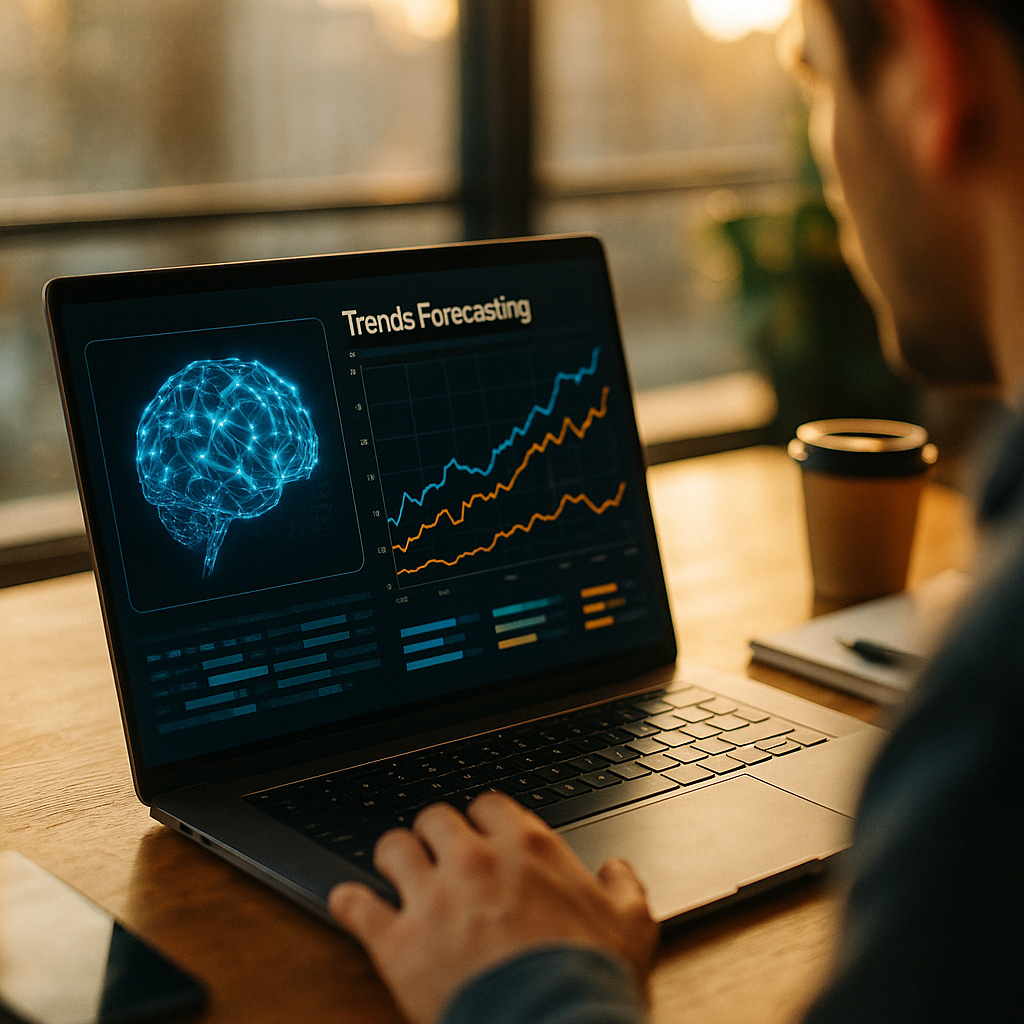
In 2025, brands, creators, and city leaders want early signals on what people will wear, eat, watch, and celebrate next. Using AI to predict cultural trends turns scattered local cues—events, posts, purchases, and playlists—into structured insight. Done well, it balances data with human context and ethics. The real advantage is spotting tomorrow’s mainstream today—before everyone else does, and acting fast.
Secondary keyword: AI trend forecasting for local culture
Local culture moves in bursts. A neighborhood dance night becomes a regional sound, a street food stall becomes a menu category, and a community craft market becomes an e-commerce aesthetic. AI trend forecasting for local culture focuses on three goals: detect early signals, explain why they matter, and estimate whether they can travel beyond their origin.
Modern forecasting systems blend multiple methods rather than relying on a single “viral score.” Strong setups typically combine:
- Natural language processing (NLP) to identify emerging topics, slang, and sentiment shifts in public text.
- Computer vision to recognize new visual motifs in images and short-form video (colors, silhouettes, food plating styles, stage lighting, typography).
- Time-series modeling to track whether growth is steady, seasonal, or driven by one-off events.
- Graph analysis to map who influences whom across communities, creators, venues, and micro-media outlets.
The “local” piece is crucial. Many mainstream hits start as hyper-specific: a regional ingredient, a community celebration, a club night, a diaspora remix. AI helps by monitoring signals at the neighborhood and city level, then testing whether those signals are beginning to appear in adjacent communities—often the first clue that a trend can cross borders.
To keep the work credible, treat predictions as probabilities, not promises. A helpful forecast explains the mechanism: what’s growing, who’s adopting it, where it’s spreading, and which constraints could stop it (price, regulation, supply chain, cultural appropriation risk, or safety concerns).
Secondary keyword: social listening for emerging trends
Social listening for emerging trends is not just counting mentions. It’s capturing the shape of conversation—who started it, what people do with it, and how quickly it changes. In 2025, valuable sources extend beyond big platforms and include local newsletters, event listings, community forums, podcast transcripts, and venue calendars.
For a durable signal, focus on these AI-detectable patterns:
- Novelty + repetition: A new phrase, dish name, or style appears, then repeats across unrelated accounts.
- Context drift: A local reference starts showing up in broader lifestyle contexts (e.g., “outfit of the day,” “weekend plans,” “best date spots”).
- Sentiment consistency: Enthusiasm remains high after the initial spike; skepticism doesn’t dominate follow-up discussions.
- Creator crossover: Different creator categories adopt it (music + food + fashion) rather than a single niche.
AI can also separate “loud” from “wide.” A small cluster might generate huge volume, while broader adoption looks quieter but spreads across many micro-communities. This is where metrics like unique authors, network diversity, and cross-community adoption outperform raw mention counts.
Readers often ask: Can we rely on social data when algorithms change? You can, if you diversify inputs and emphasize relative movement rather than absolute counts. Track multiple channels, normalize by baseline activity, and validate signals with offline indicators such as ticket sell-outs, waitlist growth, or restaurant reservation patterns.
Secondary keyword: local consumer data signals
Local consumer data signals help confirm whether a cultural trend is becoming a behavior, not just a conversation. When people spend money, travel across town, or rearrange routines, the trend has friction—and traction. AI can combine privacy-safe, aggregated datasets to measure demand without exposing individuals.
Useful local signals include:
- Search behavior: rising “near me” queries, ingredient lookups, class sign-ups, and how-to searches.
- Footfall and mobility: changes in visitation patterns to venues, markets, galleries, or districts (using aggregated, consent-based analytics).
- Point-of-sale trends: ingredient sales, product bundles, or spikes in specific categories in local retail.
- Booking data: event tickets, dining reservations, studio sessions, and workshop enrollments.
AI models can distinguish between a fad and a repeatable habit by looking at cohort retention: do first-time buyers return? Do purchases diversify into adjacent items (a strong sign of mainstream potential)? For example, a local drink trend that triggers growth in glassware sales, recipe searches, and bar menus has a better chance of scaling than one that stays limited to a single venue.
Another common follow-up question is: What if we don’t have access to robust transaction data? Start smaller. Partner with a few local businesses willing to share anonymized category-level sales changes, use publicly available search trend tools, and supplement with structured local observations (menus, flyers, event lineups) that AI can parse.
Secondary keyword: machine learning models for trend prediction
Machine learning models for trend prediction work best when you define a clear target: “go mainstream” must be measurable. Depending on your industry, that could mean national media pickup, multi-city adoption, major brand collaborations, or sustained growth across at least three distinct regions.
Effective modeling in 2025 often uses a layered approach:
- Signal detection (NLP/vision): identify candidate trends and cluster related variants (synonyms, spellings, visuals).
- Momentum scoring: measure velocity, acceleration, and stability over time, adjusted for seasonality.
- Diffusion modeling: estimate how quickly the trend moves across communities using network graphs.
- Uplift and counterfactual tests: evaluate whether attention growth is organic or driven by one influencer or paid push.
Feature choices matter. Strong predictors often include:
- Cross-community adoption rate (how many distinct audience clusters begin using it).
- Content format diversity (it appears in tutorials, reviews, memes, event recaps, product posts).
- Offline reinforcement (events, menus, retail placement, collaborations).
- Supply readiness (can it be produced, distributed, or taught at scale without losing quality).
Model outputs should include explanations. Use interpretable methods (feature importance, example-based explanations, or rule summaries) so stakeholders understand why the system believes a trend will travel. That transparency is part of EEAT: it demonstrates expertise, reduces blind trust, and makes it easier to challenge weak signals before money is spent.
To build trustworthiness, maintain a forecast log: predictions, confidence, evidence, what happened, and what you learned. This creates internal accountability and helps you improve over time instead of chasing whatever is loudest this week.
Secondary keyword: ethical AI in cultural analytics
Ethical AI in cultural analytics is not optional when you analyze local communities. Cultural trends carry identity, history, and power dynamics. Poorly designed prediction systems can amplify appropriation, misrepresent communities, or expose sensitive patterns. In 2025, responsible teams treat ethics as a design requirement, not a legal afterthought.
Key practices that align with EEAT and reduce risk:
- Use privacy-safe data: favor aggregated, anonymized, and consent-based sources; avoid scraping private spaces or bypassing platform rules.
- Minimize harm: don’t publish hyper-local “hotspots” that could cause harassment, over-policing, or unsafe crowding.
- Credit origins: document where a trend started and who shaped it; build partnerships that share value with originators.
- Bias checks: test whether the model consistently favors already-visible communities while ignoring smaller or non-English groups.
- Human review: involve cultural experts, local organizers, or community advisors for interpretation and context.
Readers often worry: Does prediction inherently exploit culture? It can, but it doesn’t have to. The difference is intent and governance. Use forecasts to support fair investment (paying creators, funding venues, commissioning local designers) rather than extracting aesthetics with no benefit to the source community.
Finally, communicate uncertainty honestly. Don’t frame cultural evolution as a certainty or “hack.” People are not datasets, and trends can change because communities respond to being observed.
Secondary keyword: turning trend insights into marketing strategy
Turning trend insights into marketing strategy requires operational discipline. A forecast only creates value when it leads to better decisions: what to launch, where to test, who to partner with, and when to scale.
A practical workflow looks like this:
- 1) Define “mainstream” for your category: set thresholds (distribution, repeat purchase, earned media, multi-city adoption) and time horizon.
- 2) Build a trend shortlist: use AI to surface candidates weekly, then select a manageable number for deeper review.
- 3) Validate with lightweight experiments: pop-ups, limited drops, pilot menus, micro-events, or small creator collaborations.
- 4) Measure leading indicators: save/share rates, waitlists, repeat attendance, referral traffic, and conversion from “curious” searches to purchases.
- 5) Scale with local credibility: expand while keeping origin communities involved—through co-creation, licensing, or revenue share.
To answer the next question—How early is too early?—use a staged approach. If the trend is fragile or identity-linked, start by supporting it locally (sponsoring events, funding spaces, commissioning work). If signals show broad, respectful adoption and supply readiness, then scale distribution and media.
Also plan for failure. Not every predicted trend should become a campaign. Use “kill criteria” (e.g., retention drops after two cycles, sentiment turns negative, or the trend remains locked to one micro-network). This prevents sunk-cost spending and protects brand trust.
FAQs
What does it mean for a local cultural trend to “go mainstream”?
It means adoption expands beyond the originating community into multiple regions and audiences, stays active long enough to influence products or media, and becomes recognizable without needing insider context. The best definitions include measurable thresholds tied to your industry.
Which data sources are most useful for predicting local cultural trends?
Combine public social content, local event and venue data, search behavior, and privacy-safe consumer signals like aggregated sales categories or bookings. The most reliable forecasts use multiple independent sources rather than one platform.
How accurate is AI at predicting cultural trends?
AI can be strong at detecting early signals and estimating spread, but culture is shaped by real-world constraints and human choices. Accuracy improves when models are updated frequently, calibrated with past outcomes, and reviewed by people with local expertise.
How can small businesses use AI trend forecasting without a big budget?
Start with affordable social listening, public search trend tools, and a simple spreadsheet to track local events, menu changes, and repeat customer requests. Use small experiments—limited runs or pop-ups—to validate demand before scaling.
How do you avoid cultural appropriation when acting on trend predictions?
Credit origins, collaborate with creators and community leaders, share economic upside, and avoid stripping cultural elements from their meaning. Add human review, document decisions, and be transparent about partnerships and sourcing.
What are the biggest mistakes teams make with AI cultural prediction?
Chasing volume instead of diffusion, relying on one platform, ignoring offline signals, treating predictions as guarantees, and skipping ethics. Another common error is scaling too fast without preserving quality or involving the communities that created the trend.
AI can help you notice the small local signals that often precede big cultural shifts, but the best results come from combining models with grounded interpretation. In 2025, teams win by tracking cross-community adoption, validating with real behavior, and acting with respect for cultural origins. Use AI to guide smarter experiments, not to manufacture culture. Spot, test, collaborate—and scale only when evidence supports it.
Top Influencer Marketing Agencies
The leading agencies shaping influencer marketing in 2026
Agencies ranked by campaign performance, client diversity, platform expertise, proven ROI, industry recognition, and client satisfaction. Assessed through verified case studies, reviews, and industry consultations.
Moburst

-
2

The Shelf
Boutique Beauty & Lifestyle Influencer AgencyA data-driven boutique agency specializing exclusively in beauty, wellness, and lifestyle influencer campaigns on Instagram and TikTok. Best for brands already focused on the beauty/personal care space that need curated, aesthetic-driven content.Clients: Pepsi, The Honest Company, Hims, Elf Cosmetics, Pure LeafVisit The Shelf → -
3

Audiencly
Niche Gaming & Esports Influencer AgencyA specialized agency focused exclusively on gaming and esports creators on YouTube, Twitch, and TikTok. Ideal if your campaign is 100% gaming-focused — from game launches to hardware and esports events.Clients: Epic Games, NordVPN, Ubisoft, Wargaming, Tencent GamesVisit Audiencly → -
4

Viral Nation
Global Influencer Marketing & Talent AgencyA dual talent management and marketing agency with proprietary brand safety tools and a global creator network spanning nano-influencers to celebrities across all major platforms.Clients: Meta, Activision Blizzard, Energizer, Aston Martin, WalmartVisit Viral Nation → -
5

The Influencer Marketing Factory
TikTok, Instagram & YouTube CampaignsA full-service agency with strong TikTok expertise, offering end-to-end campaign management from influencer discovery through performance reporting with a focus on platform-native content.Clients: Google, Snapchat, Universal Music, Bumble, YelpVisit TIMF → -
6

NeoReach
Enterprise Analytics & Influencer CampaignsAn enterprise-focused agency combining managed campaigns with a powerful self-service data platform for influencer search, audience analytics, and attribution modeling.Clients: Amazon, Airbnb, Netflix, Honda, The New York TimesVisit NeoReach → -
7

Ubiquitous
Creator-First Marketing PlatformA tech-driven platform combining self-service tools with managed campaign options, emphasizing speed and scalability for brands managing multiple influencer relationships.Clients: Lyft, Disney, Target, American Eagle, NetflixVisit Ubiquitous → -
8

Obviously
Scalable Enterprise Influencer CampaignsA tech-enabled agency built for high-volume campaigns, coordinating hundreds of creators simultaneously with end-to-end logistics, content rights management, and product seeding.Clients: Google, Ulta Beauty, Converse, AmazonVisit Obviously →