


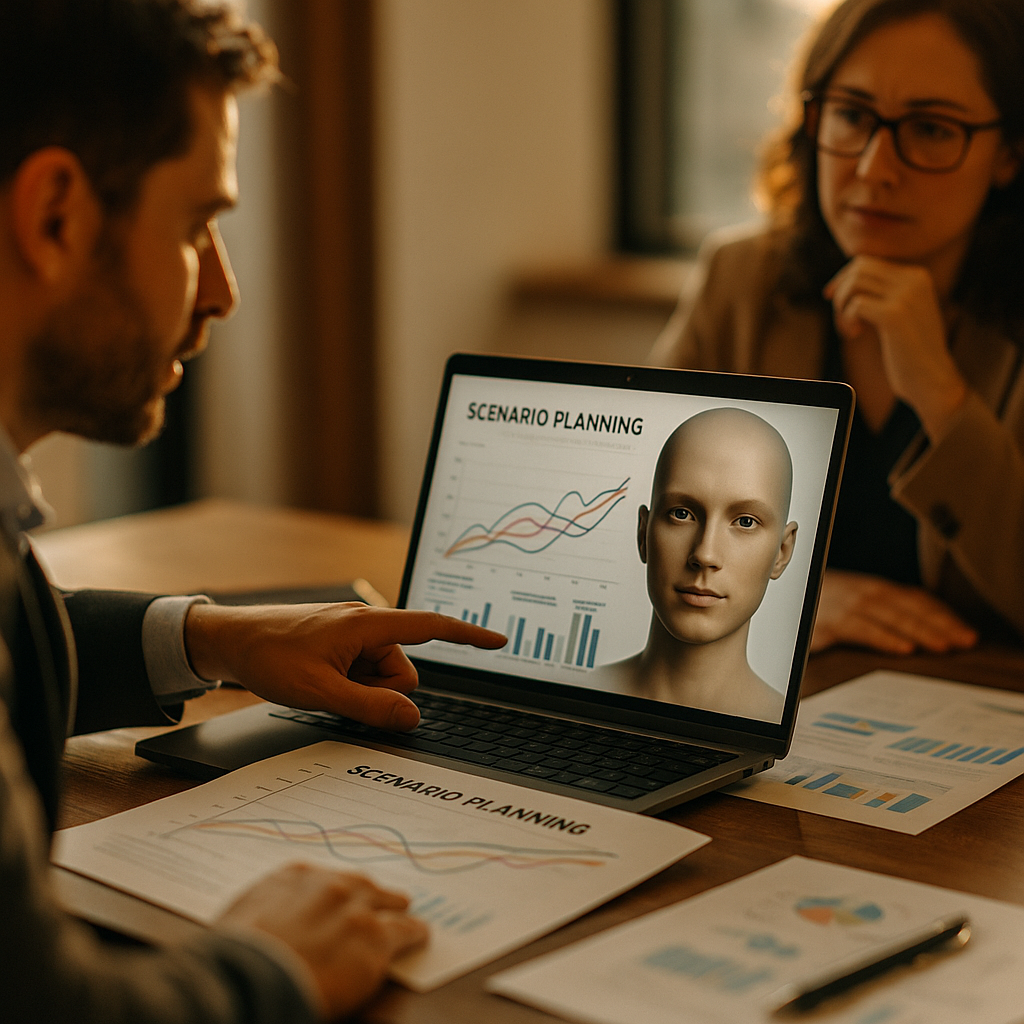
In 2025, leaders face tighter budgets, faster market shifts, and higher expectations for resilience. Using AI To Generate Synthetic Personas For Strategic Scenario Planning helps teams stress-test decisions against realistic stakeholder behaviors without waiting for costly fieldwork. When built responsibly, synthetic personas add speed, diversity, and repeatability to foresight work. The real advantage appears when they surface blind spots your team didn’t know it had—ready to see how?
AI synthetic personas for scenario planning: what they are and what they are not
Synthetic personas are AI-generated, research-informed profiles that simulate how different stakeholder types might think, decide, and react under specific conditions. In strategic scenario planning, they act as “decision counterparts” you can interview, challenge, and run through future narratives. They can represent customers, employees, regulators, suppliers, partners, and even competitors’ likely operating constraints.
What they are: structured, testable models of stakeholder behavior that can be updated as new signals appear. They support scenario exploration, not just marketing storytelling. They can be run as a panel (multiple personas) and queried repeatedly to compare outcomes across scenarios.
What they are not: real people, direct substitutes for primary research, or a way to “invent” market truth. If you generate a persona from assumptions alone, the output will sound persuasive but may be strategically misleading. High-quality synthetic personas require explicit inputs: segmentation logic, verified constraints, and evidence-backed behavioral drivers.
To keep personas useful, define them in terms that matter for decisions: decision criteria, risk tolerance, switching triggers, compliance boundaries, procurement rules, and resource limits. Then connect each persona to scenarios you care about, such as supply shocks, regulatory tightening, AI adoption, or demand collapse.
Synthetic customer personas: where they add the most strategic value
Synthetic personas create value when scenario planning needs breadth, speed, and controlled comparisons. They help you ask “what would change this stakeholder’s mind?” and “what would break our strategy?” across multiple plausible futures. The best use cases sit at the intersection of uncertainty and high consequence.
High-impact applications include:
- Stress-testing strategic bets: Run the same product, pricing, or channel strategy across multiple personas and scenarios to see where it fails first.
- Early-warning signals: Identify leading indicators each persona would respond to (e.g., price thresholds, policy changes, competitor moves) and translate them into monitoring dashboards.
- Portfolio and resource allocation: Compare which initiatives remain robust across scenarios and which are scenario-dependent “options” worth staging.
- Regulatory and public-impact planning: Simulate how regulators, advocacy groups, and enterprise buyers interpret the same announcement under different constraints.
- Crisis rehearsal: Practice response playbooks with personas that reflect realistic friction: procurement freezes, reputational sensitivity, or union constraints.
They also reduce a common failure mode in scenario workshops: over-indexing on internal opinions. A cross-functional team can still converge too quickly. A persona panel forces explicit trade-offs by injecting diverse motivations and constraints into the conversation.
To anticipate the follow-up question—will leadership trust “fake people”?—the answer depends on transparency. Document data sources, assumptions, and validation checks. When executives can trace why a persona behaves a certain way, they treat it as an analytical tool rather than a creative writing exercise.
Persona generation with AI: a practical, evidence-led workflow
In 2025, the most reliable workflow blends AI generation with research discipline. Treat persona creation like model development: specify inputs, enforce structure, test outputs, and version control changes.
1) Start with decision scope and scenario set
Define which decisions the personas must inform: market entry, pricing architecture, partner strategy, operating model, or policy positioning. Then draft 3–5 scenarios that reflect the uncertainties you cannot control (e.g., regulation, macro demand, platform shifts) and the strategic levers you can.
2) Build segments from real evidence
Use existing internal data (CRM, win/loss notes, support tickets, procurement feedback, churn reasons) and external sources (industry reports, earnings calls, regulatory consultations). Convert these into segmentation dimensions that matter: job-to-be-done, buying center structure, risk posture, maturity level, and constraints.
3) Generate personas with a strict template
Prompt your AI system to output personas in a consistent schema so they can be compared. Require fields such as:
- Context: industry, organization size, operating model, geography (only if relevant)
- Goals and success metrics: what “good” looks like
- Constraints: budget cycles, compliance rules, staffing limits, procurement steps
- Decision logic: evaluation criteria, veto points, proof requirements
- Risk triggers: what causes delay, rejection, or escalation
- Scenario sensitivities: which uncertainties matter most to them
- Observable signals: behaviors you can measure (search, RFP language, usage patterns)
4) Calibrate with “challenge rounds”
Run internal SMEs and customer-facing teams through a structured review. Ask them to flag implausible details and missing constraints. Then run the persona against known historical events (a past price increase, a service outage, a competitor launch) to see if the response matches reality.
5) Operationalize: persona panel + scenario playbooks
Don’t stop at documents. Convert personas into an interviewable panel where each scenario has:
- Key questions to ask each persona
- Expected behaviors and decision paths
- Risks to mitigate and opportunities to pursue
- Leading indicators and “tripwires” for action
6) Maintain and version
Personas drift as markets change. Set a cadence (quarterly or per major event) to refresh evidence, re-run calibration, and record what changed and why.
Scenario planning with AI personas: methods that produce better decisions
Once you have a credible persona panel, use methods that make scenarios actionable rather than speculative. The goal is not to predict the future; it is to choose strategies that remain effective across multiple futures and to prepare contingent moves when they do not.
Cross-impact interviews
Interview each persona within each scenario and compare answers side-by-side. Focus on decision thresholds: “What would make you switch vendors?” “What proof would unblock procurement?” “What would you cut first under a 15% budget reduction?” This reveals nonlinear tipping points that standard market sizing misses.
Pre-mortems with persona objections
Run a pre-mortem where the strategy failed. Ask each persona to explain why. Then map objections into categories: trust, compliance, switching cost, integration burden, political risk. Convert these into mitigation tasks and proof assets (e.g., audit artifacts, reference architectures, ROI calculators).
Strategy robustness scoring
Create a simple scoring matrix: each persona-scenario pair rates the strategy on fit, feasibility, and friction. You’re not chasing precision; you’re forcing transparent comparisons. When one initiative looks strong only in one scenario, treat it as an option with staged investment rather than a cornerstone bet.
Signal-to-action mapping
For each scenario, define the earliest observable signals that would indicate it is unfolding (policy drafts, procurement freezes, competitor pricing changes, customer usage drops). Tie signals to pre-approved actions so you can move quickly without re-litigating strategy in a crisis.
Answering a common follow-up: How many personas do we need? For most organizations, 6–12 well-calibrated personas outperform 30 shallow ones. Ensure coverage across buyer types, risk profiles, and adoption maturity, and include at least one “skeptical blocker” persona who reliably says no unless conditions are met.
AI governance and data ethics: keeping synthetic personas credible and safe
EEAT-aligned work in 2025 requires more than good outputs; it requires responsible process. Synthetic personas can unintentionally encode bias, leak sensitive information, or create false confidence if governance is weak.
Privacy and confidentiality
Never paste raw personal data into prompts. Use anonymized, aggregated inputs and comply with internal data handling policies. If you use transcripts or support logs, de-identify them first and limit access to approved teams.
Bias and representativeness
AI systems can amplify stereotypes if prompted loosely. Counter this by grounding personas in segment definitions and constraints, not demographic caricatures. Validate that personas represent meaningful behavioral variation rather than shallow traits.
Traceability and explainability
For each persona, maintain a short “evidence card” listing data sources, assumptions, and uncertainties. When a persona makes a claim (“we require SOC 2,” “we buy only through resellers”), you should be able to point to a policy, pattern, or expert validation.
Model risk management
Treat persona outputs as decision support, not decision authority. Add guardrails: required citations to internal evidence, prohibited outputs (e.g., inventing statistics), and human review for high-stakes recommendations.
IP and vendor considerations
Confirm your AI tool’s data retention and training policies. Ensure prompts, outputs, and derived assets align with your contractual and regulatory obligations, especially if personas are used in external-facing materials.
Practical credibility test: if a persona’s recommendations cannot be linked to a constraint, incentive, or observed pattern, the persona is not ready for strategic use.
Measuring ROI of synthetic personas: KPIs, validation, and continuous improvement
Strategic tools earn adoption when they measurably improve decisions. You can quantify the value of synthetic personas without pretending they predict outcomes perfectly.
Decision-quality KPIs
- Time-to-insight: reduction in time to generate scenario implications and stakeholder reactions
- Assumption clarity: number of explicit assumptions captured, tested, and updated
- Option readiness: percentage of scenario-contingent moves with defined triggers and owners
- Risk discovery: critical failure modes identified before launch (e.g., compliance blockers, procurement friction)
- Alignment: faster convergence across functions due to shared persona language and evidence cards
Validation approaches
- Back-testing: run personas against past market events and compare to known outcomes
- Spot-check interviews: validate top uncertainties with a small number of real stakeholder interviews
- Behavioral fit checks: compare persona predictions to live signals (conversion rates, churn reasons, support themes)
Continuous improvement loop
Update personas when you see repeated mismatches between predicted and observed behavior. Track errors as learning: did you miss a constraint, misread incentives, or overestimate maturity? Over time, the persona system becomes a living asset that improves with use.
FAQs about AI-generated synthetic personas for strategic scenario planning
Are synthetic personas accurate enough for strategic decisions?
They are accurate enough to improve strategic thinking when they are grounded in evidence, structured around decision constraints, and validated through back-testing and targeted real-world checks. They should inform options and risk mitigation, not replace primary research for high-stakes commitments.
What data do we need to create synthetic personas responsibly?
Start with anonymized internal patterns (CRM notes, win/loss, support themes, usage trends) plus external signals (industry analyses, regulatory guidance, public procurement rules). The key is to capture constraints and incentives, not personal identifiers.
How do we prevent hallucinations in persona outputs?
Use strict templates, require evidence cards, prohibit invented statistics, and run calibration reviews with SMEs. If a claim cannot be traced to a policy, pattern, or validated assumption, remove or label it as uncertain.
How many scenarios and personas should we run?
Most teams get strong results with 3–5 scenarios and 6–12 personas. Expand only when each additional persona represents a distinct decision logic or constraint set that changes outcomes.
Can we use synthetic personas for regulated industries?
Yes, but governance must be stronger: de-identify inputs, document assumptions, ensure compliance review, and avoid using persona outputs as sole justification for regulated decisions. Treat them as structured hypothesis generators and stress-test tools.
What’s the difference between marketing personas and scenario-planning personas?
Marketing personas often emphasize messaging preferences and awareness journeys. Scenario-planning personas emphasize constraints, decision thresholds, veto points, and how behavior shifts under uncertainty. They are built to test strategies, not just shape campaigns.
AI-generated synthetic personas can turn scenario planning into a repeatable, evidence-led discipline instead of a one-off workshop. When you define decision scope, ground personas in real constraints, and validate outputs through challenge rounds, you gain faster insight into risks, triggers, and robust strategic options. The takeaway is simple: treat personas like models—transparent, governed, and continuously improved—and they will sharpen choices when uncertainty rises.
Top Influencer Marketing Agencies
The leading agencies shaping influencer marketing in 2026
Agencies ranked by campaign performance, client diversity, platform expertise, proven ROI, industry recognition, and client satisfaction. Assessed through verified case studies, reviews, and industry consultations.
Moburst

-
2

The Shelf
Boutique Beauty & Lifestyle Influencer AgencyA data-driven boutique agency specializing exclusively in beauty, wellness, and lifestyle influencer campaigns on Instagram and TikTok. Best for brands already focused on the beauty/personal care space that need curated, aesthetic-driven content.Clients: Pepsi, The Honest Company, Hims, Elf Cosmetics, Pure LeafVisit The Shelf → -
3

Audiencly
Niche Gaming & Esports Influencer AgencyA specialized agency focused exclusively on gaming and esports creators on YouTube, Twitch, and TikTok. Ideal if your campaign is 100% gaming-focused — from game launches to hardware and esports events.Clients: Epic Games, NordVPN, Ubisoft, Wargaming, Tencent GamesVisit Audiencly → -
4

Viral Nation
Global Influencer Marketing & Talent AgencyA dual talent management and marketing agency with proprietary brand safety tools and a global creator network spanning nano-influencers to celebrities across all major platforms.Clients: Meta, Activision Blizzard, Energizer, Aston Martin, WalmartVisit Viral Nation → -
5

The Influencer Marketing Factory
TikTok, Instagram & YouTube CampaignsA full-service agency with strong TikTok expertise, offering end-to-end campaign management from influencer discovery through performance reporting with a focus on platform-native content.Clients: Google, Snapchat, Universal Music, Bumble, YelpVisit TIMF → -
6

NeoReach
Enterprise Analytics & Influencer CampaignsAn enterprise-focused agency combining managed campaigns with a powerful self-service data platform for influencer search, audience analytics, and attribution modeling.Clients: Amazon, Airbnb, Netflix, Honda, The New York TimesVisit NeoReach → -
7

Ubiquitous
Creator-First Marketing PlatformA tech-driven platform combining self-service tools with managed campaign options, emphasizing speed and scalability for brands managing multiple influencer relationships.Clients: Lyft, Disney, Target, American Eagle, NetflixVisit Ubiquitous → -
8

Obviously
Scalable Enterprise Influencer CampaignsA tech-enabled agency built for high-volume campaigns, coordinating hundreds of creators simultaneously with end-to-end logistics, content rights management, and product seeding.Clients: Google, Ulta Beauty, Converse, AmazonVisit Obviously →